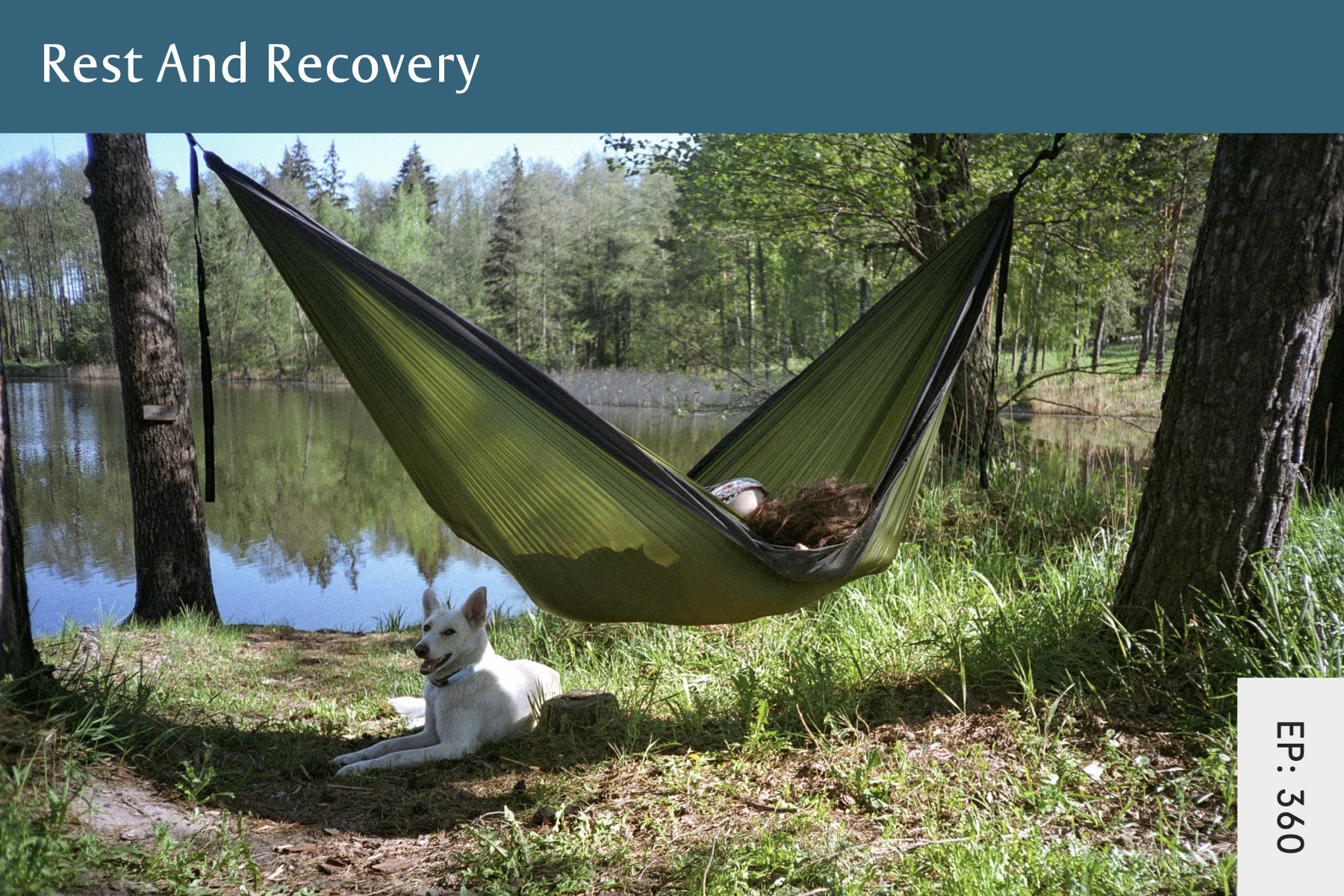
Episode 360: This week on the podcast it's a deep dive into rest and recovery. We look at why your body needs it, the different types of rest, and what blocks you from getting enough.
00:00:00
00:04:27
00:04:35
00:07:12
00:09:04
00:11:10
00:12:58
00:17:17
00:18:06
00:22:29
00:22:49
00:24:09
00:27:28
00:29:09
00:30:08
00:31:16
00:34:25
00:35:45
00:38:54
00:39:26
00:42:02
00:43:48
00:45:47
00:48:40
00:50:17
00:51:11
00:53:49
00:55:34
00:58:04
00:00:00
Chris Sandel: Hey, everyone! Welcome to Episode 360 of Real Health Radio. I’m your host, Chris Sandel. I’m a nutritionist and a coach and an eating disorder expert, and I help people to fully recover.
So today’s show, we’re going to be looking at the topic of rest and recovery, and looking at why rest is needed and all the functions that it serves as part of recovery; what are the different forms of rest – because it’s not just lying down or sitting down; there can be different types of rest, and they are all necessary. Some may be more necessary at different points in recovery, but being aware of the different types of rest I think is really important. And then looking at, what are the things that often get in the way? What are the blocks, what are the thoughts, what are the beliefs that get in the way of you actually getting enough rest as part of your recovery?
This is a topic that I recently covered on a group coaching call, and part of the reason why I’m sharing this here and now is because I’m going to be opening up the group again. I’m going to be opening this up on the 20th of April, so not that long from here.
This is a group that I created three years ago, and I think in the first year I took in people three times, something like that. And then since then, the only way that people have got into the group is through working with me one on one. When working with clients, there is the one-on-one piece, but there’s also the group element and everything that’s included as part of that. So for the last couple years, this just hasn’t been open as a standalone, but I’m opening it up again.
As part of the group, there is a programme, the Fundamentals of Full Recovery programme, where it’s six modules. It’s going through all the different aspects of recovery, and yes, it’s part education, but it’s very action-orientated, so it’s giving different writing exercises, different practical tools, things that you can then be using as part of your recovery. But also looking at this from different aspects, whether that’s physical resilience in recovery, whether that’s psychological resilience in recovery, whether that’s structurally and how to set up your days and your life, etc. Looking at this from all different angles.
There is then a group area where you can post questions, and I can answer them, other members of the group can answer them. I’ve got a person who helps out called Pamela who is a recovery coach. She recovered after 40 years of living with an eating disorder and is fully recovered, so she helps out as well as part of the group.
We do meal support calls as part of this, so we get on a Zoom call and we eat food together. It’s like a little virtual café, and we get to hang out and eat food. We don’t talk about recovery, but we just eat together like human beings.
And then there are group calls as part of this. Some of those group calls are more like office hours style calls, so people bring their questions and they can get them answered as part of that call, and then others are on a particular topic. And that can be a topic that I pick; I also ask participants what they would like me to cover, so probably once a quarter, I get a load of input of “I’d like to do a call on this” or “I’d like to do a call on that.” And this is what one of the participants had recommended, looking at rest and recovery and the challenges connected to this.
So as part of those calls, I then do some journalling prompts that people can go through to get the cogs turning, to think about this as a topic. We then have a discussion about it and people can share their thoughts or where they’re getting stuck with certain things. And then I will typically present some content with this, or some ideas connected to it. So what I’m doing today is just sharing the content that I put together as part of this recent call.
If this is something that you would be interested in, what you can do is you can send an email to info@seven-health.com and you can put the word ‘group’ in the subject line. You can message me on Instagram. It’s @sevenhealthcompany, and then just put ‘group’ as part of the direct message. There’s 20 spots that are going to be available. We want to still keep it nice and small and intimate, and then after that, I don’t know when I’m opening the doors again.
So have a listen to this episode; if this seems like something that would be really useful for you to be part of, then please get in contact.
00:04:27
So let’s start with why rest is a non-negotiable. I think this is a lot broader than a lot of people think about.
00:04:35
The first one is that energy has to go somewhere. I think this is often the one that people think about or understand. You don’t have unlimited energy. It has to be allocated towards certain things, and if energy is going towards movement or exercise or constant doing – and just as an aside as we go through this, as part of this, when I’m talking about the things that are not rest, it doesn’t just have to be going to the gym and that’s the only form of movement or exercise.
Exercise can be those kinds of things of going to the gym or going for a swim or lifting weights or whatever it may be, but it can also be walking, even if that feels like “Oh, it’s not that much.” It’s still walking that is occurring, and for lots of people, it’s a lot of walking that is occurring, and it gets talked about as like “Oh, it’s not that much because I used to be doing X amount more”, and the reality is that there’s still a lot that is going on.
But there’s all the other bits as well. The cleaning that is going on, the number of times that someone is getting up and going upstairs and then coming downstairs, or “Hey, whenever I’m working, I’m standing” or “The only time I let myself sit is in the evening time.” There can be all of these different ways, and often ways that the eating disorder says, “Oh, that’s not really movement, that’s not really a lot” when actually, when we add it together, especially when we’re needing that energy to be directed in other ways, it all does add up.
So if energy is going towards movement and exercise and constant doing and you’re really forcing the body’s hand to spending that area, it leaves less for the repair process, for hormonal restoration, for tissue repair, for nervous system regulation, for all of the things that the body has to do.
If someone – and when I say if someone, I’m hoping that if someone’s wanting to do recovery, that you are wanting to genuinely get strength back, to get stamina back, you are wanting to gain weight or at least you’re accepting that that’s the reality of what needs to happen as part of this – if you’re keeping your output high and low rest, especially if it’s low rest and there’s low energy coming in, then the body can’t do the repair and the growth that it actually needs to do.
So every bit of energy that’s going towards something else is not going towards the healing. That is the first reason for why rest is so important.
00:07:12
The next piece is that rest keeps you out of energy debt on a daily basis. And look, when someone has been living with an eating disorder for a really long time, it really doesn’t matter how much eating or resting they’re doing; on a day, they’re going to be in a pretty energy-depleted state. But if we look at how depleted you get, the longer you’re going without food, the smaller amount of food you’re eating, the more energy that is being used for movement or exercise, etc., means the lower you’re getting throughout a day.
For example, if you’re waking up and you’re having no breakfast, or you’re having a very small amount of breakfast, and then you’re going and doing exercise, and then it’s another 4 hours, 5 hours before you have something to eat, the longer that time goes on, the more energy depleted you get.
The reason that that’s a problem, outside of just number one that I talked about and there not being enough energy going to where it needs to be going to, the more depleted someone gets, the louder the eating disorder thoughts get, the higher the anxiety gets, the more the rigidity increases. It feels like, “Oh, if I can just do all this and then get further along in my day, then I’ll have more freedom to be able to eat. Then I’ll feel more comfortable eating”, and it just doesn’t work like that.
The amount of times people will say, “Oh, I’ve got this thing at dinnertime, so I need to do extra exercise and more restriction during the day so I’ll have that freedom at dinner”, and then they get to dinner and they end up eating less than they usually do, or there’s so much anxiety connected to it, or they really overestimate how much actually came in as part of that dinner. So the more you’re getting into a depleted state day to day, the more difficult it is to actually follow through on the recovery goals. The more amount of time you can be staying out of that place, the better.
00:09:04
The next one is that you can’t outthink a depleted nervous system. The thing with this is story follows state. The more that you’re in those places, the more that you’re going to be having lower emotional regulation. You’re going to have more catastrophizing, you’re going to have less resilience. You’re going to be more easily hooked by certain eating disorder thoughts because it just feels more real, it feels more true, there’s more panic connected to doing something different.
I’m a very big believer that eating disorders, while they are biopsychosocial, meaning there’s a biological component, a psychological component, a socialization component, so much of it is being driven by the biological piece and being in that lower energy state, and when you’re in that state, certain thoughts and feelings and sensations and beliefs and perceptions, etc., all naturally arise. As I said, story follows state.
So what often happens is that people are trying to outthink themselves with this. “I will do more rest, but I need to feel more ready to do more rest, and I need to get into a better place first and then I’ll start to rest”, and that just doesn’t happen, because if you’re continuing to stay in that depleted state, you’re still going to have the same stories and beliefs and everything that naturally arise. What happens is it just leads to more control, more rules, more ‘effort’, and it just continues to backfire day after day.
Really, it’s not that you need to have better thoughts, especially at the early stages of recovery; it’s that you need to have a better resource brain for that to happen, and you need to be doing the recovery piece for a while in terms of more food and more rest, etc., to really start to notice that your thoughts are truly changing. In the beginning, it’s recognising, “I can have that thought and I can still act in accordance with recovery and my values that are aligned with recovery.”
00:11:10
The next one is that rest is exposure to stillness. As I said a moment ago, when you are not stopping, the eating disorder thoughts get louder and there’s a lot of noise and it can be harder to do the things that you’re meant to do – and it can also be true that when you do stop, the eating disorder can get louder, especially in the beginning. There can be more emotions that start to surface. There can be more body sensations that start to increase.
Often, this can be where people feel like “Oh, I must be doing it wrong. This is why I shouldn’t be stopping. I’m now noticing I’m getting more aches and pains than I used to get, so it can’t possibly be true that I need to stop.”
But what is needed as part of recovery is learning to be okay with stillness, and that in the beginning, there can be some uncomfortableness with that, and that with time, that starts to change. So rather than “I need to keep being busy”, it’s “I need to learn how to be with this stillness, recognising that actually, with time, this stillness won’t feel like I’m crawling out of my skin or wanting to rip my skin off where this just feels so deeply uncomfortable.” With time, it can be a lot more enjoyable.
I’ve noticed this with so many clients. As time’s gone on, it’s been much more enjoyable. “I now am able to sit down and read a book and actually enjoy that experience” or “I’ve started getting back into watching TV and movies, and I realised this was so much of a hobby of mine before the eating disorder, and it’s nice to be able to do that again.” That didn’t happen on Day 1, but it does happen as you keep going with this. Really, rest teaches you how to be okay with being still.
00:12:58
The next one is that it breaks the flee to famine loop. The flee to famine hypothesis is proposed by anthropologist Shan Guisinger, and it’s a theory that suggests that anorexia may be linked to evolved survival mechanisms. The core idea is that during times of famine, some individuals may be biologically wired to eat less despite starvation, may become more physically active, so they’re more restless, they’re more driven to move, they feel less distress about not eating, there’s more of this focus in intensity and feeling more clear in their mind rather than fatigued. And this would’ve helped if you were in a famine-stricken area, for some members of the tribe to be able to go off and search for food.
We can also link this to many of the migratory species. If you think about birds and birds flying from Europe to Africa or Africa to Europe, depending on what the season is, when this is happening they don’t just conserve energy, they actually become more active. They suppress their normal hunger signals. They enter into a state that’s sometimes called migratory restlessness. This allows them to travel long distances without having to stop for much food, to be able to stay focused and driven despite the energy deficit, to prioritise movement over feeding.
And that’s a really useful thing when you’re trying to get to the place that you need to get to for winter, or it’s a really useful thing when you are living in a tribe and there is a famine that is going on and “we’re able to use this as a skill that helps us to find more food.” But the difficulty with someone with an eating disorder is, there isn’t an end point. With a bird, they get to wherever they need to get to for the winter and that all settles down. Or with a tribe, “we’ve now found more food and we can now settle down and we don’t need to keep doing the searching in the way we were doing before.”
But with an eating disorder, there isn’t this obvious off switch in terms of a destination, so we have to then create the off switch by resting and by bringing in more food, and that is the thing that then changes that switch that has gone on in someone’s mind – not just their mind, but their nervous system – that has then had this change.
And this, again, taps into the biological components of an eating disorder, the genetic components of an eating disorder. Because some people are wired for this to be the case, and the majority of people are not. If we look at, as an interesting comparison, the Minnesota Starvation Experiment, as part of that experiment – and I’ll link to the show that I’ve done in the show notes on this. I’ve done a number, but I’ll link to the most recent one that goes into this in more detail and has all of the up-to-date stuff connected to it.
If you look at this experiment where there are 36 men, they were starved as part of it, none of them developed an eating disorder as part of that. None of them were wanting to exercise more. They were having to exercise a certain amount as part of the experiment, and they were doing no extra. They just wanted to actually lie down and be in the sunshine because they felt cold all the time.
At the point that the experiment was over and they were allowed to eat more, none of them were like, “No, I don’t want to eat, I want to keep this going.” They were all like, “Please, I want this thing to be over. Let me be able to eat.”
I think this is a useful comparison between some people who are starved versus some people where there is starvation that then leads to the eating disorder being turned on. So again, this is why the rest piece is so important, because it then starts to turn that off. It doesn’t do it on Day 1, but as time goes on, as there is more rest, as there’s more energy that comes in, that’s when the shift actually happens.
00:17:17
The next piece is that rest reduces instability. Without rest, there is more fatigue swings. There is more dysregulated hunger and dysregulated interoceptive awareness. There is more inconsistency. So you’re constantly in this state, and when you’re in this state, it’s easy for the eating disorder to just push you over a lot more and to really get under your skin and to say the things that it needs to say that creates the fear and that you then stay stuck in this.
With getting more rest, yes, in the beginning it’s challenging, but this is the thing that then creates more of that stability, and it creates stability across the body system, whether that be your nervous system, whether that be your mind or your brain, but really all of the systems, and for them to be able to work properly.
00:18:06
Then the final piece of why I think rest is so important as part of recovery is that rest actually builds trust with the body. I know this can sound a little bit counterintuitive, but when someone isn’t resting and you’re doing all of the exercise, you’re doing all of the cleaning, you’re doing all of the walking, etc., there are a lot of signals that are being ignored. And some of those are very intentionally being ignored in terms of “I noticed I was hungry and I still didn’t eat for an hour or 2 hours” or whatever it may be, or “I noticed I was getting hungry and that’s why I did actually go out for that walk or that run or that bit of exercise.”
So sometimes it’s really “I’m noticing these things and I’m very much choosing to ignore them”, and other times, there are signals that have just become like background noise, and that is always going on and “I just don’t notice it, or at least I don’t notice it and connect it to ‘this is why I need to eat more or this is why I need to rest’.” It’s just “I just have headaches all the time” or “I just feel cold all the time” or whatever it may be.
Those signals, even though someone’s not intentionally ignoring them, like “I know what this is and I’m doing something different”, those signals are still there and being ignored.
For so many people, there’s this idea of “I just can’t trust my body. I wish I could trust my body and the feedback my body is giving.” The reality is, this needs to be flipped on its head. You need to show your body that you can be trusted, and the more that you do that, the more that it will give you the signals and the more that you then start to learn, “Oh, that’s actually what that is meaning, and that’s actually a helpful piece of feedback.”
So the more that you’re resting, the more you then start responding to signals. It’s often at that point that “Hey, I’m noticing I’m getting more hungry now that I’m resting” – which I know can be panic-inducing and not the experience someone wants, or that can then create the narrative of “Something must be going wrong”, but actually that’s a really common thing. When you start resting and you’re not doing as much exercise, you’re not turning on the body’s stress response in the same way. You’re not turning on that cortisol and adrenaline and those stress hormones that are actually propping you up and giving you this false sense of energy.
So you start to rest more, you start to eat more, and then you start to get a better sense of what your true baseline is, because the amount of times I’ve heard from people where “Hey, I thought I was doing okay and then I started to rest, and oh my gosh, now I recognise just how tired I am. I just didn’t notice it before.” It could be “It just hit me” or it’s like “It’s crept up on me and I’m now really noticing how tired I am.”
It’s by having those experiences that you’re now able to listen to your body more, and the more you keep doing that, that’s how you start to build trust in terms of “I now trust my body and now my body also trusts me”, and that’s how you then start to feel safer, that’s how symptoms then start to reduce. This is why the rest piece is such a crucial part of recovery.
Just to close this section off, rest is not optional in recovery. I think sometimes there is this idea of “I’m just going to eat more, I’m just going to increase this enough in terms of my snacks or my meals” or whatever it may be, “and then I don’t have to touch the exercise piece or I don’t have to touch the walking piece, or maybe I’ll touch them and I’ll just bring them down a little bit, but I can keep that in place.”
That’s just not the way that it works, and especially for someone where exercise has been a really big part of their eating disorder. Trying to take that approach, one, there’s just not enough food that someone can get in to have that actually work – especially considering everything I’ve talked about here – but two, what it typically leads to is that you just don’t get the food in. So even if this is the plan and this is the intention, because the rest is not happening, it just keeps you in that ‘story follows state’ place, and as part of that, you get hooked by the same thoughts and then you don’t actually follow through on what’s needed as part of recovering.
00:22:29
The second part that I want to look at is the different types of rest. As I said, rest isn’t just sitting down or watching a movie or whatever; rest can take lots of different forms, and I think it’s useful to look at what are the different categories of rest and what are some of the different things that can then fall into each of these categories.
00:22:49
The first one is physical rest. This is the thing that most people think of when they’re thinking of rest. This is very passive, this is very low demand, so it is lying down or sitting down. It could be being outside with no goal. I think this is often the thing that people say; “I don’t want to rest. I love being outside in nature. I think it’s really important for me to be getting fresh air. I feel so much better when I’m getting sunshine”, etc.
I want people to know, hey, you can do all those things. You just don’t need to be moving while you’re doing those things. It can be being outside with no goal. It can be driving and then sitting in a park, or it can be going to your garden if you have a garden. It can be noticing the birds and the trees and the sounds and really using that outside environment to be present. It can be sitting down and feeding the squirrels.
So really, what we’re trying to do is, yes, we can use the benefits of being outside if we want, and we’re then not adding extra energy usage as part of that. It could be having a hammock, putting a hammock up between two trees in your garden if that is possible for you, and then that be a place that you’re just sitting in and swinging in as part of your physical rest.
00:24:09
The next piece is mental rest. This could be – I don’t think it’s clearing your mind or stopping the thoughts, because that’s not the case, and you’re not going to be particularly successful with that because, again, story follows state. You are not the author of your thoughts. Thoughts think themselves. They come into your consciousness; you become aware of those thoughts. So you’re not going to be able to stop any of this.
But you can reduce the cognitive load. You can have ways of stepping out or stopping the loops that are going on.
Some of the practical ways of reducing this mental load is pre-decide your meals. I think especially if you’re in the very beginning part of recovery, this is why a meal plan or deciding things in advance can be helpful, because you’re not arriving at a meal, which is already the most highly charged point of your day, or one of the most highly charged points of the day, and now I’m having to decide on what to have. It’s “I arrive and my goal is now to pull out the things that I’ve already pre-made or to order the thing that I already decided in advance I was going to get, and I just need to eat this.”
I know I use the word ‘just’ there as if it’s a really simple thing to do. I know it’s not – and if we compare that versus “I then also have to decide what I’m going to eat and then I’m going to eat it”, that is just a much bigger cognitive load. And there is a point in recovery where that does become more important, and you do want to be able to be more spontaneous, and you do want to be able to make decisions on the fly, and that becomes more important. And if you’re in the earlier stages of recovery, we need to remove all of those things and we need to make it as easy as possible.
This could also mean simplifying choices. Again, even if we’re coming up with a plan, rather than having six different breakfast options, you’ve got one breakfast option, or you’ve got two different breakfast options. So then when deciding, it’s just making it on those two things. It could be writing things down. “Hey, I’m having all of these thoughts, and it just feels like it’s so overwhelming. I’m going to spend 10 minutes just doing some journal writing. I’m just going to free form, stream of consciousness, I just want to get everything out.”
There could also be the reducing of inputs as part of this mental rest. Noticing, “Hey, I’m scrolling on my phone a lot” or “I’m playing games on my phone a lot that actually aren’t working for me.” There can be times where that’s actually a really useful tool because that’s what someone needs in that moment, and there are times where “Actually, this is becoming a lot more overwhelming and it’s not helping me.” So it could be less scrolling on the phone.
It could be noticing the environment is really noisy, or especially when all the kids are at home, “I’m finding it really noisy.” And look, some of these things are just the constraints of life and I can’t avoid that, and other times there are things that one can do, whether it’s “I’m going to start putting on some headphones at certain points, I’m going to get earplugs at certain points.”
So just looking at, where are the different sensory inputs that can then be having an impact on my cognition or the mental or emotional load that I’m carrying, and what can I change as part of this?
00:27:28
The next one is emotional rest. This can look like lots of different things. And again, like I said with the mental piece, it’s not that “I’m going to avoid feeling emotions or I need to stop when that emotion comes up.” These things will naturally arise within you; the goal is then more around, “I’m not going to try and constantly fix my feelings. I can do practices that allow them to be there, and I can notice them, I can name them, I can create space for them. But when I feel that, I’m not going to instantly do something to take it away.”
It’s about letting emotions exist; it’s not about then performing or masking or pretending everything is okay, because the performance and the masking piece takes a lot of emotional load, that takes a lot of mental load. So I’m going to be really aware of that, and wherever possible, I’m going to be creating rooms for emotions, but I’m also, as part of this – especially if I’m early in recovery – going to be cognizant of not putting myself in certain positions where certain things come up that I just don’t need to be dealing with right now.
If there is, for example, this meal with these people and I know there’s going to be a ton of diet talk going on and I’m early on in my recovery, and I think that that’s going to create so much comparison, it’s going to create so much noise within me – you know what? It’s actually useful to skip over that thing. We’re just not going to do that at this point. At a latter point it becomes important, but right now, I’m going to do something else during that time that is actually much more pro recovery.
00:29:09
Then the next one is sensory rest. I’ve already touched on some of these. Finding quiet environments, lowering stimulation, time away from screens or noise or certain environments. If you have the capacity to work from home and that makes it easier for you, can you be doing that? Is there a room in the house that you can go to and spend more time in that you haven’t really been doing so? That can be helpful.
Even setting up particular rooms where “Hey, I’m going to bring these plants into that room and I’m going to have these pictures in there and I’m going to light these candles and I’m going to do things that are going to change the environment in that space so I’m getting more cues of safety and my nervous system is feeling just a little better being in this environment. It’s not that it drastically changes everything; it just gives me that extra 5% or 10%, and that actually helps me.”
00:30:08
The next one is social rest, and this isn’t that you completely avoid seeing everyone and you just go into hibernation or go into isolation. It’s that “I prioritise low pressure interactions. I’m spending time with the people who are most helpful for me in recovery, and being with people where I don’t have to perform, where I can be open, I can be honest.” These people are going to be supportive and helpful as part of recovery.
So not doing isolation, but really doing selective connection. One, you’re not going to get this right all the time. You could meet up with someone thinking it’s going to go really well and it doesn’t because of where the conversation goes. And two, there are going to be times where, “Because I’m a parent or because I’m a single parent or because of this thing with work, I just have to be in these certain environments or I have to go to this certain thing”, and where you do have control around this to be more the dictator of what you’re doing, the more I would suggest leaning into that.
00:31:16
The next one is co-regulation. I think this is a really important one, and this somewhat connects to what I was saying before in terms of the selective connection with people. But co-regulation is getting the support for your nervous system from somewhere else, someone external to you. That can be a person, but it also can be a pet or another animal.
Being really conscious of “Hey, I’m going to sit down and I’m going to have the cat in my lap or I’m going to have the dog in my lap or next to me, and I’m going to be stroking them or I’m going to be looking into their eyes or I’m going to be just being with them and getting the benefits of their nervous system and how that’s going to be having an impact on me.”
This could be the same with someone else, another human. It could be cuddling or hugging another human. It could be that just feels too overwhelming, to be cuddling or hugging someone, but just being in the room with someone else. I’m on one couch, they’re on another couch, but just having that other person in that room helps in terms of my co-regulation.
It could be we’re still sitting in silence, and that quietness and that quiet presence where someone else is there, and even though they’re reading a book or even though they’re listening to a podcast with their headphones on, I just know they’re there, and that’s actually quite regulating for me.
And figuring out what are these things for you. I said earlier about feeding the squirrels outside. That could be a form of co-regulation. It could be I love cows, I love birds, I love whatever it is, and I’m putting myself in an environment where that is there and I get to get that nervous system benefit of being around those things.
This is a really important part with recovery, again, especially in the early stages of recovery because when you’re in an energy depleted state, your capacity to actually stay regulated yourself is really hampered by your body, because when you’re in a lower energy state, part of the mechanism for the body trying to find energy is turning on stress hormones. Turning on cortisol, turning on adrenaline, turning on that stress apparatus to find energy from the body so you can continue to be able to function and to not die.
So when you’re in that state, it then becomes very difficult to be able to be regulated, because that pulls you more into this ‘fight or flight’ place or more into a shutdown place. So it’s often another nervous system, another human, another animal, etc. that is then needed as part of that co-regulation.
You may then have that experience of like “While I was with them, I noticed something different. I felt calmer in myself. It’s not that I felt calm; I just felt calmer than I felt before, and that was the co-regulation effect, and then once I left that person or was no longer with that animal, etc., I could notice that I felt a little more dysregulated or it felt more challenging.”
00:34:25
Then the next piece is hobby rest or gentle engagement rest. This could be doing puzzles. I’ve had many clients who’ve got jigsaw puzzles and put it on a big table in their house, and that’s one of the ways that they’re able to get rest. I think something that is useful with this is it’s often something that engages the mind but not really taxing the mind.
Often where we are doing something tactile with our hands can be a way of where it doesn’t just feel so overwhelming to rest. The thought of just sitting down and being with my thoughts or even just sitting down and trying to read a book can sometimes be too much, whereas doing a puzzle was the right amount of distraction that I need.
This could be also drawing or colouring. I know lots of people in recovery will get colouring books, because again, there’s this level of concentration, there’s this level of doing something with my hands. Crosswords, sudoku, knitting, cross-stitch. It could even be playing music, if you play guitar or you play piano. We’re wanting things that are engaging but not demanding.
00:35:45
In terms of number eight, this is creative rest. I already talked about this in terms of playing a musical instrument. It could be drawing or writing or playing music, and you’re doing that in the sense that you are actively doing that, so you are the one that is participating and doing those things. But it can also just be creative rest where you’re experiencing those things.
So recognising that “Hey, when I put on this soundtrack or when I put on this bit of music, or when I’m in nature” – and nature can be actually in nature, or “I’m just getting nature on my computer screen, and I’m spending time watching nature” – one of the participants in the group last year posted a YouTube video of music they listened to, and it’s like a 4-hour music video on YouTube where it is just very gentle music, and all of the imagery is just drone shots of really beautiful landscapes, whether it’s the hills of what looks like someone in Switzerland, or places where it’s more a tropical resort. But being able to hear that music while watching that visual, you can feel a difference in one’s nervous system.
And again, it’s not that it will change everything drastically and automatically, but just noticing, “Oh, being in that environment, even though I’m still in my house, can be helpful.”
And then the same with art. Again, that could be going to a gallery, but often that involves a lot of standing and walking, so probably not so much in alignment with what we’re suggesting here. But being able to go online and look at art in all of its various forms, and just using that creative expression, and even the creative expression of other people, to do something in terms of one’s nervous system and getting back more connected with the body.
So they are the different forms of rest. What I would suggest is looking at, how am I including all of these different versions at this point in my recovery? And some people will lean more heavily towards some rather than others at different points in recovery. Some may feel easier than others. But this isn’t just rest sitting on a couch. Rest can be all of the different things that I mentioned, and looking at, how do I start to bring more of those things in?
Especially if I’m now removing the exercise or I’m removing or reducing the cleaning or I’m doing these changes, could I bring some of these different forms in there?
And look, you can combine these. It could be “I’m doing a puzzle with my partner, so I’m getting the co-regulation that they are here and I’m also doing this thing where I’m using my hands and I’m using that little bit of concentration, etc.”
00:38:54
I also now want to look at what are the blocks that get in the way? I think there are lots of different stories that come up and different beliefs that come up, and I think it’s useful to be able to recognise them. So as I go through this, notice how many of these apply to you. Are these things that you’ve said before or that you currently believe? So as I go through, notice how much of these apply to you.
00:39:26
The first one is the ‘I have to’ believe. There can be this idea of “I have to do this cleaning” or “I have to do these parenting tasks” or “I have to do this to further my work or my career” or “I have to do everything myself. This is what I have to do.”
And there’s a lot of times in life where that is true in some sense, where “Hey, I am a single parent” or “I do have to have certain things that occur. There is no way around this. We do need to have shopping occur; otherwise we don’t have any food.” So it’s not that these aren’t true in some sense, but what I would push back on is, is the way you’re doing this the only way that it can be done? Also, are you the only one that needs to do it?
For example, it could be “I can delegate this thing to my partner.” Or “I know I say I have to do cleaning, but the reality is I’m doing this two times a day, and it can be done once a week. It’s not that it has to be done with the level of frequency that I’m doing it right now.” And “Hey, I say I need to do the shopping, and I can actually do an online shop. I can sit down, I can spend an hour doing an online shop, and then it gets delivered, and I don’t actually need to spend all of that time walking to the store and then walking around the store and then walking back from the store.”
So recognising, “If I look at my ‘I have to’ beliefs, what are different ways of being able to do this, and where is the eating disorder actually just using this against me?”
Because there’s times even with like “I have to do this in my career” when the reality is you spending the next 3 months or 6 months or 9 months focusing more on this particular thing is really going to be the most important thing for your career longevity and you actually being able to genuinely enjoy your job, genuinely be in good health while doing the job. So rather than thinking about this in very short-term amount of time, like “Oh, but over the next 3-6 months”, it’s like, let’s extend this out. “If I look at this from a career standpoint over the next 5 years, me taking this time where I’m focusing more on recovery is actually the best possible thing that I can do for my career longer term.”
00:42:02
The next block that gets in the way is productivity = worth. So “If I’m resting, I’m being lazy. I need to earn my rest. If I’m not doing this, if I’m not doing that cleaning or if I’m not doing that walking or if I’m not doing these things, that says something about me as a human being.” So much of one’s worth is then tied to the output, and this is why rest feels wrong.
Rather than trying to come up with a better response connected to that – so often, when I ask clients, “Does this apply to everyone else? Do you think I’m lazy because I’m not doing the amount of exercise that you’re doing or the amount of walking or cleaning or whatever it is?” And the response is typically, “No, I don’t think that’s the case. I just think it’s true for me.”
So being able to recognise, “Hey, I’m having this completely different standard for myself than other people, and one of the ways that I can get round this is, one, I actually just need to rest, because there’s no amount of thinking differently that’s going to change this. I need to act my way into thinking differently, not try and think my way into acting differently. But two, if I am going to do some thinking, what would I recommend for my best friend in this situation? What would I suggest for my eight-year-old daughter or son in this situation? Would I be saying to them ‘You can’t have your lunch because you haven’t done this thing’?”
It’s recognising, “No, I would not hold other people to that standard”, and if that is true, then you need to start holding yourself to the standard that you actually hold your friends or your kids to.
00:43:48
The next one is control disguised as responsibility. This connects a little bit to the first one I talked about. It’s “I just need to do it all myself. Others won’t do it right. I know how to do this. I’ve been doing this now for the family for the last 10 years. It just has to be this way.”
Really, with recovery, this is where you start to ask for more help. And there can be some challenges with this in the beginning, and it can mean that in the beginning there’s a lot of hand-holding so that this gets done correctly. But looking at, “Hey, I don’t want to have to be constantly controlling this all the time. I need to properly hand this off. So I’m going to spend the next couple of weeks saying ‘This is how we do it. That needs to be changed’, etc., so that that person now has full responsibility of that thing, so that’s now no longer something I need to deal with.”
I think the more that you do that, the more you can start to see that “Okay, I don’t need to do this all myself.” And it could be a partner, but it could be “That’s why I got a dog walker. That’s why I got a cleaner. That’s why I got this other person to come in and help with this thing that’s going on.”
And look, I know that there are financial constraints connected to these things. I know that lots of people don’t have partners or lots of people don’t have certain support in their life that can make it easier. And again, I would just be saying, where is this really true versus where is this the eating disorder version of this? If you were being really strategic about this and you were saying, “I need to figure out a way so that I am doing less and so that other people are helping me with this”, how would you then figure that out?
Again, maybe it’s framing it as if you were speaking to a friend who was in this situation, how would you be suggesting that they navigate this?
00:45:47
The next fear that comes up connected to this is fear of what happens when one stops. As I said earlier, this often happens in real time where you stop and the thoughts get louder, the anxiety rises, there’s more of these body sensations that increase, and there’s also all of the noise that the eating disorder says is going to happen when you stop.
Like “If you stop, you’ll never exercise again. If you stop, you’re going to start eating more” or “It’s going to be even more difficult to justify why you need the food that you’re currently eating.” “If you stop, the weight gain’s going to start coming on, and man, it’s just going to keep going on and on and on forever.”
So there’s all of these thoughts about why me continuing doing this thing is the better version. Even if I can recognise that it’s creating problems in this area and this area and this area, the narrative becomes that “This is the lesser of two evils. Me keeping going with this is the better option compared to me stopping this.” I think this is what often happens with cognitive dissonance.
With cognitive dissonance, it’s either I stop doing this thing and that’s how I actually get past it; I recognise that this is causing a problem in my life, so I actually stop it – or you do the mental gymnastics of “The reason I’m not stopping it is this is actually for the better, even though it doesn’t appear like it is on the surface, and actually this is the safer thing for me to do.”
So rather than try and think better thoughts connected to this, again, it’s about stopping and noticing that either, one, that thing I was so afraid of didn’t actually happen, and man, there was so much anticipation anxiety and I thought it was going to happen and it just didn’t – or two, that thing did actually happen, and I was able to handle it better than I thought I was going to be able to handle it. It may have still been challenging, it may have been that I didn’t handle it on Day 1 as best as I am now, but this is where you recognise “Oh, I can have difficult emotions or difficult feelings or I can go through difficult experiences and be resilient and realise that in the end, the sky didn’t fall in. I’m actually able to handle this.”
And often, it’s like “And my quality of life is just so much better connected to this.” I said the word ‘often’ there; I would say that this is true for everyone who goes through to full recovery. It’s “Things are just immeasurably better than when I was staying in my eating disorder.” So really with this one, if there is uncomfortableness with stopping, this isn’t a sign that you’re doing something wrong; this is a sign to keep going.
00:48:40
The next one would be misinterpreting fatigue. As I said before, sometimes when you stop – often when you stop – you notice that you’re more tired than before because you don’t have these stress hormones that are propping you up. So what often gets created as a narrative is “This is now a problem. I was doing better when I was just pushing through.”
I know that this can have some real-world ramifications of “It was easier for me to run the house when I was living with my eating disorder as opposed to doing recovery. Actually, work did feel a little easier when I was doing this that it is feeling right now.” It’s not that I’m not saying that those things can be true; it’s just recognising the bigger picture with this. Yes, there could be some short-term extra fatigue that’s going on, but long term, your mental capacity, emotional capacity, physical capacity, all of those things are going to be greatly improved.
So rather than thinking “I have to find a way of doing recovery where I don’t feel this fatigue and there’s all upside straight away from the beginning”, it’s recognising, “This isn’t a problem to solve. It’s a problem that I need to respond to, and the way that I do really solve it is by resting and allowing my body to do the repair so that that fatigue does genuinely disappear because my body is getting the rest and the energy that it actually needs.”
00:50:17
Another belief or thing that gets in the way is all-or-nothing thinking, so this very black-and-white idea. “If I rest, I’ll do nothing. If I stop, I’ll never start again. If I stop, the weight gain is going to be so exponential that I won’t be able to handle it.” It’s this real catastrophizing that starts to happen with it.
So really recognising that there is a real middle ground with all of these things. It’s not that I’m saying that the first day you rest, you’re like “Hallelujah, this is the most amazing thing ever!” – and it’s not the complete darkest of dark days that one is imagining. When you start to rest, there are some good things that happen, there are some not-so-good things that can happen in the short term, and as you continue on, it really does help your body to be able to repair.
00:51:11
The next piece is the fear of losing progress. We should say ‘progress’ in quotation marks or inverted commas – this idea that “I’m losing my fitness, I’m losing all the body changes that I made through having this eating disorder.” This idea of “I don’t want to have to give this up. If I give this up, I’ve sunk 5 years, 10 years, 20 years into this thing; gosh, I don’t know if I could walk away from this.”
I think that becomes a really big block for people. “I don’t want to let go of this ‘progress’ that I’ve made with this.” Kind of connected to this – and I’ve seen this come up a number of times with people, especially when they start to recognise what is required as part of recovery, sometimes it can feel like “Is that it? Is that all I need to do? I just need to eat more, I need to rest more, and then I get out of this?”
I know I’m simplifying it there; it is not just that straightforward, and obviously there is all of the anxiety and the challenges as part of that, but it can often feel like “It’s got to be more complicated than this, and if that’s the extent of it, what a fool I’ve been for doing this for the last 10 years, 20 years, 30 years.” So it can almost feel like “Oh, I can’t possibly stop and just do those things, because if that then turns out to be the case, wow, what a waste.”
So either the fear of losing progress or fear of the fact that “This thing’s been staring me in the face for so long and yet I just didn’t do it” I think can be a really big block for people. And again, the way that you get through it is that you do the rest anyway, and you realise, “That idea that I thought I was going to lose progress is just not important to me in the way I thought it was. Actually, when I’m recovered, the fact that this thing had been staring me in the face for a really long time – I don’t care about that anymore, because I would much prefer that I recovered after 20 years than I did it for 25 or I did it for 30 or I never recovered because I was being stubborn about this thing is too easy for me to do this now or it’s too simple for me to do this now.” So it’s about the doing and recognising that “When I do that long enough, my thoughts around this start to change.”
00:53:49
The next one is the overstimulation masquerading as rest. I think this could be where there’s the scrolling that I talked about before, or the constant input, and recognising there are things that look like ‘rest’ and aren’t actually rest.
This is why I went through that big long list of the different types of rest, because some of them, when you try and do it, actually will not work for you. And I don’t mean that like “It was just so uncomfortable”, but I mean it’s actually not what you need in that moment, and it’s not helpful for you.
For example, for some people, using something like playing some games on a phone could be something that really does help to regulate them. And for someone else, it could be like “No, this is just so much more stimuli than I need.” And I would say this especially – I work a lot with people who either already know it or they discover that they’re highly sensitive as part of us working together. If you’re highly sensitive, you’re going to be much more easily stimulated by being with lots of people or lots of noise or lots of bright lights or lots of sounds, looking at a phone or playing games and scrolling on that.
So recognising, “That’s having much more of an impact on me. I said I’m resting, but actually this isn’t really resting, and it’s just keeping those same loops and the same nervous system sensations going.” So realising that just because you’ve stopped moving, doesn’t necessarily mean your system is resting. It’s about finding the things that actually are providing rest for you.
00:55:34
The next one that gets in the way of this is overcommitting, lack of boundaries, saying yes too often. Sometimes there are points where “I have committed myself to this thing and I genuinely can’t get out of this for the next 4 weeks” or however long it may be, and then there are other times where it may involve having a difficult conversation with someone and saying, “I’m really sorry, but I’m going to have to change my mind on this. I know I said that I could help you with that thing, but I just can’t do it at this point right now.” And that’s totally okay with you.
I had an experience recently; I reached out to someone about getting help with being on other podcasts and getting their help to promote that and reach out to people, and we had a time booked in to do that call, and then they sent me an email a couple days beforehand and said, “Hey, I just want to let you know I’m going to need to cancel the call right now. I’m feeling like I’ve taken on a lot of work recently, I’m feeling a little bit burnt out. Do you mind if we postpone that and I can get back in contact with you when it is going to work better for me?”
And my response was, totally. I understand that. I don’t want you to be in ill health, and if you’re feeling that way, come back to me whenever is the right time for you to do this. I know it can feel uncomfortable to have to say those things, but I think it’s a really important part of, one, going through recovery, but two, just being a human being. Because even when you are fully recovered, there are going to be times where “There’s a lot going on with the family right now or there’s a lot going on with life now and I just can’t do that.”
And to make this easier for yourself, learning to say no more often, and realising when you say yes to something, you automatically say no to lots of other things. If you say yes to this one thing, it means that you’re not able to do all of the other possibilities that you could be doing during that time. So if there’s the feeling of like “Oh, I just don’t know how to say no”, you already know how to say no. You’re doing it all the time by saying yes.
So just flipping that on its head by saying, “Hey, by me saying no to things, I’m actually saying yes to other things that are really important for me. By saying no, I can’t do that thing with you right now, I’m actually saying yes to I am going to do that rest, and I am going to do that thing to support my recovery.”
00:58:04
The next piece is then waiting to deserve rest. This is the final one I want to mention connected to this. I think this is a really big trap that people fall into. “I’ll do rest, but I’ll do it later. I’ll do it when things have calmed down. I just need to do all of these other tasks today, and rest is line 14 on my to-do list. Once I’ve done all of those things, then I’ll rest.”
This just doesn’t work because, one, typically people just don’t get to the rest. Those other things that they needed to do just took up too much energy and took up too much time, or I get to that point of rest and I’m just so tired but wired that I can’t actually settle down properly. I’m going to bed, but I’m not sleeping particularly well because I’ve been in this state. So it never really materializes in terms of getting you the rest that you really need.
Again, you’re not going to have this epiphany of like “Oh, I totally fully deserve rest and I can take that onboard completely and I can feel it in my bones and that’s now why I’m starting to rest.” That feeling of deserving rest and that rest is actually something that you don’t have to earn, etc., that comes later. So you can hold the belief that “I need to earn rest”, can hold the belief that “I need to get all of these other things done first – and yet I’m going to do something different. I am going to allow myself rest. I am going to put rest as my number one priority on my to-do list, and that’s the thing that’s coming in first.”
Because if you think that you always have to earn rest, you’re always going to be in debt. You’re never going to get out of this, and it’s not going to change. So it’s about doing this first.
So that is what I wanted to cover as part of this episode. This was what I covered as part of the group call, and we then had a discussion about all of these ideas. So as I said at the top of the show, I’m going to be opening up that group on the 20th of April. There’s only going to be 20 spots. I’m keeping the group nice and intimate and small, and it’s a lovely, super supportive group already, so I want to be bringing it in in a contained way.
If this is the kind of thing that you would like to be having calls on regularly, being able to ask questions, having a programme that guides you through the different things that are required as part of recovery, having people to keep you accountable, having a place that you can ask questions and get that support, this is what the group is for.
You can send an email to info@seven-health.com and just put ‘group’ in the subject line, or you can go to Instagram @sevenhealthcompany and just DM ‘group’ and I can send over the details.
So that is it for this week’s episode. I’ll be back with another episode next week. Until then, take care and I will see you soon!
Thanks so much for joining this week. Have some feedback you’d like to share? Leave a note in the comment section below!
If you enjoyed this episode, please share it using the social media buttons you see on this page.
Also, please leave an honest review for The Real Health Radio Podcast on Apple Podcasts! Ratings and reviews are extremely helpful and greatly appreciated! They do matter in the rankings of the show, and we read each and every one of them.

Policies
Social
Copyright © 2009 – 2025
seven-health.com · All Rights Reserved.


Share
Facebook
Twitter