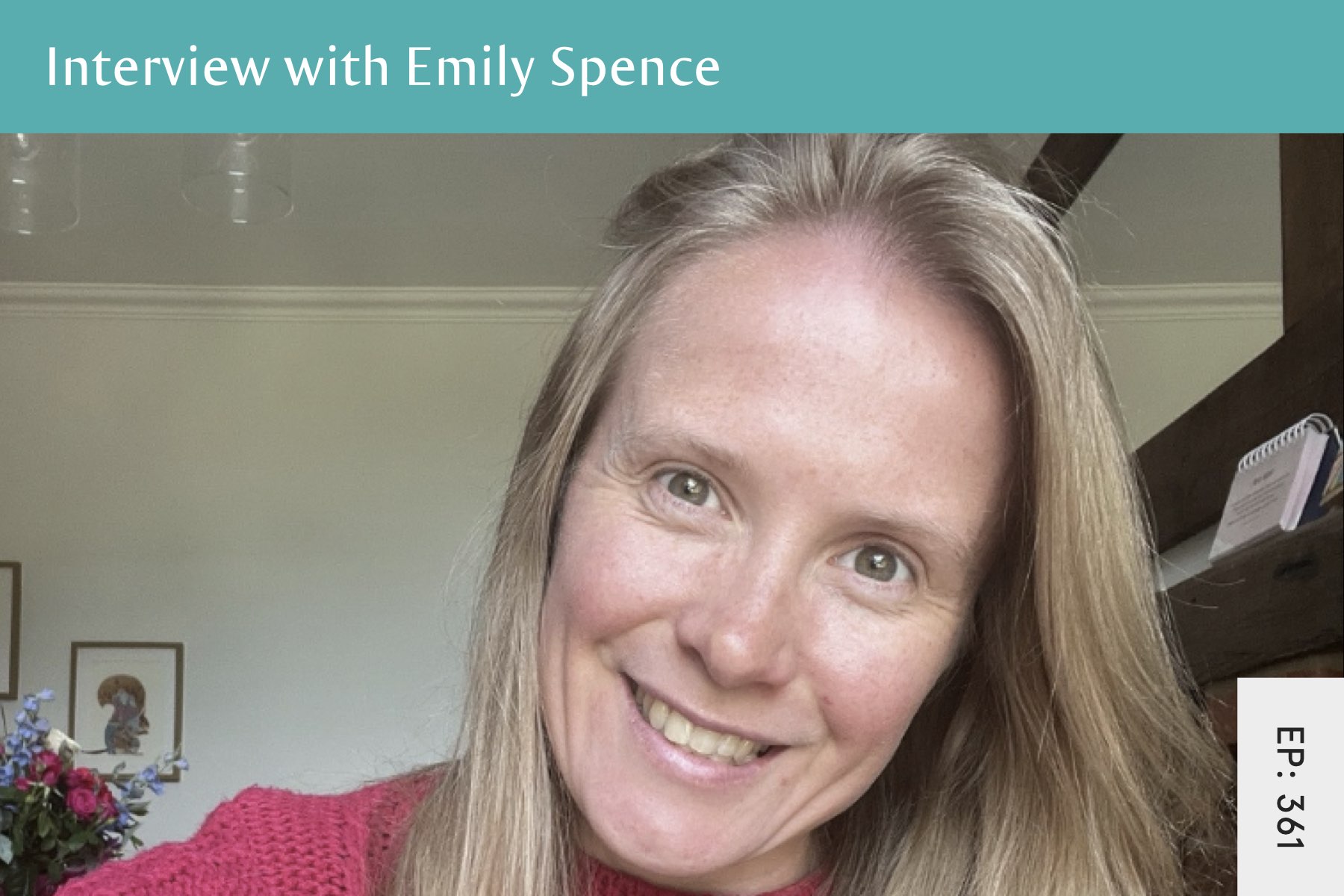
Episode 361: In this episode, I speak to recovery coach Emily Spence. We unpack the reality of living with an eating disorder and what it actually takes to reach full recovery. We cover extreme and mental hunger, neural rewiring, rest, food indecision and the importance of bold action taking in recovery.
00:00:00
00:04:58
00:12:08
00:18:15
00:24:29
00:33:42
00:37:59
00:46:09
00:53:23
00:58:35
01:08:13
01:14:08
01:19:21
01:22:06
01:31:33
01:38:20
01:47:27
00:00:00
Chris Sandel: Hey, everyone. Welcome to Episode 361 of Real Health Radio. I’m your host, Chris Sandel. I’m a nutritionist and a coach and an eating disorder expert, and I help people to fully recover.
Just a note before we get started with today’s show that I’m going to be opening up spots in my group programme this coming Monday, so Monday the 20th of April. If you’re tired of the constant food thoughts, the rules, the back-and-forth in your mind, the recognising that your life isn’t the way that you would like it to be and that your eating disorder is holding you back, this is the programme for you.
This is really where we focus on full recovery and everything that is required as part of that. Not just managing things a little better, but actually getting to a place where food and movement isn’t the centre of everything anymore and that you can properly get on with your life, and how to develop the resilience and the tools to make that a reality.
I haven’t opened up spots in this programme for the last two years, or at least not opened them up as a standalone. I’ve brought clients into this, but not as a standalone. I’m going to be releasing 20 new spots. So if this is of interest to you and you want more details on this and how to take your place in this programme, you can send an email to info@seven-health.com and just put ‘group’ in the subject line, or you can send me a message, a DM on Instagram @sevenhealthcompany and just put ‘group’ as part of that message and I can get the details over to you.
So, on with today’s episode. This one is one that’s been a long time coming, and I’m very excited about. My guest today is Emily Spence. Emily is an animal-loving outdoor enthusiast who works as a recovery coach, drawing on both lived experience and professional training to support others in their recovery journeys. Through her coaching content and online platform, she supports individuals worldwide in reclaiming freedom with food, joy in movement, and peace at rest.
Emily is the creator of the This Is Me Journal, a self-discovery in recovery tool, and the author of Quitting Quasi Journal, which documents her journey from quasi rut to full freedom. She is a passionate advocate for full recovery and encourages people to take bold, practical steps towards lasting freedom.
I’ve been aware of Emily for a really long time now. She has an incredible YouTube channel with lots of amazing videos. She has a great podcast. She’s someone that gets referenced a lot by clients. I recommend people check out her content, but often people are aware of her and bring it up to me or bring it up in the group. I think she’s just doing wonderful things in the recovery space.
As part of this conversation, we talk about Emily’s eating disorder and her recovery and really focusing very heavily on the recovery part of it, and the things that she did and didn’t do or worked on or what was most useful for her, and really looking at the messiness of all of this – that it can be very easy to have this nice clean narrative around recovery, and the reality is that that’s just not the case. We also talk about extreme hunger, mental hunger, neural rewiring, rest and having a break from movement and exercise in recovery, food indecision, and lots more.
I really loved this conversation. Emily is so wise, so articulate, and really just such a great proponent of full recovery. So without further ado, here is my conversation with Emily Spence.
Hey, Emily. Welcome to the show. I’m really excited to chat with you today. It’s been a long time coming.
Emily Spence: Yes, I’m so excited to be here. I feel like I’ve heard so much about you from my own consuming of your content and also through clients I work with and people I’m in contact in this space. I’m really excited to be here.
Chris Sandel: For sure. We’ve been trying to get this to work for quite a while, so it is lovely that it’s finally happening. Yeah, there’s a lot we can cover today.
What I did in preparation for this is I went through a lot of your content. I looked at what are the things that people are most interested in, what seems to be the things that get a lot of the views and a lot of the comments, so that’s how I’ve set this up in terms of the things I want to go through. And I know you shared some stuff that you wanted to make sure we hit. So hopefully this can be a really practical one for lots of people in the same way that your YouTube channel is a very practical thing for people in recovery.
Emily Spence: Yes. I’m always a very loud advocate for the importance of doing. Not just listening and watching, but doing. I hope that can be the case for this too.
Chris Sandel: Sure. We are very much on the same page with that.
00:04:58
Let’s start with you, because obviously you’ve got into this because of your story with this. I know, if I reflect on myself in the past, I think I’ve spent too much time sometimes talking with guests where we linger on the eating disorder part and not enough on the recovery part. So it would be useful to talk a little about your eating disorder and what went on, but I’m much more interested in how you recovered, what were the insights from that piece.
I guess for anyone who doesn’t know your story, can you give a quick snapshot of how your eating disorder started, how long it went on for, and just a brief overview?
Emily Spence: Absolutely. For me, it was in my sixth form years, and I think the main catalyst at that time –
Chris Sandel: Hang on, for people in the US who have no idea what sixth form is, how old were you?
Emily Spence: How old was I… 17, is that? Oh my goodness, yes, 17, 18. The years before university. It was a time where there was a lot of uncertainty and I wasn’t exactly sure what my path was going to look like moving forwards. I think that felt very different to the structure of education up to that point, where you just knew what was coming next. You had a little bit of choice at times of which thing you’d like to study or what class you’d like to take, but really it was very set out. And then suddenly you get this “What do you want to do with the rest of your life?”
I’ve always been a multi-passionate person, and I think it was just overwhelming, to be honest, in the extreme. Basically, over that time, the stress was quite significant. And for me, when I’m very stressed, my appetite can be affected by that. I think when I look back, I very much see that environment – what’s that phrase? I always forget the way that it’s worded. Environment loads the – no, what is it? Genetics loads the gun, environment pulls the trigger.
Chris Sandel: The environment pulls the trigger, yeah.
Emily Spence: That’s the one. I very much see at that time that the stress and the uncertainty of what was coming next meant that I wasn’t eating as I should have been doing. Not for any reason beyond that stress. And actually, that was the environmental cue that pulled that trigger, and the energy deficit began at that point.
For me, in terms of actively engaging in my eating disorder, before I decided recovery, that was a period of probably only about nine months to a year. And then I committed to recovery in 2011 – no, 2012. So 2012, and that was the point where I committed to recovery. Quite simply, I was seeing all of my peers going off and travelling and having fun summers, and I recognised that my life had become very small. I wanted things to be different, and that was the point where I committed to recovery.
Then it was a lengthy period of time, with some chunks of real bold commitment and then some lapses and slip-ups and setbacks, and then I fully recovered in 2020. So that’s a very brief overview of the journey into and then through and out of recovery.
Chris Sandel: Cool, that’s a good starting point and I can ask some more details.
If we look at you before the eating disorder, you as a 14-year-old, 15-year-old, what was your eating like at that point? Was there any ‘healthy’ eating or worries around food or any of that that predated this period?
Emily Spence: I would say that there was gloriously healthy eating, not in the inverted commas version, but in the true sense of what that is. I really listened to my body, I had what I wanted, when I wanted, as much as I wanted. There was a wide range of things. Just gloriously free and very simple, very easy. As I said, what I want, when I want, as much as I want. That was what food was to me.
The same goes with movement as well. I was always somebody – as my animals have just interrupted there – I’ve always loved animals. I’ve always loved being outside. Movement was always something which was part of my life, not necessarily in any formal way, but just going out and being in the forest. I grew up in quite a rural space, so both food and movement were really joyful, free, healthful parts of my life.
Chris Sandel: Nice. What about something like anxiety? Would you say that prior to your eating disorder, after your eating disorder, are you someone that’s higher than the average in terms of anxiety?
Emily Spence: I think I am and have always been more on the side of an overthinker, more prone to feeling very deeply about things and caring a lot. And I think when you are someone who tends to care a lot about things, naturally with that comes a tendency or a chance of being more anxious.
So I think on a spectrum of confidence to anxiousness, yes. However, I’d say that I always had a really solid ability to navigate that. When I reflect, I think the nourishment and that real healthfulness of my body and brain in that time was a very big part of being able to live in that natural characteristic in a way that didn’t negatively impact myself or my life greatly at all.
Chris Sandel: The Highly Sensitive Persons (HSPs), does that fit for you? Does it feel like that’s your wiring?
Emily Spence: Yeah, I think I feel everything loudly. And I love that because it means that I get so excited about things. I’m visibly buzzing about things if something is really joyful and exciting. But equally, on the flipside of that, that means that things can hurt a lot when they hurt, and it means that things can be really scary when they’re scary, and it means that things can be really difficult when they’re difficult.
So I think yes, I do relate to that. I think of it as – in many ways I feel like it’s a superpower, because actually I really love the fact that I feel loudly about things.
Chris Sandel: It is a superpower. This is something I suggest to lots of clients because it is something that with clients I work with, they really do over-index in terms of highly sensitive and HSPs. There are obvious downsides to that; it can be more difficult to, I don’t know, be in a loud restaurant or be in certain environments or to be watching the news or those kinds of things. And there can be something really beautiful about, “Hey, I can just feel so deeply, and watching that film or listening to that piece of music or having that experience with that friend, man, that just touched me so deeply.” So yeah, with everything there’s pros and cons.
Emily Spence: Yes, absolutely.
00:12:08
Chris Sandel: You aid that it was probably a nine-month period from when it started to when you started to recover. So in the whole scheme of things, not a long time compared to many people. Was it really at that nine-month point that you first noticed “There’s a problem”? Or “Pretty early on, even within a month, two months, three months, I was already aware this is not great”?
Emily Spence: I think it was quite a short and sharp period of very much actively engaging in disorder without any glimpse or desire for recovery. And I think it wasn’t long at all before certainly my friends and my family were aware that things were not okay. I think deep down, that was the same. I was aware of that.
However, I do look back on that time and I’m very aware that I was in this state of disconnect and denial because of that malnourishment that was present. I often talk about flying the ‘I’m fine’ flag, and that was me. It wasn’t just that I was saying it and then behind the scenes I was feeling 24/7 distraught and in great conflict. Actually, for a lot of the time, I did feel I resonated with that sense of “This is just me, and I’m fine.”
It was just this conveyor belt existence. And it’s quite scary how swiftly that occurred and took over, and how dominant and strong that was, that I was so out of touch with the reality of where actually, I was not in any way, shape, or form living my best self and life at that time.
Chris Sandel: What moment or moments started to crystallise, “This isn’t how I want to be living” or “There is a real problem here” and there was more of a connection with the reality of the situation?
Emily Spence: I think glimmers of it throughout. As I say, I don’t want to paint a picture like I was 24/7 “Oh, everything’s absolutely wonderful” because I think when you’re in that place, you know deep down that things aren’t right. But there is, particularly from that biological perspective, such a strong conveyor belt, that migratory “I’m just doing this. This is what I do, I go from A to B, B to C, and then I fall asleep and I do the whole thing again.”
I think for me, once I’d gone through my final exams at school and then it was the summer, a long summer before everyone goes off to university, I at that point was very aware that lots of my peers were going off on holidays, they were getting ready for university. There was so much life and excitement bubbling around me, and I felt so distant from that. I felt like – it wasn’t even at the time like I wanted it, but I wanted to want it.
I think that for me was a point where I really paused and went, “Mm, do I want this? Do I want to keep walking this path?” I’m always and will always be very grateful to the me who had that moment and made myself pause and go, “Right, do I want to continue walking this way?” and chose to be bold and brave and do things differently.
Chris Sandel: Nice. And maybe there was also this point of contrast where – I know you said there was a lot of anxiety around “Hey, I’m 17 or 18 and people are asking me to figure out what I want to do for the rest of my life”, and there was possibly some excitement about that of like “Maybe I could do this thing and maybe I could do that thing.” While there was indecision about it, there was still excitement of all the possibilities. And to then recognise there’s a real greying of all that, and just feeling much more muted about this, and “This is not how it was a year ago.”
Emily Spence: Absolutely. I often say – we often think when we talk about the ‘why’ of recovery, it’s very future-focused, and I am all here for that. I think it’s very important that we hold a solid sense of why we are wanting to recover, what lies on the horizon of that place of freedom. But I also think, especially when you’re in the thick of it, sometimes the thing that propels you out isn’t what lies ahead; it’s the reality of what lies where you are.
I know at that time I was like, “I have no idea what lies ahead. I don’t know why I want to go that way, but I don’t want to stay here.” And I think it’s very important not to overlook the power of going, “Mm, I’m unsure. I’m uncertain about what’s over there, but I know what this is, and I also, deep in my gut, know what this is going to continue looking like if I stay here, and I don’t want that.”
Chris Sandel: For sure. I’m glad you said that, because when I’m working with people, there are exercises I do in terms of creating your vision and where you would like to be, and for some people, that really resonates. It is so crystal clear and there’s this real pull towards this. And for other people, that is so vague and it feels so big, so let’s come back to looking at your day to day, how would you like things to actually be different? That becomes a much more helpful frame.
Emily Spence: Definitely. And as is often the way in journeys, the tools that you use and the tools that are valuable change as you move through the process. So the things and the aspects of why that help maybe at the start or at certain places may well change.
And I know I certainly found that. Initially it was a case of “I don’t want to stay here”, and as I began to make progress, the clarity of the horizon became more and more poignant to me. It’s like, “No, I want that. I want to get to this place.” So I think the tools – it’s good to have a variety of tools in your toolkit.
00:18:15
Chris Sandel: Yes, definitely. So then with you and getting started with recovery, let’s start at the very beginning. What did the first week or the first month or those very early stages look like in terms of what were you doing differently? Where did you start with this? We’ll get on to what you would do differently if you could do your time over again, but just in terms of what it did actually look like.
Emily Spence: In the UK, with the NHS, I was having sporadic input from teams. The waiting lists are very long and actually much worse now than they were a decade ago. But I personally wasn’t finding the support I was accessing there particularly helpful.
As I say, around that time where I was looking at all my peers going off and doing these things, basically myself and my mum, I sat down and I was like, “Right, I want things to be different and I don’t feel like this is helping. What can we do?” And quite simply, I made a decision to go, “What would some meals and some snacks that are challenging look like?” and I committed to making those happen, basically.
My experience was that – and I often talk about the hop, skip and a jump for this reason – that actually, by doing that and by putting in place and changing up breakfasts, lunches, dinners, changing things up to make them more challenging, after a couple of weeks of that, my hunger kicked in in a very big way. And actually, at the time, I had no idea about extreme hunger. I didn’t know what this was. I wasn’t really engaging in recovery community or recovery spaces online. So it was pretty overwhelming.
But without lots of information from online, actually, I think I was able to just tap in and tune in and go, “I’m just really, really hungry.” And at that point then, I began to be really honouring my hunger with those meals and things continuing as a backbone and building on those progressively, but ultimately, once that hunger kicked in, it wasn’t really a case of lunch, snacks, breakfast, snacks, all these things. It was just a case of a high volume of eating from the moment I was waking up till the moment I was going to sleep, basically.
Chris Sandel: Sure. We’ll come back to that piece. But I want to go back to the initial part where you said, “These are some snacks, these are some meals” and you started doing that. What advice would you have for the listeners who are at that point? And look, everyone’s experience can be different with this, but how did you get over that Day 1, that Day 3, that Day 5? Because there’s going to be lots of thoughts, there’s going to be physical sensations. How did you hold steady and say, “You know what, this is hard but I’m continuing to go forward with this”?
Emily Spence: I think the first thing I’d want to say is I’m not some unicorn. I didn’t breeze through that time. It was not smooth sailing at all. It was messy. There was a lot of emotion. There was a lot of crying. There was a lot of anger. There was a lot of fear. Huge amounts of backlash.
I think one of the key things that helped me a lot was trying as much as I could to stay in the now and trying to take things one bit at a time, so focusing on that meal that was in front of me.
I also think something that helped – and I learnt about this and I often now talk about this a lot, because now I know a lot more about it than as I went through my journey – but I think predicting is a very valuable tool. Predicting that there is going to be backlash. No, that does not make it go away. No, that does not make it easier. But if you can predict some of the moves that your opponent is going to make going into battle, you are in a more powerful position to take action.
So I think staying in the now. Being able to predict and accept that it was going to be messy and it was going to be up and down was key. And then I think also what I now call setting myself up to win. At the time, it wasn’t. Again, it’s so easy when you have been through the journey to look back, and it’s so packageable. At the time, it was very messy.
But realistically, I think setting myself up to win was important, and that looked like – I was lucky in that I had some really close recovery buddies in the form of my mum in particular. She was a real solid anchor point for me, making sure that I got rid of some of the foods that were just distinctively opposed to recovery and stocking up the house with the things that I was like, “Okay, I know that this is a breakfast that feels challenging. I’m going to buy that stuff and I’m going to keep it simple. I’m not going to plan 12 different breakfast ideas. Actually, I’m going to have one or two things and I’m going to make that happen, and I’m just going to get repeating that.”
Now I look back, and with the knowledge that I’ve gained through my own journey and then also through the work I do with others, I can see it now and go, oh yeah, that makes a lot of sense. Setting yourself up to win, keeping it simple. These are really valuable things.
Chris Sandel: Nice. I think that’s really helpful advice for people, and it’s the way I work with clients as well. Hey, let’s keep it simple. Let’s have one or two breakfast options or one or two lunch options or a couple of snack options – and also decide that stuff in advance, especially in the early days. We’re not dealing with spontaneity, we’re not dealing with those things that come later on. We’re dealing with how you get more energy in, more rest, etc. If that means that you know in advance that this is what you’re doing for this week, great. That actually helps you so that you’re not deciding at the point where things are most challenging, which is just before a meal or a snack.
Emily Spence: Yes, exactly.
00:24:29
Chris Sandel: So when that extreme hunger hit for you – and we’ll talk more generally about extreme hunger, but I want to talk first about your experience and then we can come back to that. But how long did it last before you gave in to that versus “I’m really trying to navigate my way without giving in to it”? Or what was your experience? Especially for someone who knew nothing about this as a thing.
Emily Spence: I think actually the initial leaning into it was quite swift, because it really felt like it hit me like a ton of bricks, and it almost felt like my body was going, “Right, we’re doing this, so get onboard because we’re going.”
I think the point where maybe it became more challenging was as that was continuing to happen, and then as I was doing that healing and my body was, rightfully so, making use of that energy that it was asking for, and there was restoration going on. I think it was as that went on that it starts to become a bit more challenging, where there was a bit more backlash. Particularly in terms of reflecting on the contact that I was still having with the treatment team at that time, where there was some conflicting messaging around honouring that hunger, whether that was the right thing to be doing. My gut instinct said yes, but that wasn’t always the message that I was receiving.
So I actually think, left to me and my body, quite naturally I honoured it, and that meant lots of food. And it was then as time went on that there were other things – one, that buildup of anxiety and fear and that buildup of backlash, and then also those external messages sowing seeds of doubt. That’s where things started to get a little bit trickier.
Chris Sandel: Sure. So because of those external messages, because of that doubt that it created, was there a point where you said “I’m going to step away from these services because this isn’t actually helping me”?
Emily Spence: Yeah. My experience, actually, was that my extreme levels of hunger, they blasted on for many months. At a certain point – I can’t remember the exact time frames because it was a while ago now, but a good while into that, I had made such amazing progress. It must’ve been a good six months, maybe more, six to nine months later, and my hunger was still really quite high, but it had reduced somewhat. The ferociousness of it had reduced a little, and I was feeling so much more me in every single way.
It was at that point that I actually went to my final meeting with the team, and I had a very unhelpful comment along the lines of “Ooh, don’t you think there should be a bit more control going on here?” It was a strange thing because that was my final point of contact with them. That was my sign-off, discharged and go away. And I’d barely been seeing them, to be honest, because again, I personally didn’t find it super helpful.
But it ended up that actually for me – and I suppose this is probably one of the points where I look back and go, gosh, I wish I could teleport back to that moment, because I think if I had done things differently coming away from that, the trajectory of my recovery journey would have looked very different. I think I realistically could have been recovered within the next six months after that. Fully, fully, fully recovered.
But it ended up that actually, even though I came away from that with the best intentions, that led to a quite significant lapse, and from that point onwards, there was quite a lot more of picking up and putting down, and trying to do it and trying to honour the hunger, but then trying other things, and just a lot of here and there. And it wasn’t for a number of years before I really recognised that actually, I was living in a quasi state and I committed very fully to recovering.
Sorry, I’ve probably gone off-piste a little bit there with that question.
Chris Sandel: I think that’s just useful to recognise. As you said, it can be very easy to tell your recovery story in this nice, packaged, ‘put a bow on it’ type thing, and actually you’re getting into the weeds with this a little bit and saying “There was this thing that then happened and that derailed me for a couple of years where I then got in this middle ground no-man’s-land of doing a little bit, pulling back, etc.”
I think that’s useful because I think what otherwise can happen is “Well, Emily had an eating disorder only for about nine months. Then she did some recovery and then she just got there. She had a pretty easy time of it.” And there are some elements of your story that are easier than someone who had an eating disorder for 20 years. That has to be honoured. And we don’t need to make this into this very easy thing when that’s not the reality of what happened for you.
Emily Spence: Yeah, absolutely. I feel like I’ve always been very keen to speak loudly about the messiness and the bumpiness of recovery, because everyone’s journey is unique. But I do think that it can be easy.
And I remember for myself, when I did start to learn about the online recovery space and there were particular people that I was really looking up to and watching their videos and reading about, I know for myself, I would look at these people and see them as these beacons of impenetrable recovery power who just had this unwavering certainty of what they needed to do, and that the moment they decided they were going to recover, that was it and they did it.
I know that there are probably some people that resonate with that and that’s their experience, but both my own and a lot of the people – in fact, the vast majority of the people I have crossed paths with – that just isn’t the reality, very often, for recovery. So I’ve always been very keen to be loud about the fact that recovery and getting fully recovered is possible; the journey there can and will look different. Each and every one of us has a unique path.
But it’s so important to really hold space for the fact that even these people who can sit and speak with such clarity and confidence, that actually when you are in it, it’s very, very different. It’s a lot easier when you’re sitting looking back to go, “Oh yes, that makes a lot of sense. I completely understand that. I can see how this worked.” It’s very different when you’re in it.
Chris Sandel: Yes, and it’s heartbreaking to hear that you have this person making a comment about control – and look, I will say I imagine from their perspective, it was a very well-meaning comment, it wasn’t malicious. It was, from my perspective, down to a lack of understanding about how you talk about recovery, what you say to someone who’s in recovery. And that then had a pretty profound effect on the trajectory of what happened next.
Emily Spence: Definitely. I really don’t believe that people go into helping and health care related roles wishing to cause harm or with malicious intent. But I do think there are aspects of the eating disorder treatment where people are vehemently protective of a map that doesn’t actually lead to the place of full recovery. And rather than look and go, “Oh, the map is problematic”, there is this tendency to go, “Oh, but you can’t get to that place.” And I really want there to be that shift of them going, “Hey, actually, the destination is very real. People can fully recover. Maybe we need to shift the map that we’re using somewhat.”
Chris Sandel: Totally, and especially if there’s the narrative of “Well, you don’t want to swap one eating disorder for another. This is looking like it’s turning into binge eating disorder” or “Look, you’ve hit this BMI amount, so now this is the time to do maintenance.” All of those things that are embedded in that map is what keeps people stuck.
If you are then being told “This is as good as it’s going to get” or “This is the point that you start to reduce your intake” and the eating disorder is still very loud, the message that you internalise is “I can’t recover. This is as good as it’s going to get, and if this is as loud as it is now, why am I going to stay in this body? I’ll go back to the body I was in before because it feels in some ways very similar, and this feels like the worse of those two options.”
Emily Spence: Yes. It’s an excruciating place. And as I say, one of the reasons why I wanted to start sharing, initially on Instagram and then over into YouTube and things, was because I really wanted to be another loud advocate for the fact that full freedom is possible, and to really speak honestly about the messiness of that journey, and that it is okay for it to be whatever kind of messy your ‘messy’ is, but that none of that takes away from the fact that full freedom is possible.
00:33:42
Chris Sandel: So then what happened – you said there was this couple of years where you were ping-ponging between doing some, not doing some, etc. What then stepped it up again so that you started doing that more full recovery type actions?
Emily Spence: That did feel like quite a poignant moment. It was actually – I’d finished my degree, because I had a few years –
Chris Sandel: Out of interest, what did you do? What did you study?
Emily Spence: I studied podiatry. And I’m now currently retraining as well in physiotherapy. Health care was always the right pathway for me. I really love working with people. I love being able to help and make a difference. But there were aspects of podiatry that just didn’t fully tick all of my boxes, and I’m really pleased to be now fully recovered and exploring building on that. I’m excited about it. Anyway, that’s a whole different topic.
Yeah, basically I finished my degree and I was at a point where myself and my partner, we were looking at moving somewhere that was going to be good for both of us to be getting jobs. It was a very exciting new chapter.
I think it was this really stark awakening that if I didn’t crack on and actually fully recover, my life was always going to be ‘me and ED do things’. ‘Me and ED go on holiday’, ‘me and ED move into our first house’, ‘me and ED get married’, ‘me and ED get a job’. It was always going to be there.
And I didn’t want that. Again, we come back to that ‘why’. Yes, there were all these things, but I think at that point, I was like, I can do all those things. I can go and get married. I can get a job. I’d reached a point where I was very much living my life, and a lot of people would’ve looked at me and gone, “Yeah, that’s Emily. She’s fine. She’s recovered.” But I knew deep within myself that wasn’t the case.
And it really was a point of going, “I don’t want to always have this thing with me through all of these experiences blurring my memories, marring my memories and experiences.” I was like, “Right, I need to really boldly commit.” Because I also was like, “I don’t want this recovery thing to continue to be a hobby that I’m doing. I don’t want recovery to be my hobby. I want it to be something that I did and I finished, so I’m recovered.”
It was at that point – I ended up writing a journal throughout the whole process. I termed it my Quitting Quasi Journal, because I was like, right, I’m not doing this anymore. I’m getting fully free. And that was a period of just under a year. As I say, in the early summer of 2020, I was fully, fully recovered.
Chris Sandel: Nice. Did that mean, in essence, just going back to what you were doing in the early-ish stages of your recovery before that had got interfered with?
Emily Spence: Yeah, absolutely. I think maybe one of the things that was a bit different there is the intensity of my hunger wasn’t quite the same. I definitely had recovery hunger. I think often we have this black-and-white, there’s extreme hunger and then there’s just eating, and actually I think we must remember there’s a very important middle space, which is just recovery eating, which is that abundant eating to restore and replenish an energy deficit.
So I definitely had that, but the kind of really intense extreme hunger – that didn’t show up in the same way. There were still moments of it, but not the same. And I think a big, big focus was in weeding out all of the behaviours and the tendrils of disordered fears that were still lingering, and being really proactive of going, “Right, here are these fears. I need to rewire this. I need to do this.” And it was opposite action, opposite action, opposite action.
00:37:59
Chris Sandel: Nice. We’ve talked a lot about the food aspect of it, but in terms of the movement aspect, how much did that come into your eating disorder? You said “I had this lovely healthy relationship with movement, I love being outside, I love being in nature, I love being with animals.” So what happened with your eating disorder in that, and then what happened in terms of the recovery connected to it?
Emily Spence: I think actually, what I’m about to say is one of the reasons why for a long time it kind of went under the radar, because whether I chose – I’m not sure what word to use there, but basically, I didn’t resonate with that person that is running miles and miles or going to the gym all of the time or doing any kind of formal, structured exercise. That wasn’t a feature.
What was, was this drive to be doing and moving, and a real restlessness and a real resistance to rest. And it wasn’t just in the form of movement. It was just generally in terms of busyness. I turned into this busy bee. I often call it this conveyor belt existence. It’s like my life turned into some kind of endurance event where I listed out each day what I needed to do and it was like A to B, B to C, pause for some lunch, and now – my days were just these military endurance operations.
I’d come up for air at the end of each day, maybe get an hour of just chilling, and maybe a little bit more hunger would surface and I’d watch a bit of TV, and then we’d be back around again. So I think for a long time, particularly in that first chunk of recovery and where there was this back and forth – when my extreme hunger hit, I did a brilliant job of really committing to resting, and that was crucial. I absolutely know for a fact, and I’m very loud about that as well, rest is so important.
But in that time where I was toying with things and back and forth, again, that was a period where that centring of rest became inconsistent as well as the centring of really unrestricted eating. And then when I came to the point of Quitting Quasi, that was a time, again, where I’d discovered a love of a variety of different outdoor hobbies. When I was at university, I joined the climbing club and I learnt to climb and I was like, “Oh my goodness, I love this. This is incredible. Look at these places I’m getting to go to.”
And I do think for me, the outdoors and those hobbies were part of the catalyst to me going, “If I don’t get free, it’s always going to be ‘me and my eating disorder go on a trip to the mountains, me and my eating disorder go and do this amazing climb’.” Like I alluded to a moment ago, I’d got to a point in my journey there where I was okay, and from the outside looking in, there was a lot of noise of “Oh, that’s just Emily. That’s how she is. She is just a bit of a busy bee. She’s here, there and everywhere.”
But I knew in my heart that actually, whilst no, I wasn’t somebody who was at the gym multiple times a week, every day, whatever that might look like, I wasn’t someone who was running lots – my compulsion with movement didn’t look like that – I was somebody who would always walk no matter what. I was the person who would always be washing up all of the things the night before if there was a party that was going on. I was the one who would say, “I’ll go and pop that to the shops for you.” I was always just doing and busy.
I often say this. I feel that one of our best indicators of our relationship with movement is our relationship with rest. And at that time, my relationship with rest was very poor. It was an okay at the end of the day thing, and if you’d pinpointed me down and said that at the time, I would probably have been quite defensive, like “No, no, I can rest. I’m fine. I can do rest. That’s fine. I just like doing this.”
But the reality was, rest was itchy scratchy, and it was uncomfortable, and it didn’t feel like something that I wanted to do, and it wasn’t prioritised. I feel like it was a very, very important thing to me when I quit quasi that I very boldly recentred that need for fully resting. And that was hard at the time because it meant saying no to some things that I, on a core level, had discovered a real love for. And they weren’t eating disorder. They were me. And that almost felt harder, because I was having to say no to trips and no to stuff that I was like, “I really want to do this.”
But I look back on that time now and I’m incredibly grateful that I chose to do that, because I know for a fact that that has enabled me, as a recovered me, to have a really healthful, joyful relationship with those things, and to reclaim full and complete peace at rest, too.
Chris Sandel: Nice. I think that’s a really useful message for people, because what I hear so often is “Look, I just have this true love for this thing” or “This thing was so important to me even before the eating disorder.” Two things can be true at the same time. It can be, yes, I can acknowledge that this thing isn’t a thing that has come about because of your eating disorder, and we can also acknowledge your continuing to do it is perpetuating the eating disorder and is having an impact on the amount of recovery that your body is getting, and it’s having an impact on the amount of rest you’re getting.
So to hear you be able to explain that I think is really useful. “Hey, I can love this thing and recognise it’s not an eating disorder compulsion, and also recognise that it’s keeping me stuck.”
Emily Spence: Yeah, definitely. And I think you can utilise that love to serve your recovery and to really fuel the fire for wanting to do that full healing work. And as I say, when I look back now, I am so grateful to the me who put those things back on a shelf and said, “Right, they will be a part of my life. I want those to be a part of my life. I love those. But not now.”
And actually, at that time, I’m also really grateful to the me who got proactive in being curious about the other things that I enjoy to do, because I think ultimately, rest is not just for recovery. Rest is a crucial thing for life. Particularly if you are somebody who likes any kind of active hobby or recreation. Rest is absolutely crucial.
So I think there’s a lot of value to gain from shelving those things that you love, both for the purpose of being able to go back to those things in a really free sense, but also to broaden that sense of “Actually, I love that, and I also like these. I really love that kind of film. I really enjoy that kind of craft. I like playing that game”, whatever it might be. There is so much value to doing that work.
Chris Sandel: For sure. I just did a whole podcast on rest. I’ll put it in the show notes. I think there can be this misunderstanding of what that means. Rest is not just you have to be sleeping or you have to be sitting on the couch doing nothing. It could be doing a puzzle, doing a crossword. It could be playing a guitar, playing the piano. As I go through in the podcast, there’s so many different versions of that.
And so often when I speak to clients, they’re like “It’s so nice. I used to really love film, and I’ve got back into that, and that was something I couldn’t do before.” Or “I used to always love doing puzzles and we’d have that out on the dining room table and I just stopped being able to do that because I couldn’t stand still or I couldn’t sit long enough to do it.”
So even for people who are like, “I was always quite a busy, active person”, if they reflect, there are probably things that they did use to do where there was that time of rest, whether that’s reading books, whether that’s whatever it may be.
Emily Spence: Absolutely.
00:46:09
Chris Sandel: I imagine with doing this, there would be a lot of thoughts coming up of “That’s too much food” or “That’s too much rest.” So what did you do with that? Or if you didn’t do that particularly well, what would you suggest for your past self, now knowing what you know?
Emily Spence: Again, this is another place where with hindsight, it’s so easy to sit and look and go, “Every single bit of that food and that rest was crucial to get free.” It’s so easy to have such solid clarity of that and therefore to have no doubt, no uncertainty around it.
The reality was, when I was in it, there was anxiety present. There was uncertainty present. There was flickers of judgement present. There was a lot of eating disorder backlash present.
Some of the main things that helped me were: one, reaching out and actually making contact with recovery spaces, where I started to learn what was shared in this experience. Because each of our journeys is different and we don’t walk the same exact path, but there is a lot about the shared recovery process and the shared experience of recovery that is a really valuable resource to tap into. To look ahead and to go, “Other people have walked this path before me, and I can look at that and use their experiences, their words, their reassurances as a beacon of ‘keep going’.” So I think that was very, very important.
I also think, again, keeping it one day at a time, keeping it in the now was important. And ultimately, I feel like having certain mantras that I would come back to in terms of “There is no too much.” “More is better.”
Unconditional permission to eat, now and forever. I think certainly as I was moving through recovery towards those later stages, that deep acceptance that there was no finish line to this. It wasn’t like I would get to a certain point and then suddenly things would change and I didn’t have unconditional permission. Really acting in alignment with the fact that that unconditional permission to eat without restriction stands firm and true both in and beyond recovery. I feel like that was absolutely crucial.
Chris Sandel: Yes. I think that is a stumbling block for a lot of people. And again, sometimes it’s because of the messaging they get from different services, where there’s a point you can do this and then there’s a point we need to go back to what I often refer to as ‘eating disorder lite’. Like “Don’t take it quite as far, but hey, do you really need to have those foods? Maybe you don’t need to have that snack anymore.”
That’s not the right messaging, because then it creates this struggle for people of like “When will I know that I have to do that? But also, what if I then use my recovery time and I don’t properly get in all of those foods that I haven’t had for a long time? Is that the right pizza for me to be having? What if that’s disappointing?” and all of that type of stuff, where it gives you this window, and you’d better get that window right, otherwise you’ve missed out.
I don’t want anyone to have that misconception. In the same way as you are, I want to get this across: it is now and forever.
Emily Spence: Yes, absolutely. I think it’s remembering that that isn’t just to get recovered, but it is about staying recovered as well. At the end of the day, being fully free is absolutely possible. You can live with no eating disorder thoughts in your mind at all.
But one of the things that you do have is that genetic predisposition. And ultimately, that isn’t something that goes away. For myself, it’s not like I walk through my recovered life constantly batting away the fear of “Oh my goodness, energy deficit! It might come and get me!” But ultimately, I am aware of the fact that – not that I would ever want it, because ultimately recovery teaches you the wonders of body and the wonders of that trust and the wonders of really listening to what your body needs. But even if I was to think “Ooh, I really fancy doing that thing that’s a bit restrictive. I really fancy doing that thing which is in some way micromanaging my body” – it is not and will never be for me.
And as I say, one, I don’t spend my life fighting that off, nor do I have any desire for it because of the work that goes on in recovery. But I think really knowing that ultimately, these things are not just to get recovered; they are to stay recovered.
And when it comes to that, for example, I’ve gone back to these hobbies that I love so much. Climbing and mountaineering. They’re just the greatest joys to me. But when I think of mountaineering, it is, there’s no doubt about it, an energy-demanding thing. What staying recovered looks like to me, and what being aware of that genetic predisposition looks like to me in that is, I’m the one with the snacks. I’ve always got lots and lots and lots of snacks. I am going into those shops and I’m going, “Right, where are those peanut M&Ms? Bring those to me. I need multiple bags of those.”
I feel like it isn’t this thing where you’re constantly thinking, “Oh my goodness, I must avoid it”, but it is something that you have a healthy respect for, and I worked bloody hard to get free. And I have a lot of pride, and there’s a lot of joy to be had in going, “I know that my body is a body that needs plentiful, abundant nourishment for life.” And actually, there is a lot of peace to be had in going, “Yeah, and I am going to continue both now and always embracing that, and that looks like continuing to action that unconditional permission to eat and rest and listen to my body.”
Chris Sandel: For sure. I think that’s a really useful reminder for people. And also, the unintentional ways of getting into that energy debt.
For you – and this is going to be true for other people who are listening – it’s like, “I need to be on the lookout. If there’s some grief in the family or some grief in my life, more than the average person, I need to make sure that I still eat through that because I don’t want to have this tragedy happen and then I find myself back in this place.” Or going through a pregnancy, “There’s a lot of morning sickness that’s going on, and I need to make sure that I’m doing my utmost to be getting the energy in because I could very easily get back into a place where it wasn’t a choice, but those thoughts are getting a lot stronger again.”
So being aware of these different points of life, menopause, etc., where it becomes more likely that that could be – not forced upon you, but just happens to you, and “Hey, I need to be on the lookout for that as well.”
00:53:23
Emily Spence: Absolutely. I think one of the silver linings of recovery is that it does give you such a deep sense of respect for your body. When I look at the last few years, I had a significant loss, and it wasn’t an easy time, but one of the things that was easiest was I just made sure that I continued to get regular, abundant nourishment going in.
When I was moving through recovery and thinking about keeping and staying recovered, I was thinking, what’s that going to look like? Particularly when I was thinking about going back to hobbies and thinking about these kind of things, because there are challenging times. Life throws things at you.
There were moments where I had fear and uncertainty, like “I don’t want to ever risk going backwards.” And I suppose even now, if I could speak to that me who was right on the cusp of being fully recovered and had that very understandable concern of “How do I make sure this never gets affected? How do I make sure I stay here?” – actually, I think it feels incredibly natural to do that. It feels very, very natural to look after myself.
I just know that personally, at the very top of the pedestal of looking after myself – or the bottom of the pedestal. One of the most important things, wherever you put that, whether it’s the foundation that support it or go on the top – one of the most important things is that I am nourishing and resting. It’s a really wonderful thing for that respect and that trust to be so intuitive, and it not to be this thing that I have to consciously tussle with. It’s just a conscious “Yep, I’m going to do this.”
Chris Sandel: I think this can be true for people who have had eating disorders, who’ve not had eating disorders, where you can really build up this real awareness of your own body and what is required as part of that. I often talk about that different people have different things that are more or less important to them, and that there’s often a handful of things that equate for pretty much all of the health that one sees or how someone feels.
By going through recovery and all of the things that you did in terms of food and doing exercise, not doing exercise, all of these things, you start to have this real awareness of what does and doesn’t work for you. So “Those meals tend to help me have a fairly good amount of energy for a long time” or “I really do need to prioritise getting to bed earlier because that’s just the way that I am.”
Over the weekend, last weekend was a big golf tournament called the Masters. It’s in the US. It meant that for four nights in a row, I got to bed like midnight. And I’m someone who’s normally getting to bed 9:00, 10:00. And I noticed just how much that had an impact on me. On Sunday, during the day I had a two-hour nap so I could then stay up and do this thing. And there was the recognition of like, “I don’t want to live like this. This was fun and I’m glad that I did this and this is something I’m passionate about, but my gosh, I can notice how much this had an impact on my system just doing this for four days.”
So cool, I’m going to now this week really prioritise getting to bed earlier and making up for that sleep debt that has accrued. Just being able to become really aware of, what are the things that I do need to prioritise and protect in my life?
Emily Spence: Definitely. It’s the simplicity of that and the lack of having to micromanage or force it. In the same way that – I don’t know, I often link the process, that journey back to freedom with food and freedom with nourishment, in the same way that if you were to go to the toilet, you don’t have to be thinking. There’s no great debate. You’re just like, “I need to go to the loo” and you do it and you’re finished and it’s simple, and you get up and you move on.
I feel like there is that day-to-day simplicity, and then there is also this really deepening – and I imagine this is something that has continued to deepen over the last years of being fully recovered, especially as I’ve then navigated really difficult times – just this real deep and easy solidity of “This is what looking after myself is for me.”
Chris Sandel: For sure. And there are going to be times where that’s easier and I have more bandwidth, and there’s going to be times where that becomes more challenging because of the busyness of life or going through something with the family or grief or whatever it may be.
For me, I come back to understanding what are the three to five things that truly matter for you. So when it is “I have barely any time”, if that is the case, I’m still doing my three meals and my three snacks. I’m still getting to bed at this time as much as I can. I’m still getting outside time. Or whatever those handful of things are, that’s where my priorities are, and the other stuff can fall by the wayside and I’ll pick it back up when there is more bandwidth.
Emily Spence: Yes.
00:58:35
Chris Sandel: Let’s talk more generally – I know we’ve talked a lot about your recovery journey, but I would like to talk about some other topics. We can talk about this more generally with working with clients. Let’s start with extreme hunger. We’ve obviously talked about your experience with this.
When you’re working with people or when you’re hearing other people’s stories connected to “I had extreme hunger”, what do you feel like people most likely get wrong with this? In terms of what they do or how they respond with this.
Emily Spence: I think it’s very, very natural, but I think the main mistakes that people make is trying to side-step it in various different ways. That can be trying to ignore it for periods of time and allowing pockets of permission around the honouring of that.
It can also look like filling up on certain foods, permitting greater abundance with certain safer items, but actually not having the biscuits or the pizza that your body is actually wanting in abundance. So I think side-stepping and tiptoeing around is probably one of the big errors.
I think the other one is compensation around it. That tendency to be honouring it, but then either swiftly or somewhere around it engaging in some kind of compensatory behaviour. And that could look like having a day of real unconditional permission and honouring of it and then actually having a next period of time where that is not happening. It can also look like compensation in the form of movement. It may be that there is real bold honouring of that hunger going on, but there is also engagement in some level of movement, which is providing some kind of compensatory mechanism.
Chris Sandel: For sure. I love to explain how I work with that, and I’d love to get your thoughts connected to this. Just because over the years, from doing this for a long time, I’ve come to realise there is a lot more nuance with eating disorder recovery than sometimes is presented online. It can be this very black-and-white “If you’re not eating every moment that you’re ever thinking about food, you’re restricting, you’re not doing full recovery.”
I think there can be nuance in the way that people do this, and especially for me, I’ll often use structure with people. “Hey, we’re going to run this experiment with this and see what you notice. There is a greater amount of hunger that is coming up. Let’s increase your baseline with this and see what happens.” And being able to have a conversation with someone of “Okay, what do you feel would be the best way to deal with this?”
I know you can be then asking for the eating disorder’s input, but it’s always, if we’re thinking about this from the healthy self perspective, what do you think would be most useful? Because I think what can often happen is there can be this idea of “I’ve got to fully embrace this and let myself eat every moment I think about it”, and someone does that for a week, completely freaks out, and then they’re like “I’m never doing recovery again.”
So it’s looking at, what’s the best way that we can start to get in the energy that we need while also thinking about, we need to do this long enough for you to properly recover. So figuring out, what is the right route for this? And if someone’s like “Hey, I want to completely rip the band-aid off and go headfirst into it”, I’m like, great, let’s do that.
And if someone else is like “How do I increase things more gradually while I’m honouring my hunger and I’m still keeping some structure?”, I’m also open to doing that with the “We’re running this experiment and we’ll see what happens over the next two weeks and then let’s reflect. What did you notice when you did it in this way?” I’d love to hear your thoughts on that.
Emily Spence: Certainly. I very much agree with the challenging of that very black-and-white view. I know that ‘all-in’ is a term that’s been coined and is used a lot in this space, and I think there is a lot to be said for that very bold attitude, there’s no doubt about it. I do sometimes think, though, that that very black and white – I’m either not doing it or I’m doing it completely – can in and of itself become a barrier to progress.
I think we kind of touched on this a little bit earlier. Actually, I think for the vast majority of people who have recovered, if they were to look back on their journey, it wouldn’t be a switch of zero to a hundred. Actually, often there is a somewhat stepped approach that occurs to get to that place. For me, that looked like those couple of weeks where there was some bolder action going on that then, one, opened the doors to my body actually being able to trust to talk to me and go, “Hey, I need more, please. I’m really hungry.” But also laid the way to me building up some momentum in that action.
That said, I do think that one of the mistakes that people can make is being overly tentative. I think ultimately, recovery action is going to make you uncomfortable. There is absolutely no way to do recovery that is not uncomfortable. And I think sometimes people – and it’s really natural – are wanting to find the path that isn’t uncomfortable or is as minimally uncomfortable as possible.
The problem with that is often that leads to you feeling very, very stuck because you aren’t doing the work. You’re trying to find a tunnel, a bridge, a something, and the reality of recovery is you have got to go through. You’ve got to go down, you’ve got to wade through the water, and you’ve got to scramble out the other side. There’s no bridge, there’s no tunnel, there’s no bypass. You have to do that.
So I think this is where I often speak about that kind of hop, skip and a jump. When it comes specifically to this in terms of extreme hunger, I think it is very, very important that people receive the loud message that it is okay to be really hungry and that it is very normal and natural when you are in an energy-deprived state and you have been restricting your body to be really hungry. And that ultimately, your hunger is not the enemy. Your hunger is the friend. Your body is on your side. Your body has not got malicious intent. It’s not doing it for a laugh or a joke. Your body is on your side. Your hunger is on your side.
I think the combination of that message and an awareness that it needs to be uncomfortable, when you pair that together, for some people, sometimes through their own experience, they’ll realise “I need to be really bold”, and that is going to look like, like you said, ripping the band-aid off. That’s going to look like XYZ. For others, it can be “Actually, my skip is going to look like these really bold meals that I am going to be making happen. No ifs, no buts, no maybes.” And that can then be something which is built on.
I do feel that in order to get – and certainly when I look at my own experience and the paths I have crossed and the work I get to do in this space, to fully recover, I do believe that you have to be honouring your hunger completely. At some point in that journey, that skip, that hop, that jump, there is a need to be really boldly honouring your hunger.
But I think absolutely there is a place for that step, a bold, progressive step that embraces discomfort and challenge because it has to, that is then seen as a minimum – and I talk to my clients a lot about that. Whenever we set these things, it is always a minimum. More is better. But it is always that minimum. Yeah, I think that’s a very important component to be discussed in this space.
Chris Sandel: For sure, and I agree with everything you said. Just to clarify my position, when I’m doing this with someone, we’re always working to get to this minimum place of you’re having three meals, three snacks. You’re at that 3,000–3,500 calories as a minimum. And then we’re working out, where do we go from here?
So it’s not that I’m leaving someone in this really small place and I’m like, hey, we can just add in a tiny piece. I am encouraging real, meaningful changes and getting to that pretty solid starting point as a baseline, and then we can figure out where to go from there.
Emily Spence: Yeah. I suppose the positive work that you do and the success that you have working with people, that very attitude forms the foundation of that, doesn’t it? Because as I say, there is such a need to accept that it has to be uncomfortable, it has to be challenging.
And no, recovery is not only about food. There are other aspects to it, absolutely. But it is the foundations. I think even when we think about neural rewiring, very, very often, I think there can be almost this jump to go, “Right, how do I rewire?” Ultimately, you can be doing opposite actions and that can be great, but if underneath that there is not the nutritional rehabilitation going on, it’s going to be very, very difficult for your brain to be restoring and healing in order to be able to most effectively neurally rewire.
01:08:13
Chris Sandel: For sure. This is the thing when I think about recovery – and especially with a lot of the clients I work with now, where this has been going on 10 years, 15 years, 20 years. It’s had such an impact on so many aspects of their life, actually so much of the recovery is not the nutritional rehabilitation piece. It’s not the neural rewiring connected to food and exercise. That is the foundation piece that we need to do, and it’s then starting to explore so much of the other stuff and the impact that this has had on them over the last handful of decades, and the beliefs and how that’s impacted their relationships or things with their kids or the job they’re now doing and their sense of identity or purpose or the grieving piece. That’s often the longer part.
And in some ways it then merges into “This is what I think is the case for most adults.” Especially for myself, I’m now in my mid-forties. I’m doing a lot of work connected to my childhood or how I want to be as a parent or how I was parented or experiences that I went through as a kid and how that affects me to interact as a parent or the relationships that I have.
I think for all of us, there can be a lot of ongoing work, and not in terms of “I’ve turned my life into a project”, but just recognising, “Oh, I would actually like to have a better quality relationship in this area” or “I would like to have less uncertainty or fear in that area, and that’s something I think I could work on by starting to learn these tools or practices or whatever.”
I think as recovery then goes on, when you’re doing more of that work, it merges from, is this recovery, or is this just what a lot of people are doing in their thirties and forties and fifties?
Emily Spence: Definitely. This is one of the things I think sometimes some treatment approaches get wrong. They flip that over, and there is maybe a bit too much focus on that stuff initially, when someone is in an undernourished state, when someone has got a very strong neural network for disorder and compulsive behaviour.
At that point, really, there is a need to be focusing on getting fully nutritionally rehabilitated. Rewiring those behaviours. Moving out of that stressed state, physiologically, emotionally, psychologically, in order to then absolutely, like you just said, create that really solid foundation. That solid nourished state for that person, as a human. Because we are all people, at the end of the day. We’re going through recovery, but ultimately we’re all living lives at the same time. Stuff is happening.
But it’s those things which I think really provide the foundations to then do really effective work in any area. And for some people, there isn’t anything. At the end of the day, we are all different. Some people there is minimal, some people there is a lot of stuff that at that point is really important to be working through and exploring. But yeah, I think it’s very important that we acknowledge the role and the need for that, but do not underestimate the importance of that foundation of nutritional rehabilitation – the amount of times I say that and I still can get it twisted on my tongue so many times. Nutritional rehabilitation and neural rewiring.
Chris Sandel: Yes, for sure. And I don’t think it’s an either/or. I think there can be times that I will work on some of those things early on with people, because it’s then in service of action taking. This is the thing I always say. If this just turns into navel-gazing and a lot of us reflecting on your childhood and it doesn’t lead anywhere, that’s unhelpful.
But if we can recognise that we’ve talked about the emotions that weren’t allowed to be shown when you were a child and how your parents were around these kinds of things, and that allows you to “Oh, this is why I need to start to bring in more self-compassion” or “This is why I need to be kinder to myself in this situation”, that can be helpful. So it’s looking at, this has got to be in service of what is actually required in this moment.
Emily Spence: Yes, definitely. This is one of the reasons why I am progressively shifting over to longer form content, because recovery is so nuanced. Yes, there are trends and themes, as we were just speaking there in terms of that process from nutritional rehabilitation into this work.
But absolutely, everyone is unique. Everyone’s journey is unique. And it is really important when we’re making and sharing in this space that we are respectful and open about nuance. And I know I often say when I’m creating, take what helps and leave the rest, because there are always going to be aspects of things that resonate for some, bits that don’t for others. So yeah, I feel like it’s important to be having these conversations. This feels good to be bringing that really nuanced lens here.
Chris Sandel: For sure. I know both you and I talk a lot about the biological parts of the eating disorder and the energy debt parts of the eating disorder, and we do that for a reason. And the longer I’ve done this, the more I’m seeing that people have trauma histories. There’s a lot of neurodivergence and that’s having an impact on how they experience the world and how intense recovery can be, and even after recovery, how hard things can be, etc.
Recognising that needs to be part of the treatment. It needs to be the things we are then working on with people, or if I’m not working on it with them, that they’re getting the support around that. Getting out of the very black-and-white “You just need to eat the food and rest and then everything’s going to be gold.” It’s just not that simple.
Emily Spence: No.
01:14:08
Chris Sandel: Let’s talk then about mental hunger, because I think this comes up a lot and is something that both you and I have talked about. How do you explain mental hunger to someone? What’s the difference between mental hunger or physical hunger? Do you think there’s a difference? Talk a little about this.
Emily Spence: In terms of the practical element of this, the very important message here that I’m always very keen to get across is that mental hunger is a deeply valid form of hunger. And actually, in an energy-deprived state, our mental cues for hunger can be more reliable of an indicator of our body’s need than our physical cues.
Again, if we were to bring all of the nuance here, we could be talking about this one question for hours. But generally speaking – I know this was my experience and I know a lot of people resonate with this – even where physical hunger may ebb and flow and there may be inconsistency there, many people find that that mental cueing of food, that mental focus on food and food-related things and things which provide permission to eat – mental hunger is not just thinking about a burger. It could be thinking about that recovery thing which provides permission to eat. It could be whatever the various forms of it are. But recognising that it is a really important and wholly valid form of hunger.
Chris Sandel: For sure. I think there can be this misconception where “I’ve just eaten, so this is emotional eating or this is greed”, or there can be all these other reasons why it can’t possibly be that I’m still hungry here. I think this is especially the case where someone’s getting into that extreme hunger phase. It’s not only this, but the extreme hunger phase where you knock up against the “Physically I am so full, and at the same time, I’m also so much thinking about food and there’s still this drive towards it. In some sense, it feels like there’s this mismatch between what my body is trying to tell me and what my mind is trying to tell me.”
Emily Spence: Yeah. That is a really, really hard place to be. I remember how challenging that was to be in, where absolutely, as you have just described, physically I was feeling full. But actually, on a deep level, I wasn’t satisfied. My brain was still in the cupboard with the biscuits. I was still thinking “I want more of that.” It is a really challenging place to be.
Again, I think this is where it’s so important to bring that messiness back. Because the reality of recovery is that actually honouring that and being bold does not always look like happy fluffy bunnies and butterflies and rainbows. Sometimes it looks like lying on the sofa, eating the biscuits, and then getting to a point where you’re like, “Oh my goodness, I am so, so full right now. I just need to lie down with something warm on my tummy and just wait half an hour, because even though I acknowledge my brain is still going ‘biscuits, biscuits, biscuits’, I can’t fit another M&M in right now. So I’m just going to lie here, I’m going to wait, and let’s let the 15 minutes, the half an hour” – my own experience was very much that often, that half an hour would pass and I’d think, “Okay, I can.”
One thing that really supported me in this was the bolder I was with honouring and the more consistent I was with that honouring, the greater examples of time I had where actually I felt satisfied. Sometimes it wasn’t even that I felt hungry. It’s that I didn’t feel full. There was just this vague thing in front of me, but I was just very aware, “I’m not full, but it just feels like I’m throwing food over my shoulder. I’m not quite sure where it’s going. It’s going in my mouth, I’m eating it, but it feels like I’m just chucking it over my shoulder because I don’t feel any different.”
I feel like the more I was bold and really proactive with the honouring, the more I’d reach those places of “I am satisfied.” And at times they were so fleeting. It might’ve been a few minutes before I was thinking, “Ooh, cake. That’d be nice right now.” But ultimately, those times where I was able to go “Oh, I’m satisfied” or those times where I was able to go “I’ve just been watching this film and I’ve not thought about the biscuits on the side for 15 minutes” – those were the times where I was able to be beginning to build and rebuild that trust of “Yes, this hunger feels so scary and so intense, and there are these times where it’s so uncomfortable and it feels so messy and it feels so, for want of a better word, unhealthy, it feels so un-normal.” But ultimately, those were the times where I was like, “Yeah, but my body is telling me. At the end of the day, my body is saying this is what I need, and I’m getting these glimmers of evidence that if I lean in and I’m bold, it says ‘Hey, we’re good.’”
And the more I did that, obviously that supports that nutritional rehabilitation, which supports getting out of that energy-deprived state, but it also rebuilds and rebolsters that sense of trust in your body of like “No, actually, I can trust that my body wants what it needs and needs what it wants.”
01:19:21
Chris Sandel: For sure. I imagine the trajectory with this for you – and correct me if I’m wrong, and you can talk about this with your clients as well – but what I’ve noticed is there can be this feeling in the beginning of like “How do I give myself that permission or how do I have that acceptance?”
And my response is always: acceptance is a verb. Permission is a verb. In the beginning, it’s just the doing, even if there is still some of that mental restriction going on, where “I’m eating the thing but I’m not fully giving myself permission to do it.” That’s at least stage 1. And then as you continue to do it more and more, especially as you recognise that the sky hasn’t fallen in or “I have been able to survive this experience”, it then becomes a little more of the mental or the authentic permission, where it feels like “I’m doing this thing and I’m also choosing this thing.” It’s not like “I’ll do it but I don’t know if I should be doing it” type thing.
Emily Spence: Yes, definitely. I think this is where you gather that clarity and that wisdom as you go. Also, I feel that sense of “Yeah, I know what I’m doing, I know this is the right thing that I’m doing, I know that I’m on the right path” – it only comes by taking the action. You cannot think your way there. You cannot read and watch and listen to things and get to that place. The only way that you get there is by doing it.
And with that consistency, it does happen. And the same goes as well, the same concept but in a different way, often you can only know the next steps you take by taking those initial steps, and as you go, you get more clarity on “Here it is.”
This is a totally different topic, but I think that’s an interesting one, where as you take action in recovery and as you boldly commit to doing things, you gain a new perspective on the areas – and that can feel overwhelming at times, because you think “Oh my goodness, but I’m doing these things and I’ve done that, but now I’m aware of all this other stuff”, and it can feel like more moles keep popping up. You know that game of whack-a-mole. It just feels like “The more I do, the more they’re popping up.”
It’s knowing that you learn as you go, and actually when you gain clarity over things, whether that is clarity of trust of your body or whether that’s clarity of other places where restriction is showing up – it can feel frustrating, but ultimately, with that awareness, you can do something about it. Awareness is power, because it supports you then to be able to take action with it.
01:22:06
Chris Sandel: For sure. Another topic I want to go through is neural rewiring – another thing I say a lot that’s also not the easiest to say. [laughs] For anyone who doesn’t know this term, do you want to explain what it means or what it is, and then what that looks like from a behavioural standpoint? If we’re trying to ‘do’ neural rewiring, what does that mean?
Emily Spence: Absolutely. I think in terms of boiling it down, our brains have this thing called neuroplasticity, and it basically means they have this ability to shift and change in response to things that we’re learning. Our brain is made up of all of these connections between neurons, and over our life, the things that we do, where we put our attention, experiences we have determine and drive the connection between those neurons, and this creates these pathways that we speak about.
When it comes to neural rewiring, what we’re talking about is changing the pattern and the pathways of those neural connections in our brain. If we bounce back to that word ‘neuroplasticity’, one of the most incredible things about our brain is it retains this ability to be plastic, to change and shift and grow throughout our entire lives.
At one point when it comes to neuroscience, there was this idea that really, that was something that was mainly in our younger years, and as you got older, that didn’t happen. But actually, there is evidence to show in the neuroscience field that that lasts the lifetime. I think that’s a really powerful thing to remember if you are somebody who’s been in this for a considerable period of time or if there is many years of habitual behaviour. There can be that thought of “But is it possible? I’ve been doing this for X amount of time. Can I still?”
It’s so important to remember, yes, the brain retains the ability to be plastic for its whole life, for your lifetime. The process action-wise when it comes to shifting those neural connections is about being proactive with your patterns of thinking and doing.
Now, action is top here. It’s king. The things that we do have a very powerful impact on the neural networks that we build. We are a species that drives to create habits, and habits have and will be survival mechanisms for so many reasons, so we very naturally have a brain that wants to create habits. When we walk a path and engage in a behaviour, whether that’s action, whether that’s thought, a lot, we build and we establish that habitual pattern of thinking and doing.
The wonderful thing, though, because of that neuroplasticity, is we have the ability to change that. And as I say, action and what we do is a powerful way that we can shift things. But so, too, is our thinking. In the same way that if you had a friend or a loved one – and I often like to come back to this because I think sometimes when it comes to neural rewiring, the action is one that is a bit clearer. “Okay, I understand that.” I know for myself, I was like, “I get that. If I do this thing and I do it again and again and again and again, I understand that’s going to mean that I learn that new thing.”
That feels very representative of life and learning new skills. At the end of the day, if you pick up an instrument, if you play it every day, then by the end of a month you’re going to be able to play that better than you did at the start of the month. That is neural rewiring. It’s learning in the brain. That’s plasticity.
But thinking, I think, is another place. And whilst action is king, thinking and our thought is a very important queen here. Actually, where we shine our spotlight of attention, where we think, energy flows. If you imagine it as if you had a loved one or a friend, if you every single day, multiple times, told them a certain thing – and if we then get into body image or something around there, if you repeatedly were saying unkind things to that person, and you did that every single day, there would be a pattern associated with that thought that begins to establish – one, in you, as the one who’s delivering that information, but also very importantly for the person who is hearing that.
Your brain is watching and listening all the time. It pays attention to everything you’re doing. It pays attention to everything that you are paying attention to. So actually, we have this incredible ability to shift our neural networks and change our neural wiring by addressing our patterns of behaviour and by addressing where we put our spotlight of attention. You can’t change instantly the thoughts that surface, but you absolutely can shift the spotlight of your attention and where you are directing your response to the thoughts that surface.
Chris Sandel: For sure. I totally agree with you on that, especially that last piece. I’m regularly saying you don’t think your way into acting differently, you act your way into thinking differently. I do believe that the behaviour piece is really important, and just noticing, you can have a thought that you then spend the next two hours ruminating on, or you can have a thought and because of different tools that you practise in recovery, you can let that go. And it may come back five minutes later and then you let that go.
You start to develop a different relationship with that thought, and recognise, “That can be there, but it’s actually not impacting on my behaviour” or “It’s not impacting upon where I then go with the next thought and the next thought.” Again, the more you then do that, the more that starts to shift, and the more that either that thought doesn’t come up, or when it comes up, it doesn’t have the power over you that it did before.
So yes, it’s not just the action-taking, although as you say, that is king; it can be looking at, “What do I do when certain thoughts come up? How do I react?” And this is all a practice. It’s not that someone tells you about defusion or different techniques for dealing with thoughts and “Oh, I got it Day 1.” It’s like, “Idid this over the weeks and the months and the years, and by doing that, I’ve noticed that I’m so much better with my attention.”
Emily Spence: Yeah, it’s a practice. And certainly when we think about rewiring habitual self-conversation or inner dialogue. I know this is something I work now also as a climbing instructor, and actually, it’s one of the things I learnt through my recovery journey. It’s a skill that shows up in so many areas of my life, including that. Climbing is a space where it can be easy for people to have a tendency to develop quite negative self-talk if they can’t do something. As I’m sure shows up in all sorts of sports and hobbies and interests, how almost knee-jerk it can become that if you fall off something, “Oh, I’m crap” or “I can’t do this” or all this.
And actually, even the process of just taking a moment to go “That’s not very nice” to yourself, to say to yourself, “That’s kinda mean” and just having that moment to step back ever so slightly and say, “I’m going to commit to noticing when I speak to myself unkindly.” Even the process of that, committing to doing that. And if that’s something that’s been a habit for a long time, it is going to take time, and it’s going to feel really clunky and awkward at first.
Even doing that for a number of weeks, you can start to notice where, one, you’re just more aware of that tendency. And as we said earlier, with awareness comes space to then consider doing things differently.
Chris Sandel: For sure. Also, as you talked about, I really want to reiterate how this can actually change, and that this isn’t permanent. It was a number of years ago I did a podcast looking at how restriction impacts the brain and looking at different research around it.
Unfortunately, a lot of the research within the eating disorder space around this can say “These things are permanent. Once it’s happened, it can’t change.” When I then dove into looking at what people who were in the study and meant to be recovered – like, okay, this is not people who are actually recovered. It’s comparing the supposed control group who are still living with an eating disorder and the supposed recovered group who is recovered and saying “Oh, look, their brains are fairly similar.” It was, no, these people that you’re saying are recovered aren’t actually recovered.
And then when we look at other studies where it has done a good job and it is demonstrating people who truly have recovered, there is a difference in this. I’m mentioning this because I think there can be this message out there, especially if someone dives into the research and doesn’t do a very good job of that, they can walk away with the idea of “I’ve done this permanently. These things are never going to get better”, and that’s just not true at all.
Emily Spence: Yeah, there is definitely a need for a continued building on the evidence base of full recovery. Again, it links back to we need that because that is hopefully – and I’d love to think it’s in my own lifetime, who knows – but hopefully going to start shifting that map, as I spoke about at the start. It fails people, unfortunately.
01:31:33
Chris Sandel: For sure. I know I’m about to ask you a question that is very ambiguous in terms of ‘it depends’, but if someone was saying “I’m going to start changing these behaviours; how long do you think it’s going to be until it starts to feel automatic or starts to feel easier?”, is there a ballpark that you say to someone of like “If you do this X number of times or for X amount of time, this is what I typically see”?
Emily Spence: It is a tricky one. Ambiguity is an important thing to be aware of in this. I went to a conference a number of years ago in neuroscience, and there was somebody there speaking about the idea of 30 days to be shifting and to notice, and then 60 days to certainly be noticing, on a neural level, significant change.
I think on a more practical level in terms of a combination of my experience, but then very much more so all of the different people that I have had the pleasure of walking alongside on their journeys, it’s often less time than you think.
This is going to be a weird answer because I’m going to say two things that seem completely polar opposite. It takes time. There’s no doubt about it. It’s not something that you do it for a couple of weeks and then bing, bang, bosh, all sorted. It takes time. It takes consistency of time, and that repetition is so important. If you do something once a week for two years, you could get to the end of that two years and feel pretty much the same as you did at the start, versus if you were to do it every other day for four or six months, you could feel like a totally different person in relation to that thing.
So consistency and repetition is very important. It does take time, but not as long as I think often we imagine it’s going to. Actually, I think when there is a real bold commitment to change and there is the intensity and consistency from the get-go that is needed, often people can find that even within a week – now, am I saying that people within a week, that’s it? No, I’m not, and I want to be really clear about that. But absolutely.
In my own experience, I was surprised with some things where I thought these behaviours were so wired in, it was just going to be excruciating. And it may well have been excruciating that first time, and still excruciating the second. But it was amazing to me time and time again in my own journey where maybe the third, the fourth, the fifth, the sixth time, I was like, oh my goodness. And as I say, maybe a week or two weeks in, I was thinking, “Gosh, that used to be my go-to.” It was my knee-jerk. That was that thing that I always had, and the idea of not making it like that, or whatever the behaviour might’ve been, felt just so out there, and now I’m just doing it.
As I said, it’s a very polarised response, but one, it takes time and consistency. Repetition is crucial in that to support your brain in most effectively and efficiently rewiring. But I really encourage some hope to be created around the idea that actually, often it doesn’t take as long as you think it might. Certainly in terms of that really excruciating ‘ugh’ stage.
Chris Sandel: Yes. I would agree with that totally, and especially as we get more and more specific. If it’s “One of my fear foods” – and you can have a long list, but let’s say that it’s a Snickers or a Mars Bar or something along those lines. If it’s, okay, cool, that is it, and I’m going to commit to having one of these every day or two of these every day or whatever it is, and I’m going to in a very short amount of time do this very repeatedly, that is where people get over things pretty quickly. And it is by the fifth, the seventh, the tenth time where “Actually, this feels pretty normal.”
That then becomes harder, because we now have this very, very long list of things that we need to do this for, and it takes time. But again, there can be this knock-on effect with that. “I did the Snickers and then I did the Magnum and then I did this, and actually now, I’ve come to this fifth thing or seventh thing, there’s not the same degree of worry connected to it, and it actually gets easier quicker because I’ve proven how to do this with all of these other things.”
Emily Spence: Definitely. Absolutely, there is this ripple, almost domino effect when it comes to neural rewiring. I think yes, a stepwise approach is important. Again, it has to be uncomfortable. But from my own experience and then through the work I do, I have seen many a time that for that reason, there can be a great value in going to what I call the eye of the storm.
For example, you brought up chocolate bars there. Encouraging that open conversation around, “Okay, what is the most challenging?” and really getting to the eye of the storm and going, “How might it be” – and again, everyone’s journey is unique, and there absolutely can be a place for that stepwise with discomfort. But I’ve seen time and time again people find a really powerful thing to be to go straight to the eye of the storm and go, “Right, I’m going to go right in there. I’m going to do this thing. I’m going to do that every single day for these next two weeks”, and really experiencing the domino effect whereby that list of chocolate bars, by going to the eye of the storm, it’s like “Oh my goodness, lots of these things around this now don’t feel as challenging.”
Yes, they still need to be done and they still need to be repeated, and there needs to be that consistency, that once it’s in, it’s in – all of that stands true. But the value there of going to the eye of the storm and allowing that to create this kind of ripple and domino effect.
Chris Sandel: Yes, for sure. I think people misunderstand how anxiety-provoking they think that thing is going to be. Even when we list these things out, the thing that’s 10 out of 10 most scary versus something that’s a 5 out of 10 – if we were actually to measure anxiety, heart rate, all of these different things while doing it, yes, there is more of a challenge with that thing, but I don’t think it’s proportional in the way that people think it is.
I’m, like you, the more we can do one of those 10 out of 10s to start with, man, that makes everything underneath it so much easier. And not everyone takes me up on that as a suggestion, and it can be more gradual to get there; I just know how much that can – that has a real big shift in one’s beliefs.
Emily Spence: Yes. Absolutely.
01:38:20
Chris Sandel: I want to talk next about food indecision, because I think this comes up a lot for people, especially in the early stages of recovery. They get stuck in this loop of, “What should I eat?” Especially just before a meal or just before a snack. So what would be some of the advice connected to this when they’re in this indecision place?
Emily Spence: I think one of the overarching things here is to notice that trend for this to show up more, the more hungry that you get. This is where very often, the dominant thing that lies behind that indecision is hunger and then those layers of eating disorder, anxiety, judgement, etc., which then complicates it.
I think in terms of, again, setting yourself up to win in this, this is where that consistency of nourishment is so important to best support you, to not be getting to a place where that hunger has jumped and jumped and jumped to the point where suddenly it’s like “Oh my goodness, I want that and I want that…”
I also think, in line with that, another of the things is where there is still restriction going on, as in actually, if you were honest, the issue is that your body is going “I want that and I want that and I want that and I want that. I want all of those things, please. That sounds really good to me” and there is then this tussle of “No, but which one? Which one am I going to have?”
I suppose both in a general approach of making sure that there is that consistency of adequate, abundant nourishment to support you, to be in your best place going into any situation, but also in that moment, remembering that unconditional permission to be eating without restriction. Actually, this is where ‘and, not or’ can be a really valuable tool to go “Hey, maybe we don’t have to stand here and be going, which of these do I want? Do I want to have that or do I want to have that?” Maybe this is a time to practice ‘and, not or’.
Chris Sandel: Yeah. And I would add as well the recognition that “Maybe in this state that I’m in, it’s going to feel like the wrong decision. It’s going to feel really uncomfortable, because I can recognise it didn’t feel like this yesterday.” I’ve talked to clients about the fact that I don’t have an eating disorder, but if I get super, super hungry, I can spend 20 minutes walking around a supermarket trying to figure out what I’m going to have for dinner, until the point I recognise, just pick something. Pick something, get out of here, eat it. It’s not going to be a great dinner because you’ve left this go too far, and we need to just eat something and then we need to move on.
Or if you’re at a restaurant and you’re in that situation where you can’t pick, it’s like, okay, you shouldn’t have got this hungry. It is what it is now. Just pick something and pick something that is going to be calorie-dense. Know that it’s not going to be the most enjoyable meal because of how long you’ve let this go, and great, we’re going to do something better next time.
Emily Spence: Yeah, definitely. I feel like it’s always interesting where you can notice the impact of hunger in a nourished state and how that shows up, and then obviously extrapolate from that the increased intensity of that very same thing in recovery when your body is in that energy-deprived state. And this is a perfect example of that, absolutely.
In a normal nourished state, if the day’s run away with you and then you’ve gone to the fridge and you’re like “There’s nothing in, oh my goodness, I need to go to the shops” and you end up in the supermarket and you think “Right, I’m going to McDonald’s first, and then I’ll come back and do a food shop, because right now I can’t do any kind of effective food shop because I’m just hungry.”
It’s that, but intensified when you are in that energy-deprived state. So absolutely, it is about predicting that nothing’s necessarily going to feel exactly right, especially when you add in those layers of judgement and those layers of food perfectionism and that pedestal of perfection, which is a side effect of restriction, where it feels like every choice is so important because food has become this scarce, precious resource. The idea of having a mela that is subpar feels like an emotional assault. It’s like, “No, I can’t possibly. I need to have it exactly right because this is very important.”
These are the times where predicting that, again, doesn’t get rid of it, but it helps when you can go in and go, “Okay, I know what’s going on here. This is that pedestal of perfection. I’m really hungry right now. I need to pick something. I need to start somewhere. I can ‘and, not or’. I can use these different tools.”
I also think this is a time where it is so, so important to make sure that you are setting yourself up to win. And obviously that’s not something you do in those moments, but stepped back from it, making sure that you have got options at home or with you when you’re out that are nourishing, that are energy-dense, that are fundamentally boldly recovery-aligned, but that are also quick and easy so you don’t have to spend ages.
Gosh, I remember in recovery, even something that took 20 minutes in the oven, it felt intolerable. I was like, “20 minutes? I have to wait 20 minutes for this thing? I needed it three minutes ago.” And that could be at the time where actually it was only half an hour ago that I’d finished a family cake. At the end of the day, recovery is a time where your body is going “I want food and I want it when I want it, which is now. So please can we hurry up with that.” And it’s so important to set yourself up to win.
I often speak with coachees about having go-tos. What that is, is having one, up to a maximum of three, I typically say – because again, otherwise you’ve then got too many options of go-tos, and we’re in the same problem – but one, maybe two things that are always available and in the house, maybe you’ve got the same equivalent for when you’re out, that are quick, they are energy-dense, they are recovery-aligned. Even if that is just something which you use as a go-between to the choice of what you’re going to have.
Very often when I utilise this in recovery, one of those would be a bowl of granola. I’d be like, “Right, I can’t choose. I’m going to get a bowl of granola.” And I’d sit down with that bowl of granola, and by the time I was halfway through it or so, I’d start getting a thought of “Ooh, lasagna. That sounds nice right now.” So I’d be like, “Right, okay, I’m going to stick the oven on, I’m going to come by and finish my granola, and I’m going to stick something in.”
This is where those go-tos can serve the purpose in that time to cut through, if they’re energy-dense, if they’re nourishing, to meet that need in that moment. Or they can be catalysts to you being able to cut through the fog and the quagmire of “What do I want?” and go “This is supporting my brain in the here and now to be able to go ‘That sounds good to me. I’m going to have that’.”
Chris Sandel: For sure. I would add as well, when I described it for me as an experience, it’s a one-off. And for someone in the early stages of recovery, this could be their experience every single meal, every single snack because of the state they’re in.
You’ve talked about it a number of times – you haven’t used this phrase, but managing expectations. Explaining to clients, this is what it is going to be like. This isn’t because you’ve done something wrong. This is just what happens in recovery, given the state that you’re in. So you’re going to come to each meal and each snack feeling like this, having these kinds of thoughts come up, having these kinds of sensations in your body.
Again, this is why the whole simplifying is so much easier, so that you’re not having to make some grand decision. It’s like, “Oh, that’s on my plan. That’s what I have for my lunch, and that’s what I have for my afternoon snack, and I already know, so I’m not trying to decide in that moment.”
Emily Spence: Definitely. Like you said earlier about the fact that it isn’t just about ‘eat the food and rest’. It’s not as simple as that. But there is no doubt about it, there’s lots of ways in which recovery is simple and can be simplified, and that simplifying things can help. And this is one example of that. No, it is not only those two things, but those two things do play an incredibly important role.
And wherever possible, especially because fear and anxiety like to complicate things, it is valuable to come back down to basics and to have these simple strategies that you can pick up and use, just to come back and go, “Right, I’m hungry. I need to find the things that support me to be making sure that I’m getting more food in.” Same goes for rest. “I need bum on seat, and I need to lean into the things that support me to keep bum on seat.”
01:47:27
Chris Sandel: For sure. I know there can be a lot of black-and-white thinking around meal plans and people who are like “If you’re following a meal plan, you’re not really doing recovery, you’re not listening to your body.” I’m like, let’s look at the situation here. The most important thing, especially in the beginning, is we need more energy coming in. If someone has a plan that helps them do that and that’s the way they get the most amount of energy in, that’s the best thing that someone should be doing.
Emily Spence: Definitely. I think this is often a place where you can shine a very bright light on some ED BS, as I quite like to call it, which is that very often, where resistance shows up, it can come in the form of poo-pooing things that are supportive of recovery. It can dress itself up as “Oh no, that’s not going to rewire your brain. That’s not going to do that.” And suddenly you can have this fundamentally eating disorder resistance showing up as some kind of recovery ambassador, and you think, wait a second, let’s step back and let’s shine a bright light on this.
I know for myself, that looked like going, hmm, isn’t it interesting that the moment I’m talking about having a backbone of regular, abundant meals and snacks, and sometimes these are going to have to maybe not be that varied because that’s just going to be really helpful to me when I’m home alone or when I haven’t got loads of time and space to be preparing things or I don’t have the mental bandwidth to be dealing with lots of stages and steps to prepping – hey, isn’t it funny how suddenly there’s lots of resistance to that? But the regular meals and things that I’ve been routinely having the same of, multiple, somehow that’s fine. That’s all okay, that’s good. But the idea of actually going “Here’s some regular things as that backbone”, there’s resistance here.
So yeah, I think it’s important to shine that bright light and call out where ED BS shows up, and to remember ultimately – again, we come back to that thing of the meal plan that supports recovery is one which is caveated with that it’s a minimum. At the end of the day, it is there as that backbone. If the sky falls down, no matter what, that is happening. That’s what that is. That is there as that floor to support. There is no ceiling, but we’re building and progressing that floor so it is really supportive of recovery.
Chris Sandel: Yes, I hear this a lot from people who are like “But I want to have food freedom. That’s what recovery is about.” I’m like, that’s where you get to. That’s not where we start on Day 1. And if we’re looking at what you’re actually doing and you’ve now had that same breakfast that’s adequate, but you’re still doing that and you’ve been doing that for a very long time, it’s not like you’re doing the food freedom option.
So if we’re choosing between you doing what you’re doing or a very structured approach to get more energy in, that’s the better of those two options. Because the third option you’re actually not doing. If you want to prove to me that you can do the food freedom option and you can pick in the moment and you’re getting in abundance, great. Have that work. But if that’s not actually going on, let’s not pretend that’s what’s going on.
Emily Spence: Definitely. Often something that I work with people on this is encouraging challenging that hypothesis with going, “Hey, actually, what can we do that’s going to be bringing food freedom on top of this minimum?” Because all that is, it’s just a minimum. It’s a backbone. So the best way you are going to get to that place of spontaneity, of freedom, is we can go, this is the floor. This is that backbone. How about we set some commitments where you’re going to say yes when anything’s offered?
And how about we go a bit more on this and we plan that you’re going to speak to your partner or a friend or whoever it might be, the people in your life that you’re in close contact with, and you’re going to let them know about this, so that actually there is a higher chance that’s going to happen. So hey look, we’re challenging that.
I often think this is a point when people can get honest with themselves and go, “Ooh, no, that feels really uncomfortable”, and that’s where we look and go, what’s happening here? Is this the fear that this is not going to lead to full recovery because it’s not free enough? Or is this a fear in terms of eating disorder’s resistance to change in whatever form it may come in?
Chris Sandel: Totally agree. Emily, we’ve been chatting for nearly two hours.
Emily Spence: Have we? No! [laughs]
Chris Sandel: I feel like we could continue chatting for a lot longer. But if people have enjoyed this conversation, if they want to find out more about you, where do you want to point them to go to?
Emily Spence: I think my YouTube channel, Emily Spence. I can share with you some details of that. My main place that I’m still sharing is my YouTube channel. I run a podcast with another colleague called Unrestricted. And then also my Instagram. I’m not as active on Instagram anymore, but every now and again I post bits and pieces. So those are probably the main pieces people can find me, and I’ll share the details so you can hand them on to people.
Chris Sandel: Perfect. I’ll put that in the show notes. Thank you so much. I’m so glad we got to finally do this. It was an easy conversation from my end, but a really informative, practical one.
Emily Spence: I can’t believe the time has flown by. It’s been brilliant. I’ve thoroughly, thoroughly enjoyed it. Thank you so much for having me on.
Chris Sandel: You’re very welcome.
Emily Spence: Thank you.
Chris Sandel: So that was my conversation with Emily Spence. I really loved it. I highly recommend that you check out her YouTube channel and her podcast if you’ve liked this because I think she’s doing incredible work on those platforms, and as you heard in this conversation, we are very much aligned in our approaches around eating disorder recovery and how we think about recovery.
As I mentioned at the top, I’m going to be opening up spots to my group programme on Monday the 20th. While Emily wasn’t a client of mine, I think this is a great conversation in terms of Emily being this example of what full recovery is and what is possible as part of full recovery. And it doesn’t mean that you then need to become a recovery coach, but hearing the details of her life and the things that she’s now able to do, that has been born out of the fact that she did recover and she did fully recover.
And even though there were points where to the outside world, she was living in this quasi place and no-one really knew that that was going on and people may’ve made assumptions on how good her life was or whatever it may be, she could tell that this wasn’t the life she wanted to live. This is, again, what I work on in terms of my programme. There are people who are very much at the beginning stages of recovery and there are people who “I recognise that I’ve made strides and I’m not where I was in terms of things being at their worst, and I know that the eating disorder is still having a big impact on my food choices, my movement choices, the kinds of things I’m doing in my day to day.”
So if you would like help and you want to come into that programme, you can send an email to info@seven-health.com and just put ‘group’ in the subject line, or you can send a DM @sevenhealthcompany on Instagram and I can send over the details. There’s only going to be 20 spots available, and if you’re interested, get in contact.
So that is it for this episode of the podcast. I will be back next week with another new episode. Until then, take care, and I will see you soon!
Thanks so much for joining this week. Have some feedback you’d like to share? Leave a note in the comment section below!
If you enjoyed this episode, please share it using the social media buttons you see on this page.
Also, please leave an honest review for The Real Health Radio Podcast on Apple Podcasts! Ratings and reviews are extremely helpful and greatly appreciated! They do matter in the rankings of the show, and we read each and every one of them.

Policies
Social
Copyright © 2009 – 2025
seven-health.com · All Rights Reserved.


Share
Facebook
Twitter