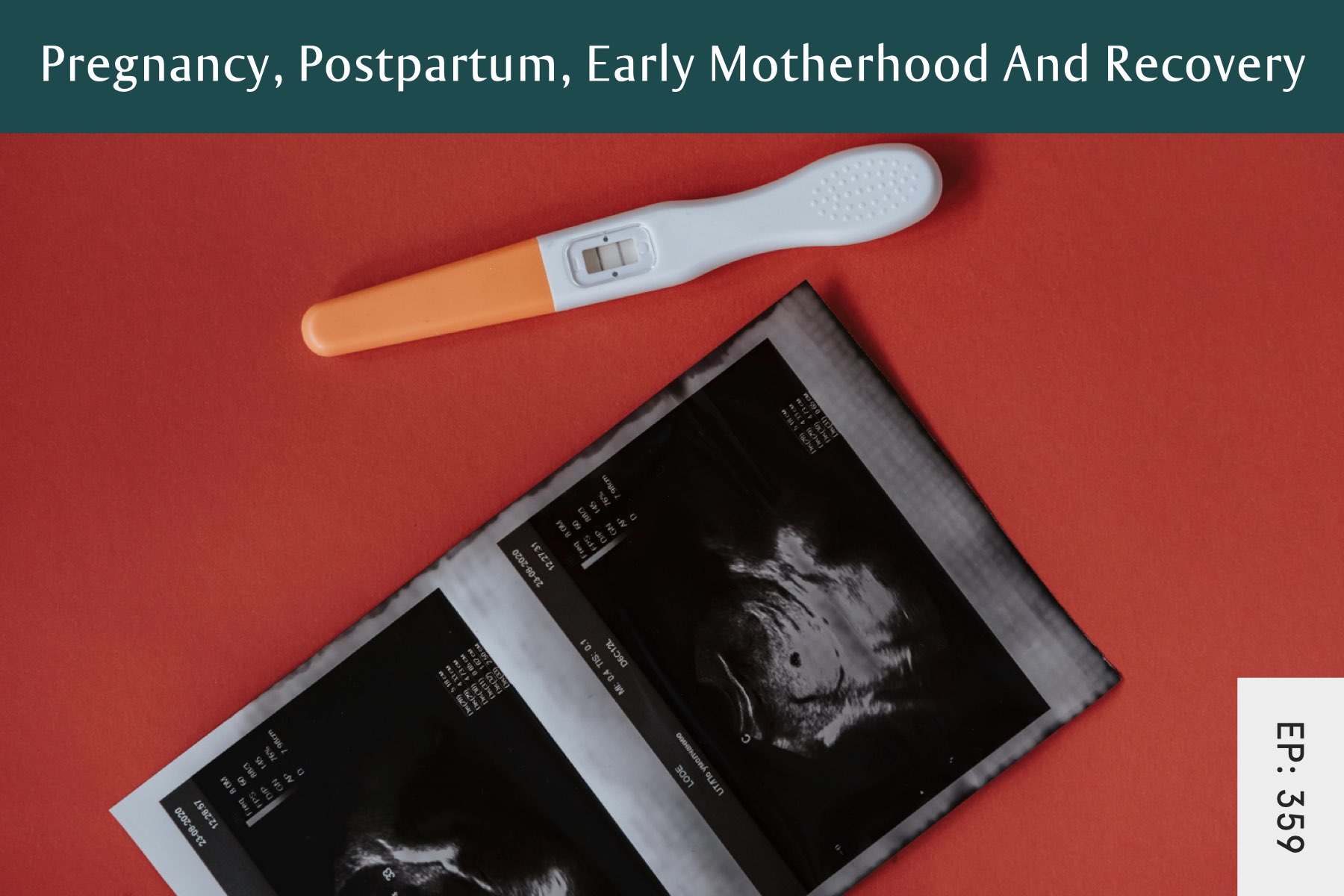
Episode 359: Pregnancy, postpartum, and early motherhood can be uniquely triggering for those with an eating disorder history. This episode explores the physiology, emotional challenges, and practical strategies to support recovery during this demanding time.
00:00:00
00:04:02
00:07:17
00:12:55
00:16:57
00:20:15
00:23:12
00:31:03
00:36:58
00:43:37
00:46:02
00:48:35
00:00:00
Chris Sandel: Hey, everyone! Welcome to another episode of Real Health Radio. I’m your host, Chris Sandel. I’m a nutritionist and a coach and an eating disorder expert, and I help people to fully recover.
So before we get started with today’s episode, I just want to make an announcement that there is something that is happening this month. On the 20th of April, I’m going to be opening up the doors to my group programme again. This was something that I created three years ago, and it’s been running all that time, and in the first year of doing it I opened the doors a number of times.
And then over the last couple years, that hasn’t happened, and the only way that people have continued to come into that group programme is through my one-on-ones. So when I work with someone one-on-one, yes, we do one-on-ones, but there’s also the group programme that they’re then a part of and they do the group calls, etc.
So that’s been the way that people then come into that programme. But on the 20th of April, I’m going to open the doors again so that people can come in as a standalone, as just coming into the group programme. There is only a limited number of new spots. There’s going to be just 20 spots because I want to keep the programme small. I want it to be nice and safe and contained and intimate and that people get the support that they need. So on the 20th of April, I’m going to be opening up spots to that again.
So if you’re interested in finding out more about that, if you’re interested in getting on the waitlist for this, you can send an email to info@seven-health.com and just put ‘group’ in the subject line and I can get the details over to you, or you can send me a message on Instagram. It’s @sevenhealthcompany, and just put ‘group’ in a DM and I can get the details over to you. So if you’re interested in finding out more, just get in contact and I can get that over.
So, on with today’s episode. This one, we’re going to be talking about pregnancy, postpartum, early motherhood, and eating disorders. This is something that I see a lot of in terms of the people I work with. Either I’m working with them and then they do get pregnant, or they come to me after being pregnant and having a relapse during that time, or during early motherhood where things have started to get more challenging again.
I think pregnancy is often framed as this beautiful and exciting period – which it can be. As a parent, I know that it can be some of those, and it’s also a lot of other challenging components connected to this. But for many people with an eating disorder or an eating disorder history, it can be a time that is really destabilising. It can be triggering, it can be confusing. And there are different points at which people enter into pregnancy in terms of where their recovery is. Some people are fully recovered or in a really good spot before they get pregnant, but other people are very much active when their eating disorder is going on and then they get pregnant, or they’re partially along in terms of recovery when this happens, or “It felt like I was in a good spot but actually, now when I reflect, I was probably more in quasi-recovery at that point.”
So what I want to do as part of this is just look at why I think pregnancy can be – not just can be, is – such an ask on the body, but why it can be such a precarious time for someone going through recovery. And I would say this even for someone who has done a lot of work in their recovery. Even someone who’s fully recovered, I still think it can be a challenging time because of the things you’re going to go through as part of this.
So we’re going to look at that and how to best navigate this, and then we’re going to look at postpartum and early motherhood and why, again, this can be such a tricky time either in recovery or even when you are recovered, because of the different demands that are going on at that point.
00:04:02
If I think about pregnancy and why it is such a challenging time, a lot of this comes down to the physical demand that pregnancy requires. And I talk a lot about eating disorders being biopsychosocial, but so much of what turns them on is getting into this lower energy state.
So if we look at something like pregnancy, for an actual pregnancy, you’re looking at somewhere between 50,000 and 80,000 extra calories over the nine months to grow the baby. But not just growing the baby; it’s the placenta, it’s the increased blood volume, it’s the maternal tissues that change, it’s this higher metabolic rate during that period. So that’s a lot of extra calories that are required for the pregnancy to happen.
The thing with the body is that if that’s not coming in, it will then get taken from the mother. This is seen often if you’re not taking enough calcium, the baby will just take it from your bones. This from an evolutionary standpoint makes a lot of sense if we have previously lived in times where there wasn’t always this abundance of food, and sometimes there were harsher times when someone was going through pregnancy, and it’s trying to make it so that that baby’s able to survive.
So there’s this really huge ask on the body from an energy standpoint for pregnancy. But then after pregnancy, if you’re looking at breastfeeding, it’s somewhere around 500 to 700 extra calories a day. So again, depending on how long someone breastfeeds for, that could be for a number of months, it could be for a year, it could be for 18 months, depending on how long someone does this for. And yes, as you’re going longer and longer into that 18-month territory and the toddler is now eating more solids, you’re not going to be needing that extra 500 or 700 calories a day, but there is more of an energy demand because of that breastfeeding that is going on.
So just really understanding how much of an energy demand this is on the body. Because I think sometimes you can rationalise or understand, “Oh okay, this does require energy” but not really understand the full scope of it. So if we’re looking at the tension between a pregnancy versus the eating disorder, the pregnancy is very much about building and growth and expanding and real nourishment, versus an eating disorder is in a lot of ways the opposite of that. It’s about controlling and restricting and shrinking and trying to override the body.
This is why it can be such a challenging point, especially if someone is very much in their active stage of the eating disorder. If they’re not really in recovery or are in the very early stages of recovery where the eating disorder has such a strong hold, there’s this very big tension in those two in terms of what pregnancy is requiring and asking and what the eating disorder is then asking.
00:07:17
What I want to do is go through the different trimesters as part of pregnancy and look at some of the challenges that can then happen at those stages – and just before I do that, looking at what could be a useful thing to be doing prior to getting pregnant.
Again, as I said earlier, there are people who are getting pregnant at all different stages in recovery, but if I was trying to create a really ideal situation – and I know things aren’t always ideal because people are certain ages and there’s a biological clock that is working against them, or sometimes something happens, we didn’t even expect this to happen – and this has happened a number of times with clients, where “I didn’t even know I was ovulating. I hadn’t even had a period and then I got pregnant.” That happens more often than one would expect. So knowing that there isn’t always the ideal situation with this, and if we are creating an ideal situation, these would be some of the things I would really suggest.
One is, from a physical standpoint, having this runway where there has been this real adequate intake that’s been going on, the body is in this stable place. You’ve gone through the nutritional rehabilitation piece. Your body isn’t needing energy for today and everything that has predated today because of the eating disorder; it’s actually done all of that catch-up. So now it’s done the physical repair, it’s done the brain repair, it’s done the rewiring, and the energy that it’s requiring is just for today. So the body is in a much more stable place.
From a psychological standpoint, there is more stability and resilience here as well, so you’re able to tolerate the weight gain. And by tolerate it, it doesn’t mean that you love it and that you’re really jazzed about it happening. It’s just, “I am able to be with this”, and there can be tears or there can be discomfort, but “I’m not going to be altering my behaviour connected to this. I’m going to be giving my body what it needs, and my body’s going to do what my body’s going to do.” In the same way as in recovery, it’s going to be the same way in pregnancy.
I always remember this when we had our son, Ramsay. Ali got pregnant and then her best friend got pregnant two weeks later. So they went through pregnancy at the exact same time, and their bodies changed in totally different ways. Ali put on a lot of weight during that pregnancy, and her friend didn’t put on as much weight during that pregnancy. Ali just ate what she needed and what she wanted to eat; there was no restriction. She doesn’t have a dieting history or anything along those lines. But it was really interesting to see these two people going through pregnancy just having very different experiences in terms of the amount of weight their body gained.
And again, bodies do what bodies are going to do, and that was not down to if Ali had done something different, her body would have gained in a different way. If she restricted, it possibly could’ve. But her body wanted to gain that weight as part of that pregnancy, and that was what her body chose to do.
In terms of the psychological piece, there’s also there just not being any fear around food, or there being very minimal fear around food, or if the fear is there, “Hey, I’m still able to eat these things.” I think this is especially important, as I’ll get on to in a moment, in that first trimester because, man, changes can occur in terms of what someone’s tastes and preferences are during that point, and being able to be flexible with this and be able to say, “All I’m feeling like is mac n’ cheese, and I’m going to allow myself to have mac n’ cheese, or all I’m feeling like is having fish and chips; I’m allowing myself to have that” even if that’s not something you eat that regularly. It’s “Hey, this is what my body is really asking for and craving for, and I’m able to do that.”
From a behavioural standpoint, that you’re in a place where you are doing real consistent eating and that it’s not a struggle to do that. It just feels very natural and normal to be having the three meals and however many snacks you’re needing that day. That there’s flexibility around that. There’s going to be times where “Hey, I do need to eat earlier” or “I do need to push that back a little later; instead of having a meal, snack, meal, I’m able to have meal, snack, snack, meal because I had to have that meal later on.”
I think that becomes important during pregnancy because of different appointments that one may have or because of just not feeling so good and “I’m just trying to get food in wherever I can get it in.” So being able to be more flexible is also really important as part of this.
And look, what I just described in terms of being in a good physical state, being in a good psychological state, being in a good behavioural state – that doesn’t mean that someone is fully recovered. Someone can be in all of those places and still have work to do. But they’re able to go through pregnancy if they then keep doing the things that are required as part of keeping them in a good place and out of getting back into the eating disorder.
00:12:55
If we then break this down by trimester, we can look at the first trimester. During this stage, the theme is “I can’t eat” versus “I need to eat.” I’ve had this very often with clients where this first trimester, there’s a lot of nausea, there’s a lot of food aversions, there’s a lot of fatigue that is going on, so it can be hard to then get food in. Or it can be hard to get food in in the way it’s looked like before you were pregnant, both in terms of the amount that you’re eating in one sitting, the frequency at which you’re eating, or the types of food.
I think what can happen here, or where there can be the eating disorder traps, there can be, one, this unintended undereating because of vomiting or because of nausea or because of morning sickness or daytime sickness that really gets in the way and “I’m not intentionally trying to restrict, but I’m getting into a place of lower energy intake because of this.”
Again, this is why it’s so important to be as far along in recovery as possible, because the further you are long, the more bandwidth you have for this. If you’re already just on the cusp of falling back into a lower energy state, it doesn’t take much to start getting into a bad place. Whereas if you’ve really done the things in terms of recovery, you can have a longer amount of time where “I just didn’t get in quite as much as I needed on that day or that week” before it really starts to have an impact on you.
But yeah, there can be this unintended undereating. And what can start to happen at this point, if the eating disorder is then starting to rear its head, there can be that I’m using that as an excuse to then not eat or I’m disguising my restriction as “I need to do this because otherwise I’m feeling so nauseous.” So it becomes disguised as a necessity when actually, this isn’t what’s really going on. There can be skipping of meals because of this.
There can be more of the playing it safe with food, especially if someone’s getting into that mentality with the eating disorder; there can already be the fear of “I don’t want to gain too much weight as part of my recovery.” And especially if there’s a feeling of I don’t want to eat the vegetables or the salad I was eating before and I’m craving more of these carb meals or I’m craving more of these ‘unhealthy’ foods, there can be this feeling of “Oh my gosh, I can’t start my pregnancy eating all of this unhealthy stuff. What’s going to happen in terms of my weight?” So that can be a really big eating disorder trap as part of this.
Really, what I would say about this first trimester – it’s not about eating perfectly. And this is true whether someone has an eating disorder or doesn’t have an eating disorder. It’s about “How do I get the food in that I really need?” And that can look like I’m eating lots of little things, I’m eating every hour, every two hours; I’m keeping things on my bedside table so as soon as I wake up, I’m having something to eat. It’s figuring out how to do this. “How do I make sure I get that food in?”
And again, depending on where you are in recovery, the necessity of doing that can be much higher or much lower. If you’re in the early stages or you’ve been in a fairly active eating disorder, this is really, really important. “It sucks that I’m having to eat through all of this nausea and feeling as terrible as I am, but it’s actually really, really important that I keep this up.”
00:16:57
Then in terms of the second trimester, this is where there is more visibility of it’s now showing that you’re pregnant. There is more of the weight gain that happens here. There can be then the point of “I’m not having the nausea that I was getting before. I’m not having the sickness I was getting before. I’m actually noticing that that appetite that had been more blunted has now started to really increase again.”
Sometimes there can be a little bit of a rebound effect in terms of “Man, I’m feeling like I’m eating more” or “My appetite here is as big as I can remember” or “Maybe I’ve had extreme hunger at other points in my recovery, but outside of that, this is the point where I feel the most hungry ever.”
There can be the body changes that are now becoming more obvious as part of this as well. So if I’m looking at what are the eating disorder traps or the things that can get in the way here, one – again, as I talked about a moment ago – trying to control the weight gain.
Again, if there’s been maybe a slower amount of weight gain during the first trimester because there’s been more nausea and because there’s been more difficulty getting food in, and then I’m starting to have this real bump in terms of my appetite, and maybe the weight gain goes on a little quicker than it’s been going before this – like, oh my gosh, I start to really get concerned about what’s going to happen, and there can be this feeling of “I just need to eat a little more carefully” and “I’m able to eat all of the things I was eating before again. I’m able to stomach the vegetables or the salad or the things that I couldn’t have before. Maybe I need to be bringing more of that in because I didn’t get to do any of that in the first trimester.”
I think there can also be comparison that is going on as part of this point. It could be looking at other friends who were pregnant. I know when we were going through this, there’s an app online of like “This is what should be happening at this week and this week” or “This is the size of the foetus at this week” and there could be “Let me figure out, what am I meant to be gaining weight at and what speed should that be happening?” and really comparing what’s going on to what should be happening or what’s the average, and that becoming a trap.
So if I’m thinking about the second trimester, this is a point where there should be weight gain. This is a point where your body should be changing as part of this. And for some people, this is often the easier point of pregnancy. Not always the case, but you’re not having all of the nausea and the challenges of the first trimester, and you’re not in the situation that I’m going to talk about now where “My body has become much bigger, I’m getting more aches and pains, I’m having more difficulty sleeping”, etc. So this can be a really nice sweet spot with pregnancy, and if that’s what you’re noticing, really leaning into that and saying “Okay, I want to make the most of this because this is a time that is easier compared to what was happening before and after this.”
00:20:15
Then in terms of the third trimester, if I’m thinking about the theme of this one, it’s a lot more discomfort, especially as you’re getting closer and closer to birth. There can be a loss of control in a lot of ways because “My body now does feel so different to how it felt before. I’m noticing I’m having issues in terms of bladder control. I’m noticing I’m having to wake up every hour to go for a pee.” There can be these kinds of changes. So you’re in a much larger body, there’s a lot more sleep disruptions, there’s a lot more physical strain that is going on.
Again, if I’m looking at this from an eating disorder perspective, yes, there can be a lot more urge to restrict at this point. Again, “I’m trying to curb the weight gain, so I’m trying to do everything I can to restrict so that that doesn’t happen too much.”
There can be a lot more of the body image distress at this point because it can feel physically more uncomfortable. “If I’m physically uncomfortable, I’m starting to become a lot more hyperaware of my body.” There can be more frustration in terms of hunger and digestion because “I’m hungry but I’m also not hungry, and I’m eating but everything’s sitting kind of heavy and not feeling so good.”
So again, there can be this feeling of like “Ugh, maybe it’s just easier if I don’t eat. Maybe I just have more of that herbal tea or whatever it is so that I’m just not going to feel so uncomfortable from eating that meal.”
I would say at this stage, what to remember is discomfort is not meaning that something is wrong. And that’s not to say that if something’s going on to not seek medical advice, but just the fact that “Hey, I’m not sleeping so well or I’m having some more heartburn or I’m having these symptoms going on” – that’s actually pretty common as part of this.
I think in a lot of ways, this is like recovery. For so many people, especially in the early stages of recovery, there can be that fear of “I’m noticing this oedema or I’m getting these aches and pains in my legs in a way that I wasn’t getting it before or I’m having more digestive issues than I was getting before and feeling like I must be doing recovery wrong if this is what’s going on” – and when I’m working with people, I’m always saying, “No, this is actually pretty normal.”
And again, it’s not that there aren’t times where we get things investigated, but actually, this is what happens as part of recovery, and this is the same with pregnancy. It’s not that you’re doing pregnancy wrong or you’re doing the eating wrong as part of pregnancy; it is uncomfortable, and it gets more uncomfortable the closer you get to birth.
00:23:12
The other piece that I just wanted to mention in terms of bigger picture when I think about the difficulties of pregnancy, especially connected to having an eating disorder – one, there’s just this real loss of control in a lot of ways. There can be these rapid changes in one’s body. There can be these changes in terms of the kinds of foods that you can or can’t eat because of where your appetite is or what feels appealing or doesn’t feel appealing.
There can be this feeling of “My life is actually starting to change or is going to be changing in a really big way”, especially if this was something that was more unplanned or has happened earlier than you thought it was going to happen. There can be this feeling of “I’m losing control here.” And considering that for a lot of people, the eating disorder has been doing so much of that and feeling in control has been such a pinnacle of “This is my everything, this is what I’m doing every day because I need to feel that control” – yeah, that’s in a lot of ways the opposite of what happens in pregnancy, or especially what happens in pregnancy if you allow the body to do what it needs to do.
There can be a lot of weight-focused care. There can be weigh-ins, there can be charts, there can be this focus on weight in a way that may not have been happening for a while. I know at least for me, when I’m working with clients, yes, there are some times when we use weights and I’m having them weigh themselves, but the vast majority of times I’m not. We tend to move away from that.
For a lot of people there has been a situation where “I’ve been weighing myself every day or I’ve been weighing myself multiple times a day” or “The number has had this really big impact on my decision-making or the behaviours that I take.” So they’ve really stepped away from that. So to be brought back into an environment where we’re now talking about weight curves or growth curves and what should be happening at different points and having these regular check-ins where your weight is noted down and it’s on the top page of the thing that you get as you’re leaving or is part of your notes can be a lot for people.
There can be this real food unpredictability, which I talked about before in terms of the loss of control, so the nausea or the cravings or just the changes. And for so many people in that situation, just how primal it feels. I think with pregnancy, it can be similar in some ways to extreme hunger, where someone is like “I’ve never felt this kind of extreme hunger and it just feels so different to any other hunger I’ve experienced.” There can be a similar kind of thing with pregnancy where “This used to be my favourite food three weeks ago, and the strongest aversion I can imagine is what I’m now feeling to that thing. Even just the sight of that being on the table, I can’t have that right now.”
That can really be destabilising, especially if someone has been in a situation where they had a pretty limited amount of foods they could eat, and now we just removed 50%, 80%, 90% of those things. That could be really difficult to deal with.
There can be a lot of comparison culture. Other people who are pregnant, seeing different things online, it’s very common when going through this that you’re now starting to follow different pregnancy blogs or pregnancy Instagram accounts or starting to get content connected to all the different aspects of this, whether that be around being a parent or going through the pregnancy journey. It can be very easy to then start to compare.
I think with having an eating disorder, you’re just so much more primed to compare, and especially compare things like body or food intake or weight gain or those kinds of things. I think as humans, we compare. It’s built into us. It’s just what you then do with that information and how much of an impact that has on you, and when you’re living with an eating disorder, that kind of information seems to have a much bigger impact and starts to really get in and have an impact on behaviour.
So being able to notice that those things are coming up and either not acting on them or saying “Hey, I’m going to just stop following that account, because when I see their posts, it just doesn’t sit very well with me and I can notice that there’s this change in my body and there’s these thoughts that are starting to come up.”
And then the final piece connected to this is there’s a real identity shift connected to this. To go from someone who was not going to be a mom to someone who is going to be a mom. And all of the things that that then entails, especially with having an eating disorder, “I’m spending a lot of time doing things of my own accord, and I eat the way that I want to eat, I exercise the way that I want to exercise” – and when I say ‘I’ want to exercise, it’s often the way the eating disorder wants to do it.
But there’s a real level of control that is there, especially if you’ve been seen as ‘the fit one’ or ‘the healthy one’ or ‘the exercising person’ and that’s then starting to change through pregnancy – yeah, that can be a lot to deal with and to navigate through.
Which, again, is why it can be so important with all of these things I’ve just gone through – the further along you are in terms of your recovery, in a lot of ways you’ve dealt with these things more already. You’ve got better with the control piece, you’ve got better with the food unpredictability piece because you’re already able to eat a much wider variety of things. You’ve got past a lot of the comparison piece and you’re not so locked into that in the same way. You’ve already noticed that your identity has shifted through going through recovery.
And then in terms of the weight focus piece, again, maybe you haven’t done the work on that, but you’re actually able to better handle this, and can be better able to handle this because “I feel much more confident to say I’m just going to do blind weigh-ins. I have an eating disorder history and I don’t want to see the number on the scale. I want this to be a blind weigh-in.”
I think for a lot of people, the further they are in recovery, they’re a lot better at being able to do that or gauge if they need to do that, versus earlier on in recovery, it can be difficult to do that and not know the number. But it can also be difficult to be able to verbalise this as “I have an eating disorder, I don’t want to see the number.” There can be a lot of shame and insecurity around doing that.
The next piece I just want to add on connected to this is just the emotional layer. And I’ve already mentioned about some of these in terms of just the grief of losing your known body. There can be a lot of grief around “I should be feeling happy about this and I’m not necessarily feeling happy about this, for a multitude of reasons.” There can be the fear of judgment that’s going on. So I think there’s another emotional layer that gets added on to all of this as you’re going through pregnancy.
00:31:03
If I’m then thinking about what would be most beneficial when going through pregnancy and when navigating having an eating disorder, or even if the eating disorder is in the past, making sure that it doesn’t come back is – and look, none of this should be a surprise; it’s things I’ve already mentioned.
But really making these things a non-negotiable – that you’re going to eat consistently, and if there’s nausea or difficulty with those things, you’re going to find a way, whether that’s “I’m now having more shakes or more smoothies than I was having before” or “I’m having a couple more of these bland foods, but they’re the things I’m actually able to stomach and get in.”
It’s recognising that yeah, your hunger is going to increase. Not for the whole time, but it’s going to increase and “That’s something I need to also be able to allow and to respond to.”
Knowing that weight gain is required and that it is a non-negotiable and that the goal is not “How do I do everything in my power to make sure it’s at the very lowest end of what the curve says it should be, but rather I’m going to do what I need to do, and if I gain a small amount of weight, if I gain a large amount of weight, that’s what my body is doing as part of this.”
Also remembering that rest really matters. I would say this is true at all stages of pregnancy. In the first trimester, in some ways it gets forced upon you because you are just so obviously tired and wiped out from this that for some people, that becomes easier to give into because it’s like “I don’t have the capacity to do anything but do the rest here.” But it’s then still important in the second trimester, and it’s still important in the third trimester.
For a lot of people in recovery, there can be this real difficult relationship with rest, and there can be still so much movement or “Most of the day when I’m working, I still have to stand up” or just doing lots of cleaning and doing lots of low-level movement and all of these things being baked into the day because of the eating disorder.
Really recognising that so much of what is important as part of being able to go through pregnancy and grow the human and have the body use the energy that I talked about – if you’re using more of that energy to do movement, to do exercise, there’s less to be going into the body to be used for the pregnancy. So being really cognizant of the amount of rest that is really required as part of this.
In terms of the practical side of things, as I mentioned a moment ago, doing blind weigh-ins and being able to say “If you absolutely need to know this information, that’s fine. I don’t want to know this information” and really being explicit about this.
And I would go a little further with this and just ask the questions of “When you take this number, where does this number go? Will I then see this if I go into my file?” Because what I’ve had happen for many people is they say “I want to do a blind weigh-in”, the person says “Yeah, we can do that”, so they don’t then find out in that moment, in that session, and then they get sent a letter and it has the number right there.
So I would say if this is something that you feel strongly about – and I think it is something that you should often feel strongly about if you have a real history with seeing the number and it being a really triggering thing – is asking the follow-up questions of “Where will this number be shown? Is there a chance this could end up on a letter that I get sent? Or if I go into the system, is it going to be there?” Just to make sure if that’s the case, “I need that not to happen” or “I need to make sure that that box is not ticked or greyed out” or whatever it may be so that “It’s not that I just didn’t find out in the session, it’s that I didn’t find out for the whole of my pregnancy, because that’s actually what I want to have happen.”
I think it’s important to have a support team. And again, this depends on where someone is in their recovery, where someone is from a financial standpoint. But going through this process, it’s definitely not a time to then drop people. If you are working with a dietitian or you are working with an eating disorder coach or you are working with a therapist or a psychologist or any of those people in terms of having a recovery team, I would definitely continue keeping that up.
Really focusing on behaviours, so keeping up with the behaviours that you need to do as part of your recovery. Not getting sucked in by the numbers. Actually, the behaviours are the things that matter the most.
And really having these emotional regulation tools. This is stuff that I work on a lot with clients as we’re going through recovery and remembering to then use them as you’re going through pregnancy, because these tools aren’t just explicit for recovery. They’re useful for everything in life. I often comment that I’m not going through recovery, but the stuff I go through with clients, I use very regularly myself because I have a son, I’ve got a wife, I run a business. There’s lots of reasons why life can be challenging or I can be having a difficult day or I can have this email that I’ve received or whatever it may be. So having these tools and remembering to then use them.
00:36:58
Then let’s look at postpartum and early motherhood. I’m wanting to mention the early motherhood piece because I think this is where there is still this real extended risk window. I think sometimes there can be this idea of “Oh, I’ve just got to get through pregnancy and then it becomes easier.” And I just don’t think that that is the case at all when I look at the different clients that I’ve worked with and the times that people have reached out and they’re saying, “I had a child six months ago or a year ago or 18 months ago and I’m finding myself back in this not-great place.”
We’re looking at this from a number of different angles. One, there’s the physiological reality. I talked about all the calories we need to grow the human and to go through pregnancy and all the changes in the body; there’s also then the recovery part of pregnancy. It is a really big ask on the body, and in the same way as going through eating disorder recovery, it takes time for the energy to come in so that the body can do all the repair work, it’s the same in terms of after giving birth.
I work with clients all over the world, and there are different things in place in different countries. I was reflecting on this recently; I grew up in Australia and the first 20 years of my life, I was in Australia, and then the next 20 years of my life I’ve been in the UK, and in a lot of ways they have similar-ish systems for pregnancy. If you’re working, you get 6 to 12 months off where that is paid, so that’s kind of the norm in terms of what can happen. And I know depending on circumstances or jobs it won’t always be exactly the same, but there are some pretty good laws in place around that in the UK and in Australia.
If I then compare that to somewhere like the US, a lot of people, 6 weeks is thought of as a really long amount of time in terms of pregnancy and after giving birth. For some people it’s like “Hey, I gave birth a week ago or two weeks ago and I’m back at work.” Just recognising that there’s been a lot of physical changes that have gone on in the body that need to be able to repair, and if you’re now straight back into a work situation two weeks later when you’re now dealing with a toddler and you’re now also dealing with full-time work or even part-time work, that’s a lot to be dealing with, and that can definitely get in the way of one’s ability to do the things that are required as part of that healing, to get in enough energy, to get enough sleep, etc.
The next piece is the sleep deprivation and how much that then has an impact on someone’s physical health, mental health, psychological perceptions of things. That’s a really big demand, and sometimes it is just a matter of “I’ve just got to get through this phase” and also recognising how impaired one becomes when they’re not getting enough sleep or you’re getting very broken sleep.
And depending on the child that someone has, that could be “Hey, it was a really tough three months” and for other people, “We’re up to year 3 and year 4 and I still feel like I’m not getting very good sleep because of the child we have.”
Rhere’s also the breastfeeding that I talked about before and how much of an energy demand that is. There’s also the extra demand if you’re going back to work after two or three weeks and you’re now having to spend time at work trying to pump and all of the things that go into that. There’s a lot physically, there’s a lot psychologically connected to that.
I’m just going through all this so there’s not this idea of “Once the baby’s born, then there isn’t the energy demand, there isn’t the physical demand.” It’s like, no, this thing still goes on for a while, and it does take time for this recovery piece to fully take and for all the healing to be done.
You’ve then got the psychological and identity piece, the overwhelm, the constant responsibility, the reduced capacity to be living your life or to be doing the things that you used to be doing before. And in this high stress, low capacity environment, this is often where the eating disorder can re-emerge. It’s like “Oh God, everything feels so out of control right now. That’s why I need to make sure that I get to go out and do my run” or “That is why I now need to go back to eating in this very rigid way. I’ve tried to get a semblance of control through these things because in so many other parts of my life, it does feel so out of control and so alien to me.”
I think there can be this real pressure to bounce back and talking about losing the baby weight and getting your body back. Again, the eating disorder can really latch onto this as an idea, like “Hey, we should be back in our pre-pregnancy jeans by this date or by this many weeks after giving birth” and there can then be this real increased desire to like “Okay, I’m going to do some things around my food to be able to get there. I’m going to be doing things around my exercise to be able to get there.”
Again, because of the culture we live in, this can often not be raising red flags, but actually be praised. Like “Oh my gosh, you only had a baby six weeks ago? How are you doing this? It’s amazing!” So you get this external validation, you get this praise for actually getting back into a not-great relationship with food and exercise and really going back into the eating disorder.
I know that that can be hard, especially if in the past, this would’ve raised eyebrows or red flags in a not-good way, and yet in this environment, it’s actually turning into praise and people asking you “How did you do it?” type questions.
00:43:37
The next piece connected to this is that often, people don’t just have one child. There can be multiple children, and oftentimes in fairly quick-ish succession. Someone could have a child and then six months later, eight months later, they’re pregnant again and then they’re having a second child. And that is then a huge ask on the body. Again, we’re now having to get in another 50,000 to 80,000 calories again to be able to grow that human and make all those changes as part of pregnancy.
What can often happen for many people is that they finish their first pregnancy really depleted. They’re on the cusp, they’re just hanging on, and maybe in the early stages of postpartum and early motherhood, some of the eating disorder stuff is coming back in a little bit. And then bam, pregnancy happens again. It’s very often that I hear from people, “It was my second child. That was the breaking point. That was where things really started to go awry again. I was barely hanging on with the first, and then the second was where it really started to go awry.”
So yeah, just recognising, whether that’s an intentional thing of like “I’m really trying to have a second child” or “Oops, this has happened and we didn’t know this was going to happen”, coming back to everything I said for the first pregnancy of how important food is and rest is and all of these things are. And if you’re recognising “I’m going into this in an even more depleted state than the first time – what do I need to do to remedy that? Do I need to be bringing in some extra people in terms of my support team? Do I need to be going back to some of the structure I was having previously in my recovery and pulling out some of those meal plans or pulling out that structure that I had and really following it?”
Being intentional about this, recognising “This is putting me in a precarious position, and I need to make sure that I’m doing the things that really do matter and that really keep me out of that bad place.”
00:46:02
The next piece with this is the pressure often to have it all together – the pressure to be able to cope, to be able to function, to be able to manage everything. And especially if someone’s come from a place of “I do everything myself, I never want to ask for help, I need to be able to stand on my own two feet”, I think this is often where the quasi-recovery becomes the norm.
Again, there can be a lot of praise that happens at this point, like “Man, you’ve got the kids and you’re still making it to the gym a couple times a week? That’s just so great” and “Oh, you’re making all of your own food? That’s just wonderful.”
So I think often there can be an ability here to really hide in plain sight and to be putting on the façade of “I’ve got it all together and I’m able to manage all this” when actually it’s just a version of the eating disorder. There’s still a lot of the controlling and the restricting and the under-fuelling; it’s just now viewed in a different way.
And especially if during this point, your body’s not changing quite as much as it used to pre-pregnancy, and actually “I’m getting into a really bad place” and yet, physically at least, it doesn’t match up to what it used to look like – so those red flags aren’t being raised in the way that they were before, and again, you’re getting that praise instead.
Again, just being on the lookout for this. And the reality is – and I’m speaking about this as a parent – none of us have it all together. It is constantly in a lot of ways making it up as you go along, constantly trying to make it through and being like “Oh, it’s been a good week” and then it’s like “And now we’ve had a really tough week” or “It’s been a good month, and now we’re having a more challenging time.”
The more that one can be honest about the realities of what it’s like to be a parent, and especially a parent in this day and age, I think the better. And the more there is this desire to put up a performance of “I’ve got it all together and I’m matching up with the Instagram life that people are putting out online”, the more that can be a trap when you’re going down that road.
00:48:35
In closing with all of this, I have seen pregnancy and motherhood be the thing that truly cements someone’s recovery. There have been clients where them getting pregnant was the thing that – they were in a good place, but it really elevated it. That was the thing where “Hey, I truly can now trust my body. I can truly now have respect for my body, and now I’ve got this small human and I’ve never felt love like this before and this has really shifted my perspective about what’s important in life. I can notice how much I would get into my own stuff before, and now I have this human that reminds me not to do that all the time.”
And again, it’s not that every day or every moment of every day is like that, but for some people, it is the thing that really does shift them and pull them out of that. And I would say that that is not a given, and I’ve also seen that the opposite is true, and that pregnancy or postpartum or early motherhood – these in a lot of ways were someone’s undoing, and “I had it on the tracks for a while and this is where it really did start to come unstuck and I let the restriction come back in and I let the exercise increase and I could notice what I was doing.”
Or sometimes “I couldn’t entice what I was doing. I thought what I was doing was healthy. I thought what I was doing was the right thing, and actually it’s not, and I can now see that, but I can see that from a place of being quite in an eating disorder hole and I’m now trying to get out of it.”
For lots of people, they have got in contact to work with me either while pregnant, just after giving birth, or a couple years after giving birth, or “Hey, I’ve just had my third kid and I’m not in a good spot.” So this is why I wanted to do this episode, because I think, as I said a moment ago, pregnancy can be a wonderful thing and can be this real north star for how someone gets out of an eating disorder or cements their recovery, but because of the changes physiologically, psychologically, your life fundamentally changes, it can also be something that is really difficult.
So, that is it for this episode. As I mentioned at the top, on the 20th of April I’m going to be opening up my group programme. There are limited spots. There are only 20 spots that are available as part of this for this intake. If you’re wanting to find out more information about this, more details, get onto the waitlist, you can send an email to info@seven-health.com or you can message on Instagram @sevenhealthcompany. Just send a DM and I can send over the details.
So that is it for this week. I’ll be back next week with another episode. Until then, take care, and I will see you soon!
Thanks so much for joining this week. Have some feedback you’d like to share? Leave a note in the comment section below!
If you enjoyed this episode, please share it using the social media buttons you see on this page.
Also, please leave an honest review for The Real Health Radio Podcast on Apple Podcasts! Ratings and reviews are extremely helpful and greatly appreciated! They do matter in the rankings of the show, and we read each and every one of them.

Policies
Social
Copyright © 2009 – 2025
seven-health.com · All Rights Reserved.


Share
Facebook
Twitter