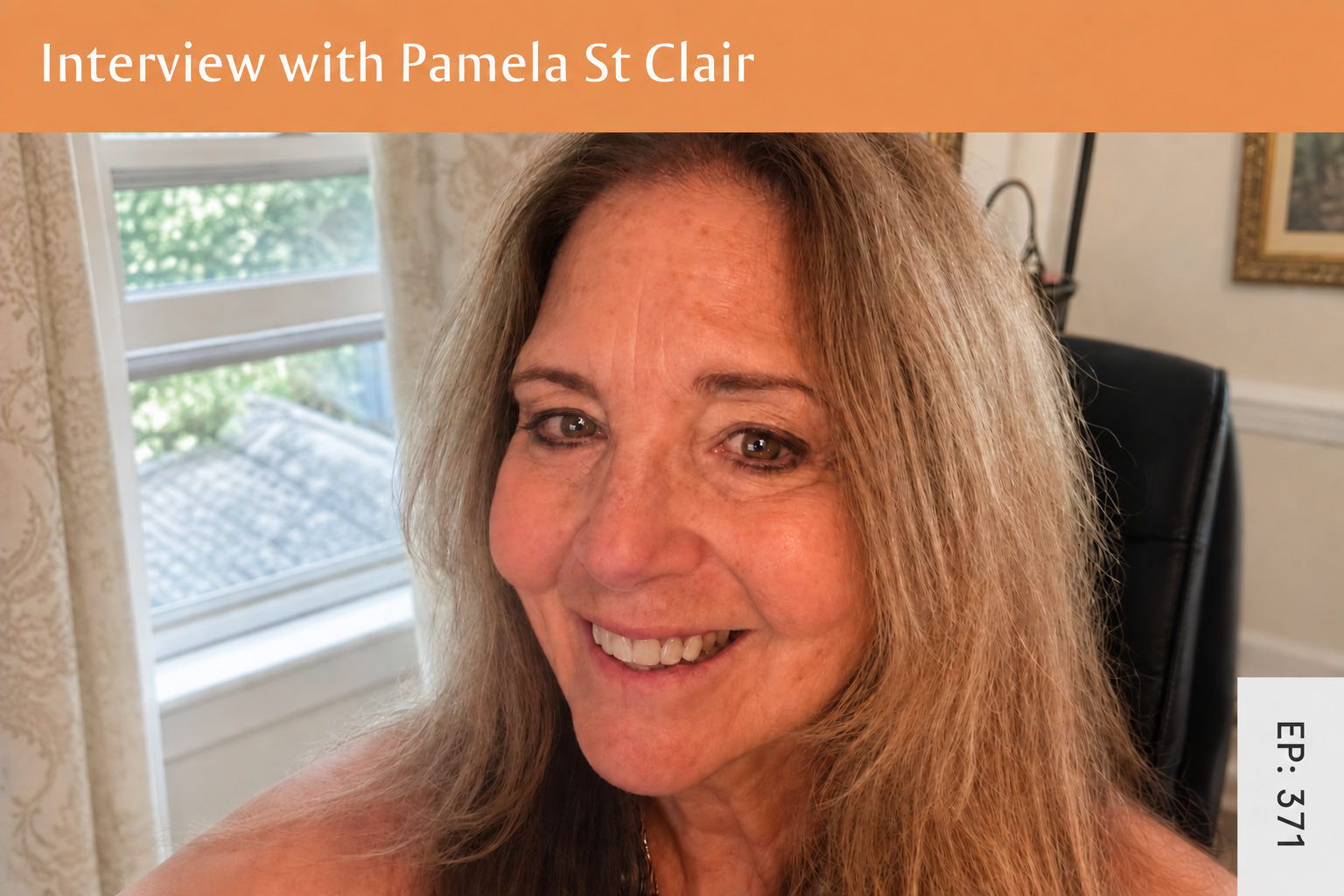
Episode 371: Pamela St Clair shares how she achieved full recovery after living with an eating disorder for decades. We explore what finally helped her recover, why it is never too late and how her experience led her to become an eating disorder recovery coach.
Pamela St. Clair is a certified eating disorder recovery coach who found freedom from her own eating disorder later in life.
Her personal experience shapes the way she works, bringing care, compassion and an understanding of how lonely and challenging recovery can feel in a world where disordered eating is often normalised.
Pamela is now an eating disorder recovery coach at Seven Health, where she supports clients through their recovery. She has spent the past year working closely with Chris Sandel and becoming deeply familiar with the Seven Health approach.
Pamela completed her Eating Disorder Recovery Coach Certification through the Carolyn Costin Institute. She also holds an MFA in poetry, an MA in literature and a BA in mathematics.
00:00:00
00:08:15
00:15:35
00:22:57
00:27:46
00:33:23
00:38:22
00:41:36
00:44:42
00:50:44
00:56:45
01:00:17
01:07:29
01:17:10
01:22:49
01:27:15
01:37:13
01:46:20
01:52:26
00:00:00
Chris Sandel: Hey, everyone! Welcome to Episode 371 of Real Health Radio. I’m your host, Chris Sandel. I’m a nutritionist and a coach and an eating disorder expert, and I help people to fully recover.
So today’s episode has been a long time in the making, and it is both a guest interview and an announcement. About a year ago, I was looking to bring someone into Seven Health to help provide additional support in the group programme that I run. I reached out to a colleague and I explained what I was after and said did they have any suggestions for me, and she suggested Pamela St Clair.
The two of them had been working together and moderating an eating disorder support group, and she felt that Pamela could really help and could fit the bill of what I was after. So I had a chat with Pamela, and I could see why the colleague had recommended her. So she started working with me.
Initially why I brought her in was to help in terms of the community area and dealing with the messages. I don’t work over the weekend, and I want to have the group supported 7 days a week, so I wanted to have someone who was able to deal with the messages over the weekend and also help out sometimes during the week. I also wanted to have someone who was on the group calls, someone who could share their lived experience with an eating disorder, but also could share their experience in terms of coaching people, in terms of recovery. Pamela is someone who has had an eating disorder – or had an eating disorder, I should say – for multiple decades and has now made a full recovery.
What became quickly apparent was just how helpful Pamela was. She really understands eating disorders, she understands recovery, she’s very compassionate and thoughtful in her way of supporting people, as well as understanding the realities of what it is like to recover. She knows how lonely it can be; she knows how challenging it can feel. Especially in the world that we’re living in, while everyone else is seemingly doing disordered stuff, to then recover in that environment is a challenge. So on both the group calls and being able to see her responses to people in the group, it was just so apparent that she was a really good coach and she really got recovery.
A little bit of background on Pamela: she is a Certified Eating Disorder Recovery Coach and completed her certification through The Carolyn Costin Institute. She’s also had her own experience of finding freedom from an eating disorder, and as I said, this had been something that had gone on for multiple decades, and she found recovery later in life – which I know will resonate with many people.
Once I saw how valuable Pamela was in the group, I started thinking about maybe she could be seeing clients through Seven Health. Over the last year, I’ve really been at maximum capacity with clients. I’m in a situation where it’s really when one client stops or finishes work together I’m able to start with another client. And I’ve had periods where for many months, I couldn’t take people on, and I was building up a waitlist because I was at capacity. For quite a while, I’ve been thinking about it would be useful to have someone who I trust, who I know is a good coach, who can help people, to come and work for Seven Health.
Despite me seeing how good Pamela was and having this feeling of “this could really work”, I also didn’t want to rush into the decision. I wanted there to be this continuity where it wasn’t that you’re just seeing someone that I think is a good coach, but if someone is coming to Seven Health and is reaching out to us to get support, there is some continuity, whether it’s working with me, whether it’s working with Pamela, whether it’s working with some other coach in the future – doesn’t matter who you’re working with, there is some sameness to that. We all bring our own unique stuff, but I wanted there to be an understanding of “This is how I do recovery and this is what I’ve built into Seven Health, and the things that I’ve learnt over this 15+ years that I’ve been doing this” that Pamela could also benefit from that.
So over the past year, Pamela has been learning all of the things. She went through the entire Fundamentals of Full Recovery Programme that I’ve created, so she understands exactly what I teach and what I cover and how I approach recovery. She’s been on every coaching call since she joined, so nearly a call every week for the past year, or just shy of a year. I’ve also been mentoring her throughout that time. And not just from a coaching perspective, but from a practical standpoint, and just making sure she understands the way that Seven Health works, the values that we have. This really hasn’t been a tough sell; she’s been onboard with all this stuff from the very beginning.
So the announcement that I wanted to share is that Pamela is now going to be seeing clients through Seven Health. This is something that, as I said a moment ago, we’ve built very carefully towards over this past year, so I feel genuinely confident and really excited about the fact that she’s going to be doing this, and I’m now able to offer this.
This coaching will also be part of the group programme, so it’s not just getting one-on-one coaching with Pamela; it’s then also being part of the group component, so you’re doing the group calls that I run, the meal support calls, the community area, the Fundamentals of Full Recovery Programme – everything that’s included as part of that with Pamela also doing the coaching.
It therefore makes sense, given this, to have Pamela come on the show so that you can hear directly from here, where she can share about her own story in terms of her eating disorder and recovery, her thoughts on recovery and the approaches she takes with clients and how she would do things differently in her own recovery now with hindsight and the benefit of that knowledge. Just to give you a sense of what it could be like to work with Pamela.
If you listen to this and think “Hey, this is someone who I would like to work with” or you simply just want to find out more about what could be included and what that looks like, then you can reach out. You can send an email to info@seven-health.com or you can reach out through Instagram. It’s @sevenhealthcompany, and just put ‘Pamela’ either in the DM or put it in the email subject line or put it in the email text. Whatever it is, just say ‘Pamela’ and ‘I want to find out more about that’ and I can send over the details.
I’ve also put a link in the show notes to a page that has all the details. If you just go www.seven-health.com/371, that’ll take you to the show notes, and you can find that link there.
So let’s get on with it. Here is my conversation with Pamela St Clair.
Hey, Pamela. Welcome to the show.
Pamela St Clair: Hi, Chris. Thanks so much for having me. I’m nervous, but I’m excited to be here.
Chris Sandel: I was reflecting on this before we hit record; I’ve been seeing you as part of our group for nearly a year, so you’ve been on a call pretty much once a week for nearly a year. So I have a bit of an understanding about you. I obviously understand you as a coach, I’ve got some understanding of your background in terms of your training and also you having an eating disorder. But I’m also excited because I know that there’s loads of stuff that I don’t know about you. So this is my chance to ask some questions and find out more, and I know that will be also helpful for the listeners as well.
Pamela St Clair: Well, I hope you’re still excited after hearing my answers. [laughs] But thank you. Because I sort of have an unfair advantage; I’ve known about you and your work for years, so I feel like I know more about you than you’ve had the opportunity to know about me.
Chris Sandel: Cool, we can right the wrongs on that, or turn the tables or whatever the correct expression is, with that today.
00:08:15
So we’re going to talk about your eating disorder and your recovery, but I would love to find out about your eating before all this started. What was your eating like in childhood, or what was your relationship with food like as a child or a teen before the eating disorder started?
Pamela St Clair: Before the eating disorder, I had a pretty healthy attitude and a healthy love of food. It would be a joke – sometimes we’d be out for dinner and – bless my mom, but she wasn’t a good cook, so when we went out to dinner it was extra exciting. My parents would – not make fun of me, not in a way that I still carry with me, but it was just an understanding that “Oh, look, Pamela enjoys her food”, because I’d finish my dinner, I’d finish whatever was left on my brother’s plate.
I just remember having freedom and enjoying food. It was never an issue whatsoever. If anything, I was – until a certain age, until about 12 or 13. And I grew up, my mom made sure we had three meals a day, and I didn’t clue in to anything. There was some dysfunction in my family around eating, but that wasn’t on my radar I don’t think until probably my teen years.
But yeah, I just loved food and looked forward to eating. It was hard to understand when the eating disorder started; I couldn’t understand what flipped the switch. “Why is this all so hard right now?”
Chris Sandel: I’ll definitely want to talk about that, but just before, what was your parents’ relationship with food or your sibling’s relationship with food? You said there was some dysfunction there, so tell me more.
Pamela St Clair: My mom is someone – I don’t think she ever had an eating disorder in that she was consumed by those thoughts, like ‘bad food’, ‘good food’, ‘have to eat’, but she was always consumed with remaining slim. It was when I was older that I realised “Mom never eats breakfast or lunch with us.” That was just what she did. We all as a family sat down for dinner, but it was rare that we sat down, even on the weekends, for breakfast or lunch.
I carried that with me forward throughout – I could see the seeds when my eating disorder happened. And then as I was older and looking back, I could see who it influenced my dad, too, because he would start not eating and that was just what you do until dinnertime, and there were various comments here and there.
Like my father saying to me once – I was probably 9 or 10 – “Are you sure you want a second scoop of ice cream? Because boys don’t like girls who are heavy.” And at the time, I remember thinking, “What the hell do I care? I don’t even like boys. Can I please have another scoop of ice cream?” But clearly that stuck. It never left. It didn’t make an impression at the moment, or I didn’t realise it did.
So there were little comments like that. There were always – not always, but there were comments on occasion about people in bigger bodies. My dad’s family and my mom’s family have two different frames. My dad’s side is just bigger boned, bigger bodies. My mom’s side is taller and slimmer. And I understood from an early age – can’t remember a specific incident – that it was better to look like Mom’s side of the family than Dad’s side. Because there was a lot of negative comments, not about the people themselves or to their faces, but there was always diet culture comments about bodies, and it was clear from early on that to look like Mom’s side was preferable than to look like my dad’s side.
And I came out of the womb all Dad, very little Mom, and my brother came out mostly Mom, very little Dad. So as I was getting older and getting influenced by diet culture and getting caught up in it, a lot of unhappiness around “Why can my brother do this and eat this and look this way? What’s wrong with me? How come that’s not working for me?” But the messaging was there early on.
Chris Sandel: Sure. Was there, your parents were okay with your brother having more of this thing, but you’re getting questioned about “Do you really need that? Are you sure?”
Pamela St Clair: I have that ice cream incident. For the most part, daily, I don’t remember any shame about the amount I was eating. I do remember two incidents, one when I first said I was going on a diet, and that was encouraged. They didn’t say “Oh my God, what are you talking about?”
And the second incident I remember is that at one point when I first started dieting and had lost some weight – around the worst time, right around puberty, when you should be allowing your child to let their body do their thing – there was some local fashion show my mom was in, and she enticed me to be in it one year. And then the next year, the pendulum swung for me. I can go into that about my history with my eating disorder, but my body would take restriction for so long and then it was like “Oh, no, we’re not doing this anymore.”
So there was a lot of weight fluctuation during my young years, too, and I remember my mom shaming me in front of family I hadn’t seen in a while, at the dinner table, saying, “Pamela won’t be in the fashion show this year because she’s gained so much weight.”
Chris Sandel: Gosh.
Pamela St Clair: Looking back, I see it as projection and the attitude that shame is going to ‘help’ make a difference. So for the most part, it wasn’t that I felt shame during dinner, but I think I was picking up on the cues, like “We shouldn’t eat so much”, even if they were talking about themselves. Like “I’m so full, I shouldn’t eat that.”
And then just not understanding why the world was different for someone in my brother’s body. Like, how did he get to do all this and look like that side of the family and I couldn’t? Not having the understanding or the language. Even something that makes so much sense, like body diversity is a thing – yeah, intellectually that makes sense, but when you’re all caught up in it, you’re like, “No, I can just do this, this, and this and I’ll look like this person this week, and next week when I want to look like that person, maybe if I change my eating I’ll look like that person.”
Chris Sandel: Yeah, you’re sold this idea that you have ultimate control, and if you want to look this way, it’s just a matter of doing this exercise or this eating, and that’s just not the reality of things.
Pamela St Clair: Yeah, and then the stuff starts getting praised. “Oh, you’re running. That’s good for your health. Oh, you’re” – whatever diet I was on that was bring praised. That gap where you start to fall through the cracks and people don’t realise that you’re suffering in ways that might not be visible on the surface. Or not right away.
00:15:35
Chris Sandel: Sure. Tell me then about how the eating disorder started and what was going on in your life at that point.
Pamela St Clair: I don’t remember a specific trigger, like “Oh, I have to lose weight.” It was puberty, 13, and just not understanding why one year at school was so easy – friends were easy, social life was easy – and all of a sudden the next year you come back to school, it was like 7th grade or something, and things shifted.
People were becoming more their adult selves, so there was that natural change in you as you’re getting to be that age, but then there was also a lot – that’s when I started becoming more aware of the two genders. Back then I would say the two genders. I wouldn’t say that today. But the two genders seeing themselves as reflected in the other person’s eyes and being aware that there’s some kind of worth or understanding that your worth depends on following the trend or what you look like in someone’s eyes, and that just seemed to shift everything.
Even the dynamics between me and my friends. Because now, where it was just having fun and doing things together, it was presenting yourself a certain way because you have a crush on this person. I just had no way to make sense of that, and I think I looked at – superficially it looked like – now I know it probably wasn’t, but it looked like, for those people who looked a certain way, life was easier. And “Maybe that’s what I need to do to make my life easy.”
Because behind the scenes at home, there was a lot going on. I come from a family that struggles with alcohol, so there was that. There was the shifting dynamic at home that I didn’t understand. It just felt like everywhere at home and at school, the sand was shifting and I couldn’t find my footing, and for whatever reason that’s what I latched onto.
Nobody seemed to think it was a problem. I remember in 8th grade a teacher making fun of me for my lunch, because I think for lunch I had brought two pears or something, and she was like, “Ap-pear-ently, you think…” whatever, she finished the sentence, “need to lose weight or be on a diet.” But it was a joke. It wasn’t anybody saying, “Oh my God, here’s a 14-year-old. This is not adequate nutrition.” But there wasn’t that awareness.
Chris Sandel: How quickly did it turn from regular dieting – and I’m not saying regular dieting is okay, but in terms of this going from something that feels a little harmless or actually feels like it’s a really helpful thing for me to be doing from a status perspective or trying to fit in with my peer group to you recognising, “Oh, there’s a problem here” or “This is not going the way I thought it would”?
Pamela St Clair: Recognising that it was a problem took a while. I didn’t think it was a problem when I was restricting, and I think part of the reason for my restricting, too – like I said, that social thing, I was feeling awkward socially. So the fact that the eating disorder was isolating me, I didn’t recognise. I just thought I was isolating because I couldn’t be social anymore, I didn’t know how to be social, I didn’t know how to fit in. So that wasn’t a red flag right away. I was just like, “It makes me feel better. If I can’t be social and have friends, at least I can have this.”
Chris Sandel: And also, you’re a teenager. It makes sense to feel socially awkward at that stage, to try and be finding your identity and your likes and all of those things. So that might not necessarily raise red flags with others or with you because they could be like, “Yeah, teenage years are tough.”
Pamela St Clair: Yeah, and I didn’t know what questions to ask or how to even say this to my – it just seemed like that’s what it was. I didn’t have the wherewithal to ask a question or to say “I’m feeling really awkward, I don’t understand.” For some reason I had a lot of shame. Like “I just don’t understand why I can’t be friends again.”
So I didn’t think it was a problem until my body responded by going “You can’t do this anymore.” Now I have the language for it: I would get hit with extreme hunger and I just couldn’t stop. It morphed into the binge-restrict cycle, with a lot of binging. And then I felt like, “Oh God, something’s wrong. Something has to change”, but in that classic eating disorder way of thinking. I was like, “The binging is wrong. That’s the problem.”
And then I would cycle through and I would go into some years of severe restriction – still not recognising it was a problem. I think as I was becoming more independent in college and was making more friends, I still felt a little bit like an outsider, like developing friendships wasn’t organic. And now looking back I’m like, well, how could it have been? You were so consumed in your eating disorder.
Then in my early twenties, when I was in the workforce and feeling more isolated because I was in a town I didn’t know anybody and starting over, it had gone to bulimia. Severe bulimia, like everyday behaviours. I didn’t know how to stop, I didn’t know what was wrong, and I would get into a relationship – not always the best relationship, but there was part of me that knew I couldn’t be alone. Because every time I’m alone, this is what happens. There was no time when it didn’t happen. I didn’t know how to ask for help.
So sometimes I would get into relationships that weren’t the best. I can see my friends rolling their eyes at ‘not the best’. [laughs] But I had glimmers of what it was like not to be engaging in behaviours. It wasn’t always my choice because there was somebody else around, but it also gave me the opportunity to expand my world a little bit because you’re with someone, your social life expands a little bit, and you’re like, “Oh, I can do this. Life is so much more freeing without this.”
And again, it wasn’t linear. Relationship would fall apart, the episodes would come back in. But there was a part of me somewhere that I’m so grateful for that knew, as much as I wanted to be alone, that I couldn’t be. And that was really hard for me to reconcile, because I have a very strong independent streak and I had this vision of me starting off my life and being independent and living by myself and having a job and making friends – and that independence was, at that point, not working in my favour.
00:22:57
Chris Sandel: I think it’s useful that you’re sharing all of this because I think what you’re demonstrating – and I see this in lots of clients, and I imagine you have as well – when eating disorders go on for a long time, or even over a fairly short amount of time, they can morph. What can initially start out as restriction can then turn into binging, and then restriction can turn into bulimia, it can then have periods where it’s much more orthorexia.
In a lot of ways, eating disorders are all the same. They just can present a little differently, but at the heart of it, there is still the restriction that is going on across all of those different times. There’s still the eating disorder being this thing that is giving you this sense of safety or this false sense of safety or this thing that you’re depending on as a regulation tool, but it can just look different depending on whether the bulimia is happening or whether the heavy restriction is happening.
And I’m saying this because I think it can feel like, as you alluded to, “Oh, when the restriction was going on everything was normal. I had everything on the rails at that point. It’s only when these other things start to happen, that’s when either the eating disorder started or that’s when it’s a problem. I want to get back to that place where I could restrict as freely as I wanted to. That’s the good place, or that’s the place I need to return to” as opposed to recognising that’s the thing that is driving this whole thing.
Pamela St Clair: Yeah. And part of me knew. Like, “Of course you’re really hungry; you haven’t eaten.” But then there was the other part that was like, “But before you could not eat, so what’s wrong?” Underneath it, the root, I think eating disorders present in different ways, but at the end of the day, there’s something in common. There’s something driving it, and there’s restriction for the most part involved.
And I think they morph within. Like my phases with anorexia looked different from one another, too. Like you said, one time it would be more orthorexic and I was only eating certain foods and I would let myself eat a lot, but only if it was a safe food. And then later in life – and I think this was what helped me to continue the fantasy that there was nothing wrong with me – I would eat anything. I had no fear food whatsoever. But I would only eat a little bit of it.
So I could convince myself, “When I was young, I couldn’t eat this. I can eat anything.” But I was still aware of, what seemed like at the time, what the ‘consequences’ would be. And even the bulimia, for me, I kind of stopped cold turkey when I was 34. I was about to get married, and before I started recovery, I would’ve said that I recovered from bulimia when I was 34. But I didn’t. I just learned how to help myself feel safe enough that those urges would not come up.
It wasn’t until I was through recovery I was like, “Oh, yeah, I stopped the behaviours, but it’s not like I recovered. I just knew the structure to put in place to keep me from engaging in behaviours.”
Chris Sandel: Yeah, that behaviour got taken off the menu, but there were these other behaviours.
Pamela St Clair: There was, yeah. So I recognise that I had extreme hunger when I was younger and the anorexia was evolving into bulimia. I forgot where I was going with this, but like I said, when I was older, I didn’t have that extreme hunger. And I wonder if it was because, one, I’d already put on some weight so my body was already nutritionally rehabilitating – against my will, but it was doing it. It was trying to keep me alive. And two, I wonder if – like I didn’t allow myself a lot of foods, but my body was still used to getting certain flavours and textures, so that wasn’t something as novel when I was going into my recovery.
I share that because I think some people – even I thought at first, “If I don’t have extreme hunger, that must mean I’m really not sick enough, right?” But no, you are. Not everybody does experience extreme hunger. If someone would talk about extreme hunger, it made me nervous, too. I was like, “Well, I’m not really that sick, so I don’t really have to do recovery the way I know in my heart it should be done. I can do it halfway.”
00:27:46
Chris Sandel: One of the things I’m thinking when I’m hearing this is this is going on for multiple decades. At what point are you starting to either search out eating disorder recovery content or to think, “Okay, I do have an eating disorder”? Are there times where you’re going into inpatient or you’re working with an outpatient or a dietitian? Are any of those things going on throughout this time?
Pamela St Clair: None of that was going on until I was in my late forties, because I’d have relative periods of stability, so it didn’t even cross my mind that I needed help. When the behaviours weren’t as consistent but they were intermittent, I guess I just figured, “Well, this happens sometimes and I hope it doesn’t happen a lot.” I didn’t even recognise that I could get help, I guess.
And there was a lot of secrecy, too. I didn’t talk about it. It didn’t share it with anybody. I think when I was younger, my mother had some hints; she would hear behaviours and things. But she didn’t know what to do. She didn’t know how to find help. She got a diagnosis for me, but then my parents were like, “What do we do?” That was it. “We know what’s wrong, but we just hope it gets better.”
So it wasn’t until I was in my late forties, and I realised that it’s probably not normal to be going out to dinner and spending so much time figuring out how to make it look like I’m eating normally when I’m really not. It’s probably not normal to be eating dinner with my husband and picking certain things apart. I was like, “Hm…” There was still some hesitancy because what I was doing – the eating disorder was still giving me something and I didn’t want to let it go. But I was getting this inkling that “This just doesn’t seem like something that I really want to be continuing to do”, on one level.
So I did research on my own. I think it was around 2017, so I started to find you. Somehow Carolyn Costin came across my feed and I got her book. I thought, “This is great. I’ll just do a self-help book. Nobody needs to know. I’ll just do it on my own.” I read through it, didn’t do any of the exercises. I was like “Skim over those parts, get the content.” So I did. I tried to implement changes, but it lasted like two months, maybe. And I never got to a place where I was actually challenging myself.
But I did get to a place where I was recognising that you can eat lunch. I had absorbed that – as an adult, I did everything in my power to only eat toward the end of the day. So there were some seeds planted.
And then it was four years later – my role was changing as a daughter; I was 50 now. I think the seeds were planted and I was realising I didn’t have a big why aside from “I don’t want to be thinking about this anymore. I don’t want these thoughts to be consuming me. I don’t want to be afraid going into the summer thinking my body’s changed.” All of that. I just felt like “I’m done. I just don’t want to do this anymore.”
I didn’t have any big milestones, which would trip me up for a bit. I’m like, “Oh, but you’re 50, all your major milestones are behind you. Why bother?” I don’t know, there was a stubborn streak in me; when I was thinking about this for the podcast, I think part of me knew that it’s not just the milestones that make your life. Sometimes it’s just the everyday moments, right? Like someone saying to you, “Don’t have that scoop of chocolate” – that might not be a great example, but it’s something that stayed with you. It’s the everyday moments. Or laughing with a friend so hard.
I wouldn’t have been able to put it into words, but part of me understood that. “That’s okay that you don’t have the milestones. You still have life left, and you still want something different.” But it took a while. I say that as if I just sat down one day and thought this, but the thought would crop up, get in the way, I’d make some changes.
Then one of the biggest things that helped me in recovery – and I don’t remember where I heard it – is that it’s not your body that needs to change or that there’s anything wrong with that; it’s your thoughts and beliefs. That was such a relief. I was like, “Oh my God, you mean I don’t have to worry about my body? I don’t have to put all this effort into manipulating and controlling it? I can just change my thoughts?” I felt like I won the bingo card. I was like, “How come nobody else knows about this?” I wanted to tell everybody, like, “Guess what? It’s not about your body. Just change your thoughts!” But that was a significant turning point for me.
Chris Sandel: As I’m hearing this, this can also sound like a bypass trick of the eating disorder. Like “Don’t worry, you don’t have to change your eating. Just start to think differently.”
Pamela St Clair: Yeah, you still have to take action. But it was just a relief to know that I could look at my body, I could come to my body from a place of care and not punishment. That just felt like a breath of fresh air. I was like, “Oh, how novel. Who knew?”
00:33:23
Chris Sandel: So what were some of the behaviours or some of the changes that made the biggest difference in your recovery? And I know we’re constraining a very long amount of time into a few characteristics. I always want to be careful when people are listening to this; there was going to be so many ups and downs and challenges and everything that Pamela is going to brush over because of the limited time we have in a podcast. But what are some of the things that stand out for “This feels like it really made a difference to me”?
Pamela St Clair: Challenging the food, the amount of food, what I was eating. It was a little rocky at the start because when I started recovery, my boyfriend decided he was going on the keto diet. So I thought, “Oh, perfect way to do recovery, because everything I hear about keto, it helps you lose weight or maintain weight, but you can also eat a lot.”
But that opened the door to eating more, but that didn’t last too long because I was gaining weight because I was eating more, and my boyfriend was losing weight. Then there’s that comparison and all that fear.
It was like a month into it, and I just sat down one day with myself and I’m like, “Pamela, you’re trying a hack. You’re trying to find a shortcut here. You’re trying to heal your relationship with food, but you’re only allowing yourself still this kind of food, this kind of food, this kind of food.” So what I did was I immersed myself in recovery content – and by recovery content, it felt like getting a PhD, like reading the books, going online, finding you, and just getting reassurance that this is really what it takes. And you can do a shortcut, you’re not going to get to recovery.
I didn’t work with anyone at that phase, so I was kind of doing it on my own, like I started with eating something for breakfast, eating something for lunch, and then I built from there, and increasing portions, slowly. So it was taking action and introducing more food, even though I didn’t like it. But I kept coming back to, “It’s your thoughts, it’s not this. Your body’s healing.” So it was taking action, eating more.
It was reaching out and sharing with people. I found a support group online, and that was immeasurably helpful because you could see your own experience mirrored in others’. Some people were further along, and you could learn from them and get reassurance.
So eating more, reaching out and asking for help, and protecting myself. I learned quickly on who not to reach out to help for. I didn’t reach out to my boyfriend. It’s not that he didn’t want to help, but it wasn’t in his capacity to help or understand at the moment. I protected myself from my mother, because I knew she would want to be helpful but she wasn’t going to be.
Probably the most helpful thing she said to me was when I told her what I was doing and that I would be gaining weight – it was kind of like a defensive move – she said to me, “Oh, you’re not gonna like that.” And I remember thinking, one, I wonder why? I wonder where I got that message? And two, it was one of those moments where I’m like, yeah, you’re right – but I don’t have a choice. Either I do or I don’t. And I didn’t have this then – I have it now as a coach; it wasn’t the understanding that it’s – what you’re learning is not to love your body in the moment, but to surrender and just accept it’s going to do its thing, and develop trust that you will be able to accept it and cope with it and care with it, but that trust takes time.
It’s not that I have to like my body, but I can learn to trust myself to take care of it regardless. And I think another component to that was learning about diet culture. That was a big recovery milestone for me. Like, “Oh, it’s not just me. I’m part of this bigger system. This messaging is all around me.” And seeing where that messaging is coming from.
And then, how dare culture or my parents or anybody tell me that if I take care of myself and my body looks a certain way, that there’s something wrong with me? That was very powerful and helpful for me.
So taking the action, eating more food, reaching out, accepting help, learning where not to get help, and learning about diet culture and the bigger system at play and how we’re all caught up in it – not just those of us that go on to develop eating disorders.
00:38:22
Chris Sandel: I also wonder in terms of your age – in terms of the stereotype of eating disorders, this is something that happens in your teens, in your early twenties, and you ‘grow out of it’. So obviously you’re in your late forties or early fifties with going through this; with the support group that you found, was there a mix of ages that are there? Because I know from doing this work that the vast majority of people I’m working with – I work with a whole range of ages, but it’s mostly people who are in their thirties and forties who are dealing with this. It’s not mostly people who are 18 and 20 and at that age demographic. But I’m just wondering about the group that you found. Was there a mix of ages or did you feel like the only old person doing this?
Pamela St Clair: At first I felt like the only old person because I found the group through someone who was younger and was attracting younger people to her platform. I don’t want to name her because I wouldn’t recommend her these days. So at first I was just quiet and lurking and just listening, because I had a lot of fear of like “Obviously it has to be different for my age. I’m sure my metabolism is different. Of course the requirements are going to be different” – blah, blah, everything the eating disorder was saying.
I can’t remember why, but eventually there was someone I realised who was closer to my age and she was becoming more active, and I’m like, “Oh my God, I’m not alone.” So it was more of a younger group, but it was the first time I met people in my age demographic, which helped me relax. Sometimes I would benefit from their treatment team, because they might be working with a coach or a therapist and they’d say, “My coach said this, this, or this, and this is what I’m doing” and I was like, “Oh okay, maybe that’s something I can try, even though I’m 50 and not 20.”
So it was the first time I was meeting people my age, but I did have a lot of shame around that, because there is this misconception that it’s something you just snap out of or that you don’t care – if your appearance is a driver, that you get to a certain age and all of a sudden you don’t care. But your insecurities don’t go away just because you’re 50 or 60 or 40 or 30.
Chris Sandel: Exactly, because there are a lot of people who are in their sixties who don’t care, but it’s not a given. And there are a lot of people in that age group who really do care and have cared for a very, very long time. I think the getting to the not-caring was “It was always there; that wasn’t a thing that I worried about” or “I had to work on it, and I had to work on the things that were connected to that in terms of my self-worth or in terms of my people-pleasing” or in terms of whatever it is that has made this thing more important.
Pamela St Clair: Yeah, people-pleasing doesn’t go away by itself. [laughs] If it does, it’s rare. That can appear at any age, if it is something that’s in your profile.
00:41:36
Chris Sandel: Since going through recovery, what would you do differently in your own recovery? If you could go back in time and recommend some things to Pamela now that you’re on the other side of this, what would you change? Or what were the things that maybe “Man, I made that way more difficult than it needed to be”? Anything that comes to mind?
Pamela St Clair: Yeah, I would’ve reached out for help. I had help for a little bit. I did see a therapist for a little while. But because I was stubborn and trying to do it by myself, it took I think – not that it matters that it took longer, but because it took longer, it was stressful for longer. And it took longer to develop that trust.
Part of me thought I knew everything. Like when someone would say to me, “You should see a nutritionist”, the classic – “I know everything there is to know about food” because everything was narrowed down to calories. I was fortunate that – I say that loosely – when the eating disorder put its hooks into me, calories were the only thing at that point that our culture was focusing on. Now it can find anything to focus on, like macros, carbs. It changes every year.
So I was dismissive of the idea of getting help because I thought I knew ‘everything’. Even though it was clear I didn’t, because I was doing all this research and going online and learning stuff. And probably, to be honest, part of me didn’t reach out because there was probably part of me that thought “If I don’t follow through or fail, I don’t want anybody to know.”
And then I got to a point where I was determined to keep going anyway and was still stubborn. But recovery is really hard. And I also should preface this by saying, when I entered recovery, I wasn’t in my most undernourished state. I had more cognitive capabilities. I wasn’t as malnourished as I had been, so I think that gave me a bit of an advantage going into recovery. It didn’t feel like an advantage at the time, but it was.
I think I just would’ve developed trust more quickly if I was working with a treatment team, a coach, a dietitian, a therapist. And if I’d had someone to say, “Yeah, okay, maybe it’s going to be financially difficult, but Pamela, look at what you’re trying to do. You’re worth it.” It’s hard to believe that when you’re in certain phases of recovery, and I see that a lot in some of my clients, that sense that “I’m not really worth it.” And you can’t convince somebody that they are. You can help them try to see that for themselves.
00:44:42
Chris Sandel: Definitely. What has surprised you about recovery? I think one of the things that I talk about, we talk about in the group often, is having a reality check about what recovery really delivers and what it really doesn’t deliver. So I would love for you to share what you noticed it did maybe deliver that you didn’t expect it to, and what it didn’t deliver that you kind of hoped it would and “maybe I needed to do these other things outside of that” or “there were these other things as part of recovery that I didn’t think were going to be part of recovery.”
Pamela St Clair: I think going into recovery – it can be glamourised on social media. I think recovery can be glamourised in a way that like if you recover, you’re going to all of a sudden live a certain type of lifestyle. I think for me, one of the most surprising things I learned through recovery is that the real glamorous parts are – this is going to sound so cliché, but it’s my experience – the glamorous parts are being present for, like I said, not so much the milestones, but those everyday moments. And realising what it really means to be present. That being present isn’t just physically being there; it’s also not being consumed with all these thoughts and being able to actually connect with other people. And yeah, it also opens up opportunities, so if you want a more glamorous lifestyle, now you have the opportunity to try to make that happen for yourself.
But I do get worried sometimes that the messaging can look like “recover and then all of a sudden you’re going to have the boyfriend or the girlfriend or the job, and where you might’ve been hesitant to travel before, now you’re going to be travelling all the time.” If that is something you really want to do, yeah, recovery’s going to give you more capacity and more opportunity to figure that out. But a lot of the glamour is just waking up and having more capacity to enjoy the day, enjoy, I don’t know, the sunshine – and also not let the little things matter so much.
I think there’s also the messaging that your life is going to be completely different, like you’re going to be a different person. And I feel like you’re not a different person, but you’re yourself – I don’t know how to say this – 2.0, 5.0? I don’t know. Reconnecting to the parts that do matter. And I think that can be scary for some people. It was for me, because I remember thinking, “I developed this eating disorder because I didn’t like myself. So what’s going to happen if I recover and I still don’t like myself?” That was one of my biggest fears.
Having come through it now on the other side, looking back, even back then, it wasn’t so much that I didn’t like myself; it’s just that I didn’t know how to ask for help or access the parts of myself – like there was a lot of fear. I can see now things that were holding me back. And yes, I still might be the kind of person that’s fearful after I recover, but I have more tools and capacity now to trust myself and figure out how I can make change.
And that’s hard to – it’s not really a sexy answer to what recovery gives you. But it’s just the everyday ease and the having trust in yourself. And I don’t mean to say that I trust myself completely. There are still things in my life that I am working on, and I recognise for me, avoidance or resistance. But now I recognise it – which can be a double-edged sword sometimes; it feels good to be in denial. Like “Oh no, now I see it!” But it doesn’t upend me. It doesn’t upend my day. I know I can find the resources or put them together to help myself get through this.
There’s nothing I regret about having gone through recovery. And there were things I expected. I wouldn’t have been able to articulate it because it would sound stupid as soon as it came out of my mouth, but I did go into recovery with an eating disorder mindset of “I’m still going to be in a body I like; I’m going to look younger; I’m going to look pretty” – everything the eating disorder was promising me was still kind of there. Part of me was hoping recovery would bring me that. And I was like, “No, it’s bringing you back to you.”
That’s when having help I think is so essential, because it’s not just – it’s about the food and getting back on track, but there’s so much more that’s scary that’s hard to articulate. Having someone there to help you notice that you don’t have the trust and that you can develop the trust, or hold up a mirror and help you see where your thoughts are going when you’re all caught up in it and you can’t jump out to see the bigger picture. I think that, more than having someone tell me it’s okay to eat this – I mean, that would’ve been helpful.
But I think having someone all the way through to help me with the bigger picture and the trust, and you’re not just recovering from this, but you’re recovering to life, and you don’t need to know what that life is right now, but you can trust that you are going to have more opportunities and capacity. That I think would’ve felt like the Willy Wonka golden ticket, if I can jump off the previous question, too.
00:50:44
Chris Sandel: As you were talking there, when you said the eating disorder had this version of recovery, that “I’m still going to have this body” or “I’m still going to have these things going on”, there’s a point where there’s a reckoning with that. Where you reach the point where you’re like “Oh, that’s not going to happen. I was hoping this would happen and that’s not going to happen”, for whatever reason. “I’ve put on more weight than I hoped I was going to put on.” There is this point where you realise, “This has gone past what I hoped for or what I thought was acceptable.”
I think there can be a huge amount of grief as part of that. I think this can be where someone gets really shaky, and that’s often where someone starts to pull back. Unfortunately, that can then create this whole narrative, because you pull back, the eating disorder thoughts get louder, you then start doing more of the behaviours, etc., and this narrative gets built up, like “I did recovery but I couldn’t sustain it” or “It got too scary” or “Once I hit this weight, then I had to pull back. I could never get past that, ever. If I ever had to do recovery, I just know that would get in the way.”
As opposed to recognising that “That was a difficult time, and as I kept going through it, I realised that I could actually make it through.” I’ll often say that it’s on the other side of those things that you think are unacceptable that the real freedom lies, because you’re no longer trying to contain it within this neat little band that is still okay. You’ve blasted past that, and that’s equally terrifying and relieving, because there’s now this “I’m not holding on to anything anymore. Let’s truly see what’s on the other side of this.”
Pamela St Clair: Yeah, and you can see what has gotten better, you can see that there are some changes, but yeah, you get to a certain point, like you said, and there’s still more to go, and we know that the brain can take longer to catch up than the body. I think that can be a really vulnerable, tender part of recovery. Having someone to reach out to, like your community, to be able to share that and not hold it on your own, for one, is really helpful. Just to get that out there.
And two, exactly what you said, Chris – it’s hard to explain to people, like, how do I surrender? For me, it was in shifts. I knew I had to, so I’d do it for a little bit and then I’d get nervous, but then I would be like, “Well, I’m still here. I’m still okay. This sucks. I don’t like this. But people keep telling me that it’s not going to last forever, so okay, I’ll keep going.”
Because of my age, too, sometimes I didn’t know why my body was changing because of recovery or why it was changing because of menopause, all that. And at some point I remember thinking, “It really doesn’t matter.” If my body’s changing due to menopause, if my hair’s getting wiry due to menopause, if it’s due to recovery, it really doesn’t matter, because I’m surrendering either way. I can’t change the ageing process, and if I really want to heal, I’m not in control of where my body wants to get to. Does it matter if it’s menopause or recovery? In the end, no. I can take care of myself, obviously, if there’s symptoms or something I’m worried about, go to the doctor.
But in terms of the surrendering – and I’ve said this in our group calls – it was a lesson in surrendering to the ageing process, too. I might not love it, but it’s a part of being human. I might not love it, but I don’t need to let it change who I am or dictate my decisions in life. And I think part of that was really connecting through recovery with your values, too. Like, “What kind of person do I want to be? And does that have anything to do with wrinkles and eyebags and the number on the scale?”
No was my answer. It might not be everybody’s, but mine was no. And again, it’s not like I was easy and I woke up one day with the epiphany, “Let’s keep going, yay! Can’t wait to look 10 years older.” But certainly that habit of surrendering is probably one of the things I’m most grateful for in recovery.
Chris Sandel: I like the fact that you called it a habit, because it is – when I think of surrender, it’s a verb. It’s like “I need to do this”, and as you say, it’s not just “I woke up, I had this epiphany, and there’s a before and after.” It’s “Hey, I took this action that proved I surrendered, and then I took this other action that proved I surrendered, and actually, when I add all those together and now I reflect back on the last 3 months, oh yeah, I was surrendering.” But in the moment, it doesn’t necessarily feel that way. You might not use that term. It’s more after the fact that it feels like, “Now that makes sense to catalogue it as surrendering.”
Pamela St Clair: Yeah, and that’s another reason why it can be helpful to have support – because you don’t notice these things in the moment, and it helps to have someone say, it takes going through it to see that. And that’s hard to trust in the moment.
00:56:45
Chris Sandel: Yeah. So you recovered, and then when did you first start thinking about coaching or “I want to use this experience to help other people”? How did that come about?
Pamela St Clair: Probably about midway through my recovery, when I was in this group, when I started being able to share what I had learned and being in a place where I could reach out and help others. That was just so rewarding. One, it was rewarding, and two, when you’re articulating it to someone else, it helps to reinforce your own healthy self or that part of you – nowadays I tend to call it your recovery-focused self. But it helped reinforce why I was doing this and why it was important.
I was just enjoying helping others, and part of my background is teaching. What I loved about teaching was helping others, but not so much everything else about teaching, like grading and stuff. It was more the one-on-one work I liked. So I think it was tapping into that part of my interests and personality, too.
But it really was having had an eating disorder for so long and wanting to help others – being a model, letting them see that you can recover even if you’re older, but also knowing what it’s like and not wanting anyone at any age to have to suffer any longer than they have to.
So it started midway through my recovery when I was feeling more secure. I wasn’t all the way there, but I was in a place where I knew I wasn’t going to go backwards. I felt really confident in that, even if I still felt shaky about some other areas. So it started midway through my recovery, that desire to be the person for someone that I didn’t have in my own recovery.
Chris Sandel: Am I right in thinking that group that you were part of, you then started to run? Whether that’s officially or unofficially, you were helping out in that group for quite a number of years – is that accurate?
Pamela St Clair: Yeah. The group is still going. It’s changed a lot since then, but yeah, Kate Ely and I moderate the group now. And there’s still some people there that were there when I was there, and they’ve come through recovery too. They might not be coaches, but they still like being able to support other people. I think it’s something that’s so lovely that I’ve noticed about communities that are truly focused on recovery, like the Seven Health community. They’re so supportive of one another.
Chris Sandel: You can feel all the ambivalence within yourself and feel so unsure, and yet when I’m posed this question from someone else of like “What should I do?” or “I’m feeling stuck”, you instantly know what the right answer to this is.
Pamela St Clair: Yeah, that’s what it felt like. When I was articulating it, that’s what it felt like, and now I think that shows up in my coaching. Like when we ask someone, “Would you say this to a friend?” or to help them get a little distance from the thought. Being able to say “No, I wouldn’t, and why wouldn’t I?”
Chris Sandel: Yeah, or “How would I help the friend through this?”
Pamela St Clair: Yeah, it can give voice to that part of you that might feel really quiet for you right now.
01:00:17
Chris Sandel: Then in terms of – I know you’ve trained with Carolyn Costin Institute. How did you choose that? What led you in that direction? I know you mentioned the Eight Keys book, but probably many decades prior.
Pamela St Clair: When I was curious about becoming a coach, of course I saw coaches online. I remember one day thinking, if I were going to help someone, and I would watch a coach and they would say something that would really strike me, I’m like, “I wouldn’t have known to ask that.” So I knew my experience alone was not enough to be a coach. Because everybody’s experience is going to be different. Mine’s not a blueprint for somebody else.
So I knew I wanted to feel responsible as a coach, too, and I’d also seen examples online of people who called themselves coaches and I would beg to differ with them. So I started to look around to see if there were any programmes. There were some. There weren’t that many. This was back in 2018, 2019.
I knew of Carolyn and I think I saw on another coach’s platform that she was going through the Carolyn Costin training. So I looked into hers, I looked into two others. There were some things about the others that I looked at that had the little diet culture red flag to me in the language. It could’ve been in part because they weren’t just working with eating disorders; they might’ve had a dietetics component that was broader than just eating disorder. But the overlap made me nervous.
Of course, I didn’t see that in Carolyn, and I knew about her and I knew about her work and about her being a pioneer in the field. When I looked at the programme, I could see how rigorous it was, and that made me feel safer. I felt safer becoming a coach, having that background and having that direct supervision. That’s ultimately why I ended up getting certified through the Carolyn Costin Institute.
Chris Sandel: Through doing that training, was there anything about your understanding of eating disorders or your understanding about recovery that shifted? I know you said going into it, you just had your lived experience or the experience of helping others in that group or that forum. But that’s obviously going to give you a bias or you’re going to be limited in that, so was there anything you discovered as part of that? You’re like either “Oh, I didn’t know that” or “That’s a bit of a paradigm shift to how I was thinking about things”?
Pamela St Clair: Yeah, going through the programme I think helped me see things about my own recovery that maybe I felt but couldn’t articulate or understand. In hindsight, I could see how the different pieces were coming together. Like I didn’t have the vocabulary in my recovery to think of the eating disorder as a part of me. I was focused on the thoughts, like “You don’t have to listen to your thoughts”, but I didn’t have this part language to help conceptualise it.
Something that stood out for me from the programme early on was this notion that the eating disorder was a part of you. It’s not all of you. And that we can learn from the eating disorder and take that knowledge and use it to further our recovery. Like when I went through recovery, I think I thought my eating disorder was more just the enemy. I never thought of it as something I could learn from; it was just a part of me that I didn’t want anymore.
I think getting that perspective helped – not that I wasn’t solid in my recovery, but it helped me feel more solid, like “Oh, that’s why this makes sense now.” And that’s why it makes sense to me that sometimes, every now and then, an eating disorder thought will crop up. But it doesn’t mean I’m not recovered; it’s just that there’s something going on that’s flaring up this old wiring in my head, and now I realise that that’s a part of me trying to help me see something else.
Whereas before, I might’ve questioned my recovery, like “I thought I wasn’t supposed to have any thoughts whatsoever”, reminding myself that you’re not going back to the person you were before recovery. You’re discovering these other parts of you, and you can’t undo everything your brain has learned, but you can work with it and understand it. So it helped deepen that message.
Also, in terms of helping clients, it seems so obvious now because I’ve been doing the work, but helping clients to understand that they’re not just recovering from an eating disorder; they’re recovering to something. I know when I started recovery, I thought I was just learning how to eat and deal with it. I had no idea that it meant there’s another life, there’s more that you’re recovering to.
Chris Sandel: Are there particular – I know you shared some different concepts or ideas as part of that, but are there particular practices from that training that you still use on a regular basis or you’re like “I find that really helpful with clients and that’s one I come back to quite often”?
Pamela St Clair: Yes, helping them to become an observer of their thoughts, to be the witness, to do the defusion to see that you’re not your thoughts. And sometimes that can be confusing. Clients aren’t always sure at different phases of recovery if this is an eating disorder thought or if it’s them. But helping them practise recognising it as a thought and practising ways to not get hooked by it. That’s something I do.
Holding up a mirror. Like clients are like “I want to do this, I want to think differently, I want to have a better body image” – “But you just told me that you body checked 10 times yesterday”, and getting curious about, “What does that mean? What’s going on? Do you even see the discrepancy?”
Chris Sandel: Yes. “This behaviour is actually making the body image worse, even though you’re saying you want that to be better” and helping someone connect the dots between “This behaviour is actually delivering this thing, even though you think it’s giving you this other thing.”
01:07:29
Pamela St Clair: Yes. And I went into recovery – I wouldn’t have said this at the time, but I see it in hindsight – what I learned through Carolyn is your agenda is not somebody else’s. I can’t make somebody want to recover. I think when I was first thinking about coaching, I was thinking of my own experience. “I’m just going to tell people what to do and then they’ll recover.” Like, I knew that wasn’t true, but I think I had that thought. And then I was like, “But this is kind of like teaching, Pamela. You give them the information, but you can’t do it for them.”
So learning how to pose questions and collaborate with them and build their sense of agency. And my job is ultimately to put myself out of a job so that I can hold the trust and belief for them for a while, and then as they develop it in themself.
But coming to it with the understanding that I’m not here to fix something; I’m here to walk beside you, give you the information. Like I said, maybe reflect back to you what’s happening when you can’t see what’s happening. And working with you on, what do you want from life? Because what you want from life might not look like what I want from life, but let’s get curious and see what that is. What can we put in motion, what steps can we do to help get you there?
Chris Sandel: I think that’s a really important thing for people to hear, but also if you’re a practitioner, to also hear, because if you’re feeling like “I have to make all these people recover”, that’s a heavy burden to carry because you have so limited control over this.
It’s one of those things I reflect on. The person who I work with who makes it to full recovery versus someone who doesn’t get very far, I haven’t done anything different with those two people. And the person who’s not getting very far, it’s not that I say “Well, I’ve given you the same thing; you should be doing this.” I will still look at, let’s look at it from this angle and let’s talk about this thing. We will find ways of looking at this, but ultimately, I don’t have control over someone. And I can’t force someone to do that.
I think as a practitioner, that can be one of the quickest ways to burnout, that feeling of like “If I just find the right exercise, if I just do this thing, if I just message that person more” – it doesn’t actually happen. In a sense, I can’t want recovery for someone more than they want it for themselves. And look, there are times where there is a little bit of that feeling, but if I’m like, “I’ve got to make you want this thing” – it just doesn’t work.
Pamela St Clair: Yeah, you can hold for them the belief and faith, but you can’t do it for them. You can’t make them want it. And that was a hard lesson for me when I first started coaching. It’s one thing to read about it and understand, “Yeah, yeah, I won’t do that”, but then when you’re actually working with someone and you’re feeling that “I just want to save you, I just want to help you, I want to fix you” – that’s not my job. That’s not why you’re here. And I wouldn’t want to do that for you, because if I fix you, you’re going to be me. You’re not going to be you.
Chris Sandel: Yes. So I’m glad that you’ve recognised that piece, and I think it’s important for other people to hear.
Pamela St Clair: I still have to remind myself sometimes. There’s days where I’m like, “Come back, Pamela.”
Chris Sandel: Well, you’re human, and there’s a reason you’re doing this work. It’s the same with me. There are times where I’ll wake up in the night and I’m thinking about this client or that client or “What should I do here?” or whatever. So it’s not that there’s not any of those things going on, but it’s more, “How do I connect with the reality of how much sway I truly have in this for someone? What is the thing that I’m really providing for those people, or the things I’m providing for clients?”
Pamela St Clair: Sometimes you can ask the client – “This doesn’t seem like it’s working” – and I don’t mean ask them and let their eating disorder run the show and give you the answer. I don’t mean colluding with the eating disorder. But sometimes I can find my own resistance showing up session after session, and sometimes that’s a clue to me that maybe the client and I need to think of something a little bit differently, and if I’m not coming up with it, maybe we should have a conversation. “Does it feel this way to you, too?” and figuring out what’s going on, on their end, too.
Chris Sandel: Yes, because it’s a relationship that you’re in with this person, and I’m not like “It’s me battling against the eating disorder.” It’s me having this relationship with this person, and as you said, trying to figure out, “What do you want your life to look like? What are the fears that are coming up and getting in the way with this? What coping skills do you have when these kinds of things come up? What would be helpful for you to start to practise or for you to start doing differently? Or what are the things you notice are actually working really well that maybe doing some more of those could help?”
But as you said earlier, it is a very collaborative thing, and it’s messy. It’s not this lovely, linear thing, like everything just improves session by session. In an ideal world, that happens, but I’ll often say it’s often when things go awry that we learn a lot. Especially if things have been going fairly well and then things fall away, you realise, “Oh, eating more was really important, because I’ve seen what happened when that started to take a dip.” Or “Having those rest days was important because I’ve seen what happens once my exercise has started to increase.” Or “Doing that exercise in the morning was really helpful.” Or whatever it may be. It’s often when things regress that it becomes so much more obvious what that thing was helping with.
Pamela St Clair: Right. You remind me of something I wanted to say earlier. I say this early on, even in the discovery call before I start working with clients, along the lines of not making them do something – “I’m not here to take anything away from you. I’m here to strengthen the part of you that wants something different.” That’s how I like to plant the seed of like “You have agency here.”
Chris Sandel: Yeah. I’m the same, where it’s like, I want you to be fully honest with me. I’m never going to get you in trouble. I’m never going to shout at you. It’s more like, tell me what’s going on. If you can be honest with me, we can then figure out what you want to do about this, or what you think would help, or what feels like has been getting in the way with that thing. We can have an honest conversation about it.
And maybe there are lots of people who are ‘lying’ to me, but I tend to feel that people are genuinely pretty honest about what’s going on. Maybe I don’t get every single detail, but I get a pretty good idea, and people do feel comfortable saying “I wasn’t able to do this thing” or “I’m really struggling with that thing.”
And I think that’s a really important thing, to feel that someone can come to you and say “I’ve had a really tough two weeks. I haven’t done any of the things that I was meant to do and it’s been really tough for these reasons” and we can then talk about that without someone feeling like “I’m going to be shamed, I’m going to be yelled at, I’m going to be made to feel bad, that I’m killing myself or wasting my life or being a bad mother” or any of those kinds of things. That way of speaking to someone is the most unmotivating thing ever.
Pamela St Clair: Yes. And sometimes in those instances, I almost want to say – when they say “I really had a bad week and I wasn’t able to do A, B, or C”, depending on my rapport with the client, I want to say, “That’s terrific. I bet there’s so much we can learn. I’m so glad that didn’t work.” There’s nuance there, but helping turn that around to see that it’s not failure. It’s putting on our detective cap, getting curious. “What did make it difficult?” And sometimes you don’t know, and sometimes it takes us a while to figure that out together.
But yeah, absolutely no shame and no judgement. I know how hard this struggle – and recovery is not a pass/fail, right or wrong. That’s eating disorder mindset talk. It’s getting curious. Curious is one of my big – I think I joked on one of our calls that I was Queen Curiosity. I think learning to be curious, learning to recognise when you’re being judgmental, and learning to be able to say “What would happen differently if I was to bring in some curiosity instead?”
I didn’t really have that that much in my recovery, but I wish I did, and that’s something I love to be able to help clients get to or recognise. Because once you practise that curiosity more often, your head becomes a nicer place to be living in than having the judgement default that’s there for so many of us in recovery.
01:17:10
Chris Sandel: For sure. I wonder if it would be useful to just go through a couple of either scenarios or things that come up fairly often with clients in terms of ambivalence or struggles and what are some of the things you can help them with or how you would guide them through.
For example, if someone was saying to you, “I really want to recover but I don’t want my body to change any further than it has now?”, what would you do? It’s not like this is the exact template, but what are some of the things you would help with in terms of that ambivalence?
Pamela St Clair: I think first, normalising it. Normalising that those two things can be true at once, “I want to recover” and “I don’t want my body to change.” And getting curious and helping them see maybe what’s underneath that. But first normalising it. Validating their fears and their concerns and their experience, but not validating the story the eating disorder is making out of that.
And helping them to reconnect – this doesn’t happen all at once; it depends on if I’m working on them in a call or through text support, but helping them to connect too to, what are you recovering from? The eating disorder is keeping us focused on this right now, “I don’t want my body to change.” And not argue with the eating disorder, but “Okay, what else might I want? What else is there?” I’m not going to win if I argue with the eating disorder, but I can practise putting forth what I do want to have different in my life.
And then working with the client to find, “What is the next step I can take? What’s in my capacity or my stretch zone right now even if it’s very small?” Doesn’t have to be very big.
But I think my overall approach is validating, like I said, the experience and how hard it is without validating the eating disorder – helping them see the difference. “This is coming from this, this is coming from fear, my eating disorder.” How can we tap into that part of you that wants something a little different?
And then also, bringing it back to moment by moment. Like, okay, that fear is going to be there, but right now in this moment, what can we focus on? One breath, one meal. I think that would be my overall arching framework for clients.
Chris Sandel: For sure. I totally agree. Especially in terms of the validation piece, it’s so common when someone is gaining weight for it to feel like either “I hate everything about this” or it’s “Okay, I can accept this part, but I can’t go any further.” Then it goes a little further and it’s like, “Okay, I can accept this part, but I can’t go any further.” That’s a natural thing that happens. It always feels like either “I don’t like the current” or “I’ve got okay with the current but I just can’t go any further.” that’s a pretty natural process.
I guess the only other thing I would add to what you said is checking in with what else is going on. Especially if it feels like this has come out of left field a little bit, if someone feels like they’ve been doing better with their goals, maybe they went out and had that more challenging meal, they’ve been doing this thing consistently, and then it’s like, are there other things going on? Is stuff going on with the kids or with your mum or with your partner or with work? Is there something else happening? Because it’s so common for other life stuff to just get pushed through the prism of the eating disorder. “That loneliness that’s come up or that guilt that’s come up or that work stress that’s come up just becomes about my body.”
Pamela St Clair: Yeah, and I think that’s such an important piece. Like I said, it’s something I come back to now – if I do get a little thought here or there, I’m like, “Where are you coming from?” Then I take a breath and I’m like, “Oh yeah, I’ve been avoiding this relationship with Nathaniel” or “There’s something in my life I’m avoiding or I’m procrastinating.” But understanding that we’re all susceptible to having vulnerable times, and for us in recovery, that vulnerability leaves the door open for the eating disorder. It doesn’t mean you haven’t made the progress you thought you had made.
And sometimes it’s a matter of reminding clients that they have made progress, too, because I think it can be easy to lose sight of the progress, because the small steps add up slowly. One day you’re like, “Oh my God, I’m eating a sandwich. I can’t believe I’m eating and I didn’t have one negative thought about that.” And then that’s easy to dismiss the next day if something does happen and all of a sudden you feel like you’re going backwards. It’s like, “No, there must be something else going on in my life right now.”
I love what you say all the time: story follows state. The story I’m telling myself is probably connected to something else that’s going on right now.
01:22:49
Chris Sandel: And then if someone was saying, “I feel like I’ve tried recovery so many times, and every time I get so far, I relapse, and this proves I’m incapable of doing this” – how might you respond in that situation?
Pamela St Clair: Relapse is a setback, but it’s not failure. Often it indicates that whatever wasn’t working at the time, wasn’t working at the time. Maybe you didn’t have the right support in place. Maybe there was something else going on. Can we take a look at what was happening that led to the relapse? What kind of support did you have? What kind of support did you wish you had?
When I first attempted recovery, I didn’t have any support. Of course I was going to relapse. I was trying to do it by myself. And we’re all at different phases in life. There’s different experience happening to us at different stages that we don’t have any control over.
So we are a different person when we come back to recovery again. It’s a setback, but it’s not failure. And I know that can sound annoying, like, “Oh, we can learn from this.” I can envision my own eyes rolling. [laughs] Like, “Yeah, I learned that I don’t like it.” But if you have support and you can talk to someone through that, you’re like, “Oh yeah, it wasn’t that I failed. It’s that this was happening and I could’ve used the support, and I didn’t have it, or maybe there was something else going on in my life at that time where the eating disorder really was the only thing to get me through it. And at that point, it wasn’t going to help me.”
And I don’t want people to hear that and think, “I’m just at a point right now where I can’t do that because I really need this”, but if you’re talking to someone and you’re looking back, you’re like, “Well of course it was really hard for me at that time, because I was alone or I didn’t have the opportunity to get here or there, and now I can see that and put together another structure for myself – or try to, anyway.”
Chris Sandel: Yeah. And the reality is that everyone fails to recover until they recover.
Pamela St Clair: Yes.
Chris Sandel: At some point, it clicks, and for all the other attempts before that, it either never gets off the ground or it gets off the ground a little bit and then it regresses again. Just because this has happened, doesn’t prove that this is how it’s going to be forever. Everyone who goes through recovery, this is what it looks like. Yes, everyone’s situations are different and trajectories are different, and how quickly or slowly things happen can be different.
But yeah, I can’t really think of anyone who’s like “I started recovery and I never looked back. That was it, I made that decision and that was it.” Even for people where they have a pretty quick recovery in the whole scheme of things, when we actually look at what it looked like over those months or years, there were ups, downs, tough days, tough weeks. It wasn’t just smooth sailing.
Pamela St Clair: Yeah, and if you’re comparing your recovery to somebody else’s, you don’t know what seeds have been planted for them. Those seeds are going to be different than the ones that were planted for you. There’s so many variables that go into recovery.
I also want to share that sometimes I have clients that can feel like they’re failing because they’ve relapsed maybe more times than somebody else, but no, it just means your circumstances were different. I’m thinking about what you said about every day is not just all wins.
Chris Sandel: Yeah.
Pamela St Clair: Not that that means there’s many relapses, but there might be setbacks or you might think “I could’ve done this a little bit better.” And that would be the point where I want to say, “That sounds a little judgey. Let’s get curious. What would make it better? Why do you think that?” I feel like I’m rambling now, but…
Chris Sandel: Cool. No, that’s good.
01:27:15
Imagine, then, a client messages you that they tried on some clothes, that it didn’t fit or it fit really tightly, that they’re starting to body check, they want to cancel on the rest of the day, they don’t want to keep going with recovery. If you were to make some encouraging either remarks or plans or suggestions for them for maybe the next 24 or 48 hours, what are some of the things you may suggest with this person?
Pamela St Clair: One, I would start by, again, validating that it’s hard and validating the discomfort. Helping them not validate the story that’s being attached to that, “What does this mean about me that these clothes don’t fit?”
I would want to have the goal of helping them to see that body checking is actually exacerbating your anxiety. It’s not going to make it any better. And the point is not to make yourself feel better right then and there about your body, because that’s kind of magical thinking. But my goal would be, how can we help you through this? How can we help you through the discomfort? What can you do to take care of yourself?
Maybe that looks like, one, getting into comfortable clothes. Two, if this is coming up a lot and this wasn’t the first time, maybe coming up with a plan. Maybe we have two or three go-to outfits that we know are comfortable, and when this comes up, “I know I can’t make myself feel better about my body, but I can help soothe myself and care for myself through this so that I still show up for my meals, I don’t compensate, I don’t restrict, I don’t go clothes shopping for maybe the types of things that I know aren’t fitting now.”
And also encouraging them, if they can, to keep going with their day. Like, “If I cancel plans, how’s that going to help me today and how is that going to help me tomorrow or a week from today or six months from today? If I do show up, what’s that going to feel like today? How is that going to help today, how’s it going to help tomorrow, how’s it going to help in a week?” And try to help clients bridge that gap between the fear and the disconnect.
I’m just thinking back to my own recovery. Yeah, there might’ve been times where I just wouldn’t go. Maybe it would’ve been overwhelming and I would do more work with a client, like “Let’s do some grounding, bring ourselves back, think about what we can put in place today to best take care of ourselves.” And that’s going to look different for each client.
I was just working with one of my clients, and what she finds really helpful is to think, “Okay, these sizes are different, this body is different, but it’s my healing body, and I’ve never been in it before, so of course it’s going to feel strange. But that’s okay. I don’t have to like it, but I can be with it right now and take care of myself.”
Chris Sandel: Yeah, and I agree with all that. In terms of the cancelling plans, I think it could be useful to keep going. Or it could be useful to cancel plans if that’s then in service of actually doing something recovery-orientated. It might be, “I recognise that it is going to be too overwhelming for me to be in that situation. Being with those people isn’t particularly regulating for me, and what is going to be more regulating for me is to come home and do some drawing and be with my cat and to get the co-regulation from that. I can honestly say this thing is in service of my recovery.”
Because there’s a difference between “I cancelled plans because of fear and the reality is, those plans would’ve actually really helped me” versus “I cancelled plans because it was the right thing to do because there’s this other way that would be better for me just this evening.”
Pamela St Clair: Right, yeah. I’m glad you brought that up. What is going to be most protective of my recovery? If going out is going to make me too nervous to follow through with my meals and I know the only way I can do that right now is by staying home – okay, then now I’m making a recovery-aligned choice.
Chris Sandel: Yeah. I was having a conversation with a client yesterday about this – that there are certain days where it is very much about really attacking recovery and making massive strides, and then there are other days where it is about damage minimisation. It is about recognising “This is a really tough day, and how do I make it as best as it can be within the constraints of the day?”
So “I didn’t go out and have that mela with the friends that could’ve been really challenging and propelled my eating disorder recovery forward, and I also recognise I didn’t have the capacity to do it, so what I did was I cancelled and did this other thing that was also pro-recovery. It’s not that I then came home and that allowed me to go out doing my exercise and I didn’t have dinner and I did all of the eating disorder stuff. I created this other plan that was actually in service of recovery that was connected to what my capacity is today.”
That is really useful, and that’s someone who then is able to recognise “This is where I’m at, and I’m able to have the psychological flexibility to make these changes that are still supporting my recovery, even if it looks different to what the plan said it was going to be at the start of the day or yesterday.”
Pamela St Clair: Yeah, exactly. The psychological flexibility is huge. It takes practice. You can do it by yourself, but it does take practice and support, I think, too. Like that saying, it’s hard to get out of your own way. It’s hard to get out of your own head sometimes.
Chris Sandel: Yeah. And recognising I’m not in recovery from an eating disorder – I still have tough days. I still have days where I get stuck in my head. I have days where I’m not my best self or I get more into a shutdown place and it takes me many, many hours to get out of it, and that then has an impact on Ali or Ramsay or – like, I don’t want recovery to create this impossible standard that someone feels like they have to live up to. We are all humans who are trying to do our best, and we are going to have moments of doing that well and moments of doing it not so well, and that’s not because you’re failing at recovery. That’s just you being a human being.
Pamela St Clair: Yeah, because recovery isn’t just messy. Life is.
Chris Sandel: Yeah.
Pamela St Clair: But I do think recovery gives you the tools and awareness to see when that’s happening and help yourself get to a different place.
Chris Sandel: And you’ll still mess up. [laughs]
Pamela St Clair: And you’ll still mess up. What you had brought up the other day about social media and changing your habits for a month – I was like, wow, I use it more than I realise to procrastinate. Like I’ll tell myself I’m just resetting for 5 minutes and then I’m like, “Oh, there went an hour.” So sometimes it takes somebody else, another perspective, to help you develop this awareness. That’s okay; you’re not expected to be perfect and have 100% awareness.
Chris Sandel: Yeah. And just for context, for people who are not aware of what Pamela was saying, I posted in the group that I’m going to have a month off of social media. I’m still doing it for work stuff, and thankfully I have someone who helps me with that, but in terms of me checking it for personal reasons and for watching videos or whatever, I’m going to come off it.
And I have a great feed; I follow the right things, I click on the right things, so I get stuff that I think is good in terms of that – and I also recognise I don’t want to have this attachment to it. I don’t want to finish a call and instantly pick up my phone and check social media for a little while. Just recognising I’m doing that more than I would like to. So I said I’m going to have a month off and run the experiment and see what I notice. We’re I think 5 days in, and so far, so good. I’ve been able to keep to it and noticed that it is actually helping.
Pamela St Clair: Because as soon as I signed on, I relapsed. I did. [laughs] I’m like, “Wait, I’m doing what I just said I was going to try not to do.” So I restarted the next day.
Chris Sandel: Good. And I found for me, having this very black-and-white thing is much easier. Rather than “Oh, you can do it some of the time” or “You can do it for 15 minutes”, I want this hard rule, and that is definitely helping.
Pamela St Clair: Yeah, I can’t wait to hear how everybody who signed on to try it, what it’s like.
01:37:13
Chris Sandel: For sure. What about in terms of someone who’s had an eating disorder for a long time, their identity has become very connected to that, and maybe it’s connected to discipline, or it’s the thinness or being ‘the healthy one’? how do you help in terms of that identity piece? You can also share your own experience connected to this. How much did it feel like your identity either was the eating disorder or some of the end results of the eating disorder, and how did you manage that? And how do you help clients with that?
Pamela St Clair: That makes so much sense, right, because it’s been taking up successful a big part of your life that it does feel like who you are. It does feel like your identity, just like other things we do can feel like our identity, like my identity as a coach or my identity as a daughter or as a girlfriend.
But I think in recovery, support can help you see that there’s certain characteristics that are maybe contributing to that. Like “I’m very health conscious.” Well, we can be health conscious in recovery, but our definition of health is probably going to expand to be the whole person and not just manipulating or trying to control your body.
“I’m a really disciplined person.” Well, what are other facets of life where discipline can serve you well? How can discipline serve you in recovery?
So I think part of it is helping a client understand what the different characteristics/attributes are contributing to the eating disorder and giving them that idea that their understanding of their identity – and Carolyn Costin talks about bringing those attributes or characteristics from the darkness and into the light. How can these elements of your identity that seem really important to you transfer in some other area of life, when you think of the bigger picture and what you do want from life?
“More flexibility.” Well, it sounds strange, but two things can be true at once. Where can discipline be used in the service of flexibility? So that kind of avenue is where I have that conversation with clients. And again, validating it without validating the eating disorder story.
But yeah, it is hard. You’ve been doing a behaviour for a long time; of course it’s going to feel like it’s you or part of you. But it’s part of you. It’s not all of you.
Chris Sandel: For you, in terms of the shift in your identity, what did you notice as you went through recovery?
Pamela St Clair: I remember at one point crying to Nathaniel. This is where he was supportive; he was very supportive of weight gain. It didn’t change anything about me for him, and that was really helpful for me to hear, because that’s a big fear. “My partner’s not going to like me anymore.” He was very good at reminding me that everything he finds beautiful or loves about me is internal; it’s not external.
Despite that, I would have meltdowns. I’m like, “But you don’t understand! Everybody else knows me as the” – this person, thin person, whatever my story was. And I had a very public-facing job, so there were moments when I was really acutely aware of that, that I was afraid of people’s judgement.
The farther along I got in recovery, I realised, “Oh, I think they think that of me. Maybe they do think of me as a thin person. But if that’s the only thing they think about me, that feels really empty.” And if I was with someone that was focusing mostly on my weight or the changes or would make unhelpful comments and I was realising we never really talked about anything else – and then I started to realise, that’s their thing. They’re projecting something onto me.
So I think what I learned about my own identity, slowly – and it took trust – is understanding that there was more to me. And how I understood that was by my taking action and looking for evidence of that. So “I want proof that someone sees me for something else than my body, so I’m going to make sure” – I did this often – “when I go somewhere mundane, like the grocery store, or have an interchange at the gas station, I’m going to make a point of connecting or trying to make this person laugh.”
So it took action on my part once I became aware of it to find proof that I am more than looking a certain way. I wouldn’t say I have a new identity so much as more of an understanding and trust in who I am as a person. Like I’m a coach, but I don’t think of myself as just a coach. I’m a recovered person, but I don’t think of myself as just a recovered person. And for a while, recovery was my identity, and that helped for a bit because it helped me keep focus on that. But then at some point, your life opens up.
So I tried not to focus on who I would become, but I remember one of my mantras was that I was not trying to be the best version of a body; I was trying to be the best version of myself. And what would that look like? How do I show up in the world if I am going to be that? So I focused more on that, more on “Who am I going to be?” For better or worse.
Chris Sandel: It makes sense that for a long while, the eating disorder or the end results of that were part of your identity. It also makes sense that for a while, recovery was a big part of your identity, probably because that was taking up a significant chunk of your day-to-day, of your week. Of all the things you did, that was the majority of it. So of course that’s going to be your identity.
It’s more when you start to have this other thing come in and there’s this other thing and “I’m doing this” – your identity massively starts to diversify because you have all of these other things that are occurring as opposed to this one thing. Like, of course someone who’s spent the last 30 years living in an eating disorder and that’s been their everyday, exercising and eating and restricting – of course that’s going to be identity. It would make no sense for it not to be a strong part of your identity because you’re spending so much time on it.
Pamela St Clair: Yeah. It’s taking up so much headspace, so many behaviours.
Chris Sandel: And I’m saying this just so – I think people want to figure out “What’s my identity?” in advance, and it’s like, you’re not going to know that. It comes about organically by starting to do these other things and noticing, “That’s an interest that I’m now spending more time on. Oh, okay, I’m starting to do that more, think about that more. If I start to think about my identity, that’s now a component of it.”
Pamela St Clair: Yeah. There’s very little about recovery that has certainty. A lot of recovery is learning to accept, surrender to the fact that things aren’t certain, but you can trust that you’ll be there for yourself. You won’t abandon yourself.
It doesn’t feel good in the moment, but I think the uncertainty is really helpful in that if you knew what was going to happen, I think you’d very significantly limit what you could learn about yourself and about your capacity.
A little bit of a tangent, but I have dementia that runs in both sides of my family, and I was talking to someone the other day whose husband took the test to see if there’s genes or something, or two genes. And I remember thinking, I’d rather be uncertain. I don’t think that certainty is going to give me the freedom I want to just keep living my life.
So I guess my point is that sometimes uncertainty – it doesn’t feel like it, but it can be a blessing in recovery.
Chris Sandel: Yeah. And the reality is, in all of life there is uncertainty, and there’s no way of us getting around that.
Pamela St Clair: Yeah.
01:46:20
Chris Sandel: You’ve been helping out in the group now for 10 months, 11 months. I can’t remember exactly when it was. What have you learnt from being in the group, or what have you taken from being part of the group and supporting people?
Pamela St Clair: Some takeaways – often people are farther along than they realise they are. I think that’s one.
I said this before, how compassionate and caring people are in responding to one another. How smart and what a sense of humour. They’re smart, they’re brilliant, they have a sense of humour, they’re so compassionate, they are non-judgmental. They’re careful to share their experiences in a way that’s helpful and isn’t just putting the spotlight on themselves, but they’re aware that other people’s experiences are different.
What’s something else I love about the group? Whether they’re quiet and only chime in sometimes, what I notice, too, is when they take that leap to be vulnerable and share something and see how much courage it shows, and then to watch their trust develop slowly over time – it’s just really rewarding, and I think it’s something I’m looking forward to, to working with clients, too. To be getting to know them as a whole person, not just on the platform, and watching that trust develop over time.
I’m trying to think what else. It’s just been a wonderful experience, and it’s been wonderful, and people come all different ages, all different backgrounds. And I see that they don’t always feel ready for change, but I see a willingness to show up in whatever way they can. I think being able to see that in other people in the group weren’t always willing or in a place to – and also, when other people are farther along, how inspiring that is to other people. Like “I can’t wait till I get to this point too.” Those are the highlights that stand out to me.
Chris Sandel: Nice. I agree with you on all of those. I always say this when I’m having an initial chat with someone and talking about the group element of the work that I do: I was really hesitant to set up a group for a really long time. I had this bias of “you put people with eating disorders in a room together, even if it’s an online room together, it doesn’t end well.” And that’s because of what I’d heard from so many people’s experiences of inpatient. Just the fact that putting those people together doesn’t mean that that group is going to be effective. It doesn’t mean people are going to build each other up. It doesn’t mean it’s going to work.
So when I did it, I was very intentional about “This is how I want this thing to run, this is how we’re going to do it.” Also being really aware of I want people to be able to share very freely and very openly, with the caveat of share what is relevant and not triggering. Like you can talk about the fact that you’re having a challenging time with your weight without actually sharing the number, or about having more food without sharing your calories or anything along those lines.
But I know from lots of people they’d also commented that they’d been in groups where there were so many rules, “I felt so muted, I’m talking almost in metaphor because I can’t actually say what’s going on” and how unhelpful that is.
So creating a space where we can share really openly – and I want you to come with your struggles, because I think there can also be this “I can only share the good bits. If I say that I’m having a tough time with this thing, that’s going to be so destabilising for everyone in the group.” It’s like, no, I think that’s actually really helpful for other people in the group. And if it does trigger something, let’s have a conversation about that. What is that bringing up for you?
But I think the more that there can be the realities of what’s going on and we’re getting the good, the bad, and everything in between, the more people can feel like “Oh, yeah, that’s what I’m going through as well” as opposed to this fantasy, and then you feel like “I’m the only one who isn’t getting this.”
Pamela St Clair: Yeah, I think your guidelines are really clear on that, how they can show up for one another. I’ve been in groups where it feels like everything’s being policed and people are screaming, “No number, no this, no that!” But you have clear boundaries.
We learn from one another from the stuff that’s not going well. It helps to know that you’re not the only one that things aren’t going well. And there’s ways to talk about that without getting into specifics and still being able to talk. That’s an important conversation about triggers. What is triggering about it? What is underneath that?
So I think your guidelines are great, like setting a boundary of this is how we protect one another, but we still want to get the messy stuff in here, because that’s where we all learn from one another.
01:52:26
Chris Sandel: For sure. If someone’s listening to this and they’re thinking “Maybe I’d like to actually start working with Pamela” – and this is obviously part of what I’m now going to be offering through Seven Health – is there anything as maybe a final or a closing of “I want someone to know this, I want to give them this hope or I want to share this bit of wisdom”? what would you want someone to take away?
Pamela St Clair: That you don’t have to be 100% ready. It helps to be willing, but you don’t have to be 100% ready to jump into recovery. I don’t know if there’s anybody that ever is 100% ready.
And if you work with me, I’m going to be there for you with compassion, curiosity, a sense of humour, and as we talked about earlier, Chris, no judgement whatsoever. I’m here to help you figure out what’s getting in the way. Even if I suggest a writing exercise, a reflection exercise, it’s not homework. I mean, it’s helpful if you do it, but if you don’t, that’s information, too. Why didn’t you? What got in the way? Why didn’t you want to, or why wasn’t that helpful? And maybe it wasn’t helpful and there was something else.
I just want them to know, too, that even though I’m compassionate, that doesn’t mean I’m not going to challenge you and help you see when the eating disorder might be trying to grab the steering wheel. But I’m not here to – I guess maybe I’m not here to drive the car for you, but I’m here to help you in driving the car, and how can we get the recovery-focused self in the driver’s seat rather than the eating disorder self?
Chris Sandel: Nice. Is there anything that I didn’t ask or that we didn’t go through that you really want to share?
Pamela St Clair: I’m trying to think. We’ve gone through so much. I think the only other thing I would want to reassure – not reassure people, but invite people to think about, because I know for so many people, body image and that distress is such a significant part of recovery – I think what I would ask them is: If you knew you could live in a different body, what would that open up for you in terms of recovery and life? Not that you have to like it, but if you had trust, if you could trust that you could handle it and that you could accept and surrender, what is that going to open up for you?
Focusing on the trust, not that you have to fix something. But if you could develop trust, what’s going to open up for you? I think that’s something to come back to throughout recovery at different points. Because like you said, you get to a point where you feel good and then you’re like “Now I’m doing the next phase.” Coming back to that and developing trust.
I keep repeating myself. I have a habit of doing that, so I’ll stop. [laughs]
Chris Sandel: Nice. I like that as a reflection piece. Thank you so much for doing this. It was lovely. I did learn a lot more about you and your eating disorder, a lot more about your recovery, and lots today. It was great.
Pamela St Clair: Oh, thank you. I hope it’s helpful for those who are listening, and I’m grateful to be part of Seven Health. Thank you.
Chris Sandel: I’m grateful that you are part of it as well.
Pamela St Clair: Thank you.
Chris Sandel: Speak to you soon.
Pamela St Clair: Okay, bye. Thank you!
Chris Sandel: So that was my conversation with Pamela St Clair. I hope this helped you to get a genuine sense of who she is and what it could feel like to be supported by her, and that you can see why I found her such a help in the group and to be part of the team.
As I mentioned at the beginning, this isn’t a decision that I’ve rushed into. Pamela has been part of Seven Health and in this world for the best part of the last year, and during that time, I’ve seen the care and the thoughtfulness and the insights that she’s been able to bring. I’ve also had the opportunity to mentor and work closely with her over this time.
So I am really excited about Pamela beginning to see clients here. She really understands the Seven Health approach and she understands the Fundamentals of Full Recovery programme and all of the different modalities and exercises that we use in the programme, as well as bringing her own knowledge and experience and personality. The goal with all of this isn’t to create another mini-me; it’s to look at someone who already has a real wealth of skills and knowledge and to be able to impart some of what I’ve learnt from doing this for the long time that I’ve been doing this.
So if you’ve been thinking about getting support with your recovery, this gives you another way to get access to that support and another option. You can find more information, as I said, on the show notes, www.seven-health.com/371. That will take you to them. Or you can send an email to info@seven-health.com or you can message on Instagram @sevenhealthcompany and just put ‘Pamela’ in the message or in the subject line.
So that is it for this episode. I am really excited about this new chapter and to have Pamela onboard seeing clients. If you’re interested, please reach out.
That is it for this week’s show. Until next week, I will be back with another episode, so until then, take care and I will see you soon!
Thanks so much for joining this week. Have some feedback you’d like to share? Leave a note in the comment section below!
If you enjoyed this episode, please share it using the social media buttons you see on this page.
Also, please leave an honest review for The Real Health Radio Podcast on Apple Podcasts! Ratings and reviews are extremely helpful and greatly appreciated! They do matter in the rankings of the show, and we read each and every one of them.

Policies
Social
Copyright © 2009 – 2025
seven-health.com · All Rights Reserved.


Share
Facebook
Twitter