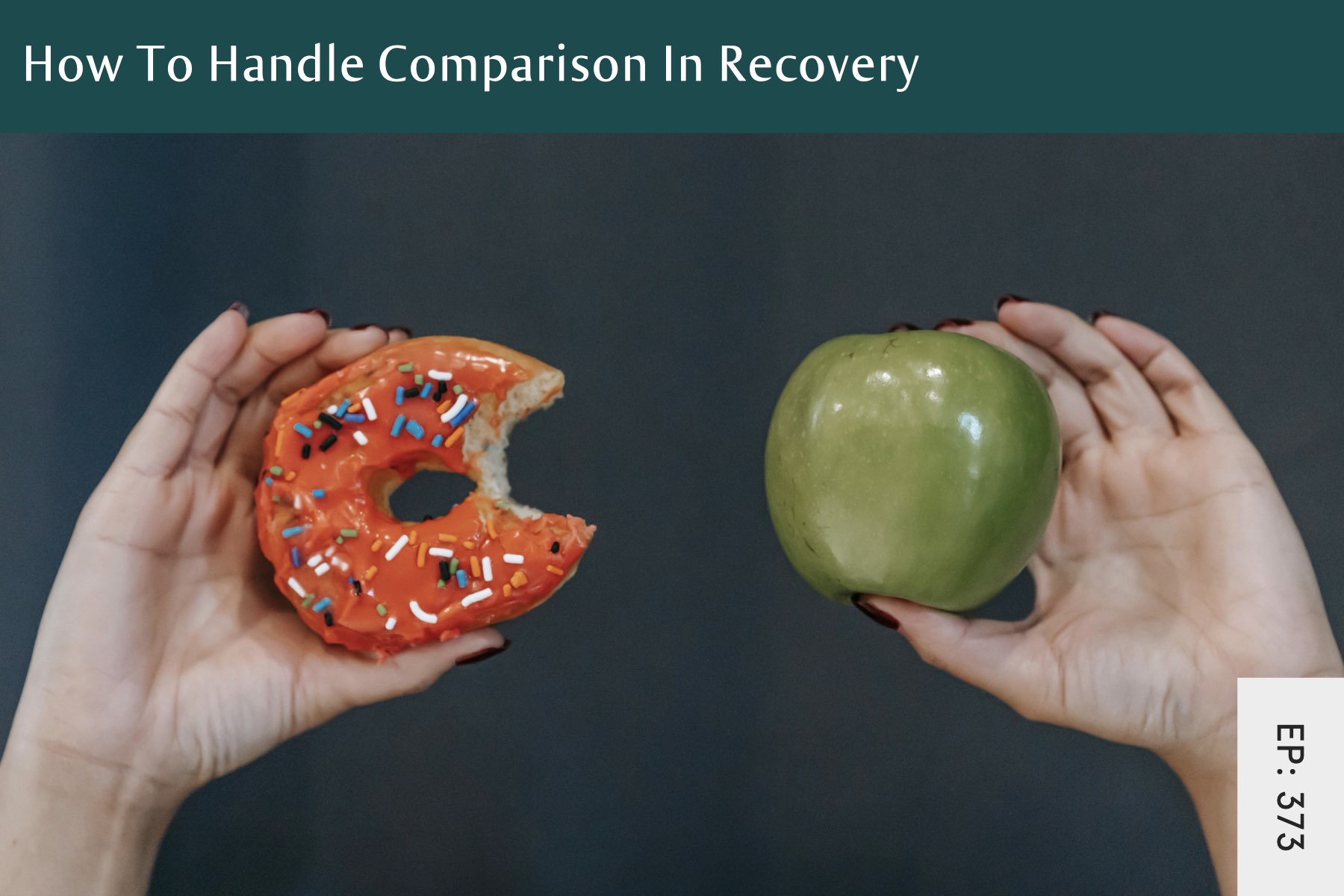
Episode 373: In this episode, I explore how eating disorders use comparison around food, bodies, achievement and recovery progress to keep you feeling inadequate and questioning your needs. I also share a practical process for dealing with comparison in real time so you can continue choosing actions that support your recovery.
00:00:00
00:02:23
00:07:16
00:10:11
00:17:21
00:21:32
00:24:15
00:25:35
00:27:31
00:29:33
00:31:31
00:34:12
00:35:31
00:36:29
00:40:05
00:44:20
00:00:00
Chris Sandel: Hey, everyone! Welcome to Episode 373 of Real Health Radio. I’m your host, Chris Sandel. I’m a nutritionist and a coach and an eating disorder expert, and I help people to fully recover.
Today’s episode, we’re going to be looking at comparison in eating disorder recovery. It’s not going to be a deep dive into this topic, but I want to look at a few reasons and a few places that it can show up, and then give you a tool that you can use when comparison is showing up for you. This is actually content that I shared as part of the group call, or a group call that I had recently. I run a recovery group; it’s called The Fundamentals of Full Recovery. As part of that group, we do group coaching calls, we do group meal support calls, there’s a community area.
So what I wanted to do today is just share some of the content form one of those recent calls. And obviously, as part of that call, we’re on as a group; it led to conversations and discussions and people were able to share where they are finding most challenges in terms of comparison or where it’s showing up the most in their recovery. So we were able to have a conversation about it. It can then be very practical based on that conversation, and me being able to ask more questions and being able to figure out how to actually deal with this in real time.
But I just wanted to share as part of this episode some of the content that I shared as part of that group call and really just say, if this is something that you’re interested in, I would love for you to be part of the group. As part of the group, this is something that all my one-on-one clients get access to, so they’re all part of it, but it’s also something that you can become part of as a standalone.
So if you like what I cover as part of this call, you think “Hey, I would like to be participating in these kinds of things more regularly, and I would love some support as part of my recovery”, you can send an email to info@seven-health.com or you can send a message on Instagram, send a DM. It’s @sevenhealthcompany. You can put either ‘group’ and I can send you the details about the group, or you can put ‘coaching’ and I can send you details about coaching. But if this call is something that is of use to you and you think “Hey, I want to get more of this”, then please get in contact.
So let’s get on with the show, then.
00:02:23
Let me just start with saying that comparison is a completely normal human tendency. Our brain will look out for other people, for information from what other people are doing, to get a sense of belonging or safety or the idea of ‘whether I’m doing things correctly’. This is a fairly normal thing. I don’t think in and of itself it’s a dangerous thing. If we look back to evolutionary links connected to this, there is this thing of “Hey, I don’t want to be excluded from the group and I want to be able to do the things that are necessary to stay as part of the group.” So it’s a way that we can learn, it’s a way that we can recognise how we’re doing.
But what happens with an eating disorder is it turns this up to 11. It really over-indexes so much of this information. What it does is takes this automatic thought and then it starts to really add stuff on top of it. What tends to happen in eating disorders, or even in recovery, is that the comparison piece becomes this really huge thing.
It’s not just the thoughts; it’s what then comes next. It’s the impact on what it permits you to do, or what it says that you can’t do. It has an impact not just on the thought but often on the actions afterwards.
And the thing with this is the eating disorder really rigs the comparison. Comparison when it’s being used in an effective way or a helpful way can be an attempt to collect objective information, to figure out “Okay, that person’s doing it that way; that would actually be really useful for me to understand”, etc.
But what often happens with the eating disorder is it influences the kind of comparison that you notice, and it has this endgame in mind even before the comparison really comes online. For example, if someone eats less than you, the eating disorder thought is “See? You don’t need that much. You need to be reducing what you’re doing. You need to change your eating.”
If someone eats more than you, it doesn’t necessarily mean that you’re allowed to eat more. There’s then the thought of “Well, we don’t know what they did earlier. Maybe they’re more active. Maybe they’re younger. Maybe they’re healthier. Maybe they naturally need more food.” It often doesn’t turn into “Okay, I can now eat a lot of food.” Sometimes it does, and that’s a wonderful thing. But the vast majority of the time, at least in terms of the eating disorder thought, the thought is always “I’m going to tell you all the reasons why them eating more now doesn’t apply to you.”
If someone else rests, it’s because “They’ve earnt it, we don’t know what they’ve done earlier.” Again, there’s all these reasons why that doesn’t apply to you and why you don’t also deserve the rest. If someone is productive, it’s looking at “You should be more productive. You should be more capable. You should be doing more. See? They’re not doing X, Y and Z. They’re able to do all of these things.”
If someone’s progressing more quickly in recovery – because I think there can be a lot of comparison in recovery – it can be “You’re failing at recovery.” Or often the eating disorder is like “See? You’re just never going to be able to recover. This is too much for you. It’s too overwhelming. You don’t have the capacity to do this. Let’s not even bother with this.”
Or if someone is visibly struggling more than you are, whether that be because their body matches up to some stereotype or you can see through their behaviours that they’re visibly struggling, this is when the eating disorder either says “See? This is why we don’t need to make those changes that we’ve been asked to make” or “They’re obviously way sicker than me. I’m not sick. I don’t even need to be really doing recovery.”
So the evidence is just used for a verdict that the eating disorder has already decided in advance, and the verdict is really always the same: “You need to be eating less, you need to be coping better, you need to be taking up less space, you need to be doing more exercise or movement.” It’s the same thing, and the eating disorder just looks at whatever information is around you and then helps to confirm that bias that it already has.
One of the things just to remember is that comparison with an eating disorder is rarely a search for truth. It’s just the eating disorder searching for justification or using the outside and things that you notice as justification for why you should keep doing the things it wants you to do and not do the things that you need to do as part of recovery.
00:07:16
If I look at comparison, it is often a tool. It’s a tool to help you avoid. I think it can be useful to take a step back and recognise that when comparison often is coming up, there is this thing that is providing for you temporarily. And even if it’s uncomfortable, even if it makes you feel worse in the moment, it’s often doing something for you.
It could be then because of that, providing a rule when you feel uncertain. It may be a way for you to override your own hunger or override your own exhaustion. So even though you’re noticing these things, there was this comparison with someone else, and that means “I’m going to keep pushing forward and ignoring them more.” It can provide reassurance that you’re not eating too much. So looking to other people for that reassurance, and it’s not just about eating too much; it could be for lots of other reasons as part of recovery.
It can be motivation through criticism or shame. A lot of the work that I do with clients, especially in the early stages, is looking at things like self-compassion. So often, people are doing the opposite of that. They’re using criticism, they’re using shame as their motivation. But rarely is that used in service of recovery; it’s often used in service of the eating disorder. It’s just become this default of “This is how I speak to myself, this is how I get myself to take some kind of action.”
It can give a sense of control by having that point of comparison, so recognising that you’re ‘doing better’ than someone else or that “This is why I don’t need to do this thing anymore.” Like “Oh, thank God I don’t have to do this anymore because I’ve noticed that thing.” So it can help you to have this sense of control again.
It can prevent you from acknowledging how much support you actually need. There is this feeling of like “Things are falling apart, but I’m able to now use this comparison to show myself everything’s fine. I don’t need to do anything; it’s all good.” So it can be used as sort of papering over what’s really going on by just pretending everything is okay.
What can be helpful – and I’ll get into this more when we look at the different tools that you can use when comparison shows up – but not just looking at “Who am I comparing myself with?”, but looking at “What is the uncertainty? What is the need, or what is the feeling that this comparison is helping me to avoid?” So really using the comparison as an entry point into “What can I actually learn from this experience? I don’t need to take it at face value as what I’m hearing from the eating disorder in this moment, but what can I actually learn from this experience?”
00:10:11
Let me just go through some of the areas where the comparison tends to show up. This is a non-exhaustive list; there’ll be lots of other areas that I’ve forgotten about. But here are some of the more common ones that I see.
Number one is food. This is a big one. It can be watching other people’s plates. It could be using what other people are doing to determine your portions. It could be determining your timing, so “Are they having a mid-morning snack? I shouldn’t have a mid-morning snack because they’re not having one.” It determines your permission to eat and when and how much and all of these things.
The thing I always want to remind people with this is, someone else’s food doesn’t tell you what your body needs. You don’t know what someone else has eaten earlier. You don’t know what they’ll eat later. You don’t know what rule someone’s following. You don’t know how well they’re serving their body by giving it what they need to fuel it adequately. We don’t know any of those things. And even if we did know all those things and it turns out that what someone else needs is less than what you need, that doesn’t change the demands your body requires – what your body requires now as part of recovery, or what it requires in the future once you pass recovery.
So just recognising that “Hey, I can notice all of these different things that people are doing with food, but that doesn’t determine and dictate what I have to do in terms of my eating.”
And I would also just be aware with the asymmetry with this stuff. Like “I notice the person when they’re not eating and why I then have to do that same thing ,but if someone is eating a huge meal followed by dessert, followed by this, I don’t typically then say ‘Oh cool, that is what I’m going to do’.” So just the asymmetry in terms of the eating disorder encouraging you to follow someone’s rules if it’s pointing in one direction but not if it’s pointing in some other direction.
The next one is with bodies and appearance. With this, the comparison is usually very selective in attention. You may notice a particular person, you may notice a particular feature, you may notice a particular photograph, and this then supports the eating disorder’s arguments. So you’re very selective finding this stuff. You could find it on Instagram, you could find it in terms of your Facebook feed, someone sends you a photo, etc., and you very much hone in on all of these things. And often it very much pulls everything else away. So “I’m only honing on these things. I’m not focused on any other parts of the story. It’s just what I’m seeing.”
I could also say that this isn’t just about other people; this can be about yourself. It can be noticing your own appearance in the mirror and trying to compare, “What was that like yesterday or last week?” Or pulling up the phone and starting to compare photos of ‘how I am now’ or ‘how I was last month or last year’ and very much just looking at the aesthetic but very rarely thinking about “What was actually going on in my life at that time?”, in this whole 3D view of “How was I actually feeling? What was I actually doing? What was going on in my life?” as opposed to the one-dimensional “What does my body look like now compared to what it looked like before?”
The reality with this stuff is you’re never going to win, at least in terms of the eating disorder. It’s never going to find this really favourable comparison and say “Great, this is why you can do recovery.” It will always find the person to compare you to where you end up feeling worse about yourself.
There can be comparison around productivity or achievement. This could be comparing work, this could be comparing income, it could be parenting, it could be exercise and how much someone else is doing. It could be even recovery and how much someone is engaging in recovery or isn’t engaging in recovery. You can get to this place of – and again, because of the selective nature of how comparison tends to work – this idea of “They can manage it all; why can’t I?”
The question of “Why can’t I?” then becomes another way to self-flagellate and tell yourself all the reasons why you’re broken or you’ve ruined everything, etc. So just recognising, “Okay, these are all the different areas that I compare.”
And again, this can come up back of a conversation at work; this can come up because you’re on social media and you saw this person from school or from college or from your old job or a cousin or whatever it may be, and all of this stuff then starts to come up.
Again, like I said with the food piece, the reminder with this being that we all have different bodies, we have different histories, we have different responsibilities and health and resources and levels of support. There’s a multitude of factors that can have an impact on someone’s life to dictate where they’ve ended up. Just because you’re in this place now doesn’t determine where you will be in six months’ time or a year’s time, even though the eating disorder often creates this real feeling of permanence, like it’s gone on so long that nothing can fundamentally change from here.
Connected to this could be, in terms of recovery progress, where you’ve got to in recovery. It could be also how much support you need. I think this often comes up a lot, like feeling like “I’m needing more support than other people. Why do I need more support than other people? Why can’t I just do this on my own? I should be able to do this without needing to message, or I should be able to do this without needing my partner to be able to support me with this.”
Again, that doesn’t normally end in a great place. You end up feeling worse about yourself, and it doesn’t lead to more action-taking.
And I think this is the central theme with all of this: the comparison is almost like an eating disorder trick or an eating disorder tool to get you to feel worse or to get you to stay doing what you’ve been doing with the eating disorder.
I often think of eating disorders as like being abusive partners. It’s like the abusive partner who wears you down, makes you think that you could never have anyone better, that you should be thankful that they’re even putting up with you, and that’s why you need to stay, because no-one else is ever going to want you and you’re never going to amount to anything, so you just need to stay put. That is pretty much how the eating disorder treats most people, or lots of people. I don’t want to say everyone or most, but for a lot of people, that’s the experience they have.
00:17:21
A thing I want to also address with this is that feeling behind isn’t just always distorted eating disorder thoughts. An eating disorder can genuinely affect your direction of life, how much time you spend on certain things, your development.
So you can honestly look at your life compared to your peers’ and notice that they have progressed further in their careers, or they have developed more financial independence, or they have formed more relationships or started a family, or they have travelled more or had more experiences. They have more solid friendships or they have more social confidence or they have more hobbies or interests, or they’ve learnt who they are outside of achievement or appearance or control.
So it’s not that when I’m working with someone around this, I’m trying to say that every one of these is just an eating disorder thought, none of this stuff is true. It can be true that the eating disorder has consumed a lot of your time, a lot of your energy, a lot of your attention, and that has meant that there’s lots of things that haven’t actually happened within your life, and hey, this thing has in a lot of ways stolen the last 5 years, 10 years, 20 years.
And it’s not that everything has fallen away. For some people it may have, but a lot of the time there are parts that have been affected. But I want to be able to acknowledge that hey, some of this is actually true in how this has affected your life, and to say there is really grief that is here. And I don’t think the answer is to just pretend that nothing’s been lost or really insist “Everyone goes at their own pace, it doesn’t really matter.” None of those really deal with the reality of the situation, and it can feel very dismissive.
But I would also add, you don’t need to have the eating disorder then turn that grief against you and into another argument against recovery. Like “I’ve already wasted so much of my time, recovery is making me fall behind even more because of what I’m having to focus on, what’s the point when everyone’s so much further ahead?” So the eating disorder has created this painful trap. It has contributed so much to your life becoming smaller, and then it uses the consequences of your life becoming smaller to say “This is why we should continue doing the eating disorder. This is why you should continue on with behaviours.”
The reality is that you can’t change the years that have passed. There is nothing that you can do to change what has happened as part of the eating disorder. But continuing on with the eating disorder is also not the solution. It won’t change anything for you. All it does is lead you to continue to be stuck.
It’s amazing how often people feel like “I’ve wasted my life” and then it’s like “Let’s imagine that 10 years from now, you’re still doing this. How would that feel?” It’s like, “I don’t really want this for another 10 years of my life.” When I work with people and they’re reaching that place of recovery, there can be the feeling of like “Man, I wish I did this earlier.” And there can be the grief or the regret or those feelings.
And there’s also the reality of “I’m so glad that I actually made a change now”, because you can feel the feelings of “I wasted my time, why did I do this for so long? This has cost me so much” and you can feel those things, and then blink and then another decade has gone by and you’ve still stayed within the eating disorder.
So it’s recognising the grief and the pain and the things that you’ve missed out on and acknowledging that “Hey, that’s not how it needs to stay forever, and I can make changes and I can recover from here.”
00:21:32
The other piece I just want to connect with this is that often, people get stuck in this messy middle with recovery, and I think it can be very easy in the early stages of recovery to have these real concrete goals where “I need to eat more, I need to reduce my exercise, I need to challenge these fear foods, I need to stop doing the compensatory behaviours.” It can be very binary, like “Did I do this? Did I not?” It can be very clear of like, “How am I progressing with my recovery?”
But I think what happens as you get further along, it can often feel a little less clear. You’re not spending every one of your moments actively trying to not engage in eating disorder behaviours. You have started to build more of a life. But at the same time, there is this gap. You’re no longer entirely living within the eating disorder, but at the same time, you haven’t fully built a life outside of it.
I think this is often when that comparison piece can become louder, because you often have more mental space to notice what other people are doing and what’s now missing from your life.
What I would just want to add is this doesn’t mean that recovery is going badly. This doesn’t mean that you’re doing recovery wrong. It just means that you’re now present to your own life and you’re now present to actually what you do want from it.
So at this point, the focus of the work isn’t simply about stopping eating disorder behaviours; it’s doing some of the deeper work about learning how to make decisions when you don’t have perfect certainty; how to discover your own interests through experimentation; how to build relationships, but do so gradually; how to tolerate being inexperienced in things, and inexperienced in things that some of your peers may be much more experienced in; how to allow yourself to want things, to be okay with having desires, to be okay with having needs, to be okay with having wants and being able to give yourself those things; how to begin to feel confident again or feel confident for the first time in your life; how to create a life that really reflects your values and reflects the values of someone who’s no longer living with an eating disorder and is able to tap into “What is really important to me?”
Those are the things that become much more important as you get further along in recovery. Some of them are still important from the word go, but they become much more the central theme as you get further along.
00:24:15
I now want to go through how to respond to comparison. I want to go through some steps that you can engage in as you notice that comparison has come up.
What I want to add with this is I know it can feel as I go through this like “How do I have time to go through all of these different things? In the moment it feels so strong and I get so overwhelmed by it.” You may not be able to do all of these things and do all of them perfectly, and that’s not the point of it. It’s to notice some of this stuff. And if you can start to do all of it, great. If it’s just noticing enough to mean that you don’t just follow along with the eating disorder behaviours, that’s the more important thing.
But what I find is as people get further along, there is a little more bandwidth to be able to create some more of this space. This could be a tool where you pull out your journal and start to do some writing connected to it. It’ll depend on the situation. Sometimes you’re very much in the moment; other times you do have more time to be able to do that refresher piece. But I want to just go through this and you can pick out the bits that are helpful for you in the moment, when you’re pressed for time, and then do the full thing when you’ve got more time.
00:25:35
The first piece of this is to notice both the thought and the behaviour. Comparison happens very automatically; it just shows up. But you then start to participate in it, and that keeps it going. So maybe initially there’s a glance at someone’s plate and you notice someone’s plate, but then you start to keep noticing that, or noticing other people’s plates. You start to take action to keep this going.
It could be looking at someone’s plate; it could be looking at someone’s body or noticing someone’s body; it could be starting to ask people questions about what they ate or if they exercised earlier. It could be checking social media, and initially it was just going on, and then I found this particular account and this person and now I’m starting to actively look through all of their different posts. It could be noticing that you were checking some photos and now you’re looking at all the old photos of your body and comparing them to now. It could be Facebook, if you’re looking at the person’s career or their relationship or their recovery. It could be just mentally replaying the comparison that happened previously and some of the things that you started to notice.
The question at this point is: “Hey, I’ve noticed this thing going on, but what am I doing to keep this comparison active?” The goal isn’t to blame yourself (1) for having the automatic thought or (2) for noticing that this thing is going on; it’s to identify the automatic thought so that it’s not continued on as a behaviour, so that we’re catching this thing as early as humanly possible. And if it’s been going on for a while, noticing “Oh, okay, I have now been stuck in this for a moment”, so being able to catch it and then interrupt it.
00:27:31
The next part with this is rather than trying to debate every detail that the eating disorder is coming up with or every detail of the comparison, it’s looking at, “What is the comparison meaning to me?” Or at least, “What is the eating disorder wanting this comparison to mean?” Like “Therefore I should…” So “Therefore I should eat less, therefore I haven’t earned my rest, therefore I’m recovering too slowly, therefore I shouldn’t really need help, therefore I’ve failed at life, therefore I need to work harder and catch up…” What is the verdict or what is the ‘therefore I need to do’?
This then exposes that the comparison is not just about the information; it’s an attempt to influence your behaviour and to get you to do something. A useful phrase or reminder as part of this is like “My mind has turned what I’ve noticed into an instruction.” So making the difference between “I’m noticing something objective” to “Now I’m having to take action as part of it.”
As part of this – and it can kind of be the same because of some of those ‘therefore’ comments, but it’s then identifying, “What does the comparison, or at least what does the eating disorder’s take on the comparison, want me to do next with this? What is the urge it is asking me to do based on this?” It’s asking me to reduce the next meal, it’s asking me to add in movement, it’s asking me to cancel my rest, to body check, to reach out for reassurance, to withdraw socially, to continue to work beyond my capacity, to abandon the exposure that I was going to do earlier on, to delay asking for support. What is it saying that you need to do in this moment?
00:29:33
The next piece is then looking at, “What has been erased as part of this comparison?” As I said earlier, the comparison is very much looking at one aspect; it’s very selective in what you’re looking at, whether it be a particular person, but even with a particular person, it’s looking at something very selective that that person is doing, whether that be the amount that they’re eating, the amount that they’re exercising, how they look in a particular photo, whatever it may be.
What is useful to ask yourself in this moment is: “What is the information that is being erased or what is the information that I actually don’t have to hand? What is missing as part of this comparison that I’m making?” For example, your history of restriction. That’s often not coming in as part of the comparison that is going on. Your current physical health. Your recovery plan. We don’t know details of what that person ate earlier or what they’ll eat later or what else is really going on in their life, what private struggles are going on that you don’t know about. We don’t know about the differences in health or finances or responsibilities or support.
There’s so many pieces that you are forgetting when this comparison is going on. And the thing I want to add with this is we’re not having to reconstruct every detail of someone else’s life. The point is simply to recognise that when we’re making this comparison, we’re comparing this very slim sliver of someone’s life or some details about someone’s life or some details about your own life, etc., to then have a big impact on how you feel about this. So it’s just being able to recognise “The thing that I’m comparing here is making me feel worse because of the small chunk that I’m comparing in this moment.”
00:31:31
The next piece connected to this is then to actually make room for the feeling that is underneath all of this. Because when there is the comparison going on, underneath that, there is typically a feeling – or many feelings. It could be fear, it could be grief, it could be envy, it could be shame, it could be loneliness, it could be uncertainty, a desire for belonging, anger at what the eating disorder has cost you, fear that the eating disorder will make you different to other people.
Rather than immediately trying to remove this feeling – which is so much of what an eating disorder is about, like “I have this feeling and I need to avoid it” – what you’re wanting to do here is be able to take a step back, to be able to have a pause and to really identify, “What is actually going on underneath? Where I’m comparing my life to that person’s life or their eating to my eating or their body to mine, what is the emotion that is underneath all of this?”
For some people, I’ll use an emotions wheel or a list of emotions so that you can go through it and able to recognise, “Oh yeah, that’s actually what is coming up.” It can then help to speak that out loud, it can help to write it down. But just being able to recognise, “Oh, of course this is bringing up grief for me” or “I’m noticing envy because they have something that I want” or “This is reminding me of what I missed out on” or “I can really feel that uncertainty is present and my mind is trying to look for a rule.”
So making the feeling that you’re having valid and that it’s okay to have that feeling; it doesn’t mean that you need to then do the proposed eating disorder behaviour connected to it. “I can have the feeling and still make some other choice.” But trying to get down below the surface, one level down, like “What’s actually going on in this moment? What’s actually coming up?”
Because that is actually really helpful to figuring out what could be helpful, either in this moment or bigger picture. Because if what I’m recognising is there’s loneliness, I need to be working on things that can help with my loneliness as opposed to “That’s why I need to exercise more” or “That’s why I need to restrict my food more.”
So being able to recognise that by being able to acknowledge these feelings and being able to identify these feelings, it can then help me to figure out how to really solve this thing as opposed to just using something to plaster over it or paper over it.
00:34:12
The next piece I want to add is to then refuse to solve the comparison with another comparison. I think this can be a real tendency for some people to prove that it’s okay by being able to say “You are more unwell than that other person, so it’s okay” or “You’re had a harder life, so it’s okay” or “You do really deserve more support than that other person” or “Someone else really is further behind you” or “Your body is preferable in some other way.”
The problem with doing this is it just keeps the whole comparison system intact. You may feel better temporarily, but your permission remains dependent on winning in that comparison. So just recognising that “I don’t have to establish that I have greater needs than some other person to make this thing okay. Their choices are not a comparison to my choices and whoever is more needy or whatever. That doesn’t have a verdict on what I do in this situation.” So not getting into a further comparison to make yourself feel okay about this situation.
00:35:31
At this point, it’s looking at “What is the relevant source of information that I can return to in this moment?” So coming back to, “What does my recovery plan say I’m doing today?” or “What has my body been communicating to me, either in this moment or even leading up to this moment? What would support my recovery in this moment? What choice reflects the person that I am becoming or want to become? If I hadn’t been exposed to this thing, if I hadn’t had this interaction with this person, if I hadn’t seen this thing on Instagram, if I hadn’t had this comparison come up, what would I have chosen? What was I going to choose before this happened?”
This relevant information is really coming back to your needs, your values, your recovery commitments, and not getting stuck in the comparison.
00:36:29
Then it’s time really to take action connected to this. I would say that with recovery, it’s often taking opposite actions. This is about the behavioural change.
If, for example, the comparison is creating an urge to restrict, it’s eating the planned amount that you were going to eat, or eating more than you were planning to eat. If the urge is to go and exercise, it’s to maintain, to have the rest day. If the urge is to cancel the support, it’s to not cancel the support and actually turn up to the appointment. If there’s now an urge to overwork or continue working, it’s like “No, I’m actually going to stop at the agreed time.” If the urge is to keep checking and keep scrolling on Instagram, it’s like “I’m logging out of the app or I’m leaving the conversation” or whatever it may be.
So it’s doing the opposite of what the eating disorder is asking of you. And I just want to add, while doing this, you’re not going to feel certain about doing this. It’s still going to feel uncomfortable, it’s still going to feel like “I’m doing the wrong thing.” The point with this is to prevent comparison from determining the actions that you take. So “Hey, I’m going to really short-circuit this by doing the opposite of what it’s asking.”
The final piece is, later on, to just review it. You may be reviewing it 10 minutes later; it might be later on that evening, it might be the next day. But just coming back to, “Hey, let me reflect on that thing that happened yesterday or that thing that happened earlier.”
“What was predicted would happen if I didn’t obey the eating disorder and the comparison? What was the eating disorder saying was going to happen, and what actually ended up happening because I took the opposite action?”
Or “Hey, what actually happened because I didn’t take the opposite action, I just followed the eating disorder on and did everything it asked me? How did that have an impact on the rest of my day or my evening?” or whatever it may be. What actually happened because of that comparison, the action that was taken?
Just being able to be honest with yourself about this. What tends to happen when you can do this again and again is you get a point of contrast between “This is what happens when I follow the eating disorder and do the things it requests of me, and this is what happens when I take opposite action, and this is where it leads.” So being able to have those points of contrast and notice the difference so that you can figure out, “What do I want to practise next time?”
Sometimes it can be useful to be answering that question away from that situation, because when you’re in the thick of it, your ability to figure out what to do becomes very clouded, versus “Hey, the next day and every time the day after or a couple of hours after, I recognise that I want to do something different, that that wasn’t the thing I wanted to do and that I really did want to take the opposite action.”
Maybe it could be “I write out two or three lines in the back of my journal or the back of my book, and when I find myself in that place, I go and open it. I look at that page and I take that action. I’ve decided in advance that’s what I’m going to do because that’s when I have the most clarity of mind. When I’m in the thick of it, I can’t think of it, but if I at least already have the plan in place, I can follow a plan. I just can’t create a plan in that moment.”
00:40:05
Let me just give you a couple of examples, some short examples of what this could look like.
One, there’s a trigger. Someone eat lunch eats less than you do. Then there’s the comparison and the thought that comes up is “They need less food than I do. They can get by on less than I do. I can’t need this much.” So the verdict that the eating disorder gives is “Your portion is excessive. You served yourself too much. You don’t need this much food.”
The urge that then shows up connected to that is to leave part of your meal, or if you’ve already eaten it, it’s to reduce the next snack or to skip the next snack.
What is erased as part of that is your recovery needs, your history of restriction, their earlier intake or their intake afterwards or the fact that you know almost nothing about their circumstances.
The feeling underneath, the emotions that come up – there could be fear of being different, uncertainty about trusting your plan and where it’s going to lead.
And then the recovery response you could take, even though those emotions are there, is “I’m still going to eat the planned amount that I had. I’m still going to have the afternoon snack. I’m going to do these things unchanged, even though those thoughts are there.”
The learning that then comes from this is that “I can feel exposed, I can feel uncertain without allowing someone else’s plate to determine how much I eat.”
Then a non-food example. It could be a peer, could be a cousin, could be a relative, could be someone in your life receives a promotion that you find out about. Could be at work that you find out about this, it could be on Facebook that you find out about this.
Then the comparison that comes up is “Everyone is progressing except me. Everyone’s making strides in their life and I’m the one that’s not.”
Then the verdict that comes down because of that is “I’ve wasted my life. I need to work harder. This isn’t really working for me”, all of this kind of stuff.
Then there’s this urge that could go in two different ways. It could be “I’m going to sacrifice the meals, I’m going to sacrifice recovery work to become even more productive. Basically I’m going to put recovery on hold and I’m just going to focus on my career because that’s how I’m going to change all of this.”
Or it could be “I’m just struggling in all of these other areas; I’m going to keep my eating disorder. The eating disorder is the one area that I do well. Most people would love to be able to do this the way that I can do this. This is where I get my sense of self, I get my sense of feeling good about myself because I’m able to do these things with food or with exercise or whatever. So I’m going to just keep the eating disorder because that’s my way of feeling successful in this moment.”
If we actually look at what’s underneath this, there could be the grief about opportunities that have been lost during the eating disorder, the fear of being stuck behind your peers. There could be lots of feelings that come up.
The recovery response can be to then acknowledge that grief or acknowledge those feelings, to still maintain the food and rest that is part of your recovery and is part of the plan.
It could be to then identify one sustainable career action you could take or some other action that you could take in your life that would help to build up your sense of self or your sense of esteem outside of the eating disorder. So “I’m actually going to do this thing that is in service of my recovery outside of just the food and the exercise piece.”
The learning from this is “I can feel grief about what the eating disorder has taken from me and still continue on with my recovery.”
Obviously, they are just two very short versions of this, but if I’m going to distill down the different components as part of this, this is what it would look like.
00:44:20
So that is what I wanted to go through as part of this episode. As I said, this wasn’t a complete deep dive into comparison, but it’s something that comes up again and again in recovery – comparing to other people’s bodies, comparing to your body in some previous version of it, comparing meals, comparing achievement, comparing recovery timelines. All of these things are going to come up.
What’s most important isn’t to prevent yourself from comparing. That’s just never going to happen. It’s always going to be there. What’s more important is being able to catch it, and to be able to catch it and not let it have an impact on your behaviours.
Because what will happen as recovery goes on, as you keep making inroads, is the comparison will become less or you’ll be able to notice that it just doesn’t have the same teeth that it used to have before, it doesn’t rock you in the way that it did before because you’re able to see through it. Or you’re able to notice, “Oh, whenever that’s coming up, that’s connected to this other thing, and this is what is actually helpful for me to do in this situation.”
So you are able to neutralise it much more because you’ve seen it, you know you don’t have to act on it; you can continue to do the things that you need to in your recovery.
So, that is it for this episode. As I said at the top, this is content from my group calls. It’s a small snippet of it. As I said, there was a lot more conversation connected to this and people sharing. So if this is something that you would be interested in, you can send an email to info@seven-health.com or you can send a message to @sevenhealthcompany on Instagram and just put ‘group’ and I can send over the group details, or ‘coaching’ if you’re wanting one-on-one. But yeah, please get in contact.
Until next time, I will see you then. Take care!
Thanks so much for joining this week. Have some feedback you’d like to share? Leave a note in the comment section below!
If you enjoyed this episode, please share it using the social media buttons you see on this page.
Also, please leave an honest review for The Real Health Radio Podcast on Apple Podcasts! Ratings and reviews are extremely helpful and greatly appreciated! They do matter in the rankings of the show, and we read each and every one of them.

Policies
Social
Copyright © 2009 – 2025
seven-health.com · All Rights Reserved.

Share
Facebook
Twitter