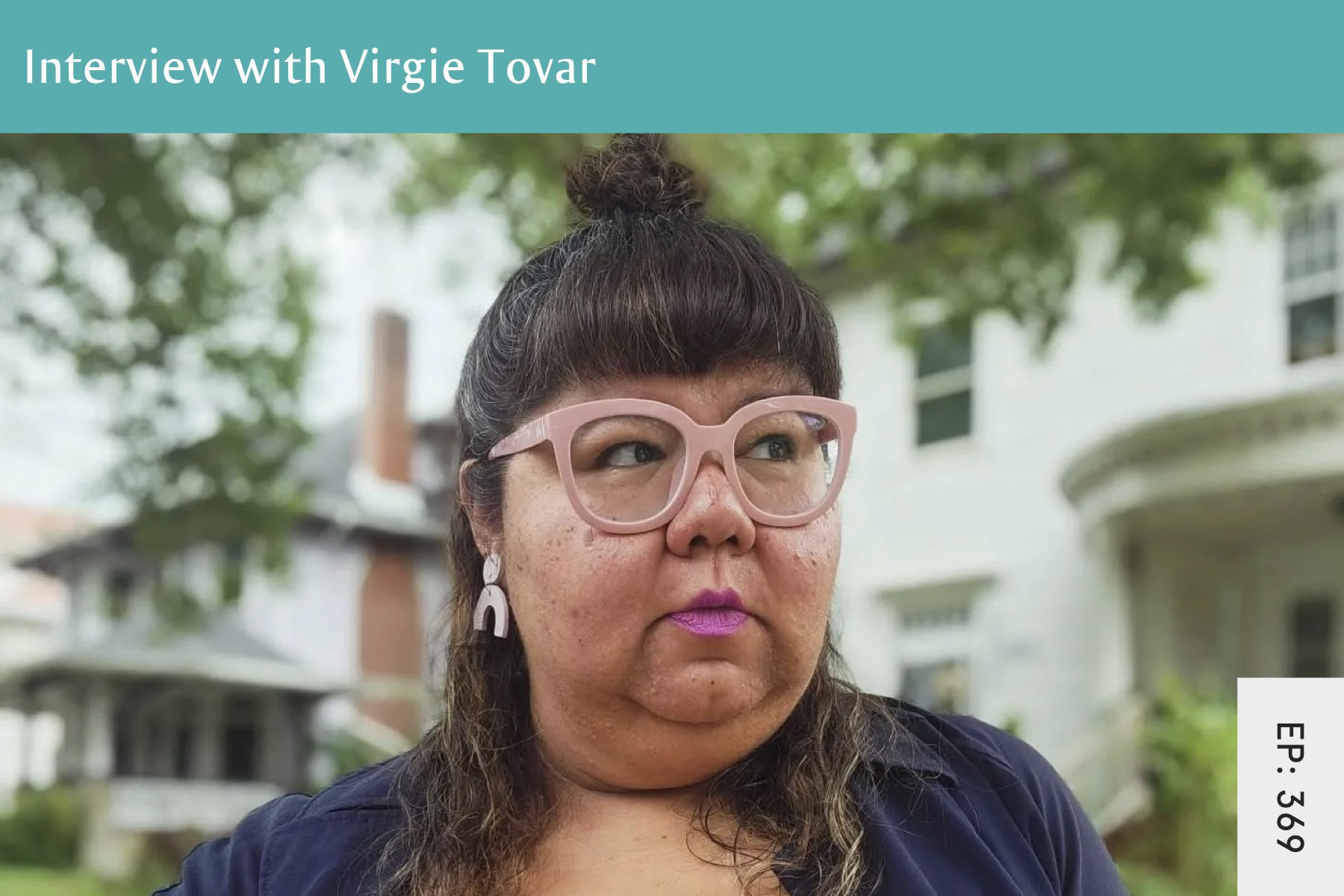
Episode 369: Virgie Tovar joins the podcast to examine how GLP-1 weight-loss drugs are reshaping diet culture, from the medicalisation of restriction to the marketing of weight stigma as compassion. We discuss the impact on eating disorder recovery, the psychological cost of weight cycling, and what it takes to choose body acceptance in a culture still determined to sell thinness.
Virgie Tovar is an author, lecturer, and one of the nation’s leading experts and trainers on weight-based discrimination and body image. A Forbes.com contributor since 2018, she covers how weight bias shapes work, media, fashion, and the plus-size market.
She is also the hosts GLP-1 Truth Serum, a podcast bringing critical questions to the injectable weight-loss boom.
She is the author of You Have the Right to Remain Fat, The Self-Love Revolution: Radical Body Positivity for Girls of Color, and The Body Positive Journal. She created the #LoseHateNotWeight campaign and delivered a TEDx talk on its origins.
Vigie has received Yale’s Poynter Fellowship in Journalism and Project HEAL’s Inspire Award, and has been featured by the New York Times, NPR, Dr. Phil and the BBC. She has co-designed and collaborated with Meta, Converse and Dove, and trained teams at Georgetown, UC Berkeley, the San Francisco Department of Public Health, Square and Waymo. She lives in San Francisco.
00:00:00
00:04:36
00:06:02
00:16:01
00:20:40
00:25:39
00:31:45
00:40:05
00:47:11
00:51:48
01:01:50
01:05:14
01:10:20
01:15:48
01:25:35
01:30:23
00:00:00
Chris Sandel: Hey, everyone. Welcome to Episode 369 of Real Health Radio. I’m your host, Chris Sandel. I’m a nutritionist and a coach and an eating disorder expert, and I help people to fully recover.
Before we get on with today’s show, I just want to give a quick note that if you’re ready to get support in your eating disorder recovery, I have a couple ways of doing that. One, it can be working with me one-on-one and getting this high-touch personalised support, or two, I run an eating disorder recovery group. You can get support in the group format.
If either of those are of interest to you, you can send an email to info@seven-health.com and you can just put ‘group’ or ‘coaching’ or ‘support’ or something in the subject line and I can send over the details, or you can send a DM to Instagram. It’s @sevenhealthcompany, and you can just put, again, ‘support’ or ‘group’ in the DM and I can get the details over to you.
So, on with today’s episode. This week on the podcast, it is a guest interview. It feels like a while since I’ve done one of these, but yeah, back with a guest, and my guest today is Virgie Tovar.
Virgie is an author, a lecturer, and one of the nation’s leading experts and trainers on weight-based discrimination and body image. A Forbes.com contributor since 2018, she covers how weight bias shapes work, media, fashion, and the plus-size market. She’s also the host of GLP-1 Truth Serum, a podcast bringing critical questions to the injectable weight-loss boom. She is also the author of You Have the Right to Remain Fat, The Self-Love Revolution: Radical Body Positivity for Girls of Color, and The Body Positive Journal. She created the #LoseHateNotWeight campaign and delivered a TEDx talk on its origins.
Virgie has received Yale’s Poynter Fellowship in Journalism and Project HEAL’s Inspire Award, and has been featured by the New York Times, NPR, Dr Phil, and the BBC. She has co-designed and collaborated with Meta, Converse, and Dove, and trained teams at Georgetown, UC Berkeley, San Francisco Department of Health, Square, and Waymo. She lives in San Francisco.
In this episode, it really is all about GLP-1s and really draws pretty heavily on the podcast that Virgie has done, GLP-1 Truth Serum. This is a topic that I see coming up more and more. It’s coming up in the group calls, it’s coming up in one-on-one sessions, and it just feels like there’s this ubiquitous nature with these things, whether it’s with people taking them, with the marketing, whether it’s people seeing it on the news. They just feel like they’re everywhere. So I wanted to invite Virgie on to be able to have this conversation.
As part of the show, we cover how GLP-1 medications suppress appetite and food intake; the media bias surrounding GLP-1 reporting; pharmaceutical companies targeting body positive influencers; how food noise has become a powerful marketing message or tool; the physical and psychological consequences of prolonged restriction; the impact of GLP-1 marketing on eating disorder recovery; why claims that the body positivity movement is dead don’t really reflect reality; how weight stigma functions as both trauma and a marketing tool; the hidden psychological cost of weight loss and weight cycling; and then finding self-acceptance and joy and connection in a larger body.
So, let’s get on with the show. Here is my interview with Virgie Tovar.
Hey, Virgie. Welcome to the podcast. It’s lovely to be seeing you and chatting with you again.
Virgie Tovar: Yeah, thanks. Same.
Chris Sandel: This is your third appearance on the show. The first one was in 2016, and I think we were mostly talking about your backstory. We talked about weight stigma and fat shaming and lots of the topics that are really in your wheelhouse. And then in 2020, you came on and talked about your book, You Have the Right to Remain Fat. And here we are again, and I think the basis of this one will be on GLP-1s, because that seems to be ubiquitous. It’s a topic that you’re talking a lot about. So yeah, I really want to be able to dive into it with you.
Virgie Tovar: Yeah, let’s do it.
00:04:36
Chris Sandel: Before we get started, for anyone who doesn’t know who you are, do you want to just give a quick bio or background, what you do, who you are, that kind of thing?
Virgie Tovar: I do a lot of different things, but it’s all under the banner of ending weight stigma. Fundamentally, weight stigma is negative cultural attitudes towards people in larger bodies, and all of the realities that come with that, including things like decreased wages, more stress, worse mental and physical health outcomes due to stigma, less access to fashion and things like that.
My work encompasses writing, speaking, training. Since we talked, I’ve worked with the San Francisco Department of Public Health, where I live, on weight neutrality in public health intervention. So there’s a new public health component to the work, which feels really exciting. But yeah, all of my work is about helping to create a world where people of all sizes can thrive.
Chris Sandel: Lovely. As I said, there’s a lot that I covered in the previous episodes, so I’m going to link to those in the show notes and people can check them out. Even though they were recorded a while ago, they’re still very much relevant, and I would suggest that people check them out.
00:06:02
In some ways it doesn’t surprise me that you’re talking a lot about GLP-1s given the cultural state that we’re in, and I know for you, there was a bit of a story about this and you getting approached by different companies, even though you’re very publicly anti all of that thing. So just tell us how the podcast came about.
Virgie Tovar: The podcast really came about because – it’s funny. There’s a story that’s a little bit silly. I was just so mad, not necessarily about GLP-1s per se, but about the poor reporting that I was seeing, the incredible media bias, especially in the United States, where it’s legal to basically market directly to consumers for prescription medications.
I’m like, wow, the media outlets that we trust to offer critical reporting on something as important as this are advertisers for this medication. So I felt like there was conflict of interest. I think in addition to that, there was bias. Even where there wasn’t conflict of interest, there was bias in favour of.
So the origin story of the podcast was that a friend was visiting, and she said, “Listen, I can’t hear you rant one more time. You’ve been talking about this for months. I need you to just do a project. Why don’t you call it ‘GLP-1 Truth Serum’?” [laughs] She’s kind of a master marketing person, so I was like, you know what? I’m just going to do it. She’s a full-time marketing person.
So that was how it began. I just found myself – honestly, it was like I didn’t want to do a project around it because I just wanted the outlets that were supposed to be offering at least balanced journalism about this to actually do their jobs. So I think the complaining was a lot about that sense of almost “I cannot believe what I’m seeing” if that makes sense.
On top of that, too – I was just posting about this yesterday – what I would consider the lack of due diligence on the science side, on the reporting side for GLP-1s, and then on the other side, these outlets champing at the bit to declare body positivity is dead. It felt like this – it was almost like – I don’t know, I’ve been thinking about it almost like this metaphorical murder, this sort of media murder frenzy.
What strikes me as so odd about it – and I do journalism part time, so I know some of the rules of journalism. I think what’s really challenging about it, some of the reasons why the reporting is so lopsided in favour of GLP-1s is that pharmaceutical companies are huge, and they’re respectable companies, and they have said that they have created a miracle, something no-one has ever seen.
As somebody who’s studied diet culture, I’m like, how does this work? How do these medications work? Oh, it’s just a diet. It’s just a more medicalised diet. It relies on food restriction. We have over 100 years of data on what food restriction does to people. I always have this line; I’m like, it changed the ‘what’ but not the ‘how’. So I was finding myself really, really frustrated by that.
But anyway, all that to say, these journalistic outlets have to presume that these companies are good actors, that they are saying something that they believe to be true, and that we have to wait until the evidence, if the evidence shows otherwise. So there’s this really frustrating component where these pharmaceutical companies, because they have so much respect and prestige in our culture, they get a kind of credibility.
Meanwhile, body positivity, which is a populist movement, primarily women-led, zero dollars in funds, was already always considered countercultural, already always had that sense that “We don’t know, this is suspicious, I’m not sure.” I think what happened was it was a perfect storm journalistically where there are no lawyers defending the body positivity movement, and then you have this incredibly resourced set of companies, and everyone is acting as if everything they’re saying should be taken 100% in good faith. I think it’s just, again, a very, very frustrating environment.
But I think fundamentally, the podcast really came about because I felt that – yeah, let’s go back to my own story here. In January of 2024, around that time I started to get a lot of emails from marketers that wanted me to promote GLP-1s to my audience. At first, I thought it was a mistake, like “Oh, they must have misunderstood.” I have worked with many companies, and typically when a company approaches me, it’s usually I would say pretty respectful. They’ve done the research, they see what I stand for, they see my values, and they see a fit with our values.
So when I was getting weight loss marketers approaching me, my thought was, “Oh, someone has their wires crossed. They just don’t understand what I do.” I deleted the first few, but then they just kept coming and they kept coming. And at a certain point, my sense of what was happening shifted. I thought, “I need to stop deleting these because I think these are evidence of something, and I don’t quite know what.” But there was a feeling in my body that there was something happening that I’d never seen before in, at that time, let’s call it 12 years of working in this space. I was like, “I don’t know what’s going to come of this, but I know I need to save these.”
In retrospect, I now realise January 2024 was the big kick-off for the huge marketing push for GLP-1s. Unprecedented ad spend from these companies. And their first order of business was to target visible body positive, fat positive influencers and content creators.
Some people might say, “Who cares? They probably reach out to a lot of influencers.” That’s probably true. The reason why it matters is because people in this space have actively opted out of weight loss messaging. They have done so because they’re recovering from an eating disorder, they’re recovering from years of weight stigma, they’re recovering from body image challenges, and they’re looking for a safe haven away from weight loss advertising and weight loss messaging.
I think of that as almost like they have removed their consent to receive this kind of messaging, that their participation in this community is about a removal of that consent. Which I take very seriously, because I also don’t want to consent to that type of marketing.
I think the other thing that felt off about it was there are so many people in the United States who absolutely love weight loss. They would buy any product, and they’re very enthusiastic about it, and they’re willing and eager consumers. The fact that they went after the people who had opted out struck me as below-the-belt marketing.
I just found it to be incredibly morally suspicious, and I thought, wow, they’re targeting this populist, largely women-led movement that has history, queer politics history, all of these different intersectional movements for liberation, for justice, and they are going after the visible leaders because they know a lot of us are going to say no, but they know all they need is one person to say yes for it to become a media sensation.
And that’s exactly what happened. Oh my God, I have so much to say, but my relationship to GLP-1s began in that January of 2024 when I went from thinking that I had been incorrectly invited to be part of a promotion for GLP-1s and then I realised, oh, no, this is not an accident; they’re targeting people like me because they want to demoralise the communities that we’ve built, and they want these people to see visible people who have been advocating against intentional weight loss to do a 180 pivot on their values, and they know that this is going to discredit the movement.
Some people would say that’s reaching, but I don’t think it is. I think it’s really, really dirty marketing.
00:16:01
Chris Sandel: If you look at the way that they’ve talked about so many of the things around weight stigma and co-opted so much of what the body positive movement was about, from my perspective, it doesn’t feel like a reach. It feels very intentional, and very intentional in the fact that it’s been strategic across so many different places. It’s really interesting – I’m sitting here, I live in the UK; we have a very different situation to the US. I always remember going to the US and you’re watching ads and it’s like “Ask your doctor about this.” We have a very different set of rules in the UK in terms of you can’t be advertising directly to consumers.
But for the first time ever, they are getting around this. There will be an advert that is now on, if I’m listening to something on Spotify or I’m listening to a podcast, where it’s like they’ve set up these wellness centres or these wellness people. Like “If you’re concerned about weight, come to this wellness place.” Or even on TV, we’re not mentioning the actual drug and not saying “Ask your doctor about this” but “You can come and contact us about this thing.”
It’s like one step away. We’re now being able to advertise this thing, which is then the next step, you’ll then get offered the drug. It’s this way around this that I haven really seen with anything else. Obviously there’s so many different medications that are available, but I haven’t seen that kind of thing with anything else. It does feel like there is this goliath, or many goliaths that are spending a lot of money to make this everywhere in a way that I can’t remember it being for anything else.
Virgie Tovar: Yeah, 100%. And you zoom out – to begin with, the ad spend, at least in the United States, is completely – there is no other example of this kind of ad spend in the weight loss space, ever. When you think about the investment, it’s very, very high.
I think there’s a lot of elements here happening. To begin with, again, it’s really challenging to talk accurately about this medication because there’s so much advertising and marketing that has been taken almost as medical advice. I often have to remind people, a marketing person wrote that copy. Food noise is not in the Diagnostic and Statistical Manual. You cannot go away with a diagnosis of ‘food noise’.
Food noise is a really big part of the advertising in the United States. Like, “Are you tired of thinking about food all the time?” Food noise is kind of a phrase that can mean a lot of things – anything from hunger to the rumination that we might see in someone who has disordered eating. It’s a little bit of a phrase that’s hard to pin down.
What’s challenging is marketing copy is being treated as medical advice, which is very complex. It’s very difficult to get people to understand that a doctor didn’t write these words, didn’t write these phrases. And yet I think because there’s so much weight stigma and this belief that weight loss is always positive, really no matter how it’s achieved – again, of course this is fatphobia, anti-fat bias – because that’s so pervasive, it’s almost like these pharmaceutical companies are coat-tailing on the blank cheque that our culture writes for weight loss.
I think similarly, going back to, at the end of the day, when we look at thinking about treatment in general, is there any medication or any intervention that has the failure rate and the harm profile that weight loss has that is prescribed daily and regularly? No.
So I think, again, people have really bought into the idea that this is truly something we’ve never seen before. And honestly, when I talk to people, they don’t seem to understand how the medication works. Can we take a second to talk about that?
00:20:40
Chris Sandel: I was going to say that. I would love for you to break it down and remove the marketing hype. How does this, from a basic mechanistic standpoint, for the layperson to understand, what’s going on when someone takes this medication?
Virgie Tovar: Fundamentally, GLP-1s are a synthetic hormone. Basically, when we feel hungry and we feel full, those sensations are caused by hormones. It’s a hormone that sends a signal to the brain and it does all kinds of interesting stuff.
The fullness hormone, that’s what GLP-1s – GLP-1s are the synthetic version of the fullness hormone. So for example, when someone is hungry, the hormone that’s being sent to the brain is making your brain feel like food smells really good. It’s making you salivate more. It narrows your cognition so that you’re more focused on getting food.
The fullness hormone does different things. It makes food taste not as good, smell not as good, slows down salivation, slows down the digestive system. So yeah, basically GLP-1s are the synthetic version of this fullness hormone. And people think that it’s the hormone that is creating this miraculous weight loss. Well actually, what’s happening is that the fullness hormone, one of the things it does is it makes you not want to eat, and in fact, it might make food smell bad, it might make food taste metallic or taste weird. It might make the smell of food make you feel nauseous.
If you’re really full, maybe after – in the American context, after Thanksgiving, when you’ve had this massive feast, you can imagine that it creates a synthetic version of that in your brain, so it makes you think that you’re really, really full and food becomes something you’re either not interested in or actually nauseated by.
It’s actually that mechanism through which the weight loss occurs. The weight loss occurs through you not eating. It’s not the hormone directly that leads to this rapid weight loss; it’s the fact that you don’t want to eat because you have so much of this hormone in your body.
Again, when you look at the history of diet culture, it’s fundamentally the same mechanism. It’s weight loss through eating significantly less or not eating. And of course, what’s a bit scary, to me, as someone who knows a lot about diet culture and what not eating does to the body, what’s scary to me is we’ve never seen a level of restriction that is this extreme, really, at the level that we’re seeing it in the population, the number of people who are taking it. We’ve never seen anything like this.
I think, for example, this medication creates a longer runway for this damage to take place. Normally what happens when someone’s on a diet, someone’s trying to lose weight through calorically restricting, is the body steps in. Fundamentally it’s like, “We’ve gotta eat. I’m gonna make you eat one way or another.” With GLP-1s, that signalling, those survival mechanisms are completely shut down.
That’s why we’re seeing these cases of scurvy, these cases of people developing anorexia nervosa, these cases of people losing their hair, losing their teeth.
The other thing that people don’t really think about when they think about this medication – this isn’t for everybody, but for a lot of users, one thing that people don’t think about is if you’re not hungry, you’re also not thirsty. If you have too much of the fullness hormone, you’re not producing saliva. This affects your teeth. If you’re not thirsty, you may be dehydrated and not know it.
It also doesn’t selectively pull body fat; it pulls body fat from everywhere, including the balls of your feet. There’s fat in your feet so that it doesn’t hurt to walk. It’s stripping that fat.
So I think there’s a lot of the realities of taking these medications that don’t ever get discussed, and yet this is a very common experience for people on them.
00:25:39
Chris Sandel: What you’re describing is what I see in practice often with working with people with eating disorders. Yes, there are many reasons why an eating disorder is not great for someone’s body, for someone’s mind, etc., but a lot of it is driven by when you’re not taking in enough energy, certain things have to be turned down, certain things have to be turned off. We can’t prioritise all the things that the body needs to be able to do to function adequately because there’s just not enough resources.
And as you say, normally there is some function where the body’s like “Hey, we need to go get food.” Obviously, for a lot of people with an eating disorder, there’s an interruption with that. But the reality is – and the statistics around eating disorders are always so skewed, but if you took 100 people and you put them on a diet, there’s a fairly small amount of those people where this feels like a pleasant thing to do, “I’m going to keep on doing this.”
What these drugs do is it means that anyone who is taking them, it feels like a pleasant thing to do to be able to keep up not doing this. Or maybe ‘pleasant’ is not the right word, but my capacity to be able to do this is greatly increased compared to if I’m just trying to do it the old-fashioned way.
Virgie Tovar: Yeah. Sorry to interrupt.
Chris Sandel: So yeah, you have people getting into a much worse nutritional state, a much more depleted state without the feedback mechanisms to really start to notice that, and with so many of these things being really muted.
Virgie Tovar: Yeah, absolutely. I looked at these statistics about a year ago, and all of the information changes so rapidly, but as of a year ago, even with all that you’re saying, 80% of people went off of it by the end of year 1, and then another enormous amount would go off by year 2. To begin with, a lot of people who get on the medications do end up in the emergency room.
And often they’re reporting – this is why there are so many lawsuits now that are being waged against these companies – they feel that they were not adequately equipped for the level of symptoms. For example, not being able to stop vomiting and you actually need to go to the emergency room to be administered something in order to stop vomiting. There’s other things, like gastroparesis, which is when your stomach literally becomes paralysed.
There’s so many things attached to these medications. So I just want to say, even though it shuts down a lot of those survival mechanisms, still most people go off of them very quickly because they find that the math doesn’t math.
Chris Sandel: The other symptoms. You still notice the other symptoms.
Virgie Tovar: Yes, absolutely. Another one that I find as someone who has a background in feminism – and obviously, as with all diet products, the disproportionate consumer of these medications are women – one thing that really scares me is these medications create a runway to clinical anhedonia, which is basically the preliminary symptom of depression. It’s that you can’t feel pleasure from anything because food is so connected to dopamine production.
And I want to say, first of all, this anhedonic state is something that’s been reported on, but more than that, the inventors of Ozempic and Wegovy talk about this on the record before the big marketing push in 2024. They go on the record in Wired Magazine saying, “Yeah, actually, we know that this medication leads to a sense that you don’t care about anything in life, and for some people that sense of losing caring about anything might become – your life may become so miserable that you have to go off of it.” They’re on the record talking about this.
I think it’s really important to understand – when I think about, what does it mean for a medication that’s being disproportionately marketed to and consumed by women, and this medication is creating a clear treadmill into anhedonia – it’s just really troubling. It brings up really big questions around morality, and why don’t we care – like, why is being in a smaller body more important than someone potentially developing anorexia, which is an extremely lethal mental illness? Why is being in a thinner body more important than a person living with anhedonia and being able to feel no pleasure from anything? Why is being in a smaller body more important than putting someone at risk of losing bone density, losing muscle density?
I think these are really big questions that our culture needs to grapple with, because fundamentally, no matter how many times these GLP ads say they’re going to help end stigma, they are using stigma as a marketing lever.
Chris Sandel: Yeah, I totally agree. Something you said earlier that we haven’t really touched on is it’s talked about as if these are these unprecedented medical breakthroughs, and it disconnects from the fact that we’ve had other versions of appetite suppressants in the past. We’ve had other versions of this.
00:31:45
I guess it would be useful, given your background, can you place this in the history of these different medications? What else has come before it, and what may be different this time with this one?
Virgie Tovar: To your point, we have used appetite suppressants for over 100 years as a culture. I wish I could tell you the nitty-gritty, but I think about certainly one of GLP-1’s precursors is this medication that also had a lot of sensational media coverage called fen-phen. Honestly, the climate during which fen-phen emerged is very similar to the one right now in terms of this obsession with thin bodies. A lot of obsession with celebrities’ weight and things like that, what we’ve seen a resurgence of since GLP-1s emerged.
Fen-phen ultimately lost popularity because it led to people dying. Again, what’s really scary is these interventions, because our culture is so obsessed with weight loss, the consequences have to be so cataclysmic for these trends to end. I think what’s really scary is as I’m looking at the mounting lawsuits, the mounting accounts of people having anorexia, having anhedonia, developing all these things – it scares me to think, what is our breaking point going to be around this? Especially considering the possibility that perhaps these pharmaceutical companies are understanding these lawsuits as just cost of doing business on some level.
Chris Sandel: Yeah. I can’t remember where I saw it recently, but I thought I saw something saying that actually, what we’re seeing now with GLP-1s is worse than what we were seeing with fen-phen, and if this had been the same thing, it would’ve already been pulled by now. Is that accurate?
Virgie Tovar: I think fair. Yeah, fundamentally – again, the marketing push plays a big role. The fact that there are so many marketplaces that are able to sell off-label GLP-1s with no real medical oversight – it is different in that way. I think the marketplace is different, the culture is different, and the marketing budgets are different.
Chris Sandel: Yeah. I’ve been thinking about this for a while in terms of, what is the tipping point? What has to happen for the culture or for governments or for oversight or whatever to be like, “Okay, we need to pull back. We can’t do this anymore”?
It feels really difficult to see that happening because of how onboard everyone is with this. I don’t remember the fen-phen thing enough, or I haven’t done enough of a deep dive to know how supported it was at a government level. If I’m thinking over here, in terms of the NHS and our health service, how much they have completely embraced and adopted these medications – was that also going on with fen-phen?
Because it makes it so much more difficult to now start to backtrack on this thing. Like, “We’ve been flying this flag now so heavily for the last handful of years, and now we’ve got to say ‘Oh yeah, we’re not doing those drugs anymore. We’re going to recall them all’.” It becomes a lot bigger because the cat is so out of the bag with this.
Virgie Tovar: Right. It’s interesting – I also don’t know the level of medical endorsement for fen-phen. I can’t speak to that.
But for example, I’m just thinking about we now have a social media – there’s a component of social media here that wasn’t there during fen-phen, and I think another really important thing that’s happening culturally, and I think emotionally, is we went straight from a near decade of body positivity – our culture rethinking weight, our culture considering the fact that it’s possible that it’s cruel to discriminate against people based on their body size, for the first time in history. And I think it’s important to understand that the diet industry looked at that as a major threat to its existence.
So I think some of what we’re seeing is a little bit of that – I mean, not only are the companies investing so heavily because they’re trying to eradicate the threat, and of course the media is jumping onboard to declare that this movement is dead and all these things – so I think there’s this massive budget that’s there, that’s inundating.
It’s also creating a sense that everyone is on them, and the fact of the matter is, everyone isn’t on them. The fact of the matter is that the person who – I would say around the percentage of the people who would’ve followed any big diet trend, it’s about the same proportion of the people who are on GLP-1s.
Obviously, a big shift can potentially happen if this begins getting funded and promoted by Medicare. It’s not quite like the NHS. It’s for a specific population. But that percentage might really significantly shift if it’s getting promoted within Medicare, Medi-Cal.
But yeah, I think part of the marketing is this sense that everybody’s doing it. I think what’s amazing is – and again, going back to even the claim that body positivity is dead, I’m like, I haven’t lost followers. I’ve gained followers. I haven’t had any moment where I’ve had to call a colleague who I know and trust and whose values have stayed the same, I haven’t had to call a single person who I know in my world of body positivity to be like, “Hey, why did you pivot 180 on your values? Can we talk about that?”
I haven’t had to have any of those calls. Again, it’s this sense of – I think doing journalism part time has allowed me to understand that the media and the stories being told in media are not the same as what’s happening on the ground. That’s not to say this isn’t a threat, but it’s to say that I think that sense that ‘everybody’s doing it except me’ is really concerning. Because we shouldn’t feel like we’re the outliers.
I think people who are adequately healthily suspicious of or have questions about GLP-1s, we’re actually the majority. I just want to say I think that even that sense that everyone’s doing it is not true. But again, I think fundamentally, GLP-1s pose an unprecedented threat in a way that fen-phen didn’t, in some ways because of that marketing, and because of where we’re at culturally.
The fact that social media disseminates ideas so quickly, the fact that you can have an influencer and they can have an audience of 2 million people, and you can say “Guess what, I decided to do this thing, I’m on a journey now.” And the sense that these people are having an intimate relationship, almost, with that influencer. I think the whole environment has shifted, so it creates these new problems. I don’t think we’re quite the same in the fen-phen era.
00:40:05
Chris Sandel: For sure. I’m glad that you said this about the ‘everybody’s doing it’ piece, because that’s what so many clients are coming to me saying, like “My mum and my sister and my aunt…” Yes, there are a lot of people that are doing this, but also there’s been a lot of people who were doing paleo and who were doing clean eating and all of these other things.
It just feels like because it’s not just the friends, it’s then “I’m hearing that on the radio and I’m also hearing it as part of my Spotify stuff and I’m seeing it here” – it does create this ubiquitous feel, because it’s not just about the people doing it; it’s that I’m seeing it in the subway and on the tube. It feels like it’s everywhere, even if the amount of people doing it isn’t that much higher than the average diet.
Virgie Tovar: Yeah. I know I’ve been harping on the marketing, but a lot of this is marketing. Fundamentally, the story of GLP-1s is the story of marketing. That sense of ubiquity, that sense that you cannot escape, that is marketing. That is the point.
I think there’s a lot of other things in the advertising that are really troubling. I kind of want to back up a little bit and say: one of the things that GLP-1s have done is they’ve changed the fundamental tone of diet culture. Fen-phen is a little bit of an outlier. I’m going to do an overview.
Historically, diet culture – I call it ‘spandex washing’. It was highly feminised. It was very much about female beauty and meeting female beauty standards in order to have access to male attention. I always think, as a kid, I always had this fantasy that if I lost weight, not only would I be ‘more beautiful’, but men would drive into walls because I’m so beautiful, and they would invite me on yachts, and I would be automatically at beaches all of the time.
The way that thinness has been packaged historically is like these incredible claims to almost heroic levels of beauty and wealth and privilege and access. Again, I call this the ‘spandex era’ of diet culture, where it was a lot about women in aerobics outfits being very fit and getting all the accolades that come with being thin. Or according to the diet industry, all these things that you get for being in a thin body.
We’re in a new era, and I call it the ‘lab coat washing era’, which is now diet culture is not about making people beautiful. There are no yachts and there aren’t thin women in spandex. It’s taken on a very different tone. It’s about medical respectability or creating a sense of medical respectability. It’s about ending stigma through medical intervention. It’s about compassion. Now all of a sudden the images that are being shown are of people in larger bodies doing things like playing with their dog or throwing around a Frisbee or being able to go to a barbecue – as if you can’t do any of these things if you’re not on GLP-1s, which is absurd.
But anyway, there’s this compassion washing also that’s come along with this. “This is serious. Weight stigma is serious, and we really care about it.”
I think there are so many things that body positivity and fat activism did for our culture; one of them is it inoculated us to that spandex stuff. It gave us the language to understand, “You do not get to tell me that I am not beautiful if I’m not thin. You don’t get to use male attention as a lever to get me to buy your product.”
I think what’s happening is that body positivity, fat activism, our culture in general isn’t quite inoculated to this chapter. And it makes sense because it’s a new chapter. I just think it’s important to understand, there’s a reason why that pivot is there as the ‘Hail Mary’ to save the diet industry. They noticed. They noticed that that is no longer how you can sell these products. And now this is how you do it; you have to say that you care, and that you want people to be healthy and you just want them to be able to throw a Frisbee with their dog on Sundays – is that too much to ask? What reasonable person wouldn’t want that for someone?
I think it becomes this way of weaponizing the conversation about stigma that body positivity and fat activism brought into the culture and saying, “We heard you, and we don’t want to sell the thing that we used to. We know that we did the wrong thing. We have a different thing. You’ve never heard of this before.”
Of course you have to abandon the entire story that you’ve been telling for 100 years in order to be able to grapple with an incredible groundswell populist movement that completely changed history.
So I just want to say – I think about, for example, who you’re talking about, what you were saying is those very same people who would’ve been on paleo, who would’ve done whatever trendy thing, it’s the same people. But the tone is different, because paleo isn’t the same as “My doctor suggested in our appointment that I take these medications before I get surgery.” “This doctor suggested…”
I think it’s really scary, that sense of everybody doing it. I think some of it has to do with the marketing, but some of it has to do with that ‘lab coat washing’. Paleo might be something that a guru had a bestselling book around or something like this, but this is different. This is a doctor telling me to do this. Yeah, there’s a lot to unpack there.
Chris Sandel: The way that it’s been able to use the things that fat activists, body positive, all that movement has been saying and just tweak it and change it – so it’s the same words, as you say, it’s this faux compassion piece.
00:47:11
As you were talking there, it feels like if we’d been able to get another 10 years, 15 years, 20 years further along with our changing views around weight – because things were heading in a much better direction. It feels like we could’ve been able to avoid this happening.
The example I often give with this is: if someone today said, “Hey, we’ve developed a medication that if you take it, you won’t be gay”, people would be like, “What the hell are you talking about? We don’t need that medication.” If that medication came out in the 1950s, there would be a whole different conversation. People would be like, “Yes, of course we want that medication. This is an abomination. We need this medication. It’s so important to have it.” Whereas today you’re like, “No, we’re not doing that.”
Maybe there are certain countries, certain areas where they still have different views around that, so maybe that medication would work there, but in a lot of Western countries, it’s like “No, we don’t need the medication. We now know enough that that is an outlandish idea.”
It feels like we didn’t quite get there with this because there hadn’t been enough of that opinion change. Because I could also see a world where we get far enough along and you’re like, “What the hell were we thinking? Why are we trying not change this thing when there’s a whole different way to be able to deal with this? People are people.”
Virgie Tovar: Yes, exactly. I often think about it like this. When I think about body positivity, fat activism – I kind of use them interchangeably – when I think about this amazing activism movement that’s still alive – it’s not dead, despite all these obituaries that seem to be all over the news. [laughs] When I think about it objectively, I’m like, okay, what the movement did very, very well was it went after the humanitarian side of this conversation, which is: everybody deserves to live with dignity regardless of body size.
And that is extremely important. But I think what’s important, in order to be able to truly vanquish diet culture and vanquish fatphobia, I would say, is people need to understand that this isn’t just pleading on behalf of humanitarianism. There’s actually a very robust scientific and medical argument for ending weight loss.
To your point, I think that that was coming. We were talking about the emotions, the trauma, and pushing against that. That’s the emotional heart of any movement. What is it like to live in this body? What is it like to live in fear of food? What is it like to be unable to swim on a hot day or wear a T-shirt on a hot day because you’re terrified that someone is going to shame you? Of course that had to be the heart of the movement.
I think what happens as a movement matures is you begin to get into the science, the stress, the reality of stigma, and you start to get into the science of – even in my own career, I see that same trajectory, where at the beginning it was very emotional, very much about the human rights argument, both on behalf of my own story and on behalf of others. But as I got further into it, I was like, what does the science actually say about this?
And to find that there’s such a robust scientific case against intentional weight loss was actually really surprising. I think fundamentally, to your point, we didn’t get to that point where that case got opened up and adjudicated in the public, and that vulnerability is what was seized upon.
Chris Sandel: For sure. It was almost like they saw how well this was working and were like “Cool, we’re going to basically use the same tactics, but we’re going to package this thing that we still know lots of people really want.”
Virgie Tovar: Yes, exactly.
Chris Sandel: I know we’re talking a lot about the marketing piece, but I do think it’s important – and I know you did a recent podcast on this – what parts of this haven’t we talked about? I know in that podcast, you talked about there’s these different seven psychological tactics that are being used. I know we’ve probably talked about some of them already, but what haven’t we hit on that you want people to be aware of?
00:51:48
Virgie Tovar: There’s sort of a hidden cost that I feel is important to discuss, a hidden cost of the marketing, stepping away from the tactics themselves. But what I’ve come to realise in talking to my community is there is a silent epidemic of people who are experiencing acute mental health challenges because of this marketing environment, because of that sense of ubiquity and omnipresence, ‘everybody’s doing it’, that sense the marketing has created that we just talked about. There are people who are deeply suffering because of that, for a number of reasons.
One, they might have an eating disorder history. Maybe they feel pulled toward taking GLP-1s, but they know that if they want to stay recovered, they need to not do that. Their recovery has become something that’s really valuable to them, either because – there’s so many reasons why someone’s recovery can be valuable.
One of them is “I worked really hard for this peace in my body and with food.” For some people, it’s “I almost died. I am not putting myself in that position again.” So I think it’s important to understand that for people who are in that space, where they’re still newer in their recovery and they’re still vulnerable to that messaging, this environment is extremely toxic for them.
For people who have experienced weight stigma and you understand that GLP-1s are just another appetite suppressant and who might very much want to live in a body that’s less stigmatised, but know that this is ultimately not going to work out in the long run for them, just like all weight loss interventions don’t tend to work long term for most people – but they’re dealing with the stigma of deciding not to take it.
They’re dealing with the feeling that they have to defend their decision to friends who are taking it. They’re dealing with “Oh wow, somebody who I thought was body positive and I was very close to and who was part of my support system has now gone on a GLP-1, and now not only do I feel abandoned and afraid and sad, and maybe angry, I also feel like I’m not allowed to talk about it, I’m not allowed to tell them that I’m upset.”
And on top of that, for a lot of people who are in larger bodies dealing with a GLP-1 moment and refusing to be on them or not being on them, it’s important to understand that we’re afraid that we’re going to lose access to clothing. We’re afraid that we’re going to lose access to Health at Every Size medicine. We’re afraid that we’re going to lose access to all the things, all the wins that we had during body positivity. And that is terrifying.
Even for me as someone who’s probably – whatever, I’m in a medium fat body or something like this – even as I’m trying to let go of things in my own wardrobe to make space for my life so clothes don’t take over my entire apartment, I’m finding myself thinking, “You didn’t have access to these clothes most of your life. You may lose access to these clothes again.”
Some enormous number of companies – even I think about clothes I have now that are in my size; those companies either folded, or they’re companies that used to make plus and now they don’t make plus anymore.
I think there’s a real environment that’s not being discussed and examined at all, of all the people who are not on them and who have either body image or weight stigma or food-related challenges and are having to navigate this incredibly hostile environment, what feels like a very hostile environment.
And I just want to say, I did a poll of about 100 people in my community and asked them, “What is it like to be living in the GLP-1 era?” And it was shocking to see what they said. They said that they felt like a failure, they felt like they couldn’t escape, they felt like it was never going to end, they felt like they were losing relationships, and they were afraid of, again, losing all of the success and all the steps they’ve made in their own recovery, whether it’s with their body image or with food.
I think that there’s this tax that no-one wants to recognise, because it’s inconvenient to see the collateral damage. It’s not just the people who ended up being part of a lawsuit against a pharmaceutical company that are the collateral damage, the people who end up with anorexia nervosa, etc. There’s this whole other population that can’t really be accounted for. They’re not necessarily going to an emergency room. They’re not necessarily talking about it in public. There’s almost no way to document or track how many – like I did that survey with 100 people; I don’t know if they represent 100 people or 1,000 people or 10,000 people. I have no idea.
But my thought about them and what they have to go through is something that I think we need to really think about. And again, no outlets are really covering that. It’s just scary.
Chris Sandel: I totally agree. I’m acutely aware of how it affects people in recovery, because that’s the population I work with, and the amount of conversations that I’m now having around this, the amount that this can be getting in the way of people’s recovery.
I think a lot of it is around the “You’re telling me to do these things for my recovery, but everywhere I look, people are doing what I’m doing in my eating disorder and it’s being praised, and it’s being normalised, and it’s being talked about as ‘quieting the food noise’” and all of these things. They’re like, “But why do I need to do something different? Why don’t I just go on one of those? If I went on one of those medications, what would be different to now?”
Eating disorders are so manipulative, and they’re so like “I will use whatever I can to argue a point, and if you argue me out of this one, I’ll give you five other reasons why.” So it is a challenging thing already, before all this came around. I think this can be one of the really difficult parts, because one, it feels so ubiquitous, and two, it’s like “Hey, you’re telling me to do something different that now everyone’s getting onboard and doing anyway.”
Virgie Tovar: Yeah, 100%. I think about this often. The Wall Street Journal recently reported on people developing anorexia nervosa and having to be treated for it after starting GLP-1s, and I was really thinking about my own experience with atypical anorexia and how the road to anorexia, the road to an eating disorder, is paved with compliments. It’s paved with cultural approval.
The thing nobody wants to say out loud is if you’re in a larger body, the culture will happily look away from your anorexia and will happily not ask you questions at the doctor. I think about being a young fat girl, and very clearly the early signs of anorexia were there. I was getting screened for all kinds of things because there was belief that my body was making me ill, and then I got no screening around my anorexia. There were no questions when I was coming in with radically different weight as a child. There was really the sense of “Don’t ask, don’t tell. Whatever you’re doing, just keep it up.”
I think this goes back to that metaphorical blank cheque I was talking about, where fatphobia gives the culture and gives anybody who’s pursuing weight loss this blank cheque. I think what’s important to recognise is no-one gets a blank cheque. No-one. The culture doesn’t get a blank cheque, medicine doesn’t get a blank cheque, and we don’t get a blank cheque with our own body.
Again, when we think about the ways that GLP-1 companies are arguing that they care about stigma, that they’re trying to end weight stigma, they’re creating an environment of virulent weight stigma. And that’s the reality.
Chris Sandel: I totally agree with you on that. They’ve switched it to be this knight in shining armour and “We’re going to come and fix this thing” when the reality is we’re just creating more of this, and more of it in a really insidious way, where it’s hard to see.
Virgie Tovar: Yes. Sorry to interrupt, but I was thinking about looking at some of the paediatric recommendations in the United States, which are pro GLP-1, and imagining being a child who is being suggested these medications. Just the very existence of the medications is evidence that our culture believes there is something wrong with being in a larger body.
01:01:50
Of course, when I think about this, when I think back to – we have some research on, for example, what happens when someone goes off of a GLP-1. They regain weight at 4x the speed of other appetite-suppressing type of interventions. So for me, I’m thinking about 10, 15, 20 years down the road; if everything we know about appetite suppression stands – which it does – we are creating a reality for the people on GLP-1s where they will experience more stigma than they ever have down the road.
I think another part of the marketing that feels very frustrating to me is that the companies speak as if they are above the FDA. They are already talking about being on these medications forever when the FDA decides if they will be on the market. How can you say that a medication that is only a few years old – how can you guarantee that to its users? I find that kind of flagrant disregard very, very troubling.
But fundamentally, presumably because of the extreme nature of the appetite suppression and the caloric restriction, I don’t know a world where someone can be on these forever. I really can’t conceive of that world. So I think ultimately what’s going to happen for even its most enthusiastic and fervent users is that they’re going to be forced to come off of them.
And then what’s going to happen is they’re going to have been so suppressed that their body is going to brilliantly rebound – but that is experienced as failure in our culture – and they’re going to re-enter an environment that’s even more fatphobic than when they started the GLP-1. Does that make sense? There’s a circular and cyclical nature to this where weight stigma is being leveraged to sell and market, and it’s actually creating a spiral of more weight stigma culturally.
And then what does it look like to come out of this in a larger body than you came into it and in a culture that’s even more stigmatised because the companies that sold you the medication created that environment?
Chris Sandel: Yeah. In addition to that, I had another guest on that we were talking about this, and I think they referenced the fact that because there’s been plateaus in terms of people losing weight with this, they’re now talking about “How do we stack a couple of these together? How do we get even more aggressive for the people that we need to have lose even more weight?”
If you’re in that body and then you come off them – and if in the regular dose, it’s a 4x weight gain, what happens when we’ve taken this more aggressive route? Where does that then leave someone? Metabolically, but also psychologically.
01:05:14
Virgie Tovar: Yeah, 100%, and I kind of want to get into that psychological component. The thing that never gets discussed publicly about weight loss, weight cycling, etc., is the enormous psychological cost of it.
People often think of weight cycling as a physical reality – numbers going up and down on a scale. But there is a massive story inside the mind of the person who is experiencing that. I often have to tell people, at that moment where a person is closer to their goal or whatever, they are euphoric. They are literally euphoric, and they are seeing everything through the eyes of how diet culture has taught them to see, which is like, “Look, every single good thing is happening to you because of this.”
And some of it is actually happening because of weight stigma and the realities that people in smaller bodies do experience less weight stigma, but some of it is also that internalised weight stigma. Like “Only good things can happen to me when I’m losing weight and only bad things can happen to me when I’m gaining weight.”
That kind of wave that a person has to ride – and then you add the GLP-1s component, and this is very anecdotal, but talking to friends who are GPs, talking to friends who are in the eating disorder space, in the medical space, and are working with patients or clients on GLP-1s, they tell me that these clients are visibly terrified of the possibility of getting off of them because they’re so afraid of weight stigma.
Again, I can remember that sense of terror that I used to have during my own weight cycling. I can’t imagine adding this component of a medication that I’ve been told is a miracle, I’ve been told is an innovation in science, I’ve been told is here to save me, and I might lose access to it, and with it, all these things that might come with being in that smaller body, including compliments, including experiencing less discrimination.
I think what really scares me – I mean, there are so many things that scare me, but one of them is like, this confirms the belief that the stigma is your fault, that the stigma is yours to control, and that is so, so damaging to a person psychologically and spiritually.
Chris Sandel: The other thing that I was thinking of as you were going through that, like “Hey, when I’m at my goal weight or getting close to it, everything’s going so well” – this is not the experience that a lot of clients have with eating disorders. And I think there can be this misunderstanding with this, where it’s like “I’m getting to this lower weight and I’m going to feel so confident and I’m going to feel so great, and I’m now the life of the party and I’m going on these holidays.”
And what is often happening is they’re having more symptoms than they’ve had ever, they’re actually more isolated, they’re actually feeling more depressed, they’re actually feeling more insecure. They can’t go to that party, or if they do, it’s this huge mental thing just to be able to get there, and “I’m actually not able to be present when I’m there.”
So I wonder if there’s also people who are having that same experience with GLP-1s, and there’s still the fear of like “But I don’t want to come off this.” There is some acceptance that is happening. Or in the same way as when you’re having an eating disorder, it starts to change your perspective; a lot of that is coming from the fact that you’re not eating enough, and that starts to change your perspective. It’s not that there’s something magical about an eating disorder per se. It can be just you get someone in a depleted state, their brain starts to think about things differently.
Especially if you’ve gone through a lot of pain and hardship to get to something. If I’m spending all of this time in the gym, or if I’m spending all my time restricting and it feeling hard to do that, you put this thing that I’m getting because of that up on this massive pedestal, and I’m going to over-index that thing because you’d better believe there’s all these other things I’ve missed out on because of that.
In a lot of ways it becomes this pot committed fallacy of “I can’t walk away from this thing now, even if I can see that there’s collateral damage in all these other areas.” There’s the fear of “What will happen when I gain weight, and when will that stop, and what will happen with my eating?” and all of those things that start to happen. The psychological toll that takes is huge, which is part of the reason why recovery can be so challenging.
01:10:20
Virgie Tovar: Yes. All of that. I was really focusing on the word ‘over-indexing’. I really want to get personal here with my own story and my own experience of over-indexing.
Fundamentally, another component of the conversation that we haven’t reached culturally is that weight stigma, experiencing fatphobia, is actually trauma. It’s a traumatising experience that changes how your brain is wired. I feel like we’re eventually going to get there in the cultural conversation and understanding this is not just a theoretical system that is at play; it lives inside the body of the people who experience it and the people who perpetrate it.
When you think about the potential of what an incredibly formative type of trauma can do to how a person sees the world and how their cognition works – again, I can speak personally to how I felt as a fat kid that I had to internalise weight stigma if I was going to survive, because I was getting so brutally bullied because of my body size, and I didn’t want to give in because it was so cruel and so awful and so unpleasant, but I just knew that I wasn’t going to be able to win. They weren’t going to let me win. It was like this sense that I had to be broken if I was going to be able to survive this environment. I’m talking about being a kid at school.
Once I allowed that realisation of “I’m going to be broken and I have to let it happen”, that was when the stigma went from a reality outside of me to a reality inside of me. And it absolutely changed how I saw and understood everything.
I think to your point, even in moments where I could look back at photographs of myself that maybe I didn’t look significantly different, but in my mind I had triumphed over my body size, and I was overattributing every positive thing to that weight shift. And then if that weight went in a different direction, I was overattributing every bad thing to that.
Again, if you think about the way that trauma can create black-and-white thinking, especially in a child, if someone is experiencing this from childhood – so it makes so much sense. I’m either alive or I’m dead. I’m either succeeding or I’m utterly failing. And when you think about for a child, social death – they can’t understand physical death from social death. So when you think about being – for me, it was eight or nine years old, and I am understanding that “I will be socially dead if I do not try to lose weight.” Those stakes get really, really high, and you begin to see everything in these really didactic, high-contrast tones.
There was a point in my life where I would’ve taken GLP-1s, no questions asked. I would’ve been the first person in line. “I don’t want to read the fine print, I don’t want informed consent, I just know I want this.” So I can relate to that mindset, and I think what it really speaks to, again, is the urgent need to end weight stigma, and the weight loss industry’s knowledge that without weight stigma, they don’t have a plan to monetise.
So there’s this massive tension, and I think what the GLP-1 conversation has again and again and again attempted to reconcile is that you can love your body and also lose weight. They’re trying to stack two incompatible ideas, which ultimately creates a reality of gaslighting for those listening.
I think fundamentally, they’re willing to gaslight people in an attempt to maintain their control of that market share. It sounds really brutal, but again, I’ve looked at this every different way, and I just haven’t really come away with any different – that’s the conclusion I come to.
Chris Sandel: I would agree with you on that conclusion. It’s basically, “How do we get more and more people to take this product? We make it that it’s okay to love your body and take this thing.”
Just coming back to what you said about the trauma piece, our nervous system starts to look out for where are cues of safety and where are cues of danger, and you become hyper-attuned to “Where is this danger?” You start to associate being in that different, bigger body to a cue of danger. So it’s not even just an intellectual thing. It’s a visceral, nervous system, body-wide reaction that is then happening in those moments.
Virgie Tovar: 100%, yes.
01:15:48
Chris Sandel: I don’t want to make the assumption that you never have struggles around your body or anything along those lines, but how did you reconcile that, or how did you get to a place where you can be living in this world and living in this body and not be saying “I am going to do a GLP-1” or “I am going to go on a diet”? What was your way to get to a place where “I can react differently to how I used to react”?
Virgie Tovar: I kind of want to talk about my moment with GLP-1s, having that internal dialogue of like, “What is this?” And I couldn’t help but think about Jurassic Park and how ‘nature finds a way’. [laughs] There’s that famous line, ‘nature finds a way’. Nature loves diversity. Nature revels in diversity. And there will never be an attempt to homogenise human life, as an extension of nature, of course, that will work.
I think I had that moment where I was like, oh wow, this is like Act I, Scene I of Jurassic Park. I thought about that beginning, like the gauntlet has been thrown. Scientists have decided that they are going to eradicate body diversity, and then shenanigans ensue. Really, really bad stuff happens.
I think for me, having that moment – and of course this is coming out of years and years of the practice of self-acceptance, the practice of that positivity. But to go back a little bit further in the timeline, I think honestly going back to the over-indexing and that black-and-white thinking, I remember getting to a point where my body was really starting to experience the signs of breakdown from not eating enough food for a very long time.
I was experiencing fatigue, loss of equilibrium, and just a lot of being chronically ill all of the time. Which of course, I attributed all of it – all the things that were happening because I was dieting and calorically restricting, I was attributing to fatness. “I’m fatigued because I’m too fat, I have loss of equilibrium because I’m too fat.” So all of this stuff.
But I think that deterioration created this longing for relief, and I think that fat activism stepped in at a moment where I don’t know that I was totally ready to give up diet culture and fatphobia, but I was so worn down from it. I think it was just this sense of “I’m in the desert and someone is offering me water, and it tastes wonderful.” It was that actual physical need for relief from years and years of disordered eating and being so deeply invested in fatphobia and diet culture.
And then I began to really take to heart the truly justice- and liberation-oriented tenets of fat activism, and that I think are also the basis of body positivity, which is: Have you considered that there’s nothing wrong with you? Have you considered that you don’t have to use food in this way? These were things I just had not really ever thought about.
I think body positivity asks those life-saving questions to the culture, and I was so deeply intervened upon and moved by these questions, and then I think the culture – obviously we saw, we are seeing, we have seen, and we will continue to see, I think, in the future, the power of these kinds of questions.
So I think there was a lot of joy in the possibility that I could just eat and be fat and that it was okay, and that it wasn’t some kind of social or physical death sentence. And then I think as time went on, like I was saying, I began to learn the scientific case for my existence and for my choice.
I think at a certain point, I can’t say that I was – when I think about GLP-1s, I don’t think anyone is 1000% immune to these kinds of messages because they tap into so much, but almost I felt vaccinated against it because, again, that case is so strong. Both from a humanitarian standpoint and from a scientific standpoint.
I think the other part of it is – you talked about clearness – I think there was a little bit of that sense of I can either live in the closet my whole life and I can try to mask – and I think of weight loss as a type of masking, as a type of trying to assimilate, or a type of closeting – or I can see what happens when I’m just myself. I think that metaphor is so valuable, even though it’s a very different existence, a very different identity. But I think fundamentally it is about the culture wants you to closet yourself and closet the parts of you that it deems inappropriate or ugly or not useful or wrong. We can either constantly try to closet or we can just see what happens when we come out in one version or another.
To me, I see GLP-1s as – I think your metaphor is so appropriately brought up – this demand to re-closet, and I’m just not going to live like that.
Chris Sandel: Cool. I’m glad that you’ve shared that. What sticks out is that there was almost this epiphany of like “Oh, I didn’t even know I could do that. I didn’t know I could eat. I didn’t know I could be in a fat body and be happy. I hadn’t had anyone tell me that before or I hadn’t seen that experience before, because everyone I’ve known has been dieting, or everyone in a body that looked like mine had been dieting, or everyone in my family had been dieting.” So actually just being able to see that there’s a different way was almost like “OH, I didn’t even know that was a possibility.”
Virgie Tovar: Yeah, 100%. And again, our culture isn’t very good at showing us that there are ways to be not what the culture expects, and that they don’t have to be these tragedies. They can actually be these incredible experiences of hope and delight and joy and connection.
I think what was so powerful was after I was able to accept there’s nothing wrong with me and I don’t have to apologise for my existence, it then became almost this beautiful experience in housekeeping. Now I have to date differently. Now I have to protect myself differently. Now I have to set boundaries.
All of this work that ultimately, I think, if we’re ever going to do the work of self-acceptance in any arena that we have to do – because whether you’re in a big body or not, everybody has a thing that pushes them to almost honour their existence. And sometimes that looks like boundaries, sometimes it looks like self-advocacy or whatever.
But I think for me, it was like, wow, I had been living this whole life thinking that I was missing out on all of life’s beautiful experiences because I wasn’t thin. And here I am, actually for the first time feeling like I have full access to those experiences in a fat body.
I was working with a group of therapists recently and we were talking about relationships and sex and stuff like that, and I was saying I think for clients in larger bodies, they may be really afraid that they’re losing out on this amazing dating pool because they’re in a larger body. And I was one of those people who used to believe that, and then on the other side of it, I was like, “Oh, you mean I don’t have to date a fatphobe? Amazing!” [laughs] That’s the kind of shift that I underwent.
Chris Sandel: Yeah, for sure. Again, thank you for sharing, because I think it’s a really useful thing for people to hear. It’s one thing – this is the stuff I’ll often talk about with clients, but when I’m talking about it, it all seems theoretical. It’s like, “Yeah, I know you’re saying that, but I don’t know if that’s necessarily true.” So it’s good that you are able to share your lived experience with this and be like, no, no, it’s not theoretical. This is what can happen once you start to do things differently and really embrace the fact that “I can actually date” or “I can go on holiday” or “I can do (fill in the blank thing).”
01:25:35
Virgie Tovar: Yes. It’s making me think about invisible labour. The culture presents it as “You can either lose weight or you can live a very, very, very hard life and just be climbing uphill all the time.” The reality is that it is hard to try to fundamentally alter your genetic body size for life. It is very hard. And it is also very hard to learn how to do all the things you need to do to have a self-respecting life and a self-accepting life. They are both labour.
I think the culture is very good at almost hiding all of the labour that is involved with having a socially acceptable identity or a socially acceptable body. Very good at brushing that under the table. And I think it’s important to pull back the curtain and say, I can speak from personal experience that weight loss is not some beautiful, clean experience. It’s riddled with vomit and diarrhoea and self-hatred and crying. It’s a very bodily experience of working against everything in your evolutionary history in order to meet a cultural standard.
And then of course, the truly tragic and catastrophic nature of every step that you are taking to have this socially acceptable body is creating a runway for you to become even larger in the long run. When I work with doctors – I work with a lot of different people in public health and medicine, and people are often surprised to hear, most of them are like, “No, weight loss doesn’t work.” They’re so relieved when I come in and tell them, “Here’s why it doesn’t work, and you don’t have to do this anymore.”
But there’s the occasional holdout, the person who’s like, “Well, I really think…” And I often have to ask them, “When you’re thinking about giving a 9-year-old GLP-1s, are you thinking about them at 10, at 13, at 25, at 30, at 35, at 40, where they’re now living with the results of that decision you made when they were 9 and they are perhaps in treatment for an eating disorder, they are perhaps in a body that is larger because you put them on a diet? Are you thinking about this patient’s life? Or are you worried about alleviating your own anxiety because you feel anxious by seeing their fat body?”
And I think that honestly, we need to ask these really hard questions. To me, when I think about where the GLP-1 story is going, I think there’s really only one way this is going, and it’s implosion. Like the way that we’ve seen any kind of intervention of this type in history, it’s not going to work out very well.
I think it’s asking, what is it about weight stigma that people are willing to sacrifice years of their life, and potentially years of a higher quality of life, for relief for a few years? I think that ultimately, I have a hard time – it’s challenging to reconcile how hard I’m going against GLP-1s, and I feel a lot of compassion for people who feel they need to be on them for weight loss.
But I think that we need to, again, really ask ourselves this hard question and do this hard thing. Is this really anything different than what we’ve seen in the history of diet culture and weight loss? What is this person’s life going to look like, knowing what we know about what this does to their teeth and their bones and their muscles? Are we literally relegating them to a future where they’re guaranteed to have osteoporosis? Things like this.
I think there’s something about fatphobia – it goes back to the trauma, where it’s like you just don’t care. You don’t care about your future self because you can’t really care about your current self, because your current self is bad and wrong and a problem. I think that it speaks to the psychology that is scaffolding all of this. It’s very uncomfortable to look at.
01:30:23
Chris Sandel: I think part of that is because, especially with GLP-1s, there’s this fantasy of what it will do and what it’s like and how it works. If someone came to me and said, “Hey, I’m going to use this magic wand and you’re going to turn into Ryan Gosling. From here on out, you don’t have to do anything. You get his body, you get all of that” – sign me up. I’m going to be honest, he’s a good-looking guy.
But if it’s like, “And you’re going to have this thing go on and this thing go on, and in two years’ time you’re really going to regret this decision, and then there’s going to be all of these things that start to happen” – that’s a whole different situation. And this is not how this is being sold. It’s being sold as “You do this, it’s going to fix everything, it’s going to be smooth sailing, it’s going to be this wonderful experience and you ride off out into the sunset.” Sunsets and rainbows and all of the fun stuff.
It’s not being presented as what you talked about there of, okay, you’re this 9-year-old kid, and then by age 11, you’ve come off of this because you’ve got so much digestive upset, and then it’s really started to mess with your body image, and now you’re 25, etc. I think it’s because we’re not explaining fully what happens as part of this experience. And not just today and this month, but what’s going to happen in two years, five years, 20 years from now.
Virgie Tovar: Yes. And again, to your point, it’s not comfortable. I think it goes back to the way that we misunderstand – okay, I recently had this realisation. There’s really interesting scholarship around drag and around trans people and the way that our culture thinks about what is a ‘real’ man and what is a ‘real’ woman, and are people trying to deceive us.
I think there’s something to be learned from that scholarship when it comes to being in a fat body. Our culture does not consider a fat body a ‘real’ body. Everyone is actually secretly a thin person. Even fat people are actually thin people.
With this in mind, you cannot understand the fat body as a legitimate thing that has to be cared for. You can only understand it as something that has to be corrected and eradicated. And I think it leads to these really sloppy ways of working with people in larger bodies. Because again, if I believe that you are actually secretly a thin person, then I’m going to do whatever I can to rescue that ‘real’ thin person. It doesn’t really matter what happens, because at the end of the day, you’re being kidnapped or something, and I’m un-kidnapping you.
Fundamentally, of course that’s going to affect how someone understands a patient and what they’re going to suggest. And I think, again, it goes back to – I feel like there’s so much around fatphobia where I watch very, very smart people begin to talk as if they’re living in a fairy tale. Like, wait a minute, where is the smart, thoughtful person I was just talking to? Because now it feels like you’re talking about a Disney movie when we’re talking about fatness. It’s almost like this bypassing that occurs because there’s so much terror around fatness.
So I don’t think that people can sit there and think, “My 9-year-old patient, I’m harming them by encouraging them to undergo weight loss. I am harming them long term.” I don’t think there’s any space in our culture right now to understand that on a larger scale, and we absolutely need to get there.
Chris Sandel: I totally agree with you on that. So what have we not covered? I know we’ve been talking about GLP-1s for a long time; what have we not covered that you want to make sure we hit?
Virgie Tovar: Let’s see. God, I feel like it’s been the last two years of my life. It’s an enormous library. I don’t know, I feel like we did a pretty good job.
Chris Sandel: Okay, cool. That’s fine from my end. If people want to know more about this stuff or know more about you, where do you want to be pointing them towards?
Virgie Tovar: You can follow me. I do most of my writing and my really thoughtful writing on GLP-1s on my Substack, virgietovar.substack.com. You can follow me on Instagram @virgietovar. And then my podcast is called GLP-1 Truth Serum, and we’re still working on Season 2 right now, but you can listen to it wherever you get your podcasts.
Chris Sandel: Awesome. I will put all of those in the show notes and people can find them. Thank you for coming on the show again. It’s always lovely to connect. And I was thinking, if we’re keeping up with the schedule for how often you come on, I will be booking you in for 2032. [laughs]
Virgie Tovar: [laughs] Oh my gosh, I can’t believe it.
Chris Sandel: Lovely to chat, and thank you, as always.
Virgie Tovar: Same. Thank you.
Chris Sandel: So that was my conversation with Virgie Tovar. Honestly, it feels like we barely scratched the surface on this topic; there is a lot more that Virgie talks about and covers. So if this is something that is interesting to you or of interest or you want to know more, then please check out her podcast.
As I mentioned at the top, I’m currently taking on new clients. I also have a recovery group. So if you’re looking to recover and would like support in that, then please get in contact. You can send an email to info@seven-health.com or you can send a DM to @sevenhealthcompany on Instagram. If you send that over, I can get in contact with you and let you know what’s included as part of that.
So that is it for this week’s episode. Until next time, I will see you soon. Take care!
Thanks so much for joining this week. Have some feedback you’d like to share? Leave a note in the comment section below!
If you enjoyed this episode, please share it using the social media buttons you see on this page.
Also, please leave an honest review for The Real Health Radio Podcast on Apple Podcasts! Ratings and reviews are extremely helpful and greatly appreciated! They do matter in the rankings of the show, and we read each and every one of them.



Policies
Social
Copyright © 2009 – 2025
seven-health.com · All Rights Reserved.
Share
Facebook
Twitter