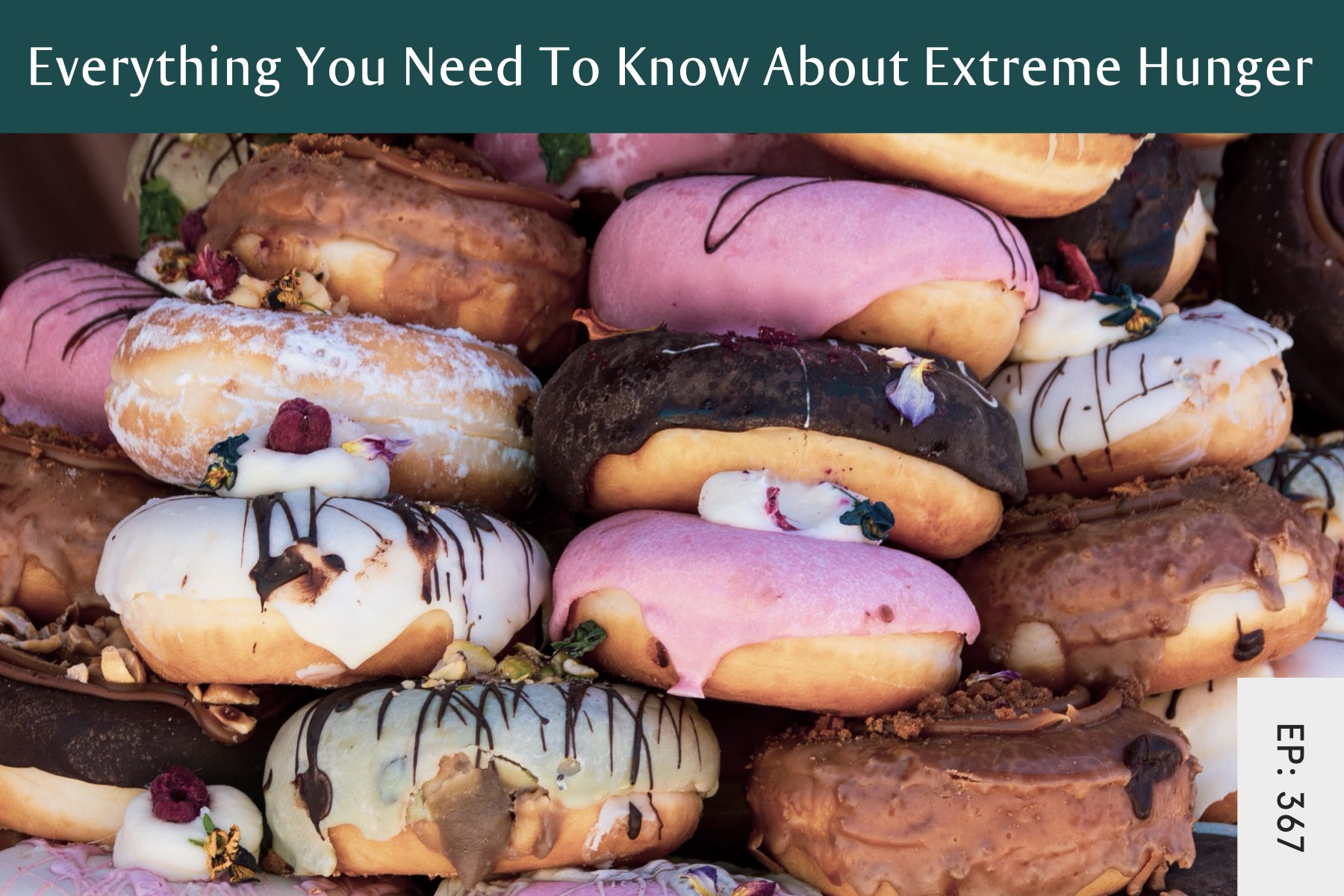
Episode 367: This episode explores everything you need to know about extreme hunger in eating disorder recovery, including why it happens, why it can feel so frightening, and how to respond when hunger feels relentless. It also covers mental hunger, hypermetabolism, weight restoration, common mistakes, and the myths that can keep people stuck.
00:00:00
00:02:03
00:06:15
00:08:23
00:12:59
00:16:26
00:18:24
00:22:24
00:24:51
00:31:28
00:37:02
00:43:19
00:50:00
00:55:15
00:56:49
00:00:00
Chris Sandel: Hey, everyone. Welcome to Episode 367 of Real Health Radio. I’m your host, Chris Sandel. I’m a nutritionist and a coach and an eating disorder expert, and I help people to fully recover.
Before we get started, I just want to say that I’m currently taking on new clients. If you’re living with an eating disorder and you would like to fully recover, then please get in contact. I know that the eating disorder may be convincing you that recovery is not possible or that full recovery is not possible, but I truly believe that full recovery is possible for everyone, and that if you do the things that are required, then you will get there.
So if you’re interested in working together, you can send an email to info@seven-health.com, or you can reach out on Instagram and send a DM to @sevenhealthcompany and just put ‘coaching’ or ‘support’ or something like that in the DM or in the subject line and then I can get the details over to you.
So let’s get on with today’s show. This one, I’m looking at extreme hunger and everything connected to extreme hunger. It feels strange that we’re this far into the show, Episode 367, and I haven’t done an episode specifically on this. It’s come up in calls with different guests, but I’ve never done a full solo episode on extreme hunger, and that’s what I want to do today because it is something that comes up a lot with people. I think it can be one of the most common things that comes up, although not for everyone, which I will go through.
I think it can be incredibly frightening for people, and it’s pretty misunderstood. You can get a lot of different answers when you look up different things online. So I really wanted to be able to explain what I’ve seen from the last 15+ years of working with clients and how I deal with it in practice. Again, there can be different options with this, but just going through all the different components that are connected to this.
00:02:03
Just as a starting point, looking at extreme hunger, what extreme hunger is, from an official diagnosis standpoint, extreme hunger is not an official term. It’s not an official diagnosis that you can get in the DSM or anything along those lines. It’s not really even used that much in terms of research. You’re not going to see research coming up using the term ‘extreme hunger’.
Instead, it’s a term that’s used often in eating disorder spaces to really describe the intense or the profound increase in hunger, increase in food preoccupation that often occurs during the nutritional rehabilitation phase of recovery.
So if you’re looking for research around this, what it will typically use in terms of terms is ‘hyperphagia’ or ‘post-starvation hyperphagia’ or ‘hyperphagic response to refeeding’ or ‘increased appetite during weight restoration’. It will often use those terms more than extreme hunger, and it’s more in the eating disorder space that this has become a very common term to use.
When I’m looking at what extreme hunger is, I don’t think this is just being really hungry. It can be a real collection of different symptoms that arise. It can be physical, it can be cognitive, it can be emotional. Again, different people have different experiences. So let me just share some of the things that can happen.
In terms of a physical standpoint, there can be this feeling of feeling physically empty. “I just feel empty, I feel like I’m bottomless. I’m trying to get this food in.” So there can be this pull towards eating really large meals, objectively large meals, and it can be eating those things pretty quickly. There can be this increase in speed in terms of eating. But it’s eating a large meal, and often finishing that large meal and then 20 minutes later, half an hour later, an hour later, a short time after, feeling like “Okay, I’m really hungry again.”
It can be waking hungry, so you eat a lot during the day and then you’re still waking in the night and you’re feeling very hungry.
There can be the experience of feeling physically full, so “I cannot feel like I can physically fit any more food in, and yet I still know that I’m hungry. I can have this same feeling, a physical feeling of hunger, or I can feel physically full but I’m still getting all this mental preoccupation with food and still thinking about food, so there’s still this mental hunger that is going on even though I’m physically full.”
There can be the experience of getting hungrier the more you eat. Obviously, normally what will happen is that you eat, and as you eat more in a meal, your hunger decreases, which is what happens for most people. And then in extreme hunger, it can be the other way around, where “I felt pretty hungry before a meal and I’m now halfway through my meal and I’m even hungrier than when I started, and I’m getting towards the end and it feels like the hunger is getting even bigger. It’s not decreasing.” Again, that can be the experience of finishing a meal and being physically full and still having the mental preoccupation or being physically hungry and still having the physical urge to eat more food.
It can often be described as a primal hunger, where there’s this primal drive in those moments to eat food, and it’s not the normal hunger that can happen were like “Oh yeah, I haven’t eaten for a couple hours and I’m hungry.” It almost takes over the whole body in terms of this drive towards food and eating.
Again, different people have different experiences with it, but those are some of the physical symptoms that can happen with it.
00:06:15
From a mental standpoint, there’s just a lot of preoccupation with food, so constantly thinking about food. There can be a lot of planning of foods or thinking “What will I have later on?” or “What will I have as part of this meal?” Some people can be scrolling for recipes or watching different cooking videos or watching people eat connected to this. There can be food dreams that start to happen during this point. There can be wondering what other people are eating and there can be preoccupation with other people’s eating.
Depending on how someone’s doing the extreme hunger and dealing with it, there can be a lot of counting down until the next meal. And there can be this feeling of just never feeling like you’re mentally done. It’s just “No matter what I eat, no matter what’s going on with food, it always feels like I’m never able to scratch that itch mentally. It’s just always there.”
A lot of people describe it as becoming really obsessed with food. Mentally, physically, “it becomes my everything in these moments.” I know for a lot of people, when this happens, there can be this real worry that “I’ve now developed this new problem. Man, I thought the eating disorder was bad, and the eating disorder warned me about this, and I shouldn’t have gone down this road.” There can be a lot of fear. There can be a lot of catastrophizing. There can be a lot of things that come up connected to this.
Really, I just want to say you haven’t created a new problem; you’re just experiencing what the body does after there’s been a famine, after it’s experienced starvation. This can happen irrespective of the size of body someone’s in. This isn’t something that only happens when someone is visibly emaciated or fits up to some stereotype of what an eating disorder looks like. I’ve seen clients all across the weight spectrum experience extreme hunger.
00:08:23
I think one of the things that often comes up is “Surely it can’t be normal to eat this amount of food. Surely something’s going wrong if I’m doing this. This isn’t what is meant to happen.”
What I will often come back to with this is the Minnesota Starvation Experiment. This is something I’ve done many podcasts on, but most recently I did a fairly deep dive into it. I will link to that in the show notes. I’m not going to repeat the whole Minnesota Starvation Experiment here, but I just want to mention it because I think it’s a really great example into how extreme hunger happens, what it can look like as part of this.
Very briefly, Minnesota Starvation Experiment happened in the 1940s. They wanted to see what happens, because of the end of the war and because there were lots of countries, areas of the world where there was famine that had been going on, they wanted to figure out what happens when people aren’t eating enough, but also, how do we help someone recover when they haven’t been eating enough? It was a very detailed study looking at all of that.
The bit that I want to point out today is that after they’d gone through the starvation part of the experiment, they then went through a phase of refeeding these guys, and originally there was a refeeding where they were fairly limited in how much they could have, and then at the end, there was a period where they could just eat as much as they want. There wasn’t a restriction on how much they would eat.
When they were doing the original refeeding where they were restricting what they had, they discovered that the human body as part of this needs a lot more than one would expect. If these men were eating around 2,000 calories, that was not touching the sides. It was not really doing anything for them. It was really once they were getting around 4,000 calories that it was starting to make a difference in terms of their repair.
But what’s interesting is when they were finally allowed to eat what they wanted, the men were averaging closer to around 5,000 calories a day. In the first weeks, some of them were getting up to 10,000–11,000 calories a day. What’s interesting is when they were eating these large amounts of food, many of the men were saying “I’m still hungry even though I’ve just had this enormous meal or I’ve had this enormous day of eating. I still feel really hungry.” They could be physically so full and unable to eat any more food, and at the same time say “I’m still very, very hungry.”
I think it’s useful to recognise that there is this mismatch here between what the stomach is saying and what the biology is saying. You can be in a situation where physically, your stomach can’t fit any more in, but biologically, your body is able to register “We are still in so much debt in terms of the energy that this body needs. So even though in this exact moment, I can’t get any more in, I’m also still registering that my body is really hungry and is in need for food.”
I’m mentioning this because I think this is often people’s experience, and this can really mess with people’s head. “Something must be really wrong here if this is going on.” Again, I’m mentioning it because this comes up in the Minnesota Starvation Experiment. We see that this happens for a length of time, but as the men were allowed to continue eating, that then starts to change. This doesn’t go on forever. This isn’t just how their experience is forever; it’s just what happened in that moment.
So just recognising that if you’re going through it, your stomach in those moments can be full long before you’re meeting the energy needs of the body. The reality is, in one single day or in one single week, you’re just not going to be able to reach those needs of the body, so you’re going to be having this mismatch and having that experience where it doesn’t seem to make sense. But as you continue to eat and you’re able to start to bring in that energy, that does start to change.
00:12:59
I want to go through then why extreme hunger happens. I know I’ve kind of started to touch on this a little bit, but I want to go through it in a little bit more detail.
As a first thing to start off with, because I know it can fee like this, this isn’t your body trying to punish you. This isn’t your body out to get you or saying “You did this to me for so long, so now I’m going to get back at you.” I know for a lot of people, there can be this feeling that the body is an adversary to them, and that’s just not the case. The body is trying to save you in these moments.
When you’ve been overexercising, restricting, doing all these things, your body has been running in a deficit. It means that it’s had to turn down lots of things. It’s had to turn off lots of things. So it means there’s a lot of repair work that hasn’t taken place over the years or decades.
I think there can be this idea that “If I’m doing recovery, it’s like filling up a petrol tank in a car. I just need to put in more energy and the tank will fill up and then that’s it.” But that’s just not how the body works, because there is a lot of repair processes that have to happen as part of this. It’s not a quick process. I think a better analogy would be it’s like repairing a city after years of war, and that takes time to do. There’s a lot of rebuilding that needs to happen as part of that. So rather than thinking of “I’m just filling a tank up with petrol”, it’s “How do I rebuild a city after a war has happened?”
As part of this, you’re not just bringing in energy for today. I think this can be where people get tripped up. “I can’t imagine that I need that much energy today.” Especially if this is in combination with someone resting more, which is definitely what I recommend, there can be this idea of “I don’t get it. I didn’t really do anything today; how could I need this amount of energy?”
And the reality is, it’s not just energy for today. It’s energy for today plus everything else that has come before it where you missed out on bringing that energy in, and that can be a lot.
So if we’re looking at what needs repairing, the short answer is everything in the body. It’s your heart, it’s your brain, it’s your gut, it’s your liver, it’s your kidneys, it’s your immune system, hormones, muscles, bone, connective tissue, blood volume, glycogen stores, body fat, hair, skin, every system of the body is needing repair.
One of the things that often happens as part of this is there’s this hypermetabolism that starts to occur as there is more food coming in, and especially as there is more of that extreme hunger when there’s a lot more food brought in in a short amount of time. And this happened with the Minnesota Starvation Experiment as well; in a matter of days, people’s metabolism would double because of the food that is coming in.
00:16:26
Again, let me explain metabolism, because I think this is one of those things that people don’t quite understand, or there can be this fear of like “I’ve broken my metabolism. I did all these years of restriction and exercise and I’ve fundamentally broken this thing” and that’s just not true. Your metabolism is very adaptive.
Metabolism is just really, how much is the body prepared to spend energy to run the body, to do all the different functions within the body? And how much energy is your body producing in the cells connected to this? If there’s not a lot of energy coming in, your body becomes very conservative. It in essence turns down your metabolism, it turns down energy production, because if it keeps producing energy at that rate, it’s going to run out pretty quickly. It’s going to run out of what’s coming in and it’s now then having to start to break down tissues and organs and all of those things to keep that energy there.
And that’s what starts to happen anyway, but your body’s trying to minimise that as much as possible. So it becomes very conservative and it slows processes and turns things off. But once food then becomes consistently available, those real energy-saving measures begin to reverse.
In the beginning, it can still be a little more conservative, so that extra energy coming in, “we’re putting that more towards you putting on fat, you putting on weight because we just don’t know if this is going to still be coming in next week and next month, and given everything that’s happened over this last handful of years or decades, we want to be a little bit conservative in terms of our spending.”
But as you’re consistently doing this and the body realises, “Okay, this energy is coming in consistently. Food is actually available”, it then starts to turn on these processes again.
00:18:24
So what you get is this increased thermogenesis. Thermogenesis is the production of heat, and the way that cells produce energy, as part of that energy production, they produce heat.
It means that for a lot of people going through extreme hunger in a very short amount of time, it can be “Man, I’m so hot all the time. I’m sweating all the time. I’m waking up with night sweats.” This can be a real indication that that energy production has increased and the body is producing more heat as part of that.
As part of that extra energy that’s being produced, we’re rebuilding and repairing tissues and organs. There’s increased protein synthesis. There’s restoration of hormone production and normal endocrine function. And this is going on well before someone gets their period, for example. And it’s not just about periods and reproductive hormones; it’s hormones across the board. But even when there’s not the obvious sign that “I’m now getting my period, which shows my hormones have obviously turned on”, there can be these things that are going on behind the scenes.
There can be increased activity in the sympathetic nervous system, there can be greater energy expenditure for things like digestion and for nutrient processing. Really, it’s just the reversing of so many of the conservation practices that the body had been using over those years or decades.
I think it’s really useful to think about this as well from an evolutionary perspective. It can be very easy to think about this through the lens of the world we live in today with the kinds of foods that are always available to us and the fact that we have supermarkets and that we have restaurants and that we have all these things available.
But the reality is, for all of our evolutionary history, those things weren’t available. So if the body had gone through a period where there was very little food around and then stumbled upon a place where the food was very abundant, the body is 100% going to drive you towards eating that food. It’s not going to say, “Just have a little bit and then we’re going to move on.” It’s going to be like, “Great, this is the thing we’ve been searching for. This is the thing we’re needing to be able to restore all these things that have been turned off and turned down.”
So it makes complete sense that you would have a situation where your body is like, “We need to get this in.”
It also makes sense that certain other functions would be deprioritised. If you haven’t been getting enough food for a very, very, very long time, yes, sleep is important – but if your body’s choosing between not getting enough sleep and eating more food at this point, the food trumps that. So it’s often common that I’ll have clients where “Actually, throughout my eating disorder, my sleep was either good or it was okay. I was managing.” But what often happens is “Now that I’m eating more, my sleep has got worse. I’m waking up more in the night. I’m having trouble getting to sleep.”
Again, this is because the body is recognising food is available and that’s going to trump your capacity to be able to sleep properly. And look, sleep is really important for repair processes, but there can be this window of time where sleep gets worse because your body wants to get in the energy and then your sleep will start to get better.
00:22:24
In terms of your appetite and your eating, I know this is another thing that comes up a lot – this thought of ‘overshoot’. I think it can be useful for me just to mention, but I also find that often people get really fixated on this and talking about “Well, I’m just in my overshoot right now”, and this has a bit of an impact on someone’s choices, whether that be “I’m not really going out so much, I’m not seeing friends so much. I’ve got to wait for the overshoot to drop off and then I’ll start doing those things” and I definitely don’t think that’s a helpful way of thinking about this.
But again, what we saw in terms of the Minnesota Starvation Experiment is that when they look at where the men’s weight was before the experiment and then during the refeeding stage, their weight was higher during that refeeding stage than it turned out to be in the end. So there was this overshoot in terms of the amount of fat the body gained going through this process and the amount of weight that was gained in total. And then for the men, that weight started to come off.
I’m always cautious when saying this because sometimes that happens for people, sometimes it doesn’t happen for people. Obviously the Minnesota Starvation Experiment is really useful in many ways, but it was something that went on for half a year in a very controlled environment, and that can be different to someone who’s had an eating disorder for two decades.
So whenever working with clients, I will say I don’t know what’s going to happen to your weight. Because the reality is, I truly don’t. I’ve worked with clients where they’ve gained a small amount of weight, I’ve worked with clients where they’ve gained a much larger amount of weight, and really, the body is going to do what the body’s going to do. It is very wise and it knows what it needs to do as part of that healing. For some people, that means gaining more weight than others. For some people, that means at some point that weight naturally comes off, and for other people that doesn’t happen.
I’m just mentioning it because it is one of those things that does come up.
00:24:51
Something I want to address is the idea “Does everyone experience extreme hunger?” I want to flat out say: no, this does not happen for every person. I think it can be really useful to understand this because there can be people who are then going through recovery thinking “Oh, I’m not getting extreme hunger, so I’m obviously not doing recovery right, or I never had an eating disorder in the first place.” There can be a lot of judgment that starts to happen because they’ve heard about extreme hunger and they’re waiting for it to happen and it then doesn’t happen.
So I just want to say, for some people this doesn’t happen at any point in terms of their recovery. And for other people, they do have certain experiences. There could be enormous amounts of physical hunger. But there could also be fairly minimal amounts of physical hunger. There can be mainly the mental hunger that happens. There can be waves of hunger. So “Hey, I’m not having this sustained extreme hunger the way I’m hearing about it online or the way it sounds like Chris is talking about it here, but I’ll have days or moments of a day where man, it’s just so extreme at those points, and then the rest of the time, it’s fine.” Or like “Saturday, Sunday, Monday it was really, really extreme, and now it’s come back down again. And then two weeks ago it was really extreme.”
So it’s not that it’s a constant for everyone. You can have these points where there’s waves. It could be that there’s more hunger only at nighttime, and sometimes that’s because you’re restricting during the day, so it makes sense that it happens, and other times it’s, no, someone’s actually eating pretty consistently across the day; there’s just that point of the day that they are more hungry. And it doesn’t necessarily just have to be at nighttime. I’ve known clients where they’re waking up and that’s when the extreme hunger is the highest, in the morning time. So just recognising that there can be different variations of this.
I also think it’s useful to realise that extreme hunger can happen at different points. I think there can be this feeling that “Oh, this should happen at the very early stages. Once I’ve just started to eat more, that’s when it should happen.” And for some people, that is true, but for a lot of people, it can be much later on in terms of their recovery. They can have been recovering for many, many months and things have genuinely been improving and they’re noticing their symptoms are getting better and then bam, extreme hunger really hits.
I think for some people that can be really destabilising where in their mind, they’re already thinking “Oh okay, we’re getting to this point where things are going to get a little gentler now” or “These symptoms are going away, so maybe I’m a little further along in my recovery” and then they get hit by this extreme hunger. So I just want to normalise that and say that that is something that happens. It’s not only when you’re at your lowest weight that this happens.
I know for some people, especially if this happens when they’re approaching the point where they thought “This is the upper limit of where my weight would get”, again, how destabilising that could be. But again, this is a pretty common thing to have happen.
So when I’m looking at who experiences extreme hunger, I’m not very good at being able to predict this. There’s people where I think it’s definitely going to happen and it doesn’t, and there’s other people where I wouldn’t have thought it would be necessarily as likely, but it does.
Some of the possible influences – but again, it’s not that this is always the case – can be the duration of restriction, so how long it’s been going on, and I would say the severity of restriction, so how long people have got in each of their days when they’re restricting and how long they’ve been able to keep this up. And this isn’t a contest. I know how easily the eating disorder can twist these kinds of things. But just looking at how long that’s gone on and the severity of it.
Someone’s age, someone’s genetics, how weight-suppressed someone is – and weight-suppressed for where their body wants to be, because someone could already have started at a fairly low weight before their eating disorder even started, and yes, they can be then looking like the stereotype of an eating disorder, but you can have someone else who’s in a ‘normal’ body, but compared to where they were before or compared to where their body wants to keep them, they are much more weight-suppressed.
Someone’s exercise history can have a big impact on this. I don’t have any data on this, but my recollection seems to be that the more someone has had exercise be part of their eating disorder, especially when there’s been a lot of exercise part of the eating disorder, that’s where you’re more likely to get the extreme hunger. So exercise can have an impact on this.
Purging. If someone’s got a purging history, this can make it more likely, especially if there’s a lot of restriction and then there’s purging that also happens, because it means that when food is coming in, not all of that energy is then staying down, whether that’s purging through vomiting or purging through exercise. It means that energy is not being able to either stay in the body or to be used for the repair because it’s been used in some other way – through exercise, for example.
Different medications can have an impact on someone’s susceptibility towards this. So yeah, there are different factors that can have an impact. But I just want to say, the absence of extreme hunger – you going through recovery and not getting extreme hunger – doesn’t mean that you weren’t sick. It’s definitely not the case. I know I said this a moment ago, but I just want to say it again because I think this can be one of those things that the eating disorder really latches onto and then someone gets stuck in that quasi-recovery place because they start thinking “Well, I was never really that sick in the first place. I don’t need to keep pushing with this.”
00:31:28
I want to just mention about physical hunger versus mental hunger. Again, I know I’ve talked about it a little bit here already; I’ve definitely talked about it in other podcasts. But I think it’s a really important distinction, because what I’ve seen often from people, and I’ve heard from clients, is “I’m just not hungry. I don’t really have any appetite. My body’s not really sending me any signals that I’m hungry. And then at the same time, I’ve got all this food preoccupation. I can’t stop thinking about cereal. I’m noticing what everyone else in the office is eating.”
So there can be this feeling of like, on one hand, you’re not getting any hunger, but on the other, what I’m hearing is there’s all this mental hunger that is going on.
I think there can be this hierarchy that gets created where if you’ve got physical hunger and you’ve got physical signs of hunger, that means it’s really hunger, and if you’ve got mental signs of hunger and “I’m thinking about food” and that side of things, that’s not really hunger. That’s emotional eating, that’s boredom. It gets chalked up to something else.
I just want to say that all types of hunger, whether we’re talking about physical, whether we’re talking about mental, it is still real hunger. The brain and the body can communicate hunger in different ways. So sometimes it is a growly stomach, or sometimes it is these physical symptoms, but sometimes it’s food thoughts. Sometimes it’s cravings. Sometimes it’s imagining food. Sometimes it’s dreaming about food. Those are still hunger signals.
What often happens is that there are so many things that are going on as part of an eating disorder that start to suppress the physical symptoms and start to suppress that appetite.
Restriction starts to suppress appetite. And obviously this doesn’t happen for everyone; lots of people, when they restrict, they get hungry. But for other people, they restrict and the hunger goes away. This is very common for people to say, that “Oh, I can’t eat breakfast or I can’t eat earlier in the day, because if I do that, then I notice how hungry I am. Whereas if I don’t eat, I just don’t even think about it. I’m not even noticing it.” So that restriction then suppresses it.
Stress has a suppressing factor. And again, not for everyone, but for a lot of people. When you’re under stress – and stress can be a variety of different things, but you’re under stress, you’re producing more cortisol, more adrenaline, that whole stress apparatus can have a suppressing impact on your ability to register appetite, cravings, hunger, etc.
Exercise has a suppressing function on appetite. Again, not for everyone, but for lots of people, that can be the case. Or at least, it can suppress it for a window of time. So “Hey, I just don’t feel that hungry during the day and there’s been a lot of fasted exercise, but at some point in the late afternoon or in the evening time, that’s when the hunger starts to increase.”
The other part with this is – and I’ve talked about this on other podcasts as well – physical hunger isn’t just a growly stomach. There can be lots of different symptoms that can point towards hunger from a physical standpoint.
It can be having a headache. It can be a slight nausea feeling. It can be the cold tip of the nose or the hands or the extremities. There can be a little more irritability, there can be a little bit of difficulty focusing, etc. I’ve got a whole long list of all these different symptoms.
What can often happen is that they are happening so frequently, or even happening permanently, that someone doesn’t even recognise those as hunger. The physical symptom they’re looking out for is the growly stomach, and “If I’m not getting that, then I’m not hungry.”
Often what I find, it’s not that the body’s not sending physical signs of hunger; it’s sending them all the time. Someone has just disconnected them from hunger. Someone doesn’t register that that’s actually a hunger system. It’s like “I just get headaches. I am just irritable. I am just on edge. I do just have a low-grade nausea feeling quite often.” And none of those are registered as hunger. They’re just like, “That’s just how I feel.”
So I think it’s important to recognise that, one, there’s often a lot of physical symptoms that you’re not registering, but two, even if there’s none of those things, there can still be all of the mental hunger, and the mental hunger is hunger. It’s not this not-as-good version, it’s not as accurate or any of those things. This is hunger in the same way as the physical symptoms are.
00:37:02
I want to talk about why this can feel so frightening. It probably seems pretty obvious why this can feel so frightening, but I would say it’s not the hunger per se, often, although the experience can be unpleasant; if I’m eating and I’m getting to a point of fullness and yet I’m still hungry and it just never seems to scratch that itch, I can understand where hunger in and of itself can start to become quite scary.
But often, it’s less about that and more about what this then means. “It means I’m binging and I’ve now swapped one eating disorder for another.” I think this is a really big fear, that “Hey, I’ve gone from this restrictive eating disorder to now I’ve developed binge eating disorder” or “I’m now addicted to food.” There’s this belief behind the fact that “I’m getting this extreme hunger; it means this thing.”
Or “I’ve broken my body. I’ve broken how my body is able to relate to food and how it functions. Maybe I’m just not able to get full. Maybe that just doesn’t work for me anymore because of everything that I’ve done.” So there’s that fear of “It’ll never stop.”
There can be this feeling of “I’m greedy. This isn’t even really about what my body needs. It’s just me being greedy. This is me just letting myself go.” All of those kinds of thoughts. “I’m really weak.”
I just want to say that it makes sense that those kinds of thoughts come up; that’s what the eating disorder does. It will latch onto anything that it can to try and reassert control and try and get you to go back to doing what it was doing.
I very much think of the eating disorder as it’s trying to keep you safe, and it’s trying to keep you safe in the way that it knows how to keep you safe. So if you’re going a different course, if you’re starting to eat more, if you’re starting to rest more, if you’re doing these different things – especially if you’re doing the extreme version of that with eating a lot more food and having this extreme hunger – of course the eating disorder is going to get loud and is going to try to use every trick to get you to go back to doing what you were doing before.
I think that’s even more amplified at the moment because of GLP-1s and the culture that we’re living in connected to this. It’s really interesting; in the UK, we have rules around the fact that you’re not able to advertise medications on TV – I think it’s still on radio as well. I know any time I’ve travelled to the US, you’re watching TV and then there’s all these ads about “Ask your doctor about such-and-such.” In the UK we’ve never had that, and I think that’s a wonderful thing. Our advertising is not just medications to people.
But what I’ve seen for the first time ever is the way that they’re now getting around this is that they’re telling a story about ‘health’ or about weight loss or about whatever, and it’s then “Get in contact with our clinic.” So there’s now basically ads about these medications but they’re not specifically saying these medications. They’re just saying “Get in contact with our clinic and we can look at different options that could be available connected to this thing.” It’s been really eye-opening. This is the first time that I’ve really seen this happen, and it is everywhere in the UK.
I am imagining this is happening in the same way everywhere else in the world, or the vast majority of places around the world. So it makes it much more difficult at this point to be going through this when all of that’s going on. And there has been this real return to the very, very thin ideal that felt like it was something from back in the early ’90s. Yes, we’d had completely unrealistic beauty standards and aesthetic standards for everyone, but we hadn’t had that ideal for a while, and it feels like that’s become much more into the culture at the moment.
I know that can be tricky for a lot of people, but if I’m thinking about the GLP-1 piece, what I’m hearing is more tough for people is that so many people around them are doing. “My auntie is now on it. My sister is now on it. My brother’s now on it. My mum’s now on it.” It’s not just the celebrity culture or what someone’s seeing in terms of that end of the spectrum; it’s “All the people around me are on this” and that makes it more difficult.
So you’ve got that going on, you’ve got social media and so much of the messaging and so many of the things around how hunger is dangerous and all of these things. So I totally get why there are all these thoughts that are then coming up.
I’m mentioning this because I think it’s useful to be able to manage expectations so that when it comes up, the response should be “Of course I’m thinking this way. Of course I’m having those thoughts come up. It doesn’t mean that it’s true. It doesn’t mean I believe them. It doesn’t mean that they’re values of mine.” Thoughts think themselves. Your mind is generating these things and they come into your conscious awareness, and just being able to recognise, “Oh, of course my mind is going to think that way.”
And I know I’m able to be very objective and unemotional as I’m talking about this on a podcast, and it’s, how do you bring in some more of that as part of this? And being able to recognise that “These thoughts are coming up and it makes sense that they’re coming up, and they don’t have to necessarily have an impact on the choices I make and the actions I take.”
00:43:19
This then leads into this next section which I want to go through, which is the common mistakes that I see around this. This is where I see people trying to deal with this in a way of trying to suppress some of this. So “How do I turn down the noise on this, but without actually doing the thing that the body’s asking for?”
I’m eating a lot of volume, so I’ve increased the amount of vegetables I have coming in, or I’m eating a lot of salad, or I’m eating a lot of these foods that are very volume heavy, but actually aren’t providing me with a lot of energy. I’m trying to do this, trying to get that feeling of fullness. If I can do that, maybe it’ll turn down that noise a little bit.” Or “I’m drinking a lot of water. I’m doing diet drinks” or “I’m chewing gum” or “I’m trying to find the low-carb bread or the low-calorie swaps.”
Basically “I’m trying to do these things that are going to trick my body into not registering the hunger in the way that it is before.” While someone may be able to get some tiny bits of relief from doing this, it’s not really solving the problem. So even if the hunger goes down a little bit, it’s not really a remedy and it’s just kicking the can down the road. You’re going to experience this again tomorrow or next week or whatever it may be.
So I’m very much against all of these options that a lot of people try – and again, it makes sense why someone is trying it, because this is what the mind is often suggesting, but yeah, I don’t see them working out pretty well.
Then there can be more of the tactics around waiting or delaying or ignoring the mental hunger, or being really rigid of only sticking to these particular mealtimes, and “I’m not eating outside of that.” Or “Yes, I’m going to allow myself to eat, but I’m going to eat only the ‘healthy’ foods. I’ll eat more, but I’m definitely not going to be eating those things.” Again, I don’t think that that works at all.
Then there can be the changes in terms of exercise and “Hey, I’m now compensating because I did have that bigger meal or I did allow myself to eat more.” Again, none of that really works.
One of the things that comes up a lot, which I mentioned a few moments ago, but I want to talk about it explicitly – this idea that “I’m already weight restored.” This, again, I think can be one of those things where maybe at some point in treatment you were told, “Hey, we just need to get you to this number. Once you hit this weight number, once you hit this BMI, then you’re ‘weight restored’.” Or maybe you made this pact with yourself. Maybe you said “Hey, I’ll do recovery, but I’m not allowing myself to go over this number”, so you’re now at that point and feeling like “I should be weight restored as part of this.”
Or you’ve suddenly hit some point in the BMI scale of “Of course I must be weight restored because my weight is ‘normal’ or my weight is ‘overweight’” or whatever it is. “Hey, at this point I should be weight restored.” Or not ‘I should be’ – “I am obviously weight restored because I’m at this weight.”
When I’m looking at, is someone weight restored, I’m not looking at the number on the scale. It’s not that it can’t be a bit of information, but it’s not the be-all and end-all. It can be useful to look at where were you before, where are you now, what can we glean from that – but I’m much more interested in terms of, what’s going on in terms of all of your physical symptoms? What’s going on in terms of your mental symptoms? What’s going on in terms of your freedom around food and your capacity to actually be able to eat food and move on and all of those different things?
The way that I know someone is weight restored is because they’re able to demonstrate that through their physical health, through their mental health, etc. It’s not just you’ve hit some BMI. It’s not that this is previously where you used to be. It’s not because you’ve determined this should be your set point. It’s not that you’ve got your period back. There’s lots of people who get their period back and they’re way, way, way off being fully recovered. So just because “Hey, I got my period back”, that doesn’t mean you’re now weight restored.
There’s so many different things that people use to prove they’re weight restored, whether it be body composition or hormones or whatever it may be, and I think it’s normally that someone’s picking this one thing or one or two things and looking at it in a very narrow way as opposed to “Hey, we need to look at this bigger picture.”
So as I said earlier, there can be points where people feel like “I’m weight restored and now I’m also having extreme hunger, and these two things don’t match up.” The reality is that while you feel like you may be weight restored because of whatever metric you’re looking at, it’s obvious for the body that that’s actually not the case. And that’s not just because of the extreme hunger; it’s because of this symptom and this symptom and this symptom and because of the way you’re still thinking about food in this way and this way and this way.
This can be a really tricky thing, but recognising “Hey, extreme hunger can still happen even when I think that my body is weight restored.”
00:50:00
Then the question is, should I honour it? How do I deal with the extreme hunger? My response to this is, yes, you should definitely respond to it and you should respond to it very promptly. You should respond to it very consistently. You should respond to it not trying to outsmart it, but actually trying to listen to it and give it what it needs.
From a practical standpoint, this can look different for different people. Typically where I’m starting is three meals and three snacks as a baseline. Let’s put that in as a baseline and see what we notice. It could be that – and look, the reality is if you’re a 22-year-old who doesn’t have a job, who lives with your parents and you have, in the whole scheme of things, pretty low responsibilities, your ability to deal with extreme hunger may look very different to someone who has got three kids, is going to work, is going through recovery. Your ability to deal with this is going to be different.
What you need to look at is, “What are the genuine constraints that I have, not the constraints that the eating disorder makes up? What are the genuine constraints I have where I can’t actually change that thing? I still need to be here at this point. What are the genuine constraints I have, and given those constraints, how am I able to deal with this?”
As I said, three meals and three snacks I think is a baseline, and then from there, it could be “You know what? I’m going to still keep that three meals, three snacks structure. For some reasons I need to keep to it. So rather than bringing in more snacks or meals in addition to those, I’m going to be increasing those three meals and three snacks. I’m just making those bigger.”
It could also be “Hey, that just doesn’t work for me, so actually what’s happening is I’m having my breakfast, then I’m having two snacks in the morning, then I’m having my lunch, then I’m having two snacks in the afternoon. So actually, I’ve increased this a lot more.”
It could be “Hey, you know what, I know everyone talks about it’s a really bad thing to eat just before going to bed, but I’m eating just before going to bed. I know people say you shouldn’t eat if you wake up in the middle of the night, but I’m going to be leaving stuff on my bedside table and when I wake up, I’m going to be having something to eat. With every one of my meals, I’m having a dessert because I need to be getting in more energy that way. I recognise that I’m hungrier in the morning, so I have my first breakfast and then I have my second breakfast.”
There can be lots of different ways of dealing with this, but my recommendation is to really honour it and to listen to it. If you’ve eaten and you’re hungry 20 minutes later, you have permission to eat again. Even if you’ve eaten a really big meal, you have permission to eat again.
And again, some people can do that because they have the lifestyle that allows that to happen. Some people genuinely can’t, so it’s okay. If that can’t happen, what do we need to do at the next meal? Or how do we find a way of being able to get some food in, even if you can’t sit down for an entire meal again?
I often work with doctors and people working in the ER, and we have to get pretty creative about how to do these things because the reality is, they’re not saying “I’m going to go and take my 15-minute break and I know I’m going to have my lunch break at this time every day.” It’s “This can be really chaotic, and I need to figure out ways of being able to get food in where I had a 45-second window where I was able to get this thing in, and I got in a whole bar with three bites. And then 40 minutes later, I had another very short window and I was able to glug down half of a milkshake during that time and then move on. This is what I need to do because these are the constraints that I have.”
The take-home message with this is giving your body what it needs. That is the way to best support this, and to have it be as short-lived as possible. Because yes, I understand that extreme hunger is your body saving you, and I also know that it’s not the most pleasant thing to be going through. So how can we get this over as quickly as possible?
Again, not in some way where “I need to optimise and I need to figure out the absolute best way of doing this as quickly as possible because I want to be the best person at getting through extreme hunger”, where you take on this perfectionist way of dealing with this, but “If I could be speeding this up, what are the things that could actually help that to happen?”
00:55:15
That then connects on to, how long does it last? My answer with this is: it depends. I’ve seen people where their extreme hunger lasted a couple of weeks and that was it. And part of that was during those couple of weeks, they ate a ton of food, and they were in a position where they didn’t have a lot else on and they were able to eat a ton of food in a very short amount of time.
For other people, I’ve seen it go on for multiple months and for a much longer amount of time. And sometimes that’s because they’re just still not giving themselves the full permission during that stage, and other times, no, someone really is giving themselves the full permission, but for whatever reason, whether it’s how long the eating disorder has gone on or the amount of exercise that they were doing during that time or whatever the reason, their body needed more energy coming in for a longer amount of time in this more intense way.
The more that you can do the things that your body does need as part of this, the shorter you are making this out to be, or you’re increasing the likelihood of making it as short a time as possible. But I would say normally at the short end we’re talking about a couple of weeks, and at the long end, many months. It could be 6 months, it could be 9 months, depending on what’s going on.
00:56:49
I just want to add a few quick myth-busting ideas connected to this. I’m not going to spend a ton of time going into these, but I just want to say them. And I’ve probably said them in some way already throughout the podcast, but I just really want to say it here before we close out.
Extreme hunger is not binge eating. And I’m not saying this, again, to create the hierarchy around eating disorders, where “You’re restricting, that’s fine, but if you’re doing binge eating, that’s a really bad thing to be doing.” I’m saying it’s not binge eating because people think “I’m developing another eating disorder.” Extreme hunger is your body needing this energy because of where it is.
And look, in a lot of ways, that’s what binge eating is, too. But I’m making that distinction because there is this – when people use the word ‘binge eating’, there are all these connotations that are connected to it. It’s not a neutral term for most people. So what I’m saying is that this is something that is biologically driven, that is really important as part of your body. It is not the same as this ‘bad’ thing of binging.
And for a lot of people who do binge eat, I’ll also tell them, let’s come up with a different term because you have these negative associations with this. And this is also being driven by you restricting. So it could be useful to come up with a different term.
Trying to use a term for this that actually has either neutrality to it or is a positive thing. So ‘post restriction feasting’ or ‘recovery eating’ or whatever works for you, I think is really helpful. And this can be useful whether you’ve got extreme hunger or whether you’ve got binge eating.
It’s not because of lack of willpower. This is not a willpower thing.
It doesn’t mean that your metabolism is broken. If anything, your metabolism is often really firing up during this stage.
It doesn’t mean that this is going to go on forever. Just because this has started and this is how it is for this week or this month, this is not a prediction of what will happen forever.
It doesn’t mean that you’ve developed food addiction. That’s definitely not the case.
It doesn’t mean that your recovery has gone wrong, like you were doing recovery fine up until this point. That’s not the case.
And it’s not something you need to control. It’s actually something you need to learn to have permission and allowance around.
It’s one of the most predictable responses to prolonged energy deprivation. As I’ve said so many times, it’s your body trying to save you, so it makes sense that this happens. And while it doesn’t happen for everyone, it happens for a lot of people. It is very predictable that this is where your body will end up once you start to give it food again after this extended famine that has gone on.
So that is it as part of this episode. I often get off these and realise “I didn’t say that thing and I didn’t say that thing and I didn’t og through that topic”, so there’s probably stuff that I’ve forgotten connected to this. If you have any questions on this, on things that I’ve missed or things that are going on for you that I didn’t mention here, please get in contact. Send an email to info@seven-health.com and I can get back to you connected to it.
But really, I just want to say, your body is not betraying you if this is happening. It’s your body really just asking for what it needs, and I think there can be this real misinterpretation of this, like “This is evidence that I’ve lost control, this is evidence that I’ve done something wrong”, and it’s actually just evidence that your body is really fighting to survive. It’s finally seeing that there is energy around and it wants to be able to use that, to be able to repair. It’s not going to go on forever, but it’s an important phase that helps the body to get into a better state.
As I mentioned at the top, I’m currently taking on new clients. If you’re wanting to fully recover – maybe you’re going through extreme hunger at this point. As I said a number of times, this is something I work on very regularly with clients. So if you are going through extreme hunger, if you’re not going through extreme hunger but you want to reach a place of full recovery, then please get in contact.
You can send an email to info@seven-health.com or you can send a message to @sevenhealthcompany on Instagram, send a DM. Just put ‘coaching’ or ‘support’ in the subject line or in the DM and I can get the details over to you.
So that is it for this week. I will be back next week with another episode. Until then, take care, and I will see you soon!
Thanks so much for joining this week. Have some feedback you’d like to share? Leave a note in the comment section below!
If you enjoyed this episode, please share it using the social media buttons you see on this page.
Also, please leave an honest review for The Real Health Radio Podcast on Apple Podcasts! Ratings and reviews are extremely helpful and greatly appreciated! They do matter in the rankings of the show, and we read each and every one of them.



Rebroadcast
EP: 301

Policies
Social
Copyright © 2009 – 2025
seven-health.com · All Rights Reserved.
Share
Facebook
Twitter