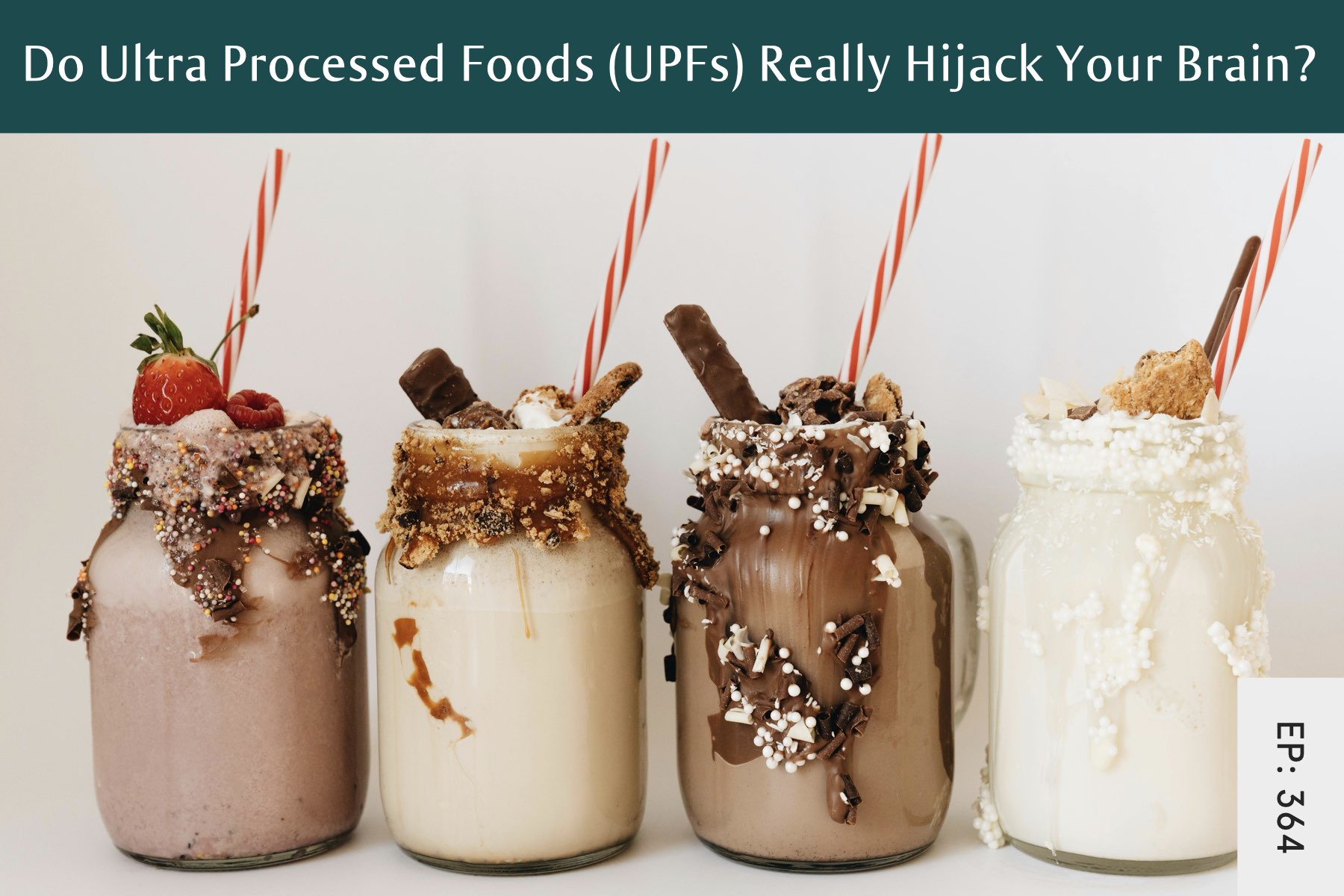
Episode 364: Are ultra-processed foods really “addictive” or is the fear around them creating more anxiety and obsession around eating? In this episode, I break down a new 2025 study exploring dopamine, ultra-processed foods, and overeating, while unpacking why restriction, deprivation, and psychology matter far more than simplistic “food addiction” narratives.

00:00:00
00:01:41
00:05:43
00:10:54
00:14:35
00:16:57
00:20:16
00:22:18
00:23:45
00:26:54
Links
00:00:00
Chris Sandel: Hey, everyone! Welcome to another episode of Real Health Radio. I’m your host, Chris Sandel. I’m a nutritionist and a coach and an eating disorder expert, and I help people to fully recover.
So before I get started with today’s show, I just want to say that I’m currently taking on new clients. I’ve opened up one-on-one spots again recently, and they’re filling up pretty quickly, but at least for now, at the point of recording this, I do have some spots available. If you’ve been living with an eating disorder for any length of time, whether it is a year, a couple years, whether it’s multiple decades, I truly believe that people can fully recover. And if you would like to have help to get to that place of full recovery, then I would love to be able to support you with that.
You can send an email to info@seven-health.com or you can send a DM on Instagram @sevenhealthcompany, and just put ‘support’ in the DM or in the email subject line and then I can get the details over to you.
So, let’s get on with today’s episode. Today I want to look at ultra-processed foods (UPFs) because they seem to be coming up everywhere. Theres’ different books about them. They’re coming up in the news cycle a lot. I’m seeing a lot of people posting about it on social media. There is a lot of fear that is connected to these. I know with clients, I know within my group, people are mentioning this and having worries around this, and there can be so much noise and also misinformation around it. So I wanted to just have a little bit of a look at this.
00:01:41
I wanted to do that by looking at a particular paper. I came across this – again, I think it was on social media that I came across this. There was this paper that was done, and I wanted to look into it and, as part of this episode, share the results of what the paper found.
So the paper is called ‘Brain dopamine responses to ultra-processed milkshakes are highly variable and not significantly related to adiposity in humans’. It appeared in the March 2015 edition of Cell Metabolism magazine.
The study specifically wanted to look at whether ultra-processed foods produce exaggerated dopamine responses and addictive-like eating behaviours in humans. I think a lot of this is because there’s been so much rhetoric around ‘these foods are addictive, it’s like having cocaine when you eat these types of foods, it lights up the same places in the brain and this is why these foods are so addictive and we need to keep them out of our food environment’. And with the idea that ‘if we have processed foods, it leads to overeating, and if we have overeating, that equals addiction, so therefore processed foods are addictive’.
What this paper was wanting to look at was if there are these dopamine reactions in the brain from eating these foods or if that is not what occurs.
Part of the reason they wanted to do this as well is that many of the food addiction claims come from animal studies or observational studies or self-report questionnaires or assumptions based on the palatability of food, and what they wanted to do was have a study that very much looked at the dopamine hypothesis in humans.
The dopamine hypothesis is, if I’m thinking about ultra-processed foods, the idea that certain foods, especially those that are high in sugar and high in fat, produce this unusually large dopamine response in the brain’s reward system.
Dopamine is often simplified as this pleasure chemical, although if we want to be more accurate with it, it’s linked to things like reward and motivation and reinforcement and learning and salience, so ‘this matters; pay attention to it’.
The theory goes something like, ultra-processed foods are engineered to overstimulate dopamine pathways in a way that resembles addictive drugs, and because of this, people then crave them more, they lose control around them, they continue eating despite negative consequences, they become ‘addicted’ to these. So a lot of the narrative around these foods has come from this addiction idea, the addiction model, and what we see with drugs is just the exact same thing with food.
One thing I want to just mention is that the existence of dopamine activity doesn’t automatically mean that something is addictive. For example, we can notice that there is a dopamine rise when we have sex, with social connection, when listening to music, with gambling, with novelty, with achievement, with exercise, with eating food generally. So the key scientific question with this isn’t “Does food activate dopamine?”, because it clearly does, just like so many other parts of human life. But the real question is, “Do ultra-processed foods produce this drug-like dopamine response that reliably overrides appetite regulation and creates this addictive behaviour?” That was what the study was trying to investigate.
00:05:43
Let me look at the design of the study and what was included as part of it. As part of the study, there were 61 participants, 61 adults. They were in varying body sizes; they had varying body fat levels. They were admitted into a metabolic research unit before the study, and this was a really tightly controlled environment. This isn’t people who were free living and eating randomly at home. This is people who are in this tight environment.
And look, there are pros and cons connected to that, but what they wanted to do was “If we do it in this very streamlined way, if we’re very specific about this when we’re serving these foods, what actually starts to happen?”
Before the people actually had – I’m going to talk about they had a milkshake; they also had a buffet – before they did this, they had this controlled maintenance feeding time. It was roughly 3 to 5 days. It depended on the participant. What they wanted to have was the participants were having this maintenance amount of calories, the meals were controlled by the researchers. They wanted to have body weight be stable over this time.
What they were trying to do is really standardise the metabolic conditions that each of the people were in as much as possible. Obviously, humans, there’s a huge amount of variation, but as much as possible, what can we do in terms of the regularity of eating, the kinds of foods that people are eating, so that we’re getting to this more standardised place. They wanted to, in essence, minimise any recent overeating or undereating experiences so that we’re coming into this in a similar place, and just trying to remove or reduce any confounders.
The first thing was a milkshake test. So before they did this, they had that 3 to 5 days of doing the maintenance, and then the participants were fasted overnight. It was roughly for 17 to 18 hours, which for me sounds like an ungodly amount of time. I would not be feeling great at the point of me wanting to then have that milkshake. But again, they wanted everyone to come into that place in a similar state, where they have all been roughly 17 to 18 hours since they’d last eaten.
So they arrive in this standard metabolic state; their hunger levels are meant to be fairly controlled because they’ve all had this same amount of time since they last had something to eat. And this was really designed to isolate the food response itself so that there couldn’t be other factors, or they’re trying to minimise those other factors.
As part of the milkshake, they consumed this milkshake – it was high in fat and in sugar. It had whole milk, it had heavy cream, it was pretty low protein in its makeup. What it was meant to be doing is representing this ultra-processed, highly palatable food.
I will say the milkshake was 226 ml (I don’t know what that is in ounces; I probably should’ve done this before I hit record on this). It’s less than a can of Coke in terms of the amount, so it’s not like they’ve had this ginormous milkshake. It is a fairly small milkshake in the whole scheme of things. But it is still something that has sugar and fat in fairly decent quantities. It is still highly palatable. It is still a milkshake.
So what they did is once they then had that, they wanted to measure the dopamine-related changes by using a PET imaging scan. PET stands for positron emission tomography. I don’t think I’ve ever said those three words together; I just say a PET scan. Basically, it’s a brain imaging technique that’s used to look at the activity inside the brain indirectly through using radioactive traces.
In this study, they were specifically looking at traces that bind to dopamine D2 and D3 receptors, and basically what they were doing, the simplified version of how this works: the traces then attach to those receptors. If the brain then releases more dopamine, more dopamine competes for the traces, and then more dopamine equals less traces binding detected on the scan. Researchers are then able to estimate the dopamine changes indirectly because of this.
This wasn’t that they were seeing dopamine light up the brain, but really they were just measuring the changes in receptor binding that are then interpreted as changes in dopamine activity.
The reason I mention this is because, yes, PET scans are sophisticated, but they are also indirect. The dopamine measurements aren’t this perfectly straightforward thing. And I’m just mentioning this so that you can understand the nuance with this test or this piece of research.
00:10:54
So what did they then actually find as part of this? They did not find any statistically significant overall dopamine surge. Yes, there were some changes in terms of dopamine, but there wasn’t the dopamine surge that you would expect based on the rhetoric around the idea that these foods are like drugs and that they have this impact on causing this huge surge in dopamine.
There were no universal reward responses. Some people had higher, some people had lower, but there wasn’t this ‘when you have this thing, it automatically creates this response’ in the way that it does with using other drugs, as an example. So there wasn’t any evidence supporting the idea that ultra-processed foods, or in this case, this milkshake, produced the drug-like dopamine effects across the participants.
Then the next thing that they did was a buffet meal. This was a couple of days afterwards, and again, the participants arrived in the standardised state, so again they had this fast, and then they were offered a buffet and they were told that they could eat as much or as little as they want.
Just to detail the buffet, if you’re thinking it was a buffet with the standard stuff when you go to a buffet, that is not the case. And again, I want to just say this so that you understand exactly what happened. As part of the buffet, there was whole-wheat toast, roast beef deli meat, turkey deli meat, Swiss cheese, American cheese, tomatoes, lettuce, grapes, Chips Ahoy cookies, mayonnaise, mustard, salsa, baby carrots, chips, and water.
So it’s not that there was a buffet with a million and one things in it; these were the things that were there, but there was as much as someone wanted to eat of those things. What they did in terms of the researchers, things were weighed and measured carefully so that they were then able to look at the data in terms of how much people consumed, etc.
So what did they find as part of this? The important thing to say is it’s not that nobody ate a lot of food or that the ultra-processed foods had absolutely no effect; it’s just that responses were highly variable. Some people ate more, some people didn’t. Dopamine responses varied considerably.
Interestingly, responses were not strongly linked to BMI or body fat. I think this is often an argument that is used, that when someone is in a higher weight body, their ability to eat these foods and for it to be safe is just not there, and the dopamine is going to have such an impact on those people. And that’s just not the case.
Also, importantly, glucose and insulin responses did not explain the dopamine findings either. So it wasn’t that the people who were having the highest glucose response or the highest amount of insulin or the lowest amount of insulin could then predict what would happen with the dopamine levels that that person had. Those two things were not connected.
What we can then take from that is that human eating behaviour is far more complex than ‘ultra-processed foods are addictive’. There is much more to it than this.
00:14:35
Let me go through what I think some of the key findings are. Obviously I’ve already touched on some of these, but I just want to make sure we hit them as I go through this.
Key finding #1: People don’t universally overeat ultra-processed foods in the dramatic way that a lot of the narratives predict they will. The data did not support that ultra-processed foods automatically override human appetite regulation. Some people did eat more, some people didn’t, but there was a real variety there. So we can’t just pinpoint that ‘it’s ultra-processed foods that made me do it’.
The second key finding, which I think is really important, is that pleasantness and reward ratings do not strongly predict excess intake. I think this is really important because a lot of the narratives around this stuff, especially the addiction discourse connected to it, is ‘if something is highly pleasurable, it will then equal compulsive overeating’. But the paper really undermines that simplification. The reality is that foods can be highly enjoyable without producing an addictive response, and that it’s normal human biology to actually enjoy food and to find it pleasurable and to like the taste of it or to feel satisfied from eating it, and just because that’s happening, doesn’t mean it’s going to create this addictive response.
The next finding was that there were what they refer to in the paper as ‘responders’ and ‘non-responders’. This was one of the most useful clinical findings: that some individuals were more susceptible to eating more of certain foods, but others could regulate much more effectively. This gets away from the simplistic argument of ‘this food is addictive to everyone’ and the real universal claims around this and the real deterministic models connected to it, and really much more supports individual variability, context, learned behaviour, dieting history, psychology, the energy state that someone is in. Just being able to remember that all of these things are important.
00:16:57
So, why do I want to talk about this and do an episode on this? I think food addiction language affects people with eating disorders a lot, and for many people – and as I said at the start, I’m hearing this from clients, I’m seeing this in my group, I’m definitely seeing a lot of it online – there is this real fear of ultra-processed foods that then increases restriction.
And I don’t think it just increases restriction around ultra-processed foods. I think it increases restriction around all foods because “There are these foods that are really dangerous, but I also just don’t think I can really be trusted with all foods.”
When you have restriction, it increases food obsession. The more that these things are made off-limits, are put up on a pedestal, the more that you start to think about them. And that food obsession then gets mistaken for addiction. It’s the, “Man, I’m always thinking about food. It has been like that for as long as I can remember, even though an eating disorder has been going on for as long as I can remember.” But it gets thought about as like “This is just who I am. I’m so obsessed with food. It’s always going to be like this and that’s why I need to keep it at arm’s length. This is why I need to keep doing what I’ve been doing.”
And then if there are times where there are really strong cravings or you do end up having a binge, whether that’s a ‘binge’ and you ate more food or a binge where it would actually fit the category of what people talk about in research as being a binge, it then gets blamed on those foods. “It was the food that drove me to do it”, often because there are certain foods that are eaten in those situations.
The thing I want to remind you is that a starved brain responds intensely to all foods, but particularly calorie-dense foods, and that’s not evidence of addiction. It’s more likely evidence of starvation. Your brain and your body is very wise and understands, “Hey, there’s a lot better energy and more of the things that I need if I eat this more processed food than if I’m eating broccoli or I’m eating this other thing that is a lot of volume but isn’t actually giving me a lot of energy.”
If you look at things like the Minnesota Starvation Experiment, which I’ve done a number of podcasts on, which I’ll link to in the show notes, or you look at other research that looked at restrained eating, which again, I’ve done – I don’t think I’ve done a podcast on, but I’ve definitely written about before – basically, when you get into a lower energy state, when you restrict, it just makes food obsession, and the ability to really control oneself around these foods once they start to be eaten, you get less and less capable at being able to do that.
Again, that’s not an indicator that you’re addicted to these things; it’s an indicator of the state that the body is in.
00:20:16
The thing I want to touch on – and I touched on it a moment ago, but I really want to hammer this home – is that there is a difference between reward and addiction. Especially when we think about food, humans are supposed to enjoy food. And this is true for especially calorie-dense foods or sweet foods or fatty foods. It’s useful for us to be able to enjoy that.
We need to start to decouple this idea that pleasure equals addiction. Sex is pleasurable. Friendship is pleasurable. Music can be pleasurable. Sunshine can be pleasurable. Drinking water, being in water can be pleasurable. We don’t just automatically say that all those things are addictive. Pleasure does not equal addiction. Addiction involves compulsivity, it involves escalation, it involves persistent use despite harms, it involves impaired control across contexts, withdrawal-like symptoms, narrowing of behavioural repertoire – there’s lots of other things that are involved as part of addiction, and this paper does not strongly support the idea that ultra-processed foods consistently produce this pattern and that they produce addiction.
And look, I will say that certain foods may become part of someone’s compulsive behaviour patterns and that this is true for some individuals, especially when there are certain psychological or environmental contexts going on, especially for someone when there has been restriction, when there’s a history of an eating disorder. But that is different from proving that ultra-processed foods are universally acting as this pharmacological addictive substance, which, as I said, the paper does not support that as an idea.
00:22:18
I want to be honest about some of the limitations connected to the paper, because it is 61 people who were brought into a lab and done in this very particular way, and I’m mentioning this because I know for these kinds of things, there can always be pushback about “What about this thing or what about that thing?”
So yeah, I will get it out in the open that the milkshake and the size of the milkshake and how it was consumed is not representative of real-world ultra-processed food eating.
Dopamine on its own might not be the right marker to be looking at. Addiction is not just dopamine.
PET scans can be indirect and they can be noisy, so maybe there’s something else that we need to look at with this.
Acute responses, like having one buffet or having one milkshake, can be very different to chronic adaption that can happen.
The buffet wasn’t particularly hyperpalatable in the way that other real-world buffets could be.
There was a pretty small sample size; it’s 61 people. Addiction may exist for some people and for only those people, and hey, this just wasn’t enough people to really start to capture that.
So I understand that there are limitations with this, and I think it’s useful to mention those limitations.
00:23:45
But when I think about the kind of clients that I work with and people who are looking to recover from an eating disorder – and even for people who just want to have a better relationship with food and to not be dieting and to not be restricting and not have disordered eating, so wherever you are on that spectrum – I truly believe that working on one’s relationship with food is going to yield way better results than demonising food.
And it’s going to yield way better results than creating this big “Those things are off limits and I have to restrict them and I’m not allowed to have them ever or we’re not allowed to have them in the house” or anything along those lines.
I don’t think that’s going to be as helpful as someone saying, “I want to learn how to have food be just food again. And yes, there are certain foods that are more palatable than other foods, and that’s okay, and I can notice the difference with those sorts of things, and I can get to a place where when I’m eating, there’s lots of different reasons I’m eating. I can be eating for pleasure, I can be eating for the fact that I need a meal that’s going to sustain me for the next 4 hours because I’ve got quite a long meeting going ahead. I want to eat a meal that I can get in in 5 minutes because it needs to be functional because I need to get on to the next thing.”
To get to a place where people are actually able to make decisions around eating that isn’t just about taste, but is actually about lots of different things. And I think that comes about not by demonising food, but by someone working on their own relationship with food and being able to notice all of those differences as opposed to “I just have this long list of foods I’m not allowed to eat.”
In summary, this paper I think is a good reminder that complex human eating behaviours can’t be reduced down to ‘the food made me do it’. Biology matters, psychology matters, restriction matters, the environment you’re in matters. There are individual differences as well.
I really believe that the more we frame foods as uniquely dangerous and addictive, the more that we unintentionally increase fear, we increase rigidity, we increase obsession around food, and it then becomes a self-fulfilling prophecy, because that food now hasn’t been eaten in such a long time and “I really fear it, but I also really like the taste of it, so then when I do eat it, I’m somewhat shaming myself for the fact that I’m eating it and then it’s more likely to spiral in not a good way when that happens.”
So we need to move away from this kind of rhetoric, and we can look at there are certain foods that are more palatable than others, but getting to the point where we’re talking about food as being addiction-like and ‘like drugs’, I do not think that that is helpful.
00:26:54
The final thing I would just say connected to this as well is that if you’re in recovery, you are meant to eat more food. I think often, things can become very relative, and if I’ve only been eating this small amount of food, it feels like “That’s the normal thing that I’m meant to eat.” Or if I have a little more than that, “My gosh, that feels like a really big portion.”
But the reality is, if you’re living with an eating disorder, your body needs more food. So it then makes sense that you’re going to start to have stronger drives to eat calorie-dense food, or you’re going to have stronger cravings, or that you’re going to have times where you go through extreme hunger. All of those things are really normal, and that’s not because ultra-processed foods are highly addictive; it’s because of the state that the body is in.
While I see many clients who do eat more of the ultra-processed foods as they’re going through recovery, it’s not because they’re choosing those foods. I’ve seen many clients where they’re eating an absolute mountain of vegetables, and they’re doing that despite the fact that they’re ending up bloated and distended, but that’s happening because that’s the only food that’s available. So they’re still eating a lot of food, but they’re only eating the thing that’s available. So the trying to get in more calories is already there. It’s not that the more palatable food made that happen.
And even if someone is able to keep it on the rails a lot more and white-knuckle it through when they remove all of these foods, that doesn’t actually mean that’s the healthy and supportive thing to do, especially for recovery. Actually bringing these foods in can be the thing that allows you to get out of the state that you’re in.
Pleasure is not pathology. Eating food is not addiction. Struggling with relationship with food, that needs to be understood in the context of dieting and deprivation and stress and shame and human psychology. So just because you think about food in a particular way when you’re in that state, it’s not how you’re going to think and feel about food as you move further along in recovery.
From my perspective, when you change your relationship with food by going through recovery, the power of a buffet or the power of a milkshake and what that has over you is greatly diminished.
So that is it for this week’s episode. I will put a link to this paper in the show notes; if anyone wants to actually go through the actual paper, you can. As I mentioned at the top, I’m currently taking on new clients. If you’re wanting to recover and maybe there’s fears around processed foods and this has been getting in the way of your recovery, please reach out. I would love to help. You can send an email to info@seven-health.com or you can send a message to @sevenhealthcompany on Instagram, and I can then get the details over to you.
That is it for this week. I will be back next week with another episode. Until then, take care, and I will see you soon!
Thanks so much for joining this week. Have some feedback you’d like to share? Leave a note in the comment section below!
If you enjoyed this episode, please share it using the social media buttons you see on this page.
Also, please leave an honest review for The Real Health Radio Podcast on Apple Podcasts! Ratings and reviews are extremely helpful and greatly appreciated! They do matter in the rankings of the show, and we read each and every one of them.

Policies
Social
Copyright © 2009 – 2025
seven-health.com · All Rights Reserved.



Share
Facebook
Twitter