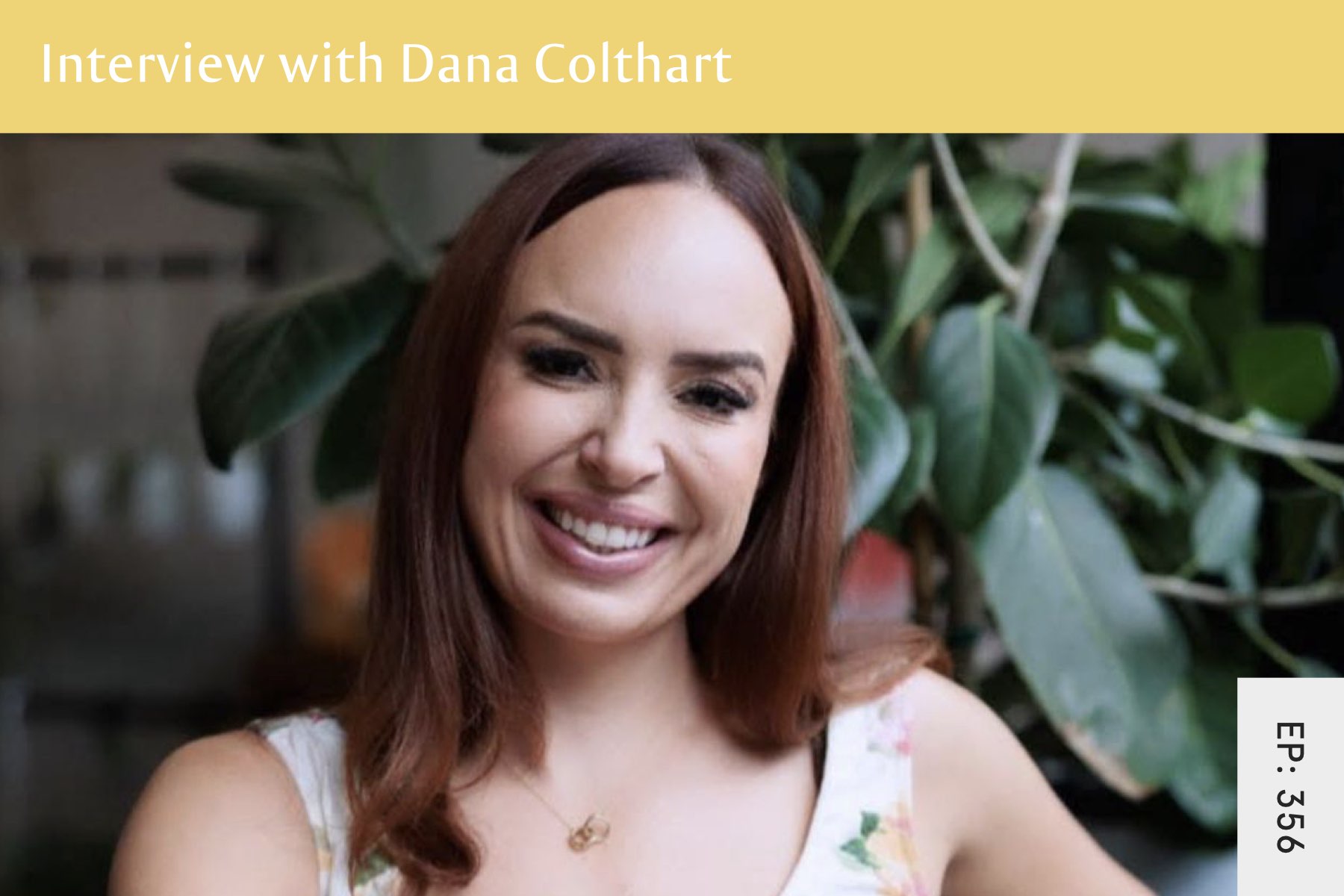
Episode 356: In this episode, I chat with therapist Dana Colthart about OCD, anxiety and eating disorders. We look at how the rituals that follow intrusive thoughts (including mental ones like rumination and reassurance seeking) reinforce the cycle, and how approaches like Exposure and Response Prevention (ERP) and Acceptance and Commitment Therapy (ACT) help people break it.
Dana Colthart is a therapist and the clinical director of Clear Light Therapy, a boutique practice based in Englewood, New Jersey. She provides evidence based treatment for OCD, anxiety disorders, and eating disorders, blending Exposure and Response Prevention, Acceptance and Commitment Therapy, and integrative mind body approaches.
Over the years she has helped teens, adults, and families understand their symptoms, build emotional flexibility, and move toward lives that feel grounded, meaningful, and aligned with their values.
00:00:00
00:05:00
00:06:10
00:09:10
00:15:17
00:19:02
00:28:54
00:32:40
00:36:25
00:41:38
00:45:40
00:48:44
00:51:04
00:56:02
01:06:18
01:09:44
01:17:09
01:20:45
00:00:00
Chris Sandel: Hey, everyone! Welcome to another episode of Real Health Radio. I’m your host, Chris Sandel. I’m a nutritionist and a coach and an eating disorder expert, and I help people to fully recover.
Before we get on with today’s episode, I just want to say that I’m currently taking on new clients. I truly believe in full recovery; it’s what I work on with people every day, and it doesn’t matter whether it’s been going on for a year, whether it’s been going on for decades, I truly believe that everyone can reach that point of full recovery. So if that is what you’re after, even if there is ambivalence or unsureness, then I would love to help. You can send an email to info@seven-health.com or you can send me a DM @sevenhealthcompany on Instagram and just say what you’re wanting coaching or support, and I can send over the details.
So let’s get on with today’s show. Today my guest is Dana Colthart, and Dana is a therapist and the clinical director of Clear Light Therapy, a boutique practice based in Englewood, New Jersey. She provides evidence-based treatment for OCD, anxiety disorders, and eating disorders, blending exposure and response prevention, acceptance and commitment therapy, and integrative mind-body approaches. Over the years, she has helped teens, adults, and families understand their symptoms, build emotional flexibility, and move toward lives that feel grounded, meaningful, and aligned with their values.
Today’s episode really is about all of these areas that Dana specialises in – so anxiety, OCD, eating disorders, and the overlaps with all of these. We talk about the different approaches she uses: ERP (exposure and response prevention), ACT (acceptance and commitment therapy), looking at what these are, breaking these down, and how they can be applied in real-life situations. Dana gives some great examples with this so you can understand how this works and how you can then be using this yourself.
We talk about anxiety and OCD, and Dana explains the Venn diagram of these two things and where there is differences between them, and where, if someone is misdiagnosed, it can start to create a problem if, for example, they’ve been diagnosed with generalised anxiety but it’s really OCD, and if someone’s taking approaches that actually don’t help the OCD. So we talk a little bit about that.
We then talk about the features of OCD. This was actually really interesting for me. I work a lot with OCD, and what Dana talked about wasn’t just the behaviour part of OCD but also the intrusive thoughts and the reassurance-seeking that can come up and be created by that or someone’s way of being able to deal with that anxiety. So that was really helpful to go through.
We then look at how to deal with OCD. This could be whether it is behaviours or whether it is thoughts, and looking at how we can use ERP as part of this, how we can use acceptance and commitment therapy as part of this. We talk about what makes a thought particularly sticky and why it can get stuck in someone’s head and they can feel that it’s difficult to let go of that.
And then we look at eating disorders and OCD and the overlap between them, and when there is not the overlap between them and when one starts because of the eating disorder or when this has been going on well before the eating disorder started. We have quite a discussion about this and how I’ve been seeing things and how Dana has been seeing things. So I think this is quite an interesting area that we explore.
This is a very practical episode, with both myself and Dana showing different tools and techniques that you can then be using in your everyday life. I’m really grateful for Dana coming on the show and talking about the intrusive thoughts part of OCD. It’s got me thinking about things a little differently, got me thinking about certain clients that I’ve been working with. So there’s been stuff that she shared that I’ve already been able to start to use in my work. So I’m really grateful for her for that.
Without further ado, let’s get on with the episode. Here is my conversation with Dana Colthart.
Hey, Dana. Welcome to the podcast. I’m really excited to be chatting with you today.
Dana Colthart: Thanks so much for having me.
Chris Sandel: I think a lot of what we’re going to talk about today is OCD and its overlap, or not necessarily overlapping, with eating disorders, and just different approaches that you have around anxiety and intrusive thoughts. A lot of things that I work on with clients and I really want to get your thoughts and insights and how you work with this stuff.
00:05:00
Before we get started, do you want to just give listeners a little background on yourself? Who you are, what training you’ve done, that kind of thing.
Dana Colthart: My name’s Dana. I have a therapy practice in New Jersey. I specialise in both OCD and eating disorders. I’m trained in ERP, exposure and response prevention, which we’re definitely going to dive into; ACT, acceptance and commitment therapy, which it sounds like you know a lot about and utilise as well; and I actually also was completing – I don’t know if you’re familiar with it – the CEDS certification. It’s the Certified Eating Disorder Specialist through IEDA, the International Eating Disorder Association. I completed that as well. I’m just waiting for my official certificate. So I have a lot of eating disorder training too.
I have two other therapists that work for me right now, so it’s a small little group practice. They also specialise in OCD and eating disorders. It’s three of us, we’re really specialising in those clientele. I’m definitely passionate about working with them.
00:06:10
Chris Sandel: Nice. How did you get into this? You specialise in OCD and anxiety and eating disorders, so what drew you into this work?
Dana Colthart: I did grow up in the ’90s, where diet culture was running rampant. I mean, it still is, but it was really running rampant then. I learned about intuitive eating in my early twenties and I loved it. It was such an out-of-the-box approach to eating. I think before that, I’d only ever heard of calorie counting and you have to restrict yourself. I don’t know, things just didn’t seem healthy or really aligned or made sense to me. I always felt like we have these bodies; biology should be able to recognise when we’re hungry and full.
So I met a dietitian when I was younger and she introduced me to intuitive eating. I thought it was amazing. I adapted it into my life; it worked really well for me. I think in terms of women and society and going against the grain of beauty standards, I’m very passionate about that. I actually thought of going to school to be a dietitian because of those reasons. I just really wanted to bring this intuitive eating / Health at Every Size framework to the world, because I think it definitely needs it.
But yeah, along my journey, I also loved therapy and I wanted to branch out a little bit more, so I decided to go for therapy. And then when I was working for different group practices, I noticed that a lot of people were misdiagnosed with general anxiety disorders and they actually had OCD, which fascinated me because – I’m sure we’ll talk about it; if you don’t get the treatment right, you can really amplify the anxiety. So if you’re mistreating OCD as general anxiety disorder, you could really ramp up the symptoms. I was so interested in that.
I’ll talk about this later, too: people progress really quickly with OCD if they exposure and response prevention and they utilise it. You see them get better very quickly. So I became very interested in OCD and anxiety, and then I also had this passion already for intuitive eating and the Health at Every Size approach. And then I noticed there’s such a large overlap with OCD and eating disorders, so I was like, “All right, I’ll just study both.” That’s how I ended up here.
00:09:10
Chris Sandel: Nice. And you said “Hey, I was exposed to intuitive eating and it made sense.” Prior to that, are you someone who has a history of dieting or disordered eating or anything that when you came to intuitive eating, it was like “Oh, this is what I need to be doing and I’ve been doing something drastically different”?
Dana Colthart: I remember in my teens – again, I talked about calorie counting. I think there was some like 20 grams of – I don’t want to trigger anyone, so let me not say that. Scratch that. But there was some very heavy diet-culture stuff that was presented to me that I tried practising in my life and it didn’t go the way I thought it should go.
So I was rerouted with the intuitive eating. I think I was just getting like – Weightwatchers was popular then, so I was trying to follow these things, and I wasn’t feeling good. I was tired. I was missing out on enjoying food on holidays.
I think I might have been 21, 22, and I just found this amazing dietitian who just happened to have a very healthy relationship with food and taught intuitive eating. I felt really lucky that I found her, because I feel like it could’ve gone a lot of different ways.
Chris Sandel: Yes, for sure. And to have it at that fairly young age – and I know when you’re 21, 22, you might not feel that young, but in the whole scheme of things, to have that be like “This really is the start of my adulthood, and to have this way of thinking about food that does mean that I can listen to hunger and fullness, but I can also focus on satisfaction, I’m also rejecting the whole dieting mentality” – all of those things, I wish that more young people were being exposed to this.
Dana Colthart: Especially in a world where everyone’s telling you differently. Definitely at that time – I don’t think Instagram existed. Definitely no TikTok. Maybe Facebook was just coming around. I feel like now, there’s so much – you can see intuitive eating on TikTok or Instagram or these out-of-the-box anti-diet – you could follow people. You could find you, you could find me, you could find this whole group of people that are going against the grain. But back then, there was nothing like that. Like I said, I felt very lucky that I found this dietitian. I just feel lucky that I did.
Chris Sandel: Definitely. I’ve been doing this since 2009, and just seeing how social media and the landscape around this has changed during that time – it felt really out-of-the-box, real renegade to be talking about intuitive eating in 2014. But now it’s like, oh yeah, lots of people are talking about it. That’s a much more common thing. And I know it’s not as common as I would like it to be, but it does not feel like the outlandish idea that it was back not that long ago.
Dana Colthart: Yeah. I love talking about it. I don’t know if you see this in your work as well – I know we were just talking about how it is more common now, but I feel like every time I explain it to a client, it’s almost like their face lights up. They’ve heard so many things explained to them, and I feel like they’ve heard everything, and then I’m explaining something they’ve never heard. They’re almost excited to try something different, because they’re like “Everything else hasn’t been working.”
Chris Sandel: Yeah, for sure. I don’t want to make it out like everyone knows about this. I definitely think that it’s not something that is that widespread, and yes, there are a lot of people who have that full light bulb moment of “I’ve never even heard of this thing. This is so incredible.” Yes, it’s lovely when you get to share that with a client and have them have that experience in front of you.
Dana Colthart: And I do find, too, that even clients that aren’t coming in for any issues with food, whether it’s anorexia or binge eating, if they’re just coming in for OCD – or sometimes I’ll see someone with just depression as well – I feel like most people have some sort of trauma, not to overuse that word, but they have some stuck points with food. It’s just nice to have the framework.
I wish all therapists knew about intuitive eating, because I do think that food is something we all deal with. Not deal with. Its’ enjoyable. But it’s something we are presented with every day, fix, six times a day. So if you have some emotional difficulties with it, it’s good to have a framework of like “Okay, this is a healthy way of managing that.”
Chris Sandel: Totally agree. In terms of your approach – I know you said there’s a blend of exposure and response prevention (ERP), acceptance and commitment therapy, and then integrative mind-body approaches. I want to talk about how you combine them, but I think we should go through what each of these things is separately. I’ve talked on the podcast at various points about ACT. It’s something I use a lot of. I think I’ve done one episode before on ERP, but it was probably a couple of years ago. So even if we’re going over things that we’ve covered at some point, I know not everyone listens to every single episode.
00:15:17
Let’s start with ERP. What is exposure and response prevention?
Dana Colthart: Exposure and response prevention – I like to split it up into two different sections. You have the exposure piece, then you have the response prevention piece. Essentially, the exposure piece helps retrain the person’s brain to no longer have a fear reaction to either intrusive thoughts or physical things.
Sometimes I’ll use a bridge as an example. If a person every time they go over a bridge has a fear response, and exposure would be gradually going over the bridge, looking at pictures of the bridge until their brain no longer has that fear response.
Same thing with our thoughts. You can have intrusive thoughts, like “What if I have cancer?” or “What if I lose my job?” People can have fear responses to those thoughts, and the exposures work the same way. You expose yourself to those thoughts until you no longer have fear around them, and that’s when the exposure is completed.
The response prevention is disrupting the OCD cycle. I didn’t talk about that, the cycle. Essentially, people with OCD do a lot of compulsions to reduce their anxiety. I don’t know if you’ve heard of reassurance seeking. A lot of people with OCD will do reassurance seeking, so say they’re worried about a health anxiety OCD type of theme, so they might worry, “What if I’m dying? What if this headache means I have cancer?” So they might continually run to their partner or a parent or a doctor and say, “Can we get another scan? Are you sure this is okay?” And that behaviour is done to alleviate the anxiety.
So the response prevention piece is not responding in that anxious, compulsive way. It’s letting the anxiety come up and then not responding to it, so it’s disrupting the compulsions. And what happens is the anxiety naturally falls. It naturally rises and falls, so the brain learns “I no longer have to keep doing that compulsively.” And then what we see happens is the person stops getting intrusive thoughts and they stop having those fears. Does that make sense so far?
Chris Sandel: It does definitely make sense. A lot of the time when I’m thinking about this kind of thing, I’m thinking about it more from a behavioural standpoint in terms of the common washing of hands type thing, or having to switch on and off lights or check the stove or some kind of behaviour. But it’s interesting that you’re talking about it can also be more thought-based where it’s more like there’s this looping thought and it doesn’t necessarily have to be connected to a behaviour outcome in that moment.
Dana Colthart: Yeah. I should’ve added this before. ERP is part of CBT, cognitive behavioural therapy, and it can be very behaviour-based. But I specifically brought up the thoughts because I think that’s one piece that gets missed a lot. When people get misdiagnosed and they think it’s general anxiety disorder but they actually are – it’s all just internal, they’re ruminating, they’re doing internal compulsions. So that’s why I wanted to bring that up too, in case that resonates.
00:19:02
Chris Sandel: If it is a thought that someone is ruminating on and it keeps coming up and it’s a problem, what would that look like from an exposure standpoint? If you’re doing this in session with someone or you’re giving them guidance to do this outside of session, what would that then look like? And you can pick a thought if it’s easier, like “This is the thought and this is how I would do it with that particular thought.”
Dana Colthart: Let me think. Let’s see. “What if I have cancer?” Actually, scratch that. “What if I lose my job?”, because I feel like that’s a really big one for people. If someone has an intrusive thought of “What if I lose my job” and they’re doing compulsions all day by making sure they’re sending the right emails and they’re rereading their emails over and over again, or they’re making sure “Let me say hi to my boss every morning. If I don’t say hi, I’m gonna lose my job. I have to get a really good review or else I’m gonna lose my job, or I’m going to work 10 hours instead of 8 because I could lose my job.” Those are all compulsive behaviours.
An internal compulsive behaviour would be if the person was ruminating and trying to calm themselves down by saying, “Oh, don’t worry, remember so-and-so gave you a good report last year.” Or “Don’t worry, the company is actually doing really bad, so they’re not going to let you go. They need you. No one wants to work here.” If you’re trying to do that self-soothing and it’s calming your anxiety, but then the thought just comes back up, that’s how that cycle would work.
I know the question was how would an exposure work for that. You would want to elicit that fear of “What if I’m gonna lose my job?” and really sit with uncertainty of “Maybe they will lose their job, maybe they won’t” and not do a compulsive behaviour.
To differentiate between general anxiety disorder and OCD, a lot of the time people with OCD really struggle with sitting with uncertainty, because they want to know, “Am I gonna lose my job, am I not gonna lose my job?” That’s why they go into this detective, data-seeking, “I need to figure it out, I need the answer.”
So what we do with the exposures a lot, we expose them to similar fears and then we want to let them just sit and watch the anxiety naturally come up and go away.
So maybe I might suggest to someone, send an email that you didn’t reread. Or why don’t you log out of work a few minutes early? Not anything that’s going to be actually dangerous and get them fired, but that probably would elicit a pretty – especially someone that’s working extra, to have them leave a minute or two beforehand, they’re going to get pretty anxious.
Then the response prevention piece would be to not do a compulsion after, to just sit with that icky discomfort of “Oh no, am I gonna get fired?” and just naturally let it rise and fall.
Chris Sandel: And with that, when they’re sitting with that, are they allowed – ‘allowed’ is not the right language, but are you encouraging them, “It’s fine if you want to do some breathing and follow your breath”? Or it’s like, “I don’t really want you doing anything out of the ordinary that you wouldn’t normally do. I don’t want you to start doing anything that’s like ‘I’m going to really intentionally come back into my body or I’m going to do this thing’”? What are you wanting someone to do in that prevention part?
Dana Colthart: That’s a great question. I would be okay with the ACT approach of being curious, like “Why am I having this anxiety right now? Where do I feel it in my body? Is it in my chest?” That’s definitely a very ACT approach to anxiety. I’m okay with that.
In terms of I’m going to do these exercises to make the anxiety go down? No. Really, the main point is to teach the person that “I can tolerate this anxiety. I don’t have to push it away. It’s not going to harm me.” I give clients the analogy a lot of OCD is like a faulty fire alarm that keeps going off all the time. So we need to learn to not go and turn it off each time, because if we go and turn it off each time, it just keeps turning on. We need to let it naturally, let the battery die out, it’ll stop itself. Does that make sense?
Chris Sandel: Yeah, it does.
Dana Colthart: It’s no different from what people are used to. People are so used to therapists telling them, “Do deep breathing. Relax your body. Calm yourself down.” And there’s nothing wrong with that, but it does give the message of like anxiety is bad and you can’t tolerate it and that you should calm yourself down. Which tends to backfire for people with OCD.
Chris Sandel: Definitely. I don’t say that I use ERP, but I use a lot of acceptance and commitment therapy, and the way that I deal with OCD with clients, whether that be connected to the eating disorder or connected to other like “I have to do these rituals before I’m allowed to eat”, etc., is what you’re suggesting.
Learning that it’s okay for that discomfort to be there. And yes, you can do things to get you back into your body, but the goal isn’t for the anxiety to disappear. If it does by its own accord, great. It’s not that you’re doing something wrong. But that shouldn’t be the intention, that “We need this to go away and that means I did it right.” It’s more like the goal is that you’re able to notice, as you said, it naturally goes up and it then comes down of its own accord, and “Hey, I was actually able to be with that discomfort. I didn’t have to do something to make it go away, I wasn’t stuck in that resistance piece. I was just able to be.”
Dana Colthart: Yeah. Like you said, you’re not saying that you do ERP, but I’m sure through your work with eating disorders, if someone has a fear food, that is ERP.
Chris Sandel: Totally. I don’t use that label, but yes. As you’re talking, I’m like, yeah, I do this.
Dana Colthart: There’s an exposure – the food is the exposure – and then the response prevention is them not doing an eating disorder behaviour after, whether that’s someone’s compulsively exercising or utilising laxatives or whatever it may be. It really is the same thing.
Chris Sandel: Yeah. It’s interesting, when you were using the job example, how easily that could get seen as just generalised anxiety, and if that’s the case, what would be the recommendation in terms of that approach? Because you said if someone gets the right diagnosis and we go through this, we can get through it pretty quickly, versus if they’re misdiagnosed, that creates a problem. So if that person was labelled as generalised anxiety, what’s the approach they get given?
Dana Colthart: I treat both generalised anxiety disorder and OCD the same. I take an ERP and an ACT approach. Those are just my foundational ways of viewing mental health, so that’s my preference. But a lot of therapists will try to reframe people’s thoughts. They’ll try to do a lot of “Is that logical? Is that catastrophic? Is that black and white? What’s the chance that you’re actually going to get fired?”
What that could do is it could be a compulsion, because now it’s lowering their anxiety, but it doesn’t really teach them sitting with the anxiety, it doesn’t teach them “Hey, I could leave exactly at 5:00 and not get fired.” So that’s how I would answer that.
Chris Sandel: Sure. I’m on the same page with this. I think what happens often – and I’m not against CBT generally, but I think when there’s a lot of the focus on the cognitive piece, that’s often where I think it can go awry.
It often then just becomes this arms race, and you’re trying to come up with a better answer to then squash it down, and then there’s this other thing that comes on top, and you end up with more rumination, with more being stuck in your head, and it doesn’t really solve the issue as opposed to learning to just be with that original discomfort. And as you continue to do that, “Oh, I’m not having those intrusive thoughts in the same ways, or when they come up, I don’t have the resistance to them, which is often what creates all of that tension.”
00:28:54
Dana Colthart: Yeah. In so much of my work too, I talk to people about us not having control over our thoughts, either. A lot of people with OCD get really shameful of they have these intrusive thoughts of like “What if I jump out this window?” and they’re like “Oh my God, I don’t want to jump out this window. Why did I have that thought? Oh no, do I have to check to make sure I don’t want to?”
So much of work is informing people, everyone has these thoughts all the time. That’s totally normal. So I don’t think we have a level of control to just manipulate – you can’t just tell yourself “Don’t worry about work. Don’t worry about getting fired.” Because if that was the case, everyone would do that and then no-one would have anxiety, if that was the answer. [laughs]
Chris Sandel: Yeah. “Don’t tell yourself that you don’t feel attractive.” There would be so many things it would be very easy to solve if that was the case, you just had to tell yourself to not think that thing and it would be fine. But that’s not the way the human brain works.
Dana Colthart: Yeah, or “Just love your body.” Like, “Okay, I’ll just do that.” Or “Don’t be afraid of that food.” It’s just not how it works.
One thing I’ve been telling clients a lot which I’ve found helpful myself is that I think our brain listens more to actions than it does to words. You know that saying “Pay attention to people’s actions, not words”? I start out like that. I feel like our brain is very similar. If you tell it “Don’t be afraid of the bridge, bridges are safe.” Or “Don’t be afraid of flying, flying is safe” but you avoid airplanes, your brain is going to pay more attention to the fact that you avoided the airplane versus the fact that you keep telling it it’s safe.
I feel like that’s a good framework to look at it, that our brain really pays attention to what we do. So if you’re avoiding certain foods, it doesn’t matter how much you’re telling yourself those foods are fine, there’s nothing wrong with them. If you’ve avoided them for three years, your brain’s going to be terrified.
Chris Sandel: Totally. A phrase I regularly say is you don’t think your way into acting differently, you act your way into thinking differently. It is just action-based, and you’re retraining your brain, you’re retraining your nervous system to react to this thing differently. It’s reacting of its own accord; it’s not like you’re choosing that it then registers this thing as a threat. But by continuing to put yourself in that situation through exposure, it will eventually learn, “Oh, this thing isn’t a threat anymore.” That’s where the shift actually occurs.
Dana Colthart: Yeah, and I feel like exactly what you said, that keeps clients encouraged instead of discouraged. I don’t know if you’ve found this in your work as well; I find that clients, like with breathing or trying to change their thoughts, they’ll come to me and be like, “I tried it. It doesn’t work.” So I feel like if you’re giving them more of a realistic like, “No, it will work, but you have to do all these behaviours and you have to do them consistently over time, and then you’ll see change” – I feel like that’s setting them up for not being discouraged, healthy expectations, versus the goal is to not be afraid of the food or the goal is to no longer feel anxiety. I feel like that’s a recipe for discouragement for clients.
00:32:40
Chris Sandel: Yes, for sure. Let’s then talk about the ACT piece. Give me your description of what is acceptance and commitment therapy?
Dana Colthart: Acceptance and commitment therapy is all about psychological flexibility, accepting our internal environment. I think a lot of what we’ve been talking about is really ACT.
Chris Sandel: It is, yeah.
Dana Colthart: So instead of looking at our internal environment as something we need to change, it’s all different skills on how to accept it, move forward. It’s very values-based. It’s learning your values, learning your client’s values, and having them make decisions based off of their values rather than anxiety or fear or depression or whatever might be coming up.
I think a lot of people’s way of living is “This makes me feel good, I’ll run towards that, and this makes me feel bad, I’ll run away from that”, where ACT is more focused on what’s important to you, and how do we follow that versus like “This doesn’t feel good, I’m gonna run away” or “This feels good, I’m gonna go towards that.”
There’s cognitive defusion skills, which is a fancy way of talking about how viewing our anxious thoughts, our eating disorder brain – I don’t know if you use that language at all with your clients, labelling the eating disorder so it’s separating yourself from either an eating disorder or OCD or anxiety and learning to observe it rather than being intertwined with it. Lots of mindfulness with ACT.
But the core way I look at it is it’s just teaching people to be psychologically flexible, so when something comes up, “How can I sit with this? How can I move through it? How can I be curious about it? How can I be with my values and make a values-based decision?” versus “This situation is making me really anxious, I don’t want to feel anxiety; how do I make my anxiety go away? Let me either get out of here, do a bunch of breathing so I can calm down” – that’s the opposite of ACT.
Chris Sandel: Yeah, a lot of the principles are connected to “How do I come back into the present moment? How can I notice my thoughts but not feel like because I had that thought, that it’s true or that it’s a value of mine or that it’s important or that I have to give it attention?” It’s like, thoughts think themselves. They can just be here.
And even the same with emotions. I can feel emotions, and it’s not that I ignore my emotions, but just because I have a particular emotion, doesn’t mean that I then have to take some particular action based on that. And so much of the suffering that people feel is because they get lost in their head and their thoughts and they then are trying to do things to get something to go away or to stop as opposed to, as you said, having that capacity to be with those things and to use the values as a bit of a guide. Like, “Okay, I know this is really uncomfortable, but actually, this is in alignment with who I want to be, so I’m going to continue to take this action.”
Dana Colthart: Yeah. That’s a great explanation too.
00:36:25
Chris Sandel: Cool. Then in terms of the integrative mind-body approaches, tell me more about this and what you mean specifically with this.
Dana Colthart: I would say the one that I use the most with ACT is being curious about where we feel things in our body in terms of when an emotion comes up, you can be curious about it, where do we feel it, do you feel it in your chest? That’s how I integrate things that way.
Chris Sandel: Nice. Yeah, that’s the same. I do a lot of starting to get back into your body and we can either be noticing, what emotions do I feel that are coming up, or what actual sensations am I noticing?
And having different techniques that make you take on more of a curiosity lens or a scientist lens to it so that this thing – in some senses it can feel very uncomfortable, but actually if I pay attention to it, where does it start? Where does it end? What’s the temperature of it? What are the different characteristics? So that this thing stops being this big scary thing that I need to get away from and I’m able to be giving it more attention and noticing what happens when I give it more attention, or noticing what happens when I breathe into it and what happens to that sensation, I think can be really helpful.
Dana Colthart: Definitely. I use the dropping anchor technique a lot. Do you use that at all too?
Chris Sandel: Yeah.
Dana Colthart: To me, how I’ve been explaining it to clients, especially with OCD that ruminate a lot lately, I have a sound machine outside of my office. So if people ask me, “I can’t stop thinking about being fired”, or “I can’t stop thinking about what if I have cancer”, or even food noise – that could be a little separate because that could be biology-based, but we can talk about that later.
But say someone is ruminating on an anxiety-based thing. You don’t want to tell them to stop, because as we know, if you try to stop something, it makes it worse. I don’t know if you’ve done the exercise where you tell someone don’t think about a cup of coffee, and then all they can think about is a cup of coffee.
To go back to the sound machine, I’ll ask clients in sessions, “Do you hear that?” They’ll be like, “Yes.” I’m like, “Did you hear it before?” They’re like, “No.” I’m like, this is shifting attention. It’s making our attention onto something and off of something, which we can do. That’s not stopping the thoughts; it’s just shifting them away.
Then I’ll teach the dropping anchor, which for the listeners that don’t know what that is, it’s essentially if someone’s ruminating or feeling anxious, a way of grounding them and shifting their attention onto something else. It takes you step by step through first you identify your thoughts, like “Okay, my brain’s having a lot of anxiety.” Then you go on to your body.
So this is to how I incorporate the mind and body. You might put your feet on the ground or you might push into your knees, but you want to become really aware of your body and then your breath, and then you go back into your activity and try to really be mindful of that and shift the attention away.
But yeah, to go back to you asking about the mind-body connection, I think it could just be a good tool to shift our attention away from our rumination sometimes. Because I think sometimes we’re so caught up in our heads, we don’t even realise our bodies are here. Like “Oh, here it is. Here’s my shoulder, here’s my leg.” Especially people who are anxious, they’re not even aware that the world’s there, and they’re just in their thoughts.
Chris Sandel: Yes, totally. I use dropping the anchor a lot because I do think it’s useful.
The thing that you mentioned, I always want to make clear to people: you’re not then telling someone, “Hey, don’t have these thoughts. We’re going to do this other thing.” Those thoughts can be here; you didn’t ask for them, but it’s fine that they’re here. We’re going to show you that “They can be here and I can also put my attention on other things. I can notice other sounds in the room or I can look around the room and I can notice there’s that bookshelf or there’s that spider’s web” or whatever it is.
Because so much of the rumination is like someone’s just being in their head, so how do we come back into the present moment, come back into the room? And to be able to notice these things at the same time that those ruminations are there, but again, building up that tolerance of like “Oh, those things can be there and I can still get on with my day to day or I can still actually do the thing that I need to do in this moment.”
00:41:38
Dana Colthart: Yeah, exactly. I don’t know if you have this experience too, but I think it’s a subtle difference – shifting attention versus stopping the thought. Sometimes clients get a little confused.
My personal opinion is you try it a few times, and once clients do try it, they’re like, “Okay, I know what you’re talking about now.” It’s almost like you have to have that experience of like “Okay, I separated myself from the thoughts and now I can see what she means when she’s saying that.” It’s kind of something you have to experientially go through. I don’t know if you see that at all with people.
Chris Sandel: I do. When I’m doing it, I will often go through it in session with a client and then they get a recording – I’ve got a recording as part of the programme that I have of me doing dropping anchor. It’s not going to be the exact same thing I did in session, but it’s going to be very similar, going through those different stages.
To start with, I say use that as the guided meditation, and at some point you will either be like “Hey, I know how to do this on my own” or “I don’t actually like it when there’s that bit, but these two bits I find quite useful.” So they just do the version that actually helps them in that moment. Because it’s not that you have to follow this exact script; it’s more like, how do we get you back into a place where “I’m just not being affected by those thoughts, or affected to the degree that I was.”
Dana Colthart: I do the same exact thing. I think I tell my clients literally the same exact thing of like, this is just the script. If it works, great, but if eventually you have some other script that shifts your attention away or you have a shorter version or you don’t even have to use those words and it’s just an experience how you shift, totally fine. This is just the framework to get you used to it.
Chris Sandel: Yeah. For some people, I discover that if I just do something with my hands and have something tactile, whether it’s a hot cup or a stone that I play with, that brings me back into the present moment and that’s enough to help me out. So whatever works for someone. It’s a lot of “Hey, I’m going to show you a bunch of different tools, and the goal isn’t that you then use every single one of them; it’s that you find one or two that works quite well, and they’re going to be the ones you pretty much use 90% of the time.”
Dana Colthart: Mm-hm.
Chris Sandel: In terms of bringing this all together, we may have already answered this, but is there anything else you’d want to add with ERP or with ACT and how you bring them together that we haven’t already touched on?
Dana Colthart: It’s so different for everyone. I think we did hit a lot of the main points that I would have answered that.
I think I do try to feel out each individual because I think each person is unique and their needs are unique. Like sometimes I do have clients that definitely do better with an ACT approach, like a heavy ACT approach, and then there are clients that are exposure-ready like six times a day. So it is so unique how I weave them.
I think I almost always weave them together. I don’t ever want to say I ever leave ACT out, and I don’t think you ever want to leave exposures out. So I think it depends on the person how much I do of each, and what they’re presenting with and what their struggles are, and their personality type. Some personalities do better with exposures and some do better with ACT. But I would say I always meld them together.
00:45:40
Chris Sandel: Nice. Let’s look at then anxiety versus OCD. I think OCD, very widely misunderstood; how could you tell the difference or how can someone tell the difference between everyday anxiety versus true OCD?
Dana Colthart: I think the major difference – you know how I was talking in the beginning of the podcast about the OCD cycle? With the OCD cycle, you have an intrusive thought, a compulsion, the anxiety goes down, then you have an intrusive thought again, and you’re just in this cycle.
With general anxiety disorder, you don’t see compulsion. You wouldn’t see someone reassurance-seeking, you wouldn’t see someone stuck on the same topic all day. You wouldn’t see them always worried about losing their job. The general anxiety bounces around a little bit more.
And, how I was saying earlier, with OCD there’s really an intolerance of uncertainty. General anxiety disorder, they tend to tolerate uncertainty a little bit better. You could say to them, “You may or may not lose your job” and that might not elicit panic in them, whereas someone with OCD is going to be like, “No, I need to know and I’m going to go into full-blown detective mode and I’m going to go on Reddit and ask ChatGPT and I’m going to figure out the statistics and I’m going to make sure I don’t.”
But there’s definitely a debate over it in the community, too, like where does the general anxiety disorder line start and end? But that would be my definition. Usually with OCD there’s compulsions; general anxiety disorder, there’s no compulsions.
Chris Sandel: Sure. I think if you’re using something like ACT, in some ways it doesn’t really matter. If someone’s having intrusive thoughts that are much more about OCD versus they’re having unhelpful thoughts that are more about generalised anxiety, we can still be using a lot of the same tools of like, let’s come back into one’s body, let’s use defusion to separate from one’s thoughts, let’s look at your values and help you make decisions based on those values.
So I think sometimes it is really useful getting the right diagnosis and sometimes it becomes a little bit of semantics because it doesn’t really matter, because we’re going to be approaching it in a similar way.
Dana Colthart: Yeah, I was talking about this with someone earlier. Really, the purpose for diagnoses is so providers can know how to treat the person. If you are going to take the same approach anyway, does it really matter if it is general anxiety or OCD? I take an approach of it doesn’t matter too much to me, because I’m going to treat it the same way.
00:48:44
Chris Sandel: Are there some myths about OCD that are out in the public that you’re like “I want everyone to know, I want to get on a soapbox, do my PSA of ‘this is not correct, you need to not be doing this thing’”?
Dana Colthart: I think there’s still that stereotype of people with OCD are very clean and orderly and they’re washing their hands all the time. That is one of the themes, contamination. Or with OCD, people might organize in a certain way. But it’s a mental health disorder. It’s not a quirk or it’s not something that’s enjoyable. It’s deeply painful for people to live with.
I think those things definitely bother me when I see people online or social media that are talking about OCD almost in a positive like, “Oh, that person’s so OCD, they’re so clean.” They’re stating it in a positive way, and I’m like, this is something that’s debilitating for people. You really shouldn’t be speaking about it in those terms.
But also, I think for the most part, OCD is really only talked about in terms of contamination. That is a big theme, but there’s so many other themes. People obsess over sexuality. Relationship OCD I see a lot. Harm OCD, like I said before. Hit-and-run OCD. There’s a lot of themes. You could have pure O where you’re just thinking and ruminating and doing compulsions all in your head and you’re not really doing them behaviourally, outside.
I think it’s a wildly misunderstood disorder.
Chris Sandel: Just in terms of the “I wish I had a little bit of OCD”, I unfortunately hear the same in terms of “I wish I had a little bit of an eating disorder. That would be really helpful.” It’s like, you don’t know the half of it if you’re making a comment along those same lines. So yes, I definitely would like people to not be making those comments.
00:51:04
With the OCD piece, what do you often see as being the genesis of it? And I know there’s lots of different people and there can be lots of different things that are going on, but is it like there’s this time of high anxiety, and as part of the high anxiety, the OCD normally starts up at that point? If you’re looking at why this is starting for a lot of your clients, what are some of the things?
Dana Colthart: That’s a really good question. OCD is definitely very genetic a lot of the time. When I’m doing an intake with a client, I’ll tend to ask, “If you can track back to the earliest memory, scary memory where you were doing these behaviours”, a lot of people will say five, six, seven years old, they remember they started worrying about a certain topic.
It’s probably then transformed over the years, but they can pretty much track it back pretty far; it just wasn’t really recognised at the time. They’ll either say their parents didn’t realise it or they didn’t realise it themselves.
There’s a very strong genetic component, but also environmental. I think that’s what you were alluding to a little bit, like when a person’s life gets more stressful – either they’re moving, maybe they had a child, or they got a new job and they’re under pressure – I do see OCD ticks up a lot. Same thing with eating disorders. This all goes for eating disorders, too, by the way. There’s genetics involved.
And I do see a trauma link as well sometimes. When people do experience traumatic events, you will see sometimes, I think because of the stress that the brain goes under, they can develop OCD from that.
Chris Sandel: In those situations, where there’s that really stressful life event or there’s the trauma, if you then go back, is there still often stuff that was there in the beginning anyways? In the same way as so often with eating disorders, before the eating disorder started, this person had high anxiety; once the eating disorder is over, they’re still going to have high anxiety. There are some things that were already there, and once it gets in this environment, that’s just one of the ways that it tends to go.
Dana Colthart: I would say most likely, yes, you can track it back. Every once in a while, definitely some people are like “No, I was calm up until I was like 25.” It varies by case, but I would say a lot of the times you can track it back and there was some underlying anxiety, predisposition. Sometimes people will say, “Oh yeah, my dad was always checking locks. I never noticed that.”
That’s something else that it will ask. “Have you ever noticed your parents doing anything compulsive?” or “Do your parents run anxious?”, because I want to get a gauge of their parents or grandparents. And a lot of the times, I don’t think they have official diagnoses because I do think it’s underdiagnosed, but they will say, “My mom asked the same questions over and over” or “My dad was always getting doctors’ second opinions or all these medical – we never knew why, he just kept going back to the doctor” or “My uncle double-checks all the locks or triple-checks or repeats himself” and they’ll start to tie together things.
Chris Sandel: I guess it’s also a lot of the things that people think of as OCD is this very narrow band. It’s the washing the hands type thing, and if that’s not happening, I wouldn’t have labelled it OCD, but then when you actually understand what’s going on and that it can be lots of things, then the light bulb starts to go off. You’re like “Oh yeah, that was definitely me, the way I used to do studying when I was at school or the way I used to do this thing. Now that makes sense, and yes, that does actually feel like OCD even though I would not have used that label previously.”
Dana Colthart: Yeah. I think I see that so much with almost every client. I feel like people are like, “Oh, I didn’t realise that was OCD. I didn’t realise I was doing a cycle. I didn’t realise I was reassurance-seeking. I didn’t realise what I was doing.” And again, I think because it’s such a misunderstood diagnosis and people don’t really realise what’s actually going on.
00:56:02
Chris Sandel: Sure. Let’s talk about the overlap between OCD and eating disorders. How do you see that overlap happening in practice? What does that look like?
Dana Colthart: I do like to talk about this topic a lot. With overlap, I get a few different clients that come to me. Sometimes I’ll get clients that have recovered from an eating disorder and want to now work on their OCD, because a lot of the times clients deal with the eating disorder piece first and then later on tackle the OCD.
Sometimes people very often will have OCD that they can track back to when they were a younger kid and it parallels with the eating disorder, and they want treatment at the same time. As we were talking a little bit before, what I tend to see in my practice is that when their eating disorder is present and active, I tend to see the OCD get quieter. And then once the eating disorder is treated, I do seem to see the OCD then get louder.
Chris Sandel: And when you say you see the OCD get quieter, do you just mean the kinds of behaviours or the kinds of things that they were focusing on from an OCD perspective quietened down? I don’t want to generalise that all eating disorders are OCD or anything along those lines, but so much of the eating disorder behaviours that I will see have OCD-like things connected to them, or they are OCD-like. So I wonder if it’s not so much that the OCD is being put on pause; it’s like we’re just scratching the itch in a different way and using food connected to it or using the way that I do my exercise or whatever. That then becomes my OCD, and when that removes, “Now I’ve noticed this uptick again in this other thing that I was previously doing.”
Dana Colthart: Right, completely. I 100% agree with you. I think it just gets transferred. I don’t think it actually gets cured or goes away. I think it transfers onto the eating disorder. But I do think it’s really important to talk about the distinction between, if we could really quick jump into the difference between an eating disorder and OCD.
Chris Sandel: Sure.
Dana Colthart: With eating disorders, they tend to be egosyntonic. For the listeners who don’t know what that means, that means it’s something that’s in line with what they want. For example, someone with anorexia, they tend to want to actually lose weight. That’s in line with what they want. With OCD, it’s referred to as an egodystonic, so it’s not in line with what they want. Their worries and obsessions are all things they don’t want to happen, whereas someone with an eating disorder, they’re worried and obsessed about things they tend to want to happen. They’re obsessed with weight loss a lot of the time and they want it to happen.
I think that’s why in my brain, I almost look at it as the OCD gets paused because I no longer see that egodystonic sort of “I don’t want it to happen.” That goes away. And that’s such a strong core of what’s happening with someone with OCD. The egosyntonic, where they want to lose weight, you won’t see that with OCD. It’s all things they don’t want to happen and they’re worried about happening.
But totally agree with you: there’s an obsessive nature. They’re singularly focused on something. You’re doing compulsions, you’re trying to prevent something from happening. So it’s very similar. I would just say that’s the biggest difference. With OCD, it’s things that are egodystonic, you don’t want to happen and they don’t feel like they align with you at all, where eating disorders tend to be egosyntonic and it seems to be something you actually want to gain or it feels more in line with you.
Chris Sandel: It’s interesting, because as I’m conceptualising this, I think about people at different stages of their eating disorder. Maybe in the honeymoon phase, “Hey, I really do want this”, and then later on, “Actually, I don’t want this and I can notice how much this goes against my values. I notice how much this is crippling my life, it’s hampering my relationships.” There’s all of these things, and even if there’s one part of this like “Oh, I would still like to lose weight or I don’t want to gain weight, once we go wider in terms of the focus, I can also recognise that the ways in which I’m going about this are causing such damage to my life that I actually don’t want to be doing this. I’m really trying to not be putting off my eating or only finishing half my plate” or whatever it may be.
That’s why it feels, for me, a lot of the times like this is very OCD-like. If someone feels so powerless against this thing that “actually I don’t really want to be doing but here I am again, and I just did the exact same thing”, it is that same compulsion.
Dana Colthart: Yeah. I was thinking about it earlier, too; I think anorexia is probably one where I feel it tends to lean more towards the egosyntonic, especially when someone’s really, really deep in it, in the early stages of recovery or their illness. But bulimia, definitely – I think most of the time working with someone, they don’t want to be purging. That’s not something they want to do. Or binge eating disorder, I feel like they don’t want to be binging.
So I think it is nuanced, too. It’s not like a perfect recipe or definition, kind of how we were talking about the difference between general anxiety disorder and OCD and eating disorders with OCD. I think I gave you a textbook answer, but are there nuances or is it more of a continuum? Is there a lot of overlap? Yeah.
Chris Sandel: Sure. I think it’s fun to have these conversations where you’re like, okay, where does this thing start to break down? Where are the edge cases? As you said earlier, where does this thing start and where does this thing end, and all of that. I think it’s sometimes useful to have that. And I think from my perspective, from brain regions, if we look at a lot of what is affected when someone is in that malnourished, low energy state, it’s a lot of the same stuff where there’s the OCD piece and there’s all the stuff connected to threat response and all of those things. So there is this huge overlap between these two things.
Dana Colthart: Yeah. How we were talking about compulsions before, with eating disorders there’s an anxiety, there’s a trigger, there’s a compulsive piece. I’m sure if there are listeners listening to the podcast, they’re probably hearing the OCD stuff and they’re probably like “This sounds like my eating disorder.” I’m sure it’s resonating. It is so, so similar.
It’s definitely interesting to think about. I don’t know if you’ve given this any thought with the Minnesota Starvation Experiment – when someone weight restores, there’s a lot of data that all these obsessions go away. So that’s one of the pieces I like to think about, too, because you can’t do that with OCD. There’s no like “I’m just going to weight restore and then my OCD is going to go away.” I don’t know if you have any thoughts on that.
Chris Sandel: I’ve done a lot of research into the Minnesota Starvation Experiment. I’ve done some very long podcasts on it. I guess where I differentiate with this is there are people where they can very easily track that their OCD was there well before the eating disorder was in their life, and then there are people where “This only became a problem when I had my eating disorder and that was the thing that really changed it.” The changes in the brain were very much because of the malnutrition and everything going on with the eating disorder.
So I think for someone where that is the case, it’s like, cool; as you do the exposures through eating disorder recovery where you’re eating fear foods and you’re eating more foods and you’re doing this, that in and of itself, the OCD is going to be fine once this is over because it’s just a function of your eating disorder.
Versus someone where there’s this long history, even after the eating disorder is over, there can still be some of that that we need to look at outside of the eating disorder. So it’s not just connected to food or it’s not just connected to this other thing that is contained within the eating disorder. It can be about other things. I think that’s where I’d differentiate.
Dana Colthart: Yeah, I agree with that. That makes a lot of sense.
01:06:18
Chris Sandel: In terms of different eating disorder treatments, I don’t know how you work with eating disorders and what eating disorders you tend to work with, so maybe it would be useful to share a little more about that.
Dana Colthart: I definitely work with all the eating disorders. Anorexia, ARFID, bulimia, binge eating disorder. I tend to take a very collaborative approach, so I almost always try to get a dietitian onboard. I think they’re invaluable to the team. I try to get a physician onboard too. Not for everyone with the physician, but I will say most of the time I try to get a dietitian involved.
My thought process there, I just feel like clients with eating disorders have so much to work through in terms of food, history with food. If they do have OCD, their history with OCD, learning ACT, learning ERP, doing food exposures, doing meal support. You can’t do this all in 50 minutes once a week. It’s just so nice to have two people working with the person that can work collaboratively, and especially if the dietitian can take more on of wherever the person is starting with their food, whether it’s a traditional meal plan or they’re doing food exposures with them, and then I can work on more of either history stuff, coping skills in the sense of from an ACT perspective, those kind of clinical tools. I can be teaching them and then we’re clinically working together to recover from the eating disorder.
Chris Sandel: Yeah, that was my question. Obviously we’ve talked a lot about ACT and ERP and the way of doing this. When you’re working with someone with an eating disorder, is that the bulk of the modalities you’re using? Or like “I actually start doing inner child work with this thing” or “I start doing this other thing because I’ve found that’s actually really helpful”?
Dana Colthart: Clinically, the only thing I would probably add to ACT – and this isn’t a technical intervention – I might talk about diet culture a lot and societal expectations of beauty and things like that on top of – I mean, you could talk about that within an ACT framework. So I would say I pretty much continue to work from an ACT framework. I do know DBT skills. Sometimes I will add in DBT skills. Probably radical acceptance, things like that. Maybe if someone needed communication stuff.
It kind of depends on their diagnoses. If they have ADHD, maybe doing some behaviour work as well, like executive functioning management. Did that answer your question?
Chris Sandel: Yeah, it did. I’m just asking to see if that would be a really useful thing for us to explore as part of this.
01:09:44
Just coming back, I know we’ve talked about intrusive thoughts; what turns a normal thought into an intrusive thought? Why is it that some thoughts are more sticky than other thoughts?
Dana Colthart: When I’m explaining intrusive thoughts to people, there’s an OCD book – it’s a child’s OCD book; I don’t remember the name, but early on in my career, I saw a picture of it and I just loved the explanation of intrusive thoughts, so I use it all the time.
But essentially, it was this conveyor belt. There was a thought sorter and there was this chute that dropped down thoughts, and then there was a conveyer belt. One side was like ‘Important Thoughts’ and one side was ‘Junk Thoughts’, and essentially it was trying to explain to kids we all have all these thoughts, and they go down this chute and then your brain sorts them, ‘Junk Thought’ and like ‘Emergency Thought’.
Essentially, what would be an intrusive thought is a thought that is incorrectly sorted into this emergency pile and your brain gets stuck on it because your brain thinks it’s an emergency and it can’t get off of it, where it’s just this silly thought that really should’ve gone into the junk pile.
Chris Sandel: That’s a nice little visual for someone. I wonder even just being able to think about that from a – do you do much visualisation with clients?
Dana Colthart: Yeah, I try to use a lot of analogies. I use the weather a lot when I’m explaining radical acceptance or how to tolerate feelings. Like imagine there’s a storm outside. It’s been snowing forever. We can’t go outside and be like, “Stop snowing.” You have to sit inside and be like, “All right, I know this is going to pass at some point.” So I’ll teach that visualisation of, this is how to handle your anxiety or wave of depression or discomfort around foods. It’s temporary, it’s going to pass.
I use a bee analogy a lot. A lot of people are afraid of bees, like when bees come to you. Most people’s reaction is like, run away. It irritates the bee more. They’re more likely to get stung. Or they swat at it, again, more likely to get stung. So I’ll tell people the best thing to do is just remain calm.
What I like about that analogy, too, is that you know it’s just a bee, you’re telling yourself “It’s a bee. I’m not allergic” – a lot of people aren’t – “nothing bad’s going to happen.” Your body’s probably still sweating. People like this one because I feel like most people have this reaction. And I’ll tell people, although you’re telling yourself nothing bad’s going to happen, your body’s still reacting, and you just want to not respond, let the bee come and go. That’s the safest thing you can do. When you swat at it, it makes it worse.
So that’s comparatively to I would say swatting at the anxiety, being like “Go away, anxiety. I don’t want to feel you. I need to make myself feel better. I shouldn’t be having these thoughts.” Going back to ACT, it’s like rejecting all of your internal feelings and being like “I don’t want to feel this way”, so that makes the bee more irritated. It’s more likely to sting you.
Chris Sandel: Cool. I like that as an analogy, because I also think that when someone thinks about that and thinks about even if you said “Stay calm”, what you’re really meaning is “Just be there.” On the inside they might not necessarily feel calm. There might be this increase in their breathing or their heart rate or there could be these sensations, but you’re just saying, “Just be with that and allow that to be there as opposed to trying to do something to make it go away.”
I think that can be the same as with your conveyor belt analogy. There is this annoying thought that is buzzing around, and we just need to allow it to be there. It can be a little bit annoying, but just allow it to be there, and with time, that will go away, or with time you just get used to it being there, and it doesn’t have that same impact and reaction as it did before.
Dana Colthart: Yeah. I don’t know if you see this with your clients and your work as well – and I know I said this before, but I want to reiterate because I feel like it’s one of the biggest stuck points I see for people. They really feel like the therapy or whatever technique I’m teaching them, whether it’s the dropping anchor or this bee analogy I’m trying to share with them, I feel like a lot of people conceptualise it like “This is going to make the anxiety go away.”
So I’m always repeating, that’s not what we’re doing. I feel like people are confused. They’re like, “I’m literally coming to therapy to make my anxiety go away. Why are you telling me that we’re not making it go away?” During exposures, I’m like, “We’re actually making your anxiety worse. We’re going to try to elicit it” and then they look at me like I have 10 heads because they’re like, “I’m coming to therapy to try to make this go away and you’re telling me to make it worse and to not make it go away?”
It’s just such a different way of approaching it. But I do really enjoy working with people with OCD because you see pretty quick results, which is really, really nice.
Chris Sandel: Yeah. What I do think is that over the long haul, while the anxiety might not go away, it tends to lessen. And it tends to lessen because the anxiety is not knocking up against all of the resistance and all of the things that you’re trying to do to make it go away that actually make it worse. So over the long haul, I think it can reduce it. And especially with something like OCD, yes, it can really get rid of it.
But the goal in that explicit moment isn’t like “this has worked if that anxiety disappears.” It’s “this works if you’re able to tolerate and be with this and not feel compelled to have to do something else.” That’s the goal as part of it.
Dana Colthart: Yeah. It does go away, and it does reduce a lot of the time. But as you said, that can’t be the motivation. The motivation has to be “I’m willing to sit with this. I’m willing to choose a different path or I’m willing to live my life with this.” And then ironically, when they get to that point, that’s when it tends to go away.
Chris Sandel: Exactly. You’ve got to let go of the idea that it’s going to go away for it to then start to go away.
01:17:09
What about perfectionism? I know perfectionism is obviously something that is quite often associated with eating disorders, so I’m wondering how you see this. Is it happening a lot? How much is there an overlap between that and OCD?
Dana Colthart: I see it a lot in eating disorders and OCD. People become very obsessive with OCD recovery. I’m sure you see people become perfectionistic with eating disorder recovery, like wanting to do intuitive eating perfectly or wanting to do exposures perfectly. I get that a lot, where people are like “Did I do it right? I think I did it wrong. I could’ve done it better.” I tend to not answer any of those questions, to be honest with you. I’m like, I don’t know. I think we just have to sit with maybe you did it wrong.
Obviously if they’re doing it wildly wrong I’ll step in and give them some guidance. But I think more harm would come from me answering them and saying “Oh, no, don’t worry, you’re doing it right.” Again, because they’re really struggling to sit with any intolerance. From my perspective anyway, a lot of people are looking for that reassurance like “Am I doing this perfectly?” and I think that needs to be challenged.
Yeah, people become very obsessive with exposures, like “Am I doing the exposure right? Did I sit with the anxiety well enough? Did I sit with it long enough? Did my anxiety go down enough?”
Chris Sandel: Yeah, and it is that ‘getting that right’ place between I do want to support you and I want to be able to answer questions to manage expectations versus “Hey, these questions are actually not helpful, and me answering for you is just keeping this loop alive and it’s a lot of the reassurance-seeking piece.”
What you’re saying is you’re wanting to leave someone in that ambiguity because it’s actually helpful for them. It’s like, cool, this is the whole point. I want you to be able to sit with that uncertainty because that’s a skill, to be able to sit with this. My guess is that it’s not like you don’t answer any questions; it’s just like “Hey, there’s times when it’s useful for me to answer that question, and there’s times when actually, let’s just be okay with the not knowing.”
Dana Colthart: Yeah, exactly. It can be hard, sometimes, to be honest, not giving reassurance. Or you want to tell someone “No, you’re doing it right, you’re doing okay, don’t worry. That thing’s not gonna happen.” But I do have so much – I don’t want to say faith, because it’s not faith, but I know ERP works. I know when someone learns to sit with uncertainty how much mental relief they get, and benefit. So it is coming from a place of empathy and kindness and me wanting to see people feel better. But it is hard in that moment to see someone wanting that reassurance and to just sit there and be like “No, I can’t give you that right now.”
01:20:45
Chris Sandel: Yeah, for sure. So what else haven’t we talked about connected to this, or any of the things that you wanted to share with the listeners?
Dana Colthart: I guess any last closing statements I would say is if someone really thinks they do possibly have OCD as well as an eating disorder, to make sure they’re getting the right treatment, like they are seeing a therapist that’s trained in ERP and ACT. I think that could be life-changing and extremely beneficial for them, for the reasons – I think we hit on tons of different points throughout the podcast.
So I would just encourage people to get the right help if they think they are struggling with OCD. I always tell people not to self-diagnose, too. I don’t know if you’ve encountered this. To go back to the social media era, I feel like people are – because we’re connected to so much and there’s so many influencers now making so much content, and the point of content is to make it relatable. So now everyone’s relating to everything. [laughs] I’m seeing so many people who feel like “I have 10 different diagnoses” because the content is so relatable.
I just tell people it’s good to go to a therapist and say, “This content is super relatable to me, but what do you think?” I think that’s good to come to the session with, like “Hey, I heard this podcast and this therapist was talking about OCD and I’m curious because it kind of related to me. What do you think? Can we do a quick analysis to see if it’s something I could have?”
But the self-diagnosing thing, I’m like, don’t do it.
Chris Sandel: Okay, cool. Where can people find you if they want to find out more about you and they’ve enjoyed the podcast?
Dana Colthart: My Instagram is @clearlighttherapynj. That’s the name of my practice, Clear Light Therapy. And then my website for my practice is www.danacolthart.com.
Chris Sandel: Perfect. I will put the links in the show notes. Thanks for coming on and talking all about this. This was fascinating.
Dana Colthart: This is fun. Thank you.
Chris Sandel: So that was my episode with Dana. If you have OCD, anxiety, are living with an eating disorder, it’s often that there’s a lot of overlap between all of those things – I really do suggest trying out some of the ideas that we suggested in this episode through ERP or ACT. Or maybe just having us go through this conversation is helping you to see certain thoughts or behaviours now in a different light, and this can help you to frame things differently or to start to approach things differently.
As I said at the top of the show, I’m currently taking on new clients. If you are living with an eating disorder and you want to fully recover, even if that feels like a thing that is far off in the future or feels somewhat out of reach, I truly believe that you can fully recover, and if you do the things, that you can get to that place.
So if you would like help and support in doing that, I would love to be able to provide that for you. You can send an email to info@seven-health.com or you can send a DM to @sevenhealthcompany on Instagram and I can get the details over to you.
So that is it for this week’s episode. Until next week, I will catch you then. Take care!
Thanks so much for joining this week. Have some feedback you’d like to share? Leave a note in the comment section below!
If you enjoyed this episode, please share it using the social media buttons you see on this page.
Also, please leave an honest review for The Real Health Radio Podcast on Apple Podcasts! Ratings and reviews are extremely helpful and greatly appreciated! They do matter in the rankings of the show, and we read each and every one of them.

Policies
Social
Copyright © 2009 – 2025
seven-health.com · All Rights Reserved.



Share
Facebook
Twitter