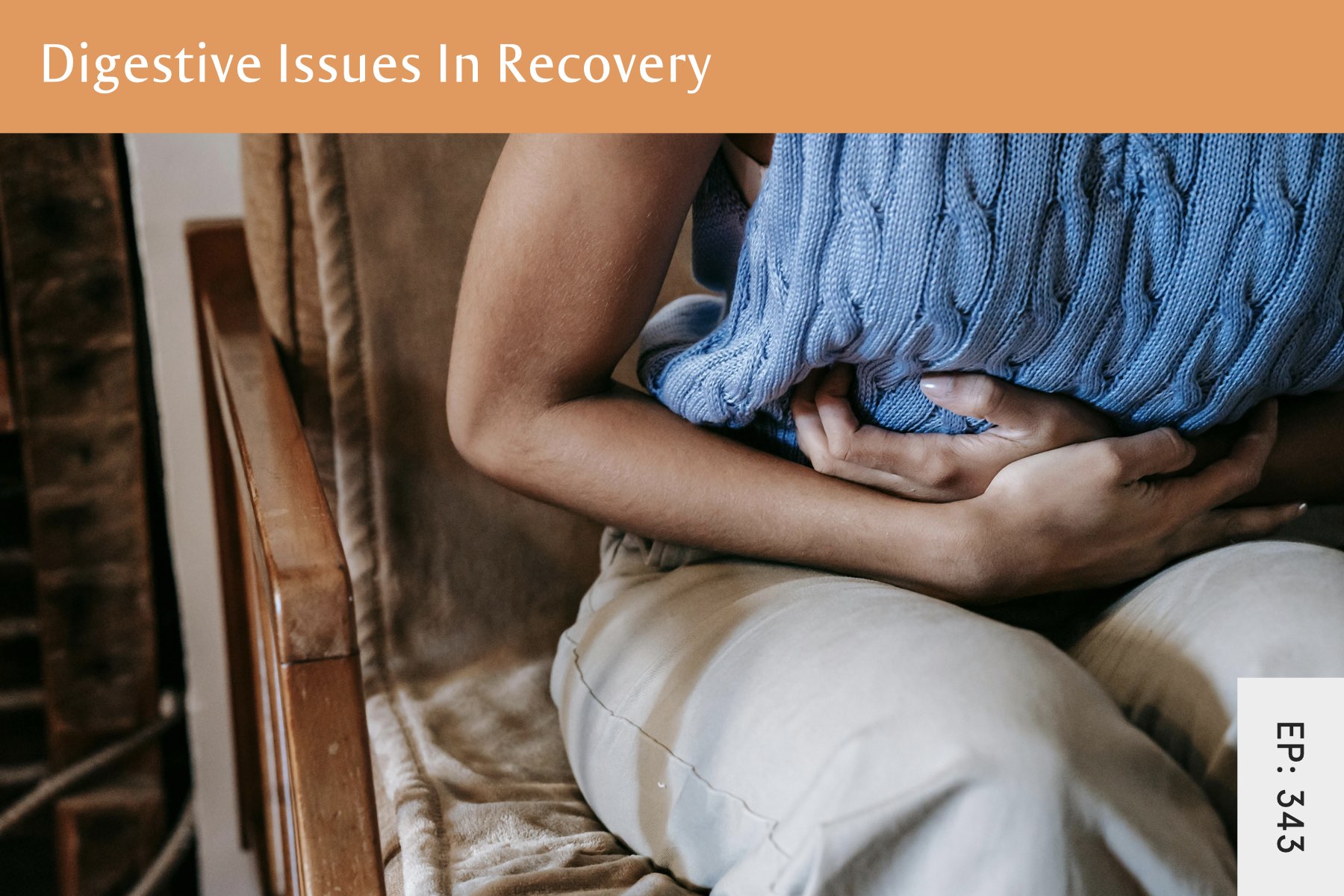
Episode 343: Digestive issues are common with an eating disorder, but can get worse in the beginning when starting to recover. In this episode I Iook at why digestive issues occur, what to expect in recovery and ways to manage this.
00:00:00
00:03:40
00:07:46
00:11:20
00:16:16
00:19:45
00:26:13
00:30:01
00:31:54
00:00:00
Chris Sandel: Hey! If you want access to the transcript, the show notes, and the links talked about as part of this episode, you can head to www.seven-health.com/343.
Hey, everyone. Welcome back to another episode of Real Health Radio. I’m your host, Chris Sandel. I’m a nutritionist and a coach and an eating disorder expert, and I help people to fully recover.
Before we get started with today’s show, I have an announcement that I’m currently taking on new clients. If you are living with an eating disorder and you would like to fully recover, I would love to help. It doesn’t matter whether this has been going on for a year, whether you’ve been living with an eating disorder for multiple decades; I truly believe that everyone can reach a place of full recovery. And I know for some, that can feel like this very distant pipe dream, but I do believe that people can get there, and it’s not about “You may get there”; it’s “If you do the things, you will get there.”
So if this is what you would like help with, I would love to be able to support you in this. Send an email to info@seven-health.com and just put ‘coaching’ in the subject line, and I can get the details over to you.
So, on with today’s show. What I want to do as part of this one, I want to look at digestive issues and eating disorders and digestive issues with recovery because this is a really common thing. It’s a really common thing that then becomes a roadblock to people pushing through in terms of their recovery. There’s this uncomfortableness that arises, “I’m getting more of these symptoms”, and the eating disorder then convinces you “This isn’t right. I need to do something different. We need to find a way where we can recover where we’re not experiencing this.” This is something I deal with a lot with clients.
It’s also something that often predates the eating disorder. For some people, they can reflect on when they were a kid, their digestion wasn’t great and that was the case all through their teenage years, or there were certain foods they just didn’t get on so well with. And for some people, this has actually been the reason that they’ve ended up with an eating disorder. Their digestion wasn’t great and they started to cut certain things out. Maybe they went and saw a naturopath and they were recommended to do this gut healing protocol or “You shouldn’t be eating gluten and dairy” and all these different things, so they got removed and someone accidentally stumbles their way into an eating disorder. They could have orthorexia, because there’s a lot of fear around ‘unhealthy’ foods and the impact this is going to have on digestion.
But all eating disorders can end up from someone starting out by cutting things out and unintentionally getting to a place of restriction. So what I want to do as part of this episode is talk about why this can happen as part of an eating disorder, why digestion gets worse. I want to look at the impact of things like laxatives or appetite suppressants if someone’s taking those and what happens from a digestive standpoint. I want to look at what then happens when someone goes into recovery. As I said, sometimes that can lead to more uncomfortableness and things can get worse before they get better. I want to offer some ideas around this and then answer some questions connected to this based on people’s experiences and things that I see coming up really regularly.
00:03:40
To start with, why do digestive issues occur with an eating disorder? Really, if we think about this from a physiological standpoint, if the body’s not getting what it needs to be able to function properly, which is what happens when an eating disorder, it’s then no surprise that systems like digestion can’t operate the way that they should.
When you get into this low-energy state, gut motility slows down because the body is in a lot of ways conserving energy. The analogy I’ll often use is – and I’m just picking a number out of thin air to demonstrate – if your digestion needs every day 500 calories, but now because things have been reduced it’s only getting 200 calories, then symptoms are going to arise as part of that because all different aspects of digestion, which I’ll go through in a moment here, are going to be impacted upon.
So bigger picture, your digestive system is not working as it should, and then the individual pieces connected to this.
One, there is reduced stomach acid and enzymes. This then makes it harder to break down and absorb nutrients, and this can, for some people, lead to food feeling like it’s really sitting in the stomach and there’s real slow digestion time.
There is a loss of muscle in the gut. Your intestines are muscles, and just like when your body’s not getting what it needs, it starts to break down lots of tissues within the body, the gut muscles are part of that. So it means that the body breaks these down for energy and digestion is then weakened.
It has an impact on the gut microbiome. This then starts to shift the microbiome, so things like restriction or purging or very limited diets because we’re only eating a handful of foods has an impact on gut biodiversity, and this can then cause different symptoms, like increased bloating or intolerance-like symptoms.
The nervous system state can have a huge impact on digestion. And this is true whether someone’s living with an eating disorder or someone’s not living with an eating disorder but just because of the state that the body’s in. When you’re in this stress state or this fight-or-flight state or this shutdown state, the gut and digestion is just de-prioritised. What this means is that more sensations start to arise. You can have a situation where “I’m not noticing my appetite” or “When I eat, things just seem to sit there. I have more nausea, I have all these symptoms that start to come up.”
Then the final one I want to mention is the ‘nocebo’ effect. Most people have heard of the placebo effect. We are given a sugar pill or they say “We’re going to do some surgery on your knee” and they open up your knee and then they don’t actually do anything; it’s called a sham surgery, and they just close it up. And because we believe this thing is going to have an impact on us, we get the benefit from it. We get an improvement even though, as I said, we’re taking a sugar pill or no surgery was done.
The opposite of this is then the ‘nocebo’ effect. This is because we believe something bad – it could be connected to a food, for example – we then start to experience symptoms connected to this. For so many people, there are these fears around certain foods, and that could be because they had these symptoms in the past or “I’ve had this association with it or I read this article about this thing.” But what then happens is because of those beliefs, someone is experiencing these symptoms.
And it’s not that the symptoms are made up. Someone is genuinely experiencing them, but it’s not because of the food per se; it’s because of the beliefs and those beliefs then having an impact on how the body is functioning.
00:07:46
Then if we look at something like laxatives or appetite suppressants, this is stuff that unfortunately I see people using on a fairly regular basis. And especially something like laxatives, these are typically things that are recommended for a short amount of time.
It’s not that I’m against laxatives, that no-one should ever take laxatives. They have a role to play and they have a purpose, but often you should be taking these things for 5 days or 7 days, and if things are still not right after that, this shouldn’t be an ongoing thing that is going on for months or even years.
What this does, if we’re looking at something like laxatives – stimulant laxatives, things like senna, for example, force the colon to contract. Over time, the colon then becomes dependent on this. Long-term use can start to damage some of the nerve endings so that they don’t function as well as they should, and this can then lead to constipation when stopping. And this isn’t a permanent thing, but this is what happens in the beginning.
They can lead to a lot of electrolyte imbalances, which can then make symptoms worse. And this can be symptoms connected specifically to digestion, but it also can be connected to other things in terms of blood pressure and dizziness on standing and other things that are impacted by having electrolyte imbalance.
As I said a moment ago, this isn’t permanent. The colon is very resilient. It can repair. But this is what starts to happen in the short term or even the long term if someone is taking these things, and the problem is that when someone goes off them, in the beginning their symptoms are going to get worse until the body starts to re-learn how to be able to function properly – and not just be able to re-learn how to function properly, but to have the energy come in so that that system can properly upregulate.
Then in terms of things like appetite suppressants or diet pills, again, many of these are stimulant-based, so they’ve got caffeine or herbal stimulants, and they can then suppress hunger, they can speed up the nervous system. This can then cause things like reflux, nausea, jitters, worsening anxiety. And as they are intended, they also suppress appetite.
Some different prescriptions connected to this can also delay gastric emptying, so the point being if we delay gastric emptying, you’re not going to get quite as hungry, and that can then slow down the process. Someone can eat a meal and it then feels like it’s sitting in the stomach for a really long time. Again, when you do this over the long haul, it then leads to a blunting of natural hunger and fullness cues because it’s then interfering with this. It’s interfering with this from a functional perspective in terms of food travelling through the digestive system, but it also then interferes with that feedback system.
Again, in the beginning, just because you come off these things, the functioning doesn’t instantly bounce back, but it does with time. Again, there’s this lag period that can feel quite scary, but I want to just reassure you that with time, these things do improve.
00:11:20
Let me just run through some of the common symptoms that you can be getting as part of this. This is not going to be an exhaustive list, but these are some of the more common things that I see people experiencing, and this can be happening both because of the eating disorder but also as someone starts to transition into recovery and they’re now having more food coming in, they’re reducing exercise or having a break from exercise, they’re having new foods coming in – these are some of the symptoms that can arise.
Constipation, especially after ceasing laxatives if that’s what someone’s been doing, or if someone has been at a very low calorie intake and they’re now bringing in more energy.
There can be bloating and gas, and this is due to the food fermenting differently because of the microbiome changes or also because of the slow motility of the food moving through.
There can be reflux, and this is especially common, one, if someone has a history of purging and vomiting being their form of purging, but two, after years of not eating enough, so when we bring in more food, there can be this tendency where it’s sitting quite heavy, it feels like it is coming back up.
There can be early fullness, this not eating very much food and then feeling very full pretty quickly. This is because in a lot of ways, the stomach shrinks – I mean physically shrinks, because of the breakdown of the stomach as part of the body trying to find energy, but it’s also because then the nerve signalling is disrupted, so even a small amount of food can feel overwhelming.
There can be nausea, and this is a very common one that I see. Again, this can be caused by slower digestion. Definitely by stress, and when you’re starting to introduce new foods or eating at new times, or we’re now bringing in this snack that you weren’t having before, that is a stressful experience. The nervous system has started to catalogue these kinds of things as a threat, so this creates the stress response in the body, and this can then lead to nausea. If there’s large amounts of food coming in after restriction and you’re increasing your intake, again, this can lead to the nausea.
Diarrhoea and loose stools. Sometimes this can happen with particular foods. If new foods are coming in and getting intolerance-like symptoms, it’s not that someone is intolerant to it; it’s just because that hasn’t been eaten for a while, we don’t have the enzymes to break that down. We don’t have the stomach acid and the capacity to deal with this, so a lot of this is like the body re-learning. If it’s starting to get foods again for the first time, it re-learns, “Oh, I need to be creating the enzymes to actually be able to break that food down” and there can be this lag period with that.
It can also be if more food is coming in and someone increases their food quite quickly, this can often lead to this uptick in metabolism, and someone can go hypermetabolic. For some people, that can then lead to this real speeding through of transit time. So for some people, it really slows up and everything feels like it’s sitting heavy, and for someone else it’s going in the other direction, and this can then lead to more of the diarrhoea or the loose stool.
And just in terms of the intolerance fears, if I’m noticing that someone is having certain foods that they’re supposedly reacting to, I’m not against having a period of saying “Hey, let’s remove this for now or let’s put it to the side for now”, especially in the early stages of recovery. The most important thing is someone bringing in more energy. There are going to be some other foods that we can be bringing in if something is obviously creating an issue and it just isn’t so useful at this point. But I’m definitely against the idea that we just need to remove all gluten and we need to remove all dairy and we need to remove all sugar, etc. That is definitely not the approach I’m taking in recovery, and I think it’s a lot of those kinds of things that really fuel the eating disorder.
So if there’s something that someone’s not tolerating so well, cool, let’s put it to the side for a couple of weeks, and being intentional with we’re not removing this thing and not adding something else in; we’re removing this thing and making sure we’re replacing it with something, and then in a few weeks’ time, let’s try bringing this thing in again and see what you notice.
00:16:16
Let’s then talk about the role of recovery in supporting digestion and helping the digestive system to function properly. I want to say this, and I’ve already said it a couple times: in the beginning, things are going to get worse to start with because you’re then bringing in more energy, you’re bringing in more food.
You’re in essence increasing the demands on the digestive system, and yet it hasn’t upregulated yet to be able to fully cope with that. It means that digestive muscles and nerves need to wake back up, and this can be uncomfortable. It can lead to lots of symptoms. We have to reverse all the things that I talked about a moment ago in terms of why things get worse. We’re having to have stomach acid and enzymes increase. We need to have the muscle loss be repaired. We need the gut microbiome to get into better balance in terms of what is then needed for healthy digestion. We need the nervous system state to be shifting, so someone spending more of their time in safe & social and parasympathetic so they can digest it properly.
It takes time for all of those things to change, and there is this unfortunate lag time between bringing in more food and getting to the point where the body can very capably and comfortably handle that extra amount of food.
I would say that often, the tendency is “Let me go slowly. Let me go at a pace where I’m bringing in a little more food and then digestion can upregulate and then I’ll bring in a little more food and digestion can upregulate.” Unfortunately, it just doesn’t work like that. There is no avoiding that digestion is going to get worse in the short term, and typically the more slowly you go, it just means you have worse digestion for a longer amount of time.
The message I really want to impart as part of this is there’s just no skipping over that. It’s just one of the unfortunate parts of recovery is there’s going to be some digestive discomfort, and it’s “Okay, I just need to keep pushing through this, I need to keep bringing in the food, and this is then going to start to get better.”
The other piece with this is there is just so much more increased sensitivity during recovery. Your capacity to actually notice these things is so much more heightened in recovery than it is longer term. And some of this, again, is connected to the nervous system and the state that someone’s in.
Some of it can be because if someone’s at a low weight, this means they don’t have the usual fat covering on the abdomen that is really important, so it means that bloating or other digestive changes are just felt so much more acutely because there isn’t this buffer that is there.
And people in all shapes and sizes can have eating disorders; people in all shapes and sizes can have digestive issues. So it’s not that that’s the only reason it’s going on, but that can then be an extra layer of why there can be digestive issues – just this heightened sensitivity and ability to notice things.
00:19:45
In terms of the things that then can be helpful as part of supporting digestion with recovery:
Really, consistency heals. Having regular meals and snacks retrains the digestive system. I would say if I’m looking at clients where digestion is worse, often what happens and what can be driving this is having these longer gaps between meals. If you have a situation where you’ve had a long time before you’ve eaten, you’ve actually got over-hungry before this happens, often you can get to a point of having nausea or having acid reflux before the point of even eating. Digestion is then worse. So making sure you’re not getting so low in energy before you’re having your next meal or snack is really important. This consistency is important from an energy standpoint, but it’s also important so that the body is having this regular energy coming in, and it then knows, “Okay, at this time of the day, this is when someone’s eating, and at this time of the day, this is when someone’s eating” and it learns “I need to be doing digestion at these particular times.”
In terms of the timeframe with this, symptoms can improve within weeks – and I’ve seen this for many people where things were bad at the start of a two-week period, and by the end of that two-week period, things have rapidly improved. And that’s not always the case for everybody. I know for some people, we can be many, many months into this and digestion is still a problem. So there isn’t some set amount of time that “if you do this, within four weeks or if you do this, within this amount of time it will be better.” But the more you’re doing recovery, the more you’re bringing in the food that the body requires, getting the rest that the body requires, it will improve.
It depends on how long this has been going on. It depends on what someone has been doing before. If someone has had a long history of purging and they’ve got a long history of laxative use and abuse, it’s going to have more of an impact on digestion, and it’s going to take longer for that to improve.
But I really want to hammer home this point that when you do the things, digestion will upregulate and it will improve. So really, consistency is really important.
Hydration I think is important. I would also say there can be a tendency for people to overhydrate and to be chugging huge amounts of water, and often huge amounts of water in place of having food or “This is what I used to do instead of having a snack” or “I used to have a big amount of water before having a meal in the hope that this would make me feel more full.” So when I’m talking about hydration, often we need to be reducing the amount of fluids that you’re taking in. You’re taking in way too many fluids for what you actually need.
So yes, hydration is important and we want this spread throughout the day, but often what this is meaning in real terms is actually reducing the amount of fluids that you have coming in.
I know gentle movement can often be recommended connected to this, and this is always a really tricky one, because for so many of the people that I’m working with, there is a real compulsive exercise component as part of their eating disorder. And for most of these people, I’m really suggesting you need to have time off of exercise. You need to be trying to be as sedentary as possible, one, so that that energy can be used as part of repair, but two, to be able to learn how to rest, to be able to learn to be in the driver’s seat as part of being the one who’s actively choosing to do exercise or movement and to have real psychological flexibility around this compared to where it’s currently at for many people, where “I don’t have the ability to do anything else, or I feel compelled to have to do this.”
So the gentle movement piece can be a little tricky, and it will depend on the person. I think doing some stretching after a meal can be helpful, or going for a very short walk after a meal can be helpful. But again, it depends on the individual and what feels appropriate given their history and given what’s going on for that person.
Supporting the nervous system I think is really important. A lot of this isn’t directly connected to things you’re doing for your digestion, but is more things that “when I do these practices, I notice that it helps to support my nervous system.”
This could be things like breathing exercises, it could be doing body scans, it could be journalling, it could be singing, it could be listening to music, it could be doing drawing or colour by numbers or a whole host of different creative hobbies. But these are things I work on with clients where they can start to identify, “These are the things that help me feel more grounded or more at ease.”
And I need to manage expectations here: if you’re in the early stages of recovery, these things are only going to take the edge off so much. There is still going to be a lot of discomfort, there’s going to be a lot of unhelpful thoughts, there’s going to be a lot of feelings coming back online. And I mean this from a sensations perspective, but also an emotion perspective. So often, the eating disorder has become this tool that even if someone hasn’t intentionally done this, it’s been very numbing. So when you’re then doing recovery and everything’s coming back online, you can feel things really deeply.
So having practices that then help to support that in terms of being able to regulate emotions, but also being able to sit and be with those difficult feelings as they come up.
00:26:13
One of the things that I’m thinking about with this piece is looking at, what are you doing when you’re eating that can then help this? Because I know there can be this idea of “Everyone needs to be fully present on the meal they’re eating, and they need to chew really slowly and they need to be fully present” and all of this mindfulness.
And I just do not buy that, especially in the early stages of recovery. I want people to do whatever they need to do to be able to eat and get the food in that they need as part of recovery. So if watching a show helps you do that, go for it. If listening to a podcast helps you do that, go for it. I’m all for certain forms of distraction that allow someone to be able to get the food in.
And what I would also say is being mindful of, is this actually doing the trick that you’re hoping it is? I bring this up because I have a client that I’m working with at the moment, and she noticed that there were some things she could do while eating that actually did help, but there were other things where it would lead to her having worse digestion.
So if she was doing work for college, for example, there were some tasks that she could do often where it was more passive, it was more her reading something or her listening to something, that would be fine. But if she was trying to do a practice test or she was trying to do something that involved more problem-solving or figuring things out while eating, afterwards she would notice a lot worse digestion because of that. And that wouldn’t just be for 20 minutes, half an hour; it could then go on for hours.
Because of the stage she’s at in recovery, she was able to notice that, and we were able to make that connection between “this is why this is happening”, whereas with someone else, if they’re not as far along, if they don’t have that level of awareness, if they don’t have someone who’s there to support them, to “let’s do some reflection here and notice”, you can then start to believe the eating disorder thoughts around that. Like, “This is a bad food, this is why I shouldn’t eat this amount of food, this is why I shouldn’t eat so early”, all of those kinds of eating disorder thoughts.
I’m just saying this to add in that I’m not against different ways of distracting yourself to allow eating to be a more comfortable experience, to allow you to get that food in, but you want to notice that it’s actually doing that, and it’s not leading to worse outcomes connected to this.
There are different supplements that you can take to support digestion, and this is something I will sometimes do with people – again, depending on the states they’re at, depending on what symptoms they’re getting. Things like magnesium can be helpful, probiotics can be helpful, things like peppermint tea can be helpful or digestive enzymes can be helpful.
But I would just say with this, these things aren’t a panacea. They’re not just magic and you take them and everything gets relieved. They can be helpful, but the thing that is going to be most important is that you’re getting in enough rest, that you’re taking in enough food, that you’re doing all the other things that we’ve talked about, and these are then things that you can add in on top that can help a little bit. But if you’re not eating enough food, if you’re not doing the things that are truly repairing your digestion, there’s no amount of peppermint, there’s no amount of magnesium that is going to support this.
00:30:01
I would just say that if you are having really severe symptoms, whether that’s reflux or abdominal pain or constipation, get support. When I’m working with someone, if I’m noticing this is going on a long time or this is something that doesn’t seem like it’s just the run-of-the-mill and it’s going to improve in a little bit of time, I want someone to go and get this investigated. Go and see a doctor, a GP. Go and see a gastroenterologist and see, is there something that can be taken? Do you need to be bringing in a laxative, again for a very short amount of time, under the care of a doctor? Do you need to be taking a diuretic, for example, because that’s going to be really important?
I know within the eating disorder realm, there’s a lot of people who are just doing it on their own or doing it with a coach, and I just want to say that there are times when it is really important to be bringing in these other outside people, or it’s important to have them from the beginning if you can.
So while, yes, digestive discomfort is common in recovery and I don’t want with any one of these things coming up that I’m instantly panicking, there are also times where it is really useful to get outside intervention, to get professional support.
That’s a lot of what I wanted to go through in terms of what happens in terms of digestive issues and why they occur and what are some of the things that can be helpful as part of this.
00:31:54
I’ve got a little FAQ section which I think it would be useful to go through based on a lot of the common questions that I get, either from clients or from people emailing me or in DMs, that kind of thing, that I think would be useful to go through connected to everything that I’ve talked about today.
One is, “Is it normal to be bloated all the time in recovery?”
I would say yes, especially in the early stages of recovery. And when I say early stages, this could be the first handful of months; it could be even six months on that this is occurring, and it happens, as I talked about earlier, because of slowed digestion, because of changes in the gut bacteria and digestion re-learning how to move food and how to digest food. So yes, I think this is a really common thing. And probably of all of the digestive symptoms, this is probably the most common one that happens.
“How long will these issues last for?”
The timeline varies. As I talked about earlier on, sometimes it can really just be a matter of weeks and then someone gets over the worst of this stuff, but for other people it can take many, many months or longer. It just depends on your history and how long this has been going on for. But the gut, just like so many parts of the human body, is highly resilient and nearly always improves.
If you had stuff that predates the eating disorder, maybe that stuff’s not going away, and I really want to be open and honest with people about that, because it’s not that recovery is this magic cure that means you never have any symptoms ever again. So if there’s stuff that predates the eating disorder, that might not get better as part of recovery, but I am always amazed at how incredible the human body is in its capacity to heal.
Another question is, “Will my stomach ever shrink back down? I feel so full after small meals.”
Yes, this does change. It is very common in the beginning to have a situation where “I eat something and it just feels like it takes so long to digest and it sits very heavy.” I know the tendency with this is then “I’m now needing to wait. I’m not going to eat anything until it feels like that’s completely emptied again.” I would definitely like to caution against that, because I think what then happens is you have a meal and then many, many, many hours go by before you eat again, and it just leads to more restriction.
So yes, it can feel uncomfortable to have this and to have to eat again before it feels like that has truly settled down, but that is the thing that does truly help recovery.
Another one is, “If I’ve used laxatives for years, will I ever poop normally again?”
Yes, you will. And it’s going to take time. As I mentioned earlier, laxatives can damage the nerves. It can create this dependency, so constipation is common when you stop. But with nourishment, with fluids, with time, the colon usually regains normal function. So yeah, I do really believe that you can get back to a place where you’re having normal bowel movements again. And again, if this wasn’t the case before your eating disorder, then maybe that’s not the case. But if it’s “Before I had an eating disorder, my digestion was fine”, yes, I believe that you can get back there.
“Why do I feel like I have IBS now?”
Again, this is connected to everything that I’ve gone through from a standpoint of how restriction impacts on digestion. When your body isn’t getting enough of what it needs, everything just gets downregulated. This means that your capacity to digest things is worse, so it means that you then have these IBS-like symptoms because of the state that the body is in.
This isn’t that you now have IBS and this is how it’s going to be forever; it’s just this is what happens in the short term, and through doing the things to recover, this will then improve.
And then “Why do I still have no hunger cues?” is a really common one I get.
Especially for people who are, “Hey, I want to embrace recovery, I want to go all-in, or I want to do the things I need to recover, or I just want to get through this process as quickly as possible”, it can be really frustrating for having a situation where “I don’t have any hunger cues.”
I do often feel like there is a little bit of ‘the grass is always greener’, where the people who have no hunger cues are telling me “Gosh, I just wish I could feel my hunger. I wish I could have the more extreme hunger and I could just get going with this thing” and then the person who has the extreme hunger is like, “Why do I have this? I wish it wasn’t so intense like this. Why can’t I just be normal? Why can’t my hunger go away like it used to?”
So I definitely feel that whatever is going on for people, there’s often this “It would be so much easier if…” And it’s not that some of those things can’t be true; it’s just I’ve worked with people where the opposite is true and it’s not necessarily easier, or they have these other things that then come to the fore of why it’s now a challenge.
Yes, hunger will start to improve as you bring in more food and as you do this more consistently and you’re eating at regular intervals throughout the day. And if you’ve been using things like appetite suppressants or different stimulants, yes, this is going to have an impact on your appetite. And when I say stimulants, this could be having lots of coffee, having lots of diet drinks – which I see very commonly.
So yes, all of those things are going to have an impact on your hunger cues along with the fact that what happens the longer someone goes with an eating disorder, the more that there’s been this restriction that has occurred, what someone recognises as hunger is so far along into hunger. It’s like, “I’ve got to be at a 10 out of 10; otherwise I’m not recognising anything.”
What happens as part of recovery is you start to notice more of the nuance with it. “I can now recognise a 9 and an 8 and a 7 and I can see the different change with all of this” as opposed to “It’s either I’m never hungry or man, I’m overwhelmingly about to pass out and it’s so obvious that I’m hungry.”
Doing the things to eat consistently and bring in the food, etc., this is what the helps to rebuild those hunger cues.
So that is it for this week’s episode. I hope you found this helpful, that it explains some things for you. I hope it’s also normalised some things for you, because as I said at the beginning, I think the digestion piece can be such a roadblock for recovery. Someone starts, their digestion gets worse, and they just pull back. I want you to know that these symptoms are really common and that they’re going to be there as part of recovery.
So rather than having this be an indicator of “I shouldn’t be doing this” or “I’m doing something wrong”, have it be an indicator of “This is what is meant to happen and I need to continue on with the eating and the consistency.”
As I mentioned at the top, I’m currently taking on new clients, so if digestion issues are a thing for you and it has been a block, I would love to be able to work with you on this, to be able to say “This is normal, just keep going” or “Let’s try this thing that could be helpful with that” or “This is actually something where I think it would be useful for you to get some professional help with it because I want to have this thing investigated.” So being able to navigate that with you as opposed to you trying to figure this out all on your own by typing some stuff into Google or going to ChatGPT to figure it out. I’ve done this for a long time; digestion issues are something that comes up a lot, so I have a good understanding of how to navigate all of this.
So if that’s of interest to you, if you want to reach a place of full recovery, send an email to info@seven-health.com and just put ‘coaching’ in the subject line, and I can get back to you with the details.
That is it for this week. Next week it’s going to be a rebroadcast episode, but I will be back then the following week with another new one. Until then, take care, and I will see you soon!
Thanks so much for joining this week. Have some feedback you’d like to share? Leave a note in the comment section below!
If you enjoyed this episode, please share it using the social media buttons you see on this page.
Also, please leave an honest review for The Real Health Radio Podcast on Apple Podcasts! Ratings and reviews are extremely helpful and greatly appreciated! They do matter in the rankings of the show, and we read each and every one of them.


Policies
Social
Copyright © 2009 – 2025
seven-health.com · All Rights Reserved.


Share
Facebook
Twitter