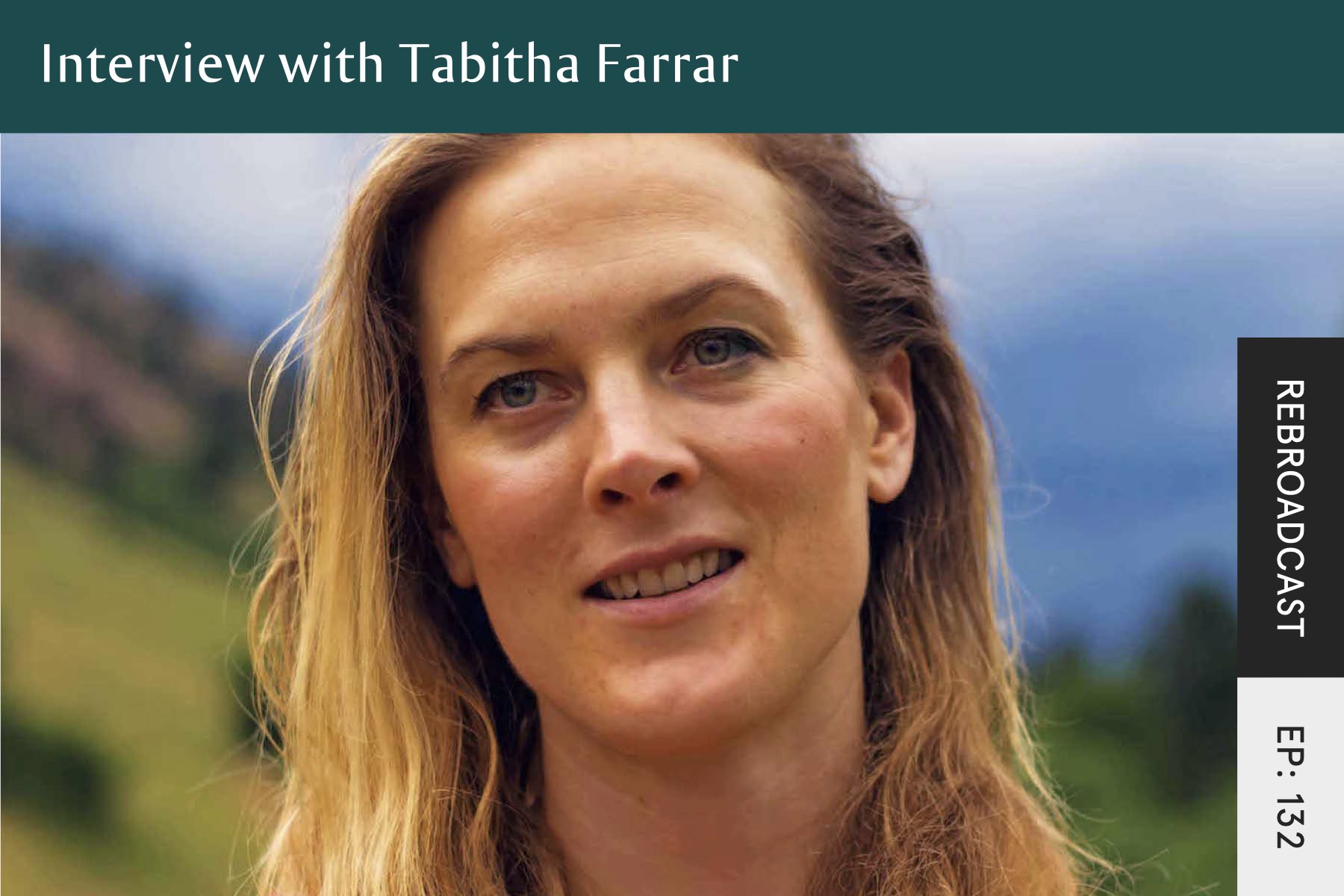
Episode 132: Welcome back to Real Health Radio. Today's guest interview is with Tabitha Farrar.
Tabitha grew up in Wiltshire, England, in an idyllic (yet rainy) village. Despite being a robust and confident teenager, she developed an eating disorder at age 17 and this devastating illness took pole position in her life until, at 25, she finally started my recovery journey. She successfully recovered from Anorexia Nervosa and the complicated matrix of obsessions and habitual eating disorder behaviours that came with it. She’s now an eating disorder recovery coach and author of Love Fat, an educational memoire on eating disorder recovery and insight, and Rehabilitate, Rewire, Recover! — a recovery guide for adults.
00:00:00
00:04:20
00:11:38
00:18:50
00:25:20
00:32:55
00:38:17
00:45:52
00:55:12
00:57:22
01:03:13
00:00:00
Chris Sandel: Welcome to Episode 132 of Real Health Radio. You can find the links talked about as part of this episode at the show notes, which is www.seven-health.com/132.
Welcome to Real Health Radio: Health advice that’s more than just about how you look. And here’s your host, Chris Sandel.
Hey, all. Thanks for joining me for another episode of Real Health Radio. I’m still working on a new solo episode and have been rather time-poor lately, so you’re going to have to be patient on that front. Or if you actually prefer the guest episodes, then you don’t have to be patient at all because that is what we’ve got on for today.
Today’s show is me chatting with Tabitha Farrar. Tabitha grew up in Wilshire, England, and despite being a robust and confident teenager, she developed an eating disorder at age 17, and this devastating illness took pole position in her life until, at age 25, she finally started her recovery journey. She successfully recovered from anorexia nervosa and the complicated matrix of obsessions and habitual eating disorder behaviours that came with it.
Since then, she’s done so much in the recovery world. She’s a founding member of International Eating Disorder Action. She’s written two books. She’s the host of the Eating Disorder Recovery Podcast. She also coaches adults in recovery.
I’ve been aware of Tabitha’s work for a number of years and have listened to many of her podcasts. More recently, her name kept coming up more and more. Probably for the last couple of times, probably two or three times that I’ve done client intakes, when I speak to clients about who they follow and who has helped them in recovery so far, there are two names that are mentioned more than anyone else. One of them is Meret Boxler and her podcast, Life Unrestricted, and the other is Tabitha Farrar.
Earlier this year, Tabitha released her second book called Rehabilitate, Rewire, Recover, and again I had a number of clients mention it. So recently I read it and I really enjoyed it. I think Tabitha and I share a lot of things in common in how we think about recovery. Having a resource like her book that does go through things in such detail but is also accessible and easy to read has been really helpful. After following her from afar for the last couple of years, I finally decided to get in contact and ask her on the show.
As part of the episode, we talk about her experience of dealing with anorexia and the recovery process. Many of the aspects of Tabitha’s experience are atypical, so it was good to be able to go through this and show how some of the assumptions or the stereotypes that we have about eating disorders aren’t always true.
Then we use her book, the most recent book, as the basis for the rest of the conversation. We go through the migration theory for anorexia, through the concepts of nutritional rehabilitation and neural rewiring, take a look at energy debt and various symptoms of malnutrition and different types of restriction, and lots more.
Tabitha, by her own admission, is blunt and has a lot to say on the topic of eating disorders, but I’m very grateful for what we got to cover and her insights around recovery. So let’s get on with the show. Here is my conversation with Tabitha Farrar.
Hey, Tabitha. Thanks so much for joining me today. I’m really excited to be chatting with you.
Tabitha Farrar: Yeah, me too, Chris.
Chris Sandel: Anorexia recovery is basically what I want to chat about today, and there’s two parts to this. Firstly, there’s your story and experience with anorexia and recovery, and then secondly there’s the most recent book that you’ve written, which is Rehabilitate, Rewire, Recover, which I’ve read and I loved. That looks at recovery both more broadly and also in more detail. So that’s the general idea for today’s chat.
00:04:20
But I guess as a starting place, for any listener who doesn’t know who you are, do you want to give a bit of background on yourself? We’re going to go into more detail on this stuff, but just starting with who you are and what you do.
Tabitha Farrar: My name is Tabitha Farrar. I am a Brit, but I live in Colorado. I work as an eating disorder recovery coach, which is a bit of a strange thing, and I’m not sure that it was actually a thing when I started working as an eating disorder recovery coach. I began by recovering myself, which I did without any professional treatments. I just want to put in there, that’s not something I necessarily advise. It was just what happened in my situation.
I began writing about it, and then people began following my blog, and then people began emailing me and asking me lots of questions and asking me if I could coach them. I started doing that. I was working in marketing at the time, had a full-time job. Then the demand for the coaching got so much that I quit my full-time job, and now I’m a full-time coach. It just sort of happened by accident.
Chris Sandel: Right. Let’s then start with your start of the story. You suffer with anorexia, and I know your story is probably atypical, or atypical at least in terms of the narrative that people hear in terms of how it started. Do you want to describe this?
Tabitha Farrar: Yes. I never had any body image issues, actually. I was an anomaly in that I was a really body confident teenager. I didn’t really have any negative self-talk about my body. I always found it slightly strange how my friends were always – I used to think of it as slagging their bodies off. I just found that strange. I remember that often as a teenager, just thinking, “It’s your body. Why are you so mean to it?” [laughs] Which I know is not normal for a teenage girl, but that was me.
That’s also one of the reasons that I was somebody that nobody thought would develop an eating disorder. And I did. I like to talk about that because I think it helps get rid of that stereotype a little bit that it’s only people who are having a lot of negative body image problems that develop eating disorders.
I did go on a diet, though, but my reasoning for going on a diet was because I was working in a racing yard at the time as an exercise jockey because I’m too tall. Actually, racing is not the industry I was in; I used to ride event horses. But it was just to earn money. I would exercise some of the racehorses at a local yard.
I fell in love with a little horse called Kit Kat. She was a little chestnut filly. She was very small, though, and I wasn’t ever getting to ride on her. Then I worked out it was because the trainer had figured that I was just a little bit too heavy for her. That was my motivation for losing a bit of weight. I didn’t want to lose much at all. I wanted to lose 5 pounds or something.
It worked; I got to ride Kit Kat because my weight dropped. But then it didn’t go as expected, and I then couldn’t get myself eating again. As many people who have anorexia or a restrictive eating disorder will know, it just happens so naturally. It’s just like, “Oh, feels kind of good not to eat, and everybody’s complimenting me for losing a bit of weight. This must be a good thing. I should keep on doing this.”
Then I started to want to exercise more, and it felt, again, like a natural thing. “I feel good when I exercise, and everybody tells me exercise is good for me, and everybody’s saying it’s a good thing that I’ve got a gym membership and that I’m going.” Then it starts to snowball. And then people start telling you it’s not a good thing. [laughs] But at that point you can’t do much about it, or at least I couldn’t.
I was way too far gone. I lost weight very quickly, and then I had very severe anorexia for around 10 years.
Chris Sandel: With the losing weight quickly, was that also atypical in comparison to what is the norm?
Tabitha Farrar: I don’t think that there’s necessarily a norm. I think that all people’s bodies lose weight differently, and mine reacted to the reduction in calories, the reduction in food intake, and the increase in exercise. I did lose weight pretty quickly. But I don’t think you necessarily have to lose a lot of weight to have anorexia. I know lots of people who don’t even lose enough weight to fall into the underweight category in the BMI chart, but they have very active anorexia.
That’s just the way my body reacted. My whole family are relatively string bean body types anyway. I’m tall as well, so it was very obvious on me. It looked bad very quickly.
Chris Sandel: How quickly did you go from “I really want to ride this racehorse; I’m going to go on a diet” to being in the depths or being in a place that would get you categorised as having anorexia?
Tabitha Farrar: It was the middle of the summer. That’s when I had the racing job. I can’t remember exactly when, but I know it was the middle of the summer when I had that job. I would imagine it was around June, July time. I was going away to university for the first time that fall, and I guess I went away in September time. I do remember that about a month before I was due to go to university, my mother started to get worried about me. Most people were still in the category of “You look great, and it’s great that you’re enjoying exercise” and these things, but I know my mum was getting worried.
The week before I was due to go away, she really tried to get me not to go. I think she’d already clicked that there was something very much not right and I had lost far too much weight – and not even just the weight, but my behaviour changed. I used to be somebody who ate everything and anything, and now I am somebody who eats everything and anything. So I think it was majorly concerning for her seeing me decline biscuits with my tea. Seeing all these little things that were not me really alerted her that something was wrong.
But I wanted to go to uni, so I went, even though she asked me not to. About middle of that first term, a friend came up to visit me. She stayed for three days, and she went straight home after staying with me for three days and drove straight from the train station to my parents’ house and then dissolved in tears at my parents’ house because I looked so awful. I think my parents were then set up for, by the time I came home at Christmas, what they were going to get.
By the time that I came home at Christmas, it was really entrenched because I’d had that whole term just to exercise and not eat and get into all of these behavioural patterns.
00:11:38
Chris Sandel: Can you describe and maybe give a bit of a potted history of the 10 years – and I know I’m asking you to do a lot there – but the 10 years of the disorder and how it progressed, and then also how you started to come out of that?
Tabitha Farrar: I had a very strong OCD component to my eating disorder. That’s true for many of us who have the exercise compulsion. I think genetically, according to the work that people like Cynthia Buick have done, genetically OCD and anorexia lie close together. Some people, not everybody, have a strong OCD component to their eating disorders, and I was on the really strong side.
The exercise thing, I joined a gym in the first term, I think it was. I can’t quite remember; it might’ve been a bit later. But I’d been someone who never went to the gym apart from in PE when we were made to at school. Then I started to enjoy working out and then become very, very quickly very obsessive about working out, particularly running. I started running.
I can’t really say I’ve ever, if I’m honest, enjoyed running. I hate it. But it was just that compulsion, “I have to do this.” It was very quickly that movement and food became linked in my brain. So it was really fast that if I was going to eat that day, I had to have done a lot of exercise.
I still starkly remember at university digs, going to the canteen at breakfast time – I was on my own because the rest of my digs all slept in. I was always an early riser. I’d always been somebody that eats breakfast. I remember the first time I got myself something like a banana, low fat yogurt, tiny little breakfast, and I remember looking at it and thinking, “This is all I’m going to eat today.” That sort of thing started to kick in, that sort of challenge, and that challenge making me feel good.
I very quickly got into those sorts of habits. Most of them stuck with me throughout that 10 years, but everything shifts and changes. Not many people with anorexia can strictly restrict for a prolonged period of time. Most of us can only do it for 6 to 8 months, and that’s when the exercise starts to come in because you can’t continue to strictly restrict. In order to justify eating, the exercise starts to creep in. So the exercise really, for me, was a form of purging.
Then after that, the exercise turned into its own thing, which it really was a compulsion. “This is what I do every day. This is what I do when I wake up.” Then the OCD started to filter into everything else as well, so just my daily routines. I was absolutely rigid. Even the way that I made a cup of tea. Not necessarily what I put in the cup of tea, but the way I made it. The amount of times I walked across the kitchen to get a glass, to get a mug, to get the milk. Even that was routine.
Many of these things were so small that an onlooker wouldn’t necessarily notice unless they were very close to me, but I knew. I knew it caused me distress to make my cup of tea in a different order. Now, I’m not somebody who has OCD other than when I have anorexia. I didn’t have any OCD before. Many of these behavioural traits started to come out in me just as a result of my brain and body being in malnutrition.
What happens then is that many of these things begin to become entrenched and the brain starts to learn. Say for example with that cup of tea – something which is very non-threatening. I knew logically I could make a cup of tea differently and it wouldn’t be a threat to me. But my survival brain just didn’t seem to know that.
I think when you do something repetitively, your brain starts to think, “I obviously have to do this this way because I always do this this way, so this is obviously the safe way to do this, and it’s obviously unsafe to do it any other way just because I don’t do it any other way.” So this completely illogical HPA axis fight or flight response would come up in me even about changing the tiniest thing, like the thought of “I’m going to go and get the milk first before I go and get the tea bag” – which part of me knew was completely illogical. But fear is fear, and most of us tend to run away from fear rather than challenge it.
So I would just do the same thing every day and filter out any friends, filter out any influences that might make me have to be flexible. Then you get very lonely. [laughs] Which gives you much more time to be inflexible, rigid, and OCD, because I would fill that time that I should’ve been probably spending with friends or doing leisure activities or socialising, with exercise and other routines.
That was really my life for many years. It would shift from time to time. Obviously, when I left uni, moving environments, different jobs, different things would cause shifts. But the general theme was the same, and the exercise always being a huge component of it.
I never would admit to myself or anybody else that I had an eating disorder. I didn’t believe I was the type of person that could because I thought that eating disorders happened to vain teenage girls and people who were obsessed with their bodies, and I was never any of those things.
I think that got many of my doctors and GPs as well. I just think it baffled many people that I had an eating disorder. I also swore blind that I didn’t, so that didn’t help. But I remember doctors trying to pry into my family life and see if there’d been any abuse there, because many doctors at that time also thought eating disorders were a product of poor parenting and problems like that. None of the reasons why people get eating disorders, apparently, fit me.
I think really, when it started to come to my awareness that I had an eating disorder, I knew that it was something biological happening to me. It wasn’t something I’d chosen. I didn’t want to be that way. I didn’t even like running. It felt very biological, like “I have to do this.” No choice in there.
Long story short, around the age of 26 I was suicidal because it’s very depressing living like that. It’s tiring as well. It’s exhausting. The thoughts don’t end. I didn’t sleep because what I discovered is that when my body is in malnutrition and thinks it needs food all the time, because it does need food all the time, it prioritises food over sleep. So I had horrible insomnia. The days were never-ending. My thoughts were relentless, looping thoughts, obsessing about food, obsessing about exercise, that mental hunger.
It really was “I’m going to change or I’m going to kill myself, and I’m serious about that.” That’s what pushed me to change – which, again, I don’t necessarily recommend. I’m just telling the truth how it worked out for me. I’m not saying that my story is ideal by any means.
00:18:50
I kind of dabbled. I think my recovery process was around 4 years, to be honest. I tried different things. I failed more than I didn’t fail.
One of the standout things for me was when I decided to go cold turkey on the exercise, and I just stopped. It was absolutely the hardest thing I’ve ever done. It’s the hardest decision I’ve ever made in my life. My brain was so fearful of stopping movement.
Chris Sandel: Where was that in the 4 years?
Tabitha Farrar: That was towards the end. That was one of the things – I would say that moment actually kickstarted my recovery because I don’t believe you can recover from restrictive eating disorder and have compulsive exercise and still compulsively exercise. You can gain weight; that’s not the same as recovery. For me, I needed to stop the exercise.
I see exercise, for those of us who have the exercise component of anorexia, as like this big energy source for the eating disorder. It fires up and provides energy to all of those neural pathways that the eating disorder has created. So I think it’s very difficult to, for example, change what you’re eating when you’re exercising each day and you are completely in that eating disorder neural network.
The first morning that I woke up and didn’t go for a run, I felt like I was having an out-of-body experience. It was like my brain didn’t have a set for that day because I always got up and ran, and then I’d have my very disordered breakfast afterwards. Because I hadn’t got up and run, it was like my brain was on a completely different neural track.
It completely shifted it off, and I actually found that I was able to start changing the foods that I was eating much easier because I wasn’t in this neural rut which says “After you run, you eat XYZ.” It was like, “You haven’t been for a run, so what the hell are we doing?” I was able to take advantage of that and say, “We’re doing this, which is completely different, but hey.” I was riding that energy, which was adrenaline energy, to push myself to start to change.
So recovery really went from there. It was still messy. I still made slips and slides. But that year was immense change. What I discovered in that year – I hated being underweight. I really did. I looked awful. I didn’t have body dysmorphia. I could see it. I looked horrific. Didn’t stop me being scared of gaining weight, which is another illogical and rather strange, weird, or wonderful thing about anorexia. You can be very underweight, want to gain weight, and still be terrified of gaining weight.
But I would always tell people, “I know I’m really skinny. I’m trying to gain weight.” Trying to gain weight for 10+ years. What I really discovered was that when I put my mind to it, I could gain weight no problem. I think that’s one of the things that scared me. I knew that if I really wanted to gain weight, I could. And I did.
With the nutritional rehabilitation, my brain started to turn off that anorexia response, which I believe is a migration response. When your brain thinks that food is scarce, it wants to move a lot and eat very little because that’s what migrating animals do. As that started to switch off, all those traits, they didn’t go away but they got weaker. And then with determination, I was able to break them because the nutritional rehabilitation had helped me weaken the strength of those “I have to do these things,” especially the movement and the restrictive eating. I hope that makes sense.
Chris Sandel: Definitely. Some of those things that you touched on terms of the migration, in terms of nutritional rehabilitation, the neural rewiring, are things I want to go into in more detail because they come up in the book, and I think they’re incredibly important.
You said earlier that you did all this on your own. You didn’t really go through any traditional treatment. Were you pushed in that direction? You mentioned your mom was terrified after just 3 months of it, so I imagine over a 10-year period is going to be also pushing you that way.
Tabitha Farrar: Yeah, I don’t know. I stopped going to the doctor, so there wasn’t really anyone to push me. I was so reactive. Both my parents know that even if they mentioned the words ‘eating disorder’, I was out the door. And because I was an adult, there was nothing they could do to stop me. I had a car. I had my own place. So there wasn’t really anyone to push me, and I guess most people who would’ve just got their head bitten off too many times to keep trying.
So I don’t know that I was ever necessarily pushed in that direction after the initial couple of GPs who tried to psychoanalyse me, but I just knew it wouldn’t help me because I knew I had no trauma. I had had no trauma. I knew that there was nothing that – what I felt was if I went into a psychotherapist’s office and they were asking me, “Why are you doing this to yourself?”, I’d be making stuff up to please them.
I figured if I couldn’t work out why I was doing this to myself, then I wasn’t doing it to myself in that sense, and it didn’t feel like that to me. Like I said, it felt biological. I don’t know how I knew that, but that’s what it felt like. It felt like it was something biological in me that was pushing me to be this way, not something that was some deep, dark, repressed psychological reason.
I think it’s just my personality type as well. I think I’m too argumentative. I just don’t think it would’ve worked. A lot of that may have been my stereotypical, at that time, view of what a therapist does. I didn’t know any other way.
I’m definitely one of these people – and again, I’m not advocating for this; I think everyone should absolutely seek help to recover from an eating disorder, and I think I should have as well. But I’m just a stubborn idiot a lot of the time who has to do everything herself, even if that means it’s going to take 10 years rather than 1 year. And that’s what happened.
00:25:20
Chris Sandel: Even though you weren’t going down that traditional route, were there resources that you found that really helped you?
Tabitha Farrar: Nothing that was helpful in terms of therapy, and I can’t really say that I ever looked for anything. The resource I found really helped me at that time – and this must’ve been – I remember for most of my eating disorder, the internet wasn’t really a thing, but it was towards that time when I was actually like, “Okay, I have an eating disorder. Holy crap, I need to work out how to deal with this.” I came across the FEAST website, which is a website aimed at parents of children with eating disorders. It’s a family-based treatment website teaching people how to re-feed their child.
The stuff on there was really helpful to me because the parents were basically describing my reaction to food when they were talking about the tantrums their children were having. It also was really focused on nutritional rehabilitation more than anything else, which is if you get nutrition into this child, they will start to get better and their brain will start to come back.
Again, I don’t really know why; for some reason it clicked with me. I was like, “I have to force-feed myself.” I say it like that, as if it was easy. It wasn’t. [laughs] That was traumatic, force-feeding myself. There were many meals that I sat through, blubbing and sobbing and crying and shaking. But I was actually able to use that stubborn idiot to my advantage in those sorts of situations.
Just in the same way if I looked at something in the morning and said, “I’m not eating anything else all day,” I could do that, if I looked at a plate of food that terrified me and said, “I’m not leaving this table until it’s all eaten,” I could do that too. And I did start doing that.
Chris Sandel: So really channelling the thing that got you into it to be the thing that gets you out of it.
Tabitha Farrar: I’m very competitive with myself. [laughs] Another key thing for me – which again sounds like it should be obvious, but it really wasn’t for me for many years – another key thing was being able to identify my tantrum around food and my resistance to eating and my resistance to not exercising was fear.
As soon as I was able to understand, “Oh, I’m scared of that lasagne” rather than all the sort of things I’d been telling myself, like “I don’t like meat” or “I don’t eat dairy” or “I don’t eat gluten” or “I don’t like the fact that someone’s trying to make me eat it, and I don’t like people telling me what to do. These are all the reasons I don’t want to eat that lasagne” –when I could be truthful and identify “I don’t want to eat that lasagne because I’m scared of it,” then something clicked with me. Because I hate being scared of anything. So then I was like, “I’m going to damn well eat that lasagne just to prove to myself that I can.”
Chris Sandel: Did that level of truthfulness happen early on, or there needed to be some level of nutritional rehabilitation before you could get to that place?
Tabitha Farrar: I think I sort of stumbled myself up. I stopped exercising. That was hard. Then I stumbled myself up to somewhere that people might say was within the healthy BMI range but was still underweight for me. But that is some degree of nutritional rehabilitation.
It was actually only after I got myself up there that I started to begin to understand the concept of unrestricted eating and that I needed to do that. So I definitely had to get some nutritional rehabilitation before my brain was open enough to “I’m going to go out there and eat the scariest things that I can find because those are the things that I really want.”
Chris Sandel: You talked earlier about you becoming a recovery coach, and it sounded like that happened almost organically or even haphazardly. If you hadn’t been pulled back into that by other people, had there been thoughts of “maybe I want to go back and help people” or “maybe I want to stay in this field”? Or when you got into your marketing, you were thinking “I’m going to make a clean break and do something else”?
Tabitha Farrar: I think early on in the first couple of years of my moving towards full recovery, I absolutely needed a break from absolutely everything. It was years later that I started to write my blog a bit more and get more involved with advocacy. I certainly needed that break.
And I don’t think at that time I considered I would go into doing anything to do with eating disorders. I was quite happy with marketing. But now I’m really glad that I did change that.
Honestly, the one thing that I wanted to be all my life was a vet, and that really changed with anorexia. It definitely took that away from me. I was so obsessed with the gym, I didn’t really care what I did. I staggered through university, mostly using university as an excuse to stay away from my parents so they couldn’t try to stop me exercising. Then as soon as I got out of university, I wasn’t at all interested in further education; I just wanted to move into my own place and go more into the exercise industry. So there wasn’t much hope. I felt like it was too late for me to go back and do all of the re-schooling I’d need to do in order to be a vet.
My first choice career would definitely be I would want to be a vet, but that’s not going to happen, so eating disorder recovery coach is what we’ve got. [laughs]
Chris Sandel: With your book, Rehabilitate, Rewire, Recover, when did this come out? Am I right in thinking it was this year, or am I really behind the curve on this?
Tabitha Farrar: That’s right, this year. It was this year. I think it was April.
Chris Sandel: I’ve read the book fairly recently. I really love it. It’s very comprehensive and touches on so many aspects of recovery and physiology and goes through the multitude of different symptoms that occur. But despite that, it’s also quite an easy read. As a practitioner, I find it helpful, but it’s also a book that’s useful for me to recommend to clients if they haven’t read it already. When you were writing it, what was the intended audience?
Tabitha Farrar: Definitely intended audience is adults in recovery from eating disorders. Really myself at that time is the intended audience. When I’m talking about eating disorders, and especially when I’m talking to adults who are in recovery, pretty much the only tone that I have is a very blunt one. I talk to people the way I needed someone to talk to me. [laughs] The tone of the book is, again, pretty straightforward and to the point.
Chris Sandel: Yes. How would you characterise the book as being different to other things that are within the recovery space? Is it just the bluntness? What other things do you think you’re offering that’s different?
Tabitha Farrar: There’s very little in the way of therapy, or even actually nutritional education in the book, and that’s actually one of my stances. I think people with restrictive eating disorders are already hyper-aware around food and nutrition and all those things. That’s the last thing they need more education on.
00:32:55
I have some very different views on recovery processes than I think is the traditional route – one of those being that anorexia is a migration response. I’d say that’s pretty different. It’s actually, I think, a much more scientific view. If you look at migrating animals, what happens is they go into energy deficit, the food reduces in their environment, and then something in them triggers this response to move a lot and not eat while they’re moving until they get to the place that they’re migrating to, and then they stop moving and they eat. It’s not like a bird sits there and just decides “I fancy a vacation or a holiday in Australia.” Something in its biology is prompting this desire to move.
When animals are migrating, they can’t stop and eat very much. That’s actually a threat to their survival to try and find food in the area that they’re migrating from because food is scarce there, and they’ll spend a lot of energy moving around looking for food when really, they just need to use that energy getting the hell out of there.
I think why that theory hit me so hard was the movement thing. The movement felt so crucial to my survival when I had an eating disorder in a way that I couldn’t logically explain. It had to be something biological.
So I think that’s hugely different, and then riding off the back of that, which is very controversial in this field, is that I think binge eating, or feast eating as I call it, is entirely appropriate when somebody is recovering from a restrictive eating disorder and is in malnutrition. For many of us, admit it or not – lots of people don’t like to admit it – the desire to eat a lot of food when you’re in recovery is absolutely huge. So I think that’s, as I said, entirely appropriate. And that’s what migrating animals do when they get to the place that they’re migrating. They feast. They eat a lot to make up for the deficit.
One of my biggest issues with the eating disorder industry is centres, treatment, professionals that tell people that if they want an extra bag of crisps or whatever – somebody that’s been brave enough to admit that and say that – telling them that that’s too much and that that’s a binge. I think you can do way more damage to a person by saying that to somebody who’s in recovery than anything else.
Chris Sandel: And both of those are things that I really enjoyed about the book. With the migration theory, is this something you go through with clients? If so, does it help? Because when I read that, I feel like it’s a really nice level detachment and helps people see through their thoughts and behaviours as part of that response as opposed to who they are.
Tabitha Farrar: Yes, certainly. Everything in that book is a big way that I recovery coach as well, which is “Oh yeah, you’re scared of highly caloric foods because your brain is scared of these foods because your brain thinks you need to migrate, and highly caloric foods would be the ones that you would have to stop and hunt for, because that would be meat when we were back in migrating years. So of course your brain is really scared of that. But we need to teach your brain not to be scared of that by eating highly caloric food.
Because the fear response is so strong, most people, when they can understand “Oh, this is a biological reaction. Of course it doesn’t seem logical,” that really helps them understand that it’s not to do with anything. It’s just this biological reaction that we have to amend by gaining weight, not suppressing body weight, and rewiring the brain. Then I think they can become quite task-orientated, take the emotion out and just be like, “Oh, I’m having a fear reaction. I have to sort that out by going towards the thing I’m scared of rather than running away from it.”
Chris Sandel: Yeah. Fear is something that runs through the book, and you bring it up again and again because it comes up again and again. In pretty much everything that has to be overcome or has to be dealt with, fear is going to be a part of that.
Tabitha Farrar: Yes. The real kicker with anorexia is that it does trigger our fear response, and fear response is so strong. It’s so strong for a reason in humans. It’s strong because it needs to be to keep us safe. So you’re really dealing with something pretty huge when you’re trying to rewire a fear response. You have to be incredibly consistent and you have to be incredibly determined and knowing that you’re doing the right thing.
I think that’s often the missing link for people who are having this fear response. A part of them know, “I really should push myself to eat more cake if I’m scared of eating more cake, and I kind of want to do it anyway. I really want to eat more cake.” There’s a part of people that knows what the right answer is, but then there’s a lot of confusion that gets put on top of that when you hear stories of “Oh, but somebody once told me that eating more of that would be binge eating disorder.” It all plies on top and it adds to the fear rather than adding to the person’s recovery.
I think when we’re dealing with this strong a fear response, all of the energy that we’re using to help people in recovery has to be the “You can do this,” not the “Oh, you should be a bit careful, though.” [laughs]
00:38:17
Chris Sandel: Yeah. You touched on it already, but the book can roughly be broken into two parts that are worked on concurrently. There’s the nutritional rehabilitation, and then you’ve got the neural rewiring or the brain rewiring. I want to go through these in a bit of detail. Do you want to give an explanation about what both of those are and mean?
Tabitha Farrar: Nutritional rehabilitation, you can’t recover without that because it’s the energy deficit or lack of nutrition that triggers the brain to think “Oh heck, I must be in a famine because why else would there not be enough food?” This is brain stem area. I’m not talking like logical brain; this is brain stem area that reacts and keeps us safe. Famine would’ve been one of the biggest threats to humans, not now, but in years when our brains were developing.
That’s what we call the reptile brain, and we call it the reptile brain for a reason, because it’s the oldest part of the brain. In those of us who have the anorexia genetics, you go into energy deficit and this reptile brain kicks off and is like, “Right, we have to migrate.” That usually has this cascading behavioural things that start to happen to us.
So without nutritional rehabilitation, if you imagine that’s a switch that turns on, going into energy deficit, and therefore we need to move, we need to get that switch turned off. And the only way that’s going to happen is if you get out of energy deficit. For the majority of us, that means committing to weight gain.
The nutritional rehabilitation is not an option. It has to happen if you want to recover. But the neural rewiring also has to happen because, especially if you’ve had an eating disorder for anything longer than 20 minutes, your brain’s going to start forming neural pathways of these repeated behaviours.
Over years and years and years, like it had for me, these neural pathways cease to need to have a reason. They’re just what you do. If you stop doing or change doing what it is you do, your brain elicits this fear response. When your body is in malnutrition, your brain is going to come to the conclusion that you must be in this hostile environment, something’s really not right. I think when our brains are in that kind of survival instinct mode, they form habitual behaviour a lot quicker.
So this habitual behaviour that many of us get and all these compulsions can be really strong, but it’s all tied up to one another. If you just do the nutritional rehabilitation – which is what happens a lot of the time; you go to a treatment centre and you’re just fed, and that’s brilliant. That’s great. You need to gain weight. But if it’s done without neural rewriting, the neural network is still there.
So you still behave the same way, and as soon as you leave that treatment centre, you snap back to that way of operating. Of course you’re going to relapse, going to go backwards. Also, what happens a lot is what many people find is they’re just as eating disordered. They still have anorexia. They’re just in a larger body. Being in a larger body is great, but it’s not full recovery.
Full recovery is not having anorexia, and in order to get there, which I believe absolutely anybody who sets their mind to it can do, you have to understand the neural rewiring piece as well, and you have to train your brain that it’s safe to eat all of these foods, and you have to train your brain that it’s safe not to do all of these routines.
That’s what causes the brain to really start relaxing, come out of thinking that food is scarce. Another part of this is the food scarcity bit. If your brain thinks that food is scarce and it’s acting a certain way because it thinks food is scarce, then even if your weight goes up, if you’re still acting like food is scarce, eating in a really restricted way, exercising quite a lot – if you’re still doing all of the things you did when food was scarce, then your brain is going to continue to think that despite the fact that your weight went up, there’s still something not right. Because why would you be doing all those things if food was no longer scarce?
I see recovery as a lot of it is – and this is both neural rewiring and nutritional rehabilitation – we have to convince the brain that food is not scarce, both in our actions (that’s eating the food), responding to hunger as if there’s no food scarcity, and all of our behaviours, and even our thought patterns.
So you need to rewire even thought patterns that say to you, “I can only eat so much of that.” Because it’s not true. You can eat as much of it as you want, and you can’t keep giving your brain the message that food is scarce, which is exactly what you do when you place a limit on the amount of food you can eat. I hope that makes sense.
Chris Sandel: Yeah, it does. With the energy deficit part of it, you give a really great analogy using money to illustrate the debts someone can find themselves in after a decade of restriction. It really shows why nutritional rehabilitation takes so long and also why it can take a lot more food than what people originally think it’s going to take. I don’t know if you remember the example to share it, but I think it’s really helpful for people to get.
Tabitha Farrar: And also why nutritional rehabilitation does not stop when the magic BMI 19 is reached, or whatever it is, or when a target rate is reached – which is nonsense, the idea of a target weight being set by anybody other than the person’s body, but that’s another topic. [laughs]
The money analogy is that I talk about something called energy debt, which is the accumulation of prolonged energy deficit. The money example is if you’ve got a job, you’ve got a great house, and then you get laid off your job and you don’t have a job for a number of years, so you cut all of your subscriptions, you start scrimping and saving, you cut down on anything that was considered a luxury, and you get by for a number of years – but over that number of years, you don’t have enough money to say pay a plumber, or the roof starts to go and you don’t have enough money to repair the roof on your house – the house is still standing, but over the years it deteriorates.
Then you get a job, which is like whoop-de-do. You start to get enough money coming in to cover the day to day stuff. So you start to live a bit better each day. But just because you’ve got a job and you’ve had a job for a couple of months, does that mean that you can repair the roof yet? No, it doesn’t. You have to save money so that you can slash out twenty grand or whatever it is to buy a roof.
Getting that job and being able to feel a bit better about the day to day stuff doesn’t take care of all of the debt you’ve accumulated over however many years you haven’t had a job or those people you have to pay back. So you need to keep lots of money coming in, I’m afraid, to cover that debt, or to even start to get that debt covered.
That’s how I see nutritional rehabilitation. The whole time that your body has been in energy deficit, especially if you’ve been an idiot like me, exercising the whole time your body’s in malnutrition, your body has so much to repair that you start eating more and you’re covering your daily needs maybe, but your body’s got these huge debts it needs to pay off by repairing things. You need a lot more energy.
Energy deficit can go on for a long time after the scale says nutritional rehabilitation is reached because your body is still doing internal repairs and it’s still paying off that debt that was accumulated.
00:45:52
Chris Sandel: As part of it, you also cover many different effects of malnutrition. I also find this can be helpful for people to hear because there can almost be a normalisation that symptoms start to happen, and they happen for so long that you often stop thinking of them as symptoms. Going through this can be useful to make people realise that these are symptoms. They aren’t a normal state of health.
Do you want to talk about some of the ones you cover in the book? Or if it’s easier to remember, the symptoms that you went through as part of malnutrition?
Tabitha Farrar: The physical symptoms I think people understand more. The mental symptoms can be a lot more interesting and actually help people who are in that path of “Maybe I’m not super underweight, so I don’t have an eating disorder,” or anyone who’s trying to convince themselves they don’t have an eating disorder. The mental state symptoms of malnutrition are often more telling.
For me, one of these was I suddenly became very sensitive to noise and crowds. Basically, I’d always been an extrovert as a child, and that really changed the more into malnutrition I went. I think that makes perfect sense. I think when the body has not got enough energy, it becomes more introverted. Not passing any judgments on people who are introverts, but I think another thing why this is to do with malnutrition is that if your brain thinks you’re in a situation of food scarcity, then you become less social because your brain’s like “other people could be a threat to the food source.”
Part of me was very lonely, but part of me was really happy being quite insular and just keeping to myself.
Massive increases in impatience and irritability. I think a malnourished brain and body has every reason to be impatient and irritable, but I was just awful. I couldn’t even stand myself, I was so horrible. Vile to everyone, especially, unfortunately, those who were closest to me like my parents.
I think depression is also another one, as well as – and this is interesting; I only noticed this as I came out the other side – that there had been a dulling of my senses, such as hearing and my visual senses. As I came through recovery, suddenly the world literally started to feel like it was brighter. Colours seemed brighter. That was another thing I noticed that must’ve been something to do with malnutrition.
I was more paranoid and defensive, which, if you think of a starving animal, they’re pretty defensive. I developed a kind of hoarding habit. Hoarding food, mostly, but not just food. I would hoard all sorts of things – anything that I could get for free, I would hoard. I had plastic bags. I used to save plastic bags. Don’t even really remember why. I used to save things like plastic cutlery and sachets of salt and anything that I might get. I would just hoard all these things – which makes sense. As a malnourished person or in areas of food scarcity, your brain would come to this place of “resources are scarce, so I need to save them.”
Mental hunger is the huge one for most of us. There’s not many people who can deny that they are thinking – they can deny it to other people, but not themselves. The looping, continuous thinking about food is mental hunger. For many of us, I think that mental hunger and just how boring it is and taunting it is, is what really drives us to want to recover. I was just so sick of my own head. That was a big one for me, the mental hunger, and that absolutely went away with full recovery, not sitting there and thinking about food the whole time.
Trouble sleeping is a symptom of eating disorders. Things like low sex drive, losing your menstrual cycle if you’re a woman, thinning hair. These are all more like physical ones as well.
The mental ones, though, some more of those are this fear of eating too much. I think that’s a huge mental one. Most of us have this idea of how much we should or can eat in a day, and eating anything more than that elicits this fear response. I think that’s because when your brain thinks you need to be migrating, you should be eating the smallest amount possible for you to survive that day and not wasting any more time searching for food above and beyond that. To do so is a threat to your survival, and therefore we have this huge fear response about eating more.
Many of us find during recovery we can eat more and that’s scary, and then that becomes safe, and then eating more again is scary. That usually continues throughout recovery.
Fear of weight gain. I think for migrating animals, that weight gain signifies that you’re not doing that if you’re in a food scarcity area and you’re spending too much time looking for food and eating food in that area and too little time migrating. I think this is why there’s this fear across the board for weight again, even in people like myself who don’t like being underweight. I never wanted to lose weight the first time. I was still terrified of weight gain.
Another one was a fear of being still, fear of not moving. It went beyond anything else. I got to the point where I couldn’t really sit down during the day. Not willingly, at least. I would stand. It was really limiting. I couldn’t go places because I was too scared to sit in the car. I had this really huge fear of being still.
There are more, and I go into a lot of these more in the book, but another one I’d really like to draw attention to is that eating becomes highly emotional when you’re in malnutrition. Whether you have the anorexia genetics or not, if a person’s in malnutrition, eating is still more emotional than it should be, and that’s because our brains use the emotions of lust and desire and wanting. When we’re in malnutrition, our brain uses these to try and motivate us to eat.
But if you also have that migration response, your brain uses the emotions of fear, distrust, regret, dread, shame to motivate you not to eat ‘too much’ because you should be migrating.
So if you’re still having an emotional response to food, it means you’re in an energy deficit because it’s not normal to hit the wall if someone comes in and offers you a grilled cheese sandwich. That’s not a normal reaction to food. So if you’re ever wondering, “Do I still have an eating disorder?”, that’s what you have to look out for. You have to look out for that emotional reaction to food because if you have that, that’s not normal.
And for me, fully recovered, that has completely gone away. Yeah, I like food. Yeah, I eat food. I’m not lusting after it every moment of the day – mentally, at least. I’m not having a fear reaction or a reaction of someone threatening me if they come in and offer me food. So I think that one’s a really big and important one.
Chris Sandel: There’s another one that you mentioned as well in the book, which was difficulty spending money on yourself. The reason I’m bringing this one up is because I’ve noticed it and I’ve had many conversations with clients about this. It was then quite telling or really helpful to read about it in the book and see this is very much a common part of the illness.
Tabitha Farrar: Yes, and I’m really glad you mentioned that, because it really does tie into the whole resource scarcity thing. It was also my inability to spend money and my huge fear reaction at having to spend money that also led me into understanding that this is a biological response. My brain thinks that resources are scarce, and when resources are scarce, I can’t go off spending money. I have to save.
It’s like every day I was saving for an apocalypse or something. I was hoarding stuff, and spending money or giving away resources created huge anxiety for me.
I think this is one of the things, alongside – the exercise is becoming more recognised, but I think the money spending thing is often really overlooked. This is an eating disorder thing, and it’s also annoyingly one of those traits – just like being somebody who exercises, just like being somebody who likes to eat clean – it’s one of those things that’s kind of congratulated by our culture. “Oh, good, lucky you. You’re a saver. Aren’t you great? Saving’s good. Yes, being frugal is good.”
For a person with an eating disorder, it’s not good. [laughs] It’s part of the eating disorder and can turn into something that’s really a lot bigger than just being a little bit frugal.
So that’s something for me that I had to rewire. If I was still acting like money was scarce, my brain would still think resources are scarce. I had to stop acting as if resources were scarce in order to convince my brain that resources weren’t scarce anymore, and that was one of the ways I had to stop acting like resources were scarce. I had to be able to spend money.
00:55:12
Chris Sandel: You also talk about different types of restriction that occur. People are probably aware of restricting calories or restricting certain types of foods – avoiding carbs or, as you said there, only eating clean. But you go through lots of different options that can also occur. Again, I think it’s useful because after a while, these can become the norm and people can forget to recognise that this behaviour is a problem. Do you want to go through some of the other types of restriction you comment on in the book?
Tabitha Farrar: Yeah, and many of them really come about in the rules that we all have. Like you said, the obvious is just restricting parts of your diet, but many of us have these – it’s just so much more entwined and in-depth than that.
Event restriction is a huge one. For me, if anything that was going to happen was going to be outside of my normal day – it didn’t have to be something huge; I always use the example of taking the dog to the vet appointment in the afternoon – it would cause me to restrict more that day to try and create more energy deficit. Any change in my normal routine would cause me to do what I call event restrict, which is like “in preparation for an out of the normal event, I need to restrict food or exercise more.”
The monetary restriction we talked about. That’s a huge one.
I think many people, especially if you’re functioning with your eating disorder, you can fly under the radar because you restrict, but it’s in a way that’s culturally appropriate. Like, I” don’t eat gluten” or “I don’t eat these things” or “I’m just healthy eating,” and it’s all actually really restriction.
I think many of us have also real what I call tiny rules around when we can eat, what we can eat, the time of day that we can eat, which is a huge form of restriction for many of us. It’s like, “Well, I’m hungry at 11:00 but I don’t eat lunch until 1 p.m. It’s not that I’m not eating lunch; I’m just restricting by not eating earlier, even though I’m hungry for it.”
00:57:22
Chris Sandel: Definitely. Let’s chat a little bit more about the brain rewiring piece and maybe what that looks like in real terms. How does someone go about that?
Tabitha Farrar: It’s really as easy and as difficult as detecting what it is that you are resistant to or scared of and then doing exactly those things until your brain is no longer scared of it. It’s just like training an animal. You’re training your brain, and the way that you train your brain is you give your brain that experience over and over again until your brain knows that it’s safe.
A really obvious one is “I’m scared of pizza. I don’t eat pizza.” For whatever reason. All these things usually fly into your head as reasons why you can’t eat pizza, and really all of those reasons are just fluff. It just boils down to fear. “I’m scared of the damn pizza.”
So you run towards it rather than away from it. You go and eat pizza. What I did with things like that, fear foods, I just ate – consistency is really important, and doing it as often and consecutively as you can. I ate pizza every mealtime for a number of days until it was no longer something that my brain thought was different or scary. That’s an example of my brain starting to rewire around that thing. Because my brain has experienced and I’ve given it data to show it that nothing bad happens after I’ve eaten pizza, my brain learns that that’s safe. That’s a really obvious one.
But the rewiring stuff is often less obvious than that. Many of us have these what I call neural ruts that we get into, which is like “This is the way I do my day.” Like I spoke about with the exercise, “First of all, I go running and then I eat breakfast and then I do this and then I do that.” Just changing that day can provoke huge anxiety for many of us.
It’s just detecting where you’re rigid – the way I made a cup of tea was rigid – and just taking a deep breath and saying, “I’m going to change it,” and just blindly going in and going, “And I’m changing it just to prove that I can,” because there will be so much resistance in your brain to actually changing it. All these reasons why you shouldn’t do that.
Then even the tiniest things – eating with a teaspoon was something I had to rewire. “No, I’m not doing that. I’m eating with normal cutlery.” That times that I ate was something I had to rewire. “No, I’m going to eat earlier than that time that I’m not allowed to eat before.” You just attack all of them by doing the opposite of exactly what your eating disorder brain wants you to do, and doing it consistently as well.
If I’d just done the “I’m not going to eat with a teaspoon” once, then it’s really big and scary the first time and kind of like you force yourself to not do it – if I’d done it once and then not done it again for a month, it would be just as difficult as the next time. You’ve got to do it really consistently. The next time I eat, “No, I’m not eating with a teaspoon. I’m not doing this anymore.” Really fast, actually, I find that the brain can then learn that something’s safe. If I’m really consistent, it only ever took me a couple of days to stop something provoking an anxiety type reaction in me.
Chris Sandel: I know you aren’t necessarily the norm, but how long did it feel like that neural rewiring process took?
Tabitha Farrar: Well, I also didn’t have any guidance. I didn’t really know what I was doing. I certainly didn’t have words like neural rewiring. It just felt to me like “I have to start challenging these things I’m scared of. I hate that I’m scared of these things, and damn it, I’m not going to be scared anymore. I’m going to prove I can do it.”
Restriction unfolds the more that you dig into it. There’s the really obvious types, and then as you keep going through it, it’s like “Damn it, I’m restrictive like this and like this and like that.” One of my clients once described restriction as like dog crap that you’ve stepped in and then walked all over your house. It’s everywhere. [laughs] And that’s what most of us come to, like, “Oh my gosh, it’s in everything that I do.”
So the quicker you can unravel that and just attack it, the quicker it can happen. But really, we’re talking months rather than years to change the behaviours. It doesn’t take long to change things, but what it does take a long time to do is for those neural pathways to become old and not likely to resurface again.
It’s a bit like for example if you’ve been in a huge traumatic relationship and one day you make the decision, “I’m leaving.” The Day 1, the day that you make the decision “I’m leaving” and you leave, your life’s going to be way different and way better, I would hope. But it’s probably going to take a couple of years before you can walk down that old street you used to live in without having an emotional or any kind of physical response, without having those neural pathways come back up, without having some trauma come back up or whatever it was.
I found that in that first couple of months, I could change a lot. I changed all the behaviours. But it took me a couple of years before I was no longer vulnerable to those neural pathways coming back. It took me a couple of years before I could exercise and it not become compulsive. It took me a couple of years before I could do a lot of things and not have them trigger my eating disorder. I had to be really vigilant for a couple of years in keeping those neural pathways underneath and not letting them resurface.
01:03:13
Chris Sandel: My final question or final area that I’d like to focus on is parents in recovery. I know the stereotype is typically young, single female. Many of the clients that I work with, and I imagine that you probably work with as well, are people who are older and do have a family. Any advice or comments you want to make around this segment when it comes to recovery when you’re older and when you’re a parent?
Tabitha Farrar: Use whatever help and support you can get, and usually your family are going to be the best source of that. I know that’s not true for absolutely everyone, but for the majority of us, our family are the people that are there with us, no matter how vile we’ve been to them for years, in my case. They’re also the people that are going to call you on your bullshit.
I think for most people, it’s not actually that you can’t use your family to help support you; it’s that you don’t want to or there’s shame there or embarrassment. There’s many other reasons. But I can’t urge strongly enough for people not to do what I did, because it took me a long time. My recovery could’ve been so much faster if I had allowed my family to support me and help me.
I think when you’re an adult, there’s also this stigma around going back home and asking for help. But I’ve had a number of people who I’ve worked with as a coach, and the decision that we’ve come to is – one client I had was 45; she went home and stayed with her parents for 3 to 4 months to re-feed herself, or to have them help her re-feed herself. That was the best thing she could’ve done, and it was exactly what she needed to do.
So if you have got that situation, if you have got family support, use it. It’s just going to make your recovery faster and stronger.
Chris Sandel: I would definitely agree with that. Tabitha, this has been great. I thoroughly enjoyed your book and have loved this conversation. I think there’s a wealth of information that people can use.
Before I wrap this up, can you tell people where they can go and find out more information about you? Website, social media, podcast? I’ll put all of that in the show notes.
Tabitha Farrar: I think the best place is really my website, tabithafarrar.com. The podcasts run there, and I think links to YouTube videos and blogs and all those sorts of things. I’m also on Facebook as Tabitha Farrar, and Twitter and Instagram. It’s actually under my first book, which was called Love Fat. So my handle on Twitter is @_lovefat_.
Chris Sandel: Perfect. Thank you so much for coming on and for chatting with me today.
Tabitha Farrar: It was really fun. Thank you. Thanks for taking the time. Great questions, and just a real pleasure to talk to you, Chris.
Thanks for listening to Real Health Radio. If you are interested in more details, you can find them at the Seven Health website. That’s www.seven-health.com.
Thanks so much for joining this week. Have some feedback you’d like to share? Leave a note in the comment section below!
If you enjoyed this episode, please share it using the social media buttons you see on this page.
Also, please leave an honest review for The Real Health Radio Podcast on Apple Podcasts! Ratings and reviews are extremely helpful and greatly appreciated! They do matter in the rankings of the show, and we read each and every one of them.

Policies
Social
Copyright © 2009 – 2025
seven-health.com · All Rights Reserved.




Share
Facebook
Twitter