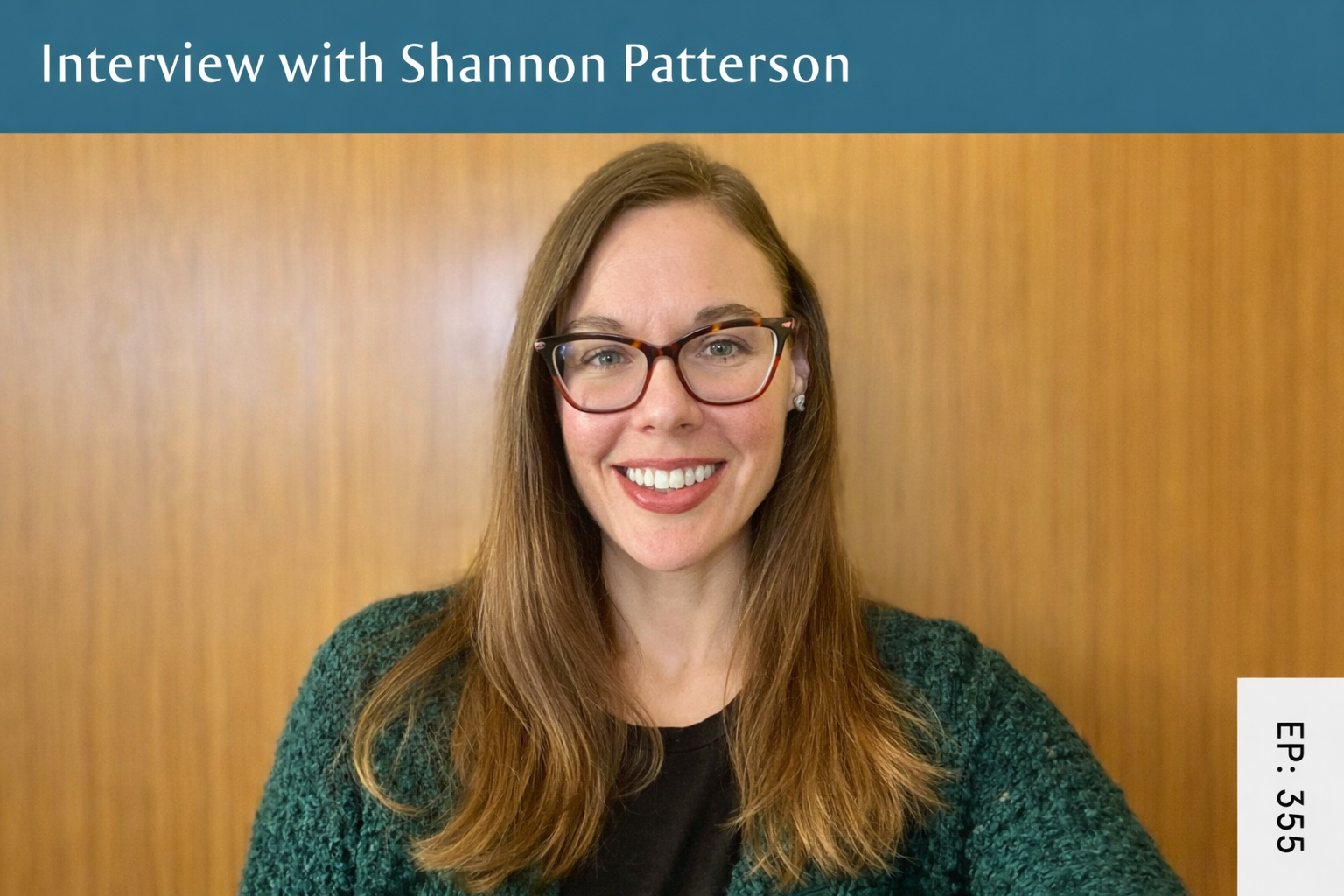
Episode 355: In this episode, I’m joined by psychologist Shannon Patterson, co-author of The Weight-Inclusive CBT Workbook for Eating Disorders, to explore how CBT can support full recovery in the context of chronic illness, perfectionism, ADHD, and neurodivergence.
00:00:00
00:04:25
00:07:42
00:12:07
00:17:19
00:22:28
00:27:30
00:33:35
00:40:36
00:50:15
00:55:53
01:03:47
01:18:03
01:21:09
01:29:17
01:36:33
00:00:00
Chris Sandel: Hey, everyone. Welcome to Episode 355 of Real Health Radio. I’m your host, Chris Sandel. I’m a nutritionist and a coach and an eating disorder expert, and I help people to fully recover.
Before we get on with today’s show and I introduce the guest, I just want to say that I’m currently taking on new clients. If you’re someone who is living with an eating disorder – and it really doesn’t matter how long this has been going on, whether it’s a couple of months, which would be fantastic to catch it that early, or whether it’s been going on for multiple decades. I truly believe that everyone can reach a place of full recovery, and if that is the place that you want to get to, even if it feels like this far-off, distant, “I don’t even know if it’s possible” type thing, I believe that you can get there and I would love to help you get to that place.
You can send an email to info@seven-health.com and just put ‘coaching’ in the subject line, or you can send me a DM on Instagram, @sevenhealthcompany, and just say you’re looking for support and I can get the details over to you.
So with today’s show, it is a guest interview, and my guest today is Dr Shannon Patterson. Shannon is a licensed psychologist based in Madison, Wisconsin and works with adults and families who are navigating eating disorder concerns, chronic health conditions, and career challenges. Many people come to therapy feeling overwhelmed, uncertain, or simply worn down from trying to manage everything on their own, and Shannon’s hope is to offer a space where things feel easier to talk about, more understandable, and less isolating.
Before opening her private practice, Shannon spent nearly two decades working in a wide range of health care settings, including academic medical centres, nursing homes, home-based mental health care, and university health services. Those experiences shaped not only how she practises, but what she cares most about, which is therapy that is research-supported, collaborative, and grounded in the realities of everyday life.
Alongside her work with clients, Shannon enjoys supporting other clinicians through training, supervision, and consultations across the US. She also serves as a reviewer for the International Journal of Eating Disorders and is a co-author of The Weight-Inclusive CBT Workbook.
I became aware of Shannon because of her involvement in this book. A couple of episodes ago, I interviewed Dr Lauren Muhlheim, who I’d had on the show before, but I had her back on because she was also an author of this book. This episode is not going to just be a rehash of everything from the previous episode; it’s looking at things that we didn’t include in that last episode and areas where Shannon really has her own strengths and her own passions.
As part of this episode, we are looking at Shannon’s really wide-ranging experience that led her up to getting into working with eating disorders and why she likes working in this area. We also talk about chronic illness and eating disorders, perfectionism and eating disorders. We look at ADHD and neurodivergence in eating disorders and in recovery; monitoring and gathering data in recovery and what can be helpful, what’s not actually helpful; and also that there is hope, even if you’re supposedly harder or more complicated because of co-occurring conditions or factors in your life. Where it’s appropriate, throughout the conversation we talk about, how can CBT be used in this area or in this situation?
This was a great conversation. I really loved what Shannon had to say and I loved that the conversation did go in lots of different directions. So without further ado, here is my conversation with Dr Shannon Patterson.
Hey, Shannon. Welcome to Real Health Radio. I’m really glad to be chatting with you today.
Dr Shannon Patterson: Likewise. Thanks for having me, Chris.
Chris Sandel: There’s a lot that we want to go through. I know there were some ideas you suggested around chronic illness and eating disorders, perfectionism, ADHD and neurodivergence with eating disorders, along with you’re also the co-author of The Weight-Inclusive CBT Workbook for Eating Disorders. So it’s going to be a mish-mash of all of those things and just seeing where the conversation goes.
00:04:25
But as a starting place, do you want to just give listeners a bit of background on yourself? Who you are, what training you’ve done, that kind of thing.
Dr Shannon Patterson: Absolutely, I’m happy to. I am a licensed psychologist. I work in Madison, Wisconsin. I actually have my own private practice and have had that now going on three years, and I work in clinical instruction for a national eating disorder company in the United States. So I enjoy doing and working with clinicians on supervision, consultation, live training, education development, and I really appreciate task diversity in my day-to-day life.
I was trained specifically in counselling psychology. Have you heard anything about counselling psychology?
Chris Sandel: I maybe have, but share with the listeners. Tell us more.
Dr Shannon Patterson: Counselling psychology is a specific type of psychology that really looks longitudinally across the lifespan at normative development, and it specifically has a focus on strengths and inclusion, so taking a look at multicultural factors, diversity, social justice. It really trains its therapists or its practitioners to look from that specific lens. So I have that unique training history that I think might be different from a lot of my peers that are trained as clinical psychologists.
Chris Sandel: I just wanted to know, did you pick that course because it had that? Or it’s just like “In retrospect, I feel so lucky that I went to the place that provided that for me”?
Dr Shannon Patterson: That’s a great question. It’s so interesting to me that we ask people at the age of 18, between 18 and 22, what they want to be for the rest of their lives. [laughs] When I was 22 years old, I was looking at programmes and trying to decide between clinical psychology and counselling psychology programmes, not knowing a whole lot about the differences other than the fact that there was this focus on social justice that aligned with my personal belief system, my passions and advocacy.
So I kind of picked it based on really the topic of interest that I wanted to study for research, which at that time was aging and older adulthood and gerontology. So it’s interesting; I did a career pivot over time, but I really focused more on what the individual programme had to offer, and I think for me it was a bonus to have the emphasis on those specific elements of training. Looking back, I’m glad that I did. But to your point, yeah, I fell into it a little bit in my early twenties, and I’m just glad I ended up in that direction.
Chris Sandel: Nice. It sounds like you’re doing a lot of different things at this point. It’s not just working with clients. It’s the supervision. It sounds like a good, well-rounded – for someone who has lots of interests, it sounds like a nice way to be spending one’s week.
Dr Shannon Patterson: Yeah, it is. You’re never doing just one thing.
00:07:42
Chris Sandel: You said “I had a career pivot” and that’s how you ended up more in this space, so what drew you then to this? How did you end up doing your work so much more around eating disorders?
Dr Shannon Patterson: Chris, that’s a really, really good question. I trained for a number of years. I did my first practicum in a college counselling centre, and around that time I was seeing clients from so many different backgrounds culturally, but also with so many different presenting concerns. I worked with a couple of clients in that space who were struggling with eating disorders and really loved the work. I was really passionate about it, mostly because I was sad that anyone had to have their life taken up by such a malicious illness and took the focus off of what mattered to them, and I really found it to be really intriguing work, and I found it challenging and had seen a couple of those cases.
But like I told you before, I was drawn to my graduate programme because I for many years worked in nursing homes, long-term care facilities, and that was the focus. So I had this little budding passion that I felt like I couldn’t really follow at the time, so I went back and I did two years really working in rehabilitation hospitals, working with people who have chronic illness, long-term care, dementia, Parkinson’s disease, etc.
What was so interesting to me there was really seeing the role that food, shape, and weight would carry through in a person’s lifetime. Sometimes we think as people age, maybe they loosen up with their food rules or they feel better about their bodies over time or they stop caring about their bodies and the way they look. What was so interesting to me is I found so many cases that that wasn’t true.
My last practicum opportunity at grad school, I was at that point really interested in health psychology and the role that physical health had on mental health and vice versa. So I had the opportunity – I thought, this is my one last-ditch chance to get a supervised opportunity working with eating disorders. Why don’t I try to go and get a practicum experience? Which is essentially like a clinical rotation in the States. Why don’t I try doing that with eating disorders?
I ended up doing it in specifically a well-known – it’s called the Center for Weight and Eating Disorders out in Pennsylvania, through Penn Medicine. I ended up working in context of eating disorders and folks who were interested in getting bariatric surgery. Definitely was, I think for me, an intersectional health psychology and eating disorder treatment landscape that I think I’ve learned for many is not the route they learn when they learn eating disorders. I have a lot of colleagues that came about it in a different way.
So that was my last practicum opportunity, and just really had an amazing supervisor. Fell in love with treating eating disorders, and the rest has been history. I went in that direction after that and I’m really glad I took that extra year to explore that interest. So that’s been my journey so far.
Chris Sandel: Nice. It sounds like there’s been lots of different things that you’ve done along the way. That always kind of informs what you do now. Like I think of myself in terms of books that have no real relevance to eating disorder recovery but actually then become really important in what I do, or a documentary that I saw or something. I’m very much a believer of like, how do we bring our lived experiences in here, or how do we bring these things that feel very tangential or even not even connected at all, but actually could be really useful to be having a conversation around or to be using as an analogy for this thing?
Dr Shannon Patterson: Yeah, absolutely. That was a neat space to be in, and I got a chance – it’s been interesting, though, to see how my work has changed over time, just given that’s the space I entered in and it’s not the space I’m in now.
00:12:07
Chris Sandel: And then what about the CBT piece? Obviously you’ve co-authored this book, so how did you initially get drawn into CBT? Was it originally used for eating disorders, or “I’ve been using this way back when with these other patients”?
Dr Shannon Patterson: Yeah, that’s a really good question. I think in Dr Muhlheim’s episode, she talked about the versatility of CBT and how it can be used for different chronic conditions or mental health concerns. I think I had been using CBT in different capacities when working with people who had depression and anxiety, so the logical step for me was to get training with it basically to use in eating disorders.
I had come from an environment where I was using it with folks in these different capacities and then transferred some of the skills and started using it with eating disorders. I would say the way, though, that I practised CBT then is very different than the way I practise it now. Thus I think the need for a rewrite.
I have a colleague who said, so wisely, you need to learn the rules in order to break them. I think at that point, I was very much, I think like anyone does at the beginning when they’re learning a skill, they’re following it mechanically, they’re doing it as it was written, and there’s not a lot of thought, always, about how – there is some consideration; you can think about adaptation. But you don’t always think on a deeper level, “Was this intervention created for this person sitting in front of me, and how, if at all, might there be harms associated with it?”
One of the questions that I think often came up, even in your previous episode with Lauren, was the role of weighing in CBT. At that time, a big part of that process was getting clients on the scale with this intention to desensitise or habituate them to the number. I think the more time I’ve spent in this field, the more I’ve realised that that’s not the answer for everybody and it might actually in some cases be harmful.
So the way I practised it then was definitely more in that weight-normative context versus now, beliefs and practices have changed considerably over time.
Chris Sandel: For sure. I think that speaks to the longer you start to do something, the more you really understand the nuance with it. And as you say, you’re not just following the exact playbook; you’re able to understand, “In this situation it’s a little different.”
I often have conversations with clients where it might be about Intuitive Eating, and they read it in a specific way and I’m like, “Well, let’s step back and look at it from this angle or that angle” because I understand all of the different layers with this, versus when they’re reading it, it’s much more black and white.
Dr Shannon Patterson: Yeah, 100%. I think when I was training in that first rotation, I was seeing a lot of folks with night eating syndrome and binge eating disorder. Those were my two eating disorders I was treating at that time. The manual or the treatment we were using at that time really had weight management interventions baked into it, and I feel sad looking back now that that was a part of my process and a part of what I offered at that time.
I think as a field, we’re finally starting to take a close look at the harms associated with some of those interventions and how they really don’t belong in eating disorder treatment, many times.
Chris Sandel: Yeah. What’s that quote, “when you know better, you do better” type thing? There’s a lot of stuff that if I could do my time over again, I would do very differently, and I have the compassion of like, hey, I just didn’t know.
Dr Shannon Patterson: Yeah, you don’t know what you don’t know. I think the flexibility to adapt over time is – what’s cool about being a clinician is you continue to learn and you continue to be able to think creatively.
The Weight-Inclusive CBT Workbook I think Jen, Lauren, and I really all together, over time, recognised that the ways that it was written was really not delivered or wasn’t designed in a way to help people across the body spectrum, across body sizes, and especially for folks with chronic health conditions. There were just elements of it that didn’t really fit for some of the people we were working with, so I think we were motivated to rewrite it so we could offer something that wouldn’t be harmful and would allow people a different path.
Chris Sandel: Nice. I said this in the conversation with Lauren; I think you guys have done a really great job with that where someone can use the best bits of CBT, but you can then leave behind the bits that actually were not in service of so many people.
Dr Shannon Patterson: Yeah, absolutely. That’s the hope.
00:17:19
Chris Sandel: Sure. I know on your website, you say you care most about therapy that’s research-supported, collaborative, and grounded in the realities of everyday life. How does CBT and weight-inclusive CBT allow you to do that in practice?
Dr Shannon Patterson: That’s a really good question, Chris. I think at my heart, I’m a scientist practitioner, so I love looking at data and I love making sure that what I’m doing is grounded in evidence and research, and the reality is that much of the evidence we have to treat eating disorders has been delivered on a specific subset of the population, many times, not including the clients or the patients we have in front of us.
I think that desire for some semblance of research that we know works at least for some people was something I’m drawn to, but being able to adapt it and being able to think strategically about applying it in a way that I think is a little bit more flexible, and I think also not coercive.
The thing I was hoping to do with the CBT workbook that we created was really to take that authoritarian voice out of it. I think for a lot of CBT, it has a little bit of a tone to it where it has a little bit of ‘do this, do that’ and that instructive capacity rather than sometimes a true therapeutic capacity.
I also know when you write a treatment manual and you write a book, as we learned, it’s impossible sometimes to communicate everything that you’re trying to communicate in that text. But some of the material that CBT has can come off as authoritarian and “I’m the teacher, you’re the student, I’m teaching you, listen to me.” So the hope is we also want to take a gentler tone and approach when recreating these materials, to help restructure that in a way that was a little bit more approachable for everybody.
Chris Sandel: Sure, and I think when you do that right, it goes from being this very “I’ll tell you how to do it” to “Hey, let’s run this experiment, let’s bring in some curiosity. Hey, let’s figure out what are some of the things we can be exploring here. You go away, you run those little tests, come back, tell me what did you notice?”
It very much becomes collaborative, and then you can use your expertise and insight to say “Hey, the thing that you’re noticing here, what I’ve noticed with other clients is this thing often going on.” So it does become “If you’re not helping me, I can’t help you” type thing. We’re doing this thing together, and it’s based on the feedback that you’re giving me that we can then figure out what are the next things to be looking at.
Dr Shannon Patterson: Yeah, you’re so right. I think about CBT, often – at least CBT for eating disorders – as not necessarily always just a talk therapy, but it’s a doing therapy. And that can be really challenging for folks, because as you know, Chris, there’s people with different levels of readiness. I think that’s also some of the biggest challenges in the field that we have, too: how do we approach people with different levels of readiness and meet everybody where they’re at, even if they’re not ready to start eating regularly or start eating more?
And to your point, those experiments and the way we phrase that of like “What are the pros and cons of eating in this way?” and “What if we just made this little tweak and tried it for this week and came back and explored a little bit about how that went for you?” Well put.
Chris Sandel: I definitely have some biases around this stuff. If you’re doing eating disorder therapy and you’re not actually changing stuff, there is a part of me that’s like, how much is actually changing? Are we just getting into navel-gazing here? Are we getting into all of this stuff that – unless it’s leading somewhere, you can very much just stay in that place for a really long time. And you can do all the journalling, you can do all the self-exploration, you can in a sense try to solve this impossible riddle, but if you’re not getting yourself out of that state that you’re in, you will just stay in that same place.
Dr Shannon Patterson: You’ve had some great Instagram posts on that that I think can be for patients and people who are recovering really powerful, to keep hearing that message of mostly “We need to be eating enough. We need to making the changes. We need to be doing the feared things” and continuing to get that message.
I think understandably, that’s the thing people are most afraid of, so that avoidance cycle would certainly make sense. But I think having that in written form just to see – yeah, I’ve been so on board with so much of your content because I think that’s really important and needs to be reinforced over and over again. Completely agree with you.
Chris Sandel: Cool. Thank you for saying that.
00:22:28
Let’s talk about chronic illness and eating disorders. To start with, what are the health conditions that you’re seeing more often than not, or what are some of the big ones you’re working with more often?
Dr Shannon Patterson: That’s a great question. As a health psychologist, I’ve worked across many different medical settings and have had that intersectional special spot of being able to treat eating disorders in health care settings. So in those settings and even in my private practice currently, I see a fair amount of folks that are coping with diagnoses like PCOS, diabetes, cancer survivors, hypothyroidism, I would say IBS, coeliac disease, and then to a lesser extent these days, but in the past definitely, a lot of folks that have had chronic heart disease in different capacities.
Those are really I would say the core conditions that I work with. I think another challenge is, how do we think strategically for those folks about how to adapt treatment and how to really meet them where they’re at and honour their health concerns as well?
Chris Sandel: You just said honouring the health concerns. I think this is often where a lot of people get stuck, because there can be so much dietary advice, whether it’s low FODMAPs or autoimmune protocol or super low carb or anti-inflammatory diets or all these different things that they’re told to do from their doctor or they’re told to do online, and this idea of like “I need to restrict in order to manage my health.”
How do you deal with this? I know there’s no black-and-white answer, but tell me some of the stuff that comes up when you’re navigating this with clients.
Dr Shannon Patterson: I shouldn’t be smiling because it’s actually kind of devastating these days, how much noise people are hearing and how many different messages folks are getting from not only their practitioners – who may or mya not be trained dietitians or nutritionists with that background – but also just online and getting their information.
First of all, I want to say I value working within my scope, so I very much value working with talented registered dietitians, nutrition folks that have that background and training. I really rely on eating disorder specialists to help support patients. So I want to say I’m a big referrer to dietitians and love working with them. They help us tease that out a little bit as well.
But one of the things I like to do is exploring, on a basic level – it’s pretty boring, but exploring the pros and cons of how what they’re doing is working or not working for them, and helping them to understand where it fits in in their specific cycle. We call it the case formulation in CBT, but really understanding, how is trying to adhere to these rules or guidelines, in the spirit of health, impacting their overall mental health? And how might that be keeping their eating disorder going in different ways? I like to take that as a first step, like let’s just get curious about how this is all working together.
And so often what I notice is that people have sky-high beliefs about what they should be doing and just so many rules and so many rigid guidelines, I think both inherited from medical providers, but then also, they’re getting information online, and we’re bombarded with information. So I think the first step is just exploring how it’s working for them, the way it’s keeping their eating disorder going, and then the second step is where they’re getting their information from. And being really critical of examining, where are you getting your evidence from? And can we connect them with, often, if at all possible, an eating disorder RD specialist to help them with some of that?
If that’s not available, or they’re not ready, I really love – I don’t know if you’ve heard of Joshua Wolrich’s book Food Isn’t Medicine. That has been so eye-opening, that bibliotherapy, for my clients. That’s one of my favourite recommendations in that genre because he really goes into great detail about challenging some of those rules. So we have conversations about that. And I think he does it in such an approachable way.
Chris Sandel: He’s got a great Instagram.
Dr Shannon Patterson: Yeah. You both do. That resource has been invaluable for folks that maybe don’t have access to a dietitian, or maybe they’re not ready. So I think that’s a really nice resource to help challenge some of that as well and to think a little more critically.
But I do want to be clear, my role isn’t always to make that decision for them, but it’s to help them examine how it’s working for them and then getting them to a resource, ideally a dietitian, that can also help support them as well with it.
00:27:30
Chris Sandel: As I was listening to all that, one of the things that came up for me when dealing with clients is really managing expectations – so knowing, “What is the belief of, if I do these things, where is it going to get to? Have I been indoctrinated into the idea that if I follow this, then I’m going to cure my fill-in-the-blank?” Because I think knowing someone’s like “I’m expecting this to happen” can also be important as part of that conversation.
Because sometimes it’s like, hey, this is something you’re going to have to live with. And that’s not necessarily the way I think about eating disorders; I’m a full advocate of full recovery – and there are going to be other things that, hey, that may still be sticking around for you. And we can see what happens once we’ve done more of the recovery work, but the fact that you are now having celery juice or you are now having this thing or that thing, I don’t believe that that’s going to cure you based on the available evidence that you’re providing.
Dr Shannon Patterson: Absolutely. I think one of the things – a health psychologist is exploring what healthy means to that person. What does health mean to them, and helping to expand that. I think also there’s so much internalised ableism that develops over time, and this belief that “I can pull myself up by my bootstraps. If I can drink enough celery juice or if I can cut my carbs enough, I can cure my diabetes without medication.” There’s that moral assignment to medication.
So part of my job is to examine that belief system and to be able to gently guide people to resources. In the case of diabetes, often that’s a progressive illness, so it’s a progressive disease that often requires medication. So also unpacking and exploring people’s beliefs about medication and where those came from, how that’s working for the person, and being able to take the blame off of them.
Because so often, I think within medicine, even, there is this belief that ‘food is medicine’, and if you just change your food, you won’t need medicine. That’s my biggest pet peeve as a psychologist in this space, just hearing that narrative, even from well-meaning medical providers. The reality is for so many people, accessibility of that food is not a possibility, but also the time constraints of what that would look like for every person, even if that were the case for them. So I think a lot of it is unpacking some of that too.
Chris Sandel: Yes. For me as well, how do we broaden this out? If there are things that can help you, it’s not just food and exercise. So often when working with clients, I’m looking at their life and I’m like, “You’re a single mom. You’ve got two young kids. You’ve got an ex-partner that’s a lot, and there’s a huge amount of trauma in your history. You having less carbs is not the solution. There’s all of this other nervous system regulation stuff to go on. There’s all these different elements that you may or may not be able to deal with, but let’s call a spade a spade. The things that are really making an impact on you aren’t, often, where you’re putting a lot of the attention.”
Dr Shannon Patterson: Yeah. As you’re saying that, it’s also getting me thinking about how for so many people, though, food and manipulation of shape and weight or exercise is such a convenient focus when there’s so many other painful things happening in life. It’s this mechanism that becomes perceived – that illusion of control, rather, of like “I have control over this and it’s convenient to use this as a vehicle to focus”, but in reality there’s just so much else that’s happening that’s influencing quality of life.
But it’s a convenient focus for so many people, and a belief system of like, “If I just change X about myself, then Y will happen.” It’s good to unpack and stop and slow down, and I think therapy is that space to be able to help people to examine that a little bit.
Chris Sandel: For sure, and there’s safety in that. We want to feel like we have a semblance of control. If I can think that there’s this one thing and if I just do that thing, that’s going to help me, that can really calm someone’s nervous system. That can make it feel like “Okay, I’m doing something here.” It makes sense why our brain goes in that direction.
Dr Shannon Patterson: There’s safety in the cycles. One thing that CBT hasn’t always done a great job of is – obviously, I think Dr Lauren Muhlheim explained in her talk the role that culture and society have on maintaining that cycle, but I think the function of this stuff isn’t always discussed and leaned into. It’s like we diagram this out and this is the way it is, and if we just interrupt X, then Y will happen.
But I think in reality, we don’t talk enough about what those things are doing for the person and honouring that process and just thinking about the really clever ways in so many situations that human beings find ways to solve their problems, even if it’s not working for them in the long run. In the short term, often it is doing something for the person.
Chris Sandel: Yeah, for sure. That’s how people survive. I remember reading a book last year about someone who was in the Holocaust and they were in a number of concentration camps, and where it started to unravel more wasn’t while they were in there. In there, it’s like “Hey, I’ve just got to keep focused. I’ve got to make sure I do these things because these are all the rules.” It’s when you get out and there is enough safety that I can now feel all these things. I can now start to look around.
00:33:35
I think as we’re going through this, the thing that keeps coming up for me in terms of this processing piece is grief – the grief of my expectations about what I thought was going to be my healthy body and what is actually the reality. “I didn’t think I was going to be the person who had this happen to them. Did I cause this for myself?” All of those kinds of things that then come up as part of this, and really navigating that grief process.
Dr Shannon Patterson: Absolutely. That was something that is not in traditional CBT that we found was helpful. There’s so many people that have been doing work in that space – Body Image with Bri, Brianna Campos, is one of those accounts where I’ve referred so many patients to her podcasts and her content because I think that lived experience piece is so important to be able to help clients to hear that.
So I think one of the things we wanted to do in our book is just, also from an ACT perspective, that acceptance piece. We don’t have to like it, but introducing people to that concept and allowing them to be able to entertain that idea. And that’s a really tough thing for people to sit with, and people aren’t always ready to do it, but it’s a really special thing to be able to watch people over time and to see. It’s not something that happens in one session, but it’s this seed you plant and you get to water it in between a little bit and see. For some people it takes weeks, but for some people it takes years. It’s just one of the cool things about being a therapist, watching that and how it unfolds for people.
Chris Sandel: Maybe you’ve already answered this or we’ve talked about it, but from CBT, is there anything specific you could mention that helps people tolerate either the physical stuff or just the uncertainty with the fact that “Now I’m grappling with the fact that maybe that diet that I thought was going to work is actually not going to work” and reckoning with the idea that “I now have this chronic illness”? Especially like “I’m already dealing with an eating disorder, and I’ve got this. There’s a lot.” So from a CBT perspective, is there anything that comes to mind to help?
Dr Shannon Patterson: That’s a really good question, Chris. I think in some of those cases, just being able to stop, slow down, and examine the stories and the narratives – it does come a little bit from a narrative therapy approach, just to explore, what are the stories we’re telling ourself or what is that narrative that we’ve created for ourself?
That capacity is less about, honestly, CBT as it is about just being human with somebody in the room and allowing them to sit with some of that and to practise not only what’s happening up here, but just being able to notice a little bit about what’s happening in the body and thinking a little bit about – I’m not a somatic provider, but just helping people to tune into what that experience looks like and helping them to practise emotional naming. I think for so many of our patients, honestly sometimes myself included, we’re very cerebral and we’re up here, and we’re not tuned into what’s happening emotionally.
I think in some of those cases, my job is even less to have them do a thought record or try to experiment their way out of it so much as just to allow them to sit, process, name, and guide them through that emotional naming experience.
I think CBT gets a bad rap sometimes for it being a little gaslighty. That’s some of the criticism people have had about it, that we’re trying to talk people out of their cognitions and their thoughts. I think that acceptance piece is a big component in sometimes allowing people to have the thoughts that they have and being able to just sit with the emotions and sensations that come with that is more my job than it is to try to change any of those thoughts, if that makes sense.
Chris Sandel: It does. When I talk about what I use in terms of different tools, I’m much more likely to say that I use ACT, acceptance and commitment therapy, than CBT. Although from going through your book and talking to Lauren, I use CBT a lot; I just don’t necessarily use that label. But what I really do like about acceptance and commitment therapy, and other modalities, is how do we get back into the present moment? How do we get back into our body?
This is my personal work. I know I live in my head way too much and I’m very good at being able to talk to people about this, but in terms of me actually feeling this for me and being able to clearly name that emotion and be in that without going straight into shutdown and all of those things – that’s the work that I’m doing myself, and how much I notice a difference the more I’m able to do that.
Dr Shannon Patterson: Totally. I also think, too, one of the things since we’ve seen an uptick in social media use – I’ve been reflecting on this, being in the field. I’ve been here since probably 2011 now, and I think one of the things I’ve noticed is just the rise of social media ‘therapy’. It’s not therapy, but social media presence of mental health providers, dietitians, health providers, etc., and there’s so much great content out there that it can feel intimidating and almost like in some ways we’re needing to always provide a nugget of – at least for me, sometimes I feel that internal pressure to provide a nugget or do something useful.
But so often I think it’s more about just asking questions and allowing people to sit in that space and be able to be with their thoughts and emotions. For what’s that worth, I think that’s a unique piece of the puzzle that maybe wasn’t there 15 years ago but now we’re having to grapple with too. People have content in different ways and they follow amazing things, so just being able to have the space for them to name their experiences and to be able to be is a gift.
Chris Sandel: Yes. I think it’s very healing just to be witnessed or to have someone hear what you say and reflect back “Man, that’s really hard” as opposed to “Here, I’ve got a three-point plan of how you can overcome this thing.”
Dr Shannon Patterson: Mm-hm. Tempting to do that and to fall into that. I think so many of us that are socialised, at least in America, our health care systems are very quick and they want results and they want us to demonstrate our worth as providers. So I think we have a lot of pressure to demonstrate change, and I think it takes time to unlearn that.
00:40:36
Chris Sandel: Sure. What a perfect segue into perfectionism. [laughs] This is another area that you wanted to talk about. So perfectionism, often described as a personality trait – driven, disciplined, high-achieving. But I think in practice, it often feels a lot more like a threat response and like “I can never quite do enough.” So how do you conceptualise perfectionism in general, in eating disorders? What about within the CBT model? I know I’ve asked you a lot there.
Dr Shannon Patterson: Kind of like old-school CBT with eating disorders, CBT for perfectionism has a cognitive model that, of course, has nothing about the reinforcement of society and systems, and I think my take on perfectionism – and hopefully there’s flavours of this in the workbook – but very much is looking at systems and the way that pretty dehumanizing systems can really demand perfectionism and demand some of these things. I view it these days less as a personality trait, to your point, and more about a survival response. It’s less about even being perfect as it is about never feeling like enough.
Without getting super political, we try to touch a little bit on capitalism and the role of dehumanizing systems and the maintenance of this. I’ve learned a lot from Dana and Hilary at the Center for Body Trust. I love the work that they’ve done and we also use that as a resource for folks to reflect a little bit on this. Also Sonya Renee Taylor’s The Body Is Not an Apology reflects really well on the way that these types of concepts intercept with perfectionism and the role that these larger systems have.
But I think when I’m working with clients, I really want to be curious about how that came to be. Who’s telling them that they should be perfect? And for a lot of people also, I’ve noticed people don’t always identify with that term ‘perfectionism’ because they really don’t believe they’re perfect. That’s kind of the Catch-22, maybe. They’re never perfect because that standard, the bar is always being raised for them.
So I think being able to evaluate what that looks like for them behaviourally – I think the cognitive behavioural model does a nice job of at least identifying, what are those behaviours that might suggest somebody has or is struggling with that? So we can do a little bit of an analysis or a little psychoeducation on what those behaviours look like, whether it’s repeatedly checking work or whether it’s – I have a lot of patients who have a lot of tendencies for perfectionism in their physical environment, and practising sitting with some of that.
The difficulty, though, is that can belly up sometimes with neurodivergence, so I also want to be really careful to respect routine and respect people’s nervous system preference and neurotype preference. It’s a complicated thing to try to unpack, but I think for me, I’m really wanting to understand, how is it helping them, how is it serving them, and then who’s reinforcing it? Because chances are, 99% of the time it’s being reinforced by somebody or something, whether it’s getting a higher paid job or getting a promotion or a parent or a boss. So really being able to highlight that cycle for that person.
I have a passion for career counselling and exploration, and I see a lot of what can develop and intersect with people’s eating disorders is their work performance and the way that shows up. So we do a lot of fun work to unpack what that looks like and to be able to also explore how that’s working for them.
Chris Sandel: For sure. A couple of things came up for me as you were going through that. One, in a lot of ways it feels like perfectionism is the symptom, but the real root of it is anxiety. In a sense, I’m using perfectionism as a way to see if I can overcome that anxiety. Like “I feel anxious, and if I can just get this thing right, then maybe that will get lowered.” And you never quite get there because there isn’t ever enough. I would imagine that anxiety is so much at the root of this.
And then in terms of your comment about careers and work, there’s probably a lot of stuff that’s not actually going on today, but this got into me during childhood. I know you talked at the very beginning about looking at someone’s full history going all the way back, like “There were these messages I received, either implicitly or explicitly, when I was a child, even in the house environment I was in or seeing this parent or that parent do this kind of job, and that got into me that this is how I get love or this is how it makes me worthy. And if I don’t have this thing, then I don’t match up.”
Dr Shannon Patterson: I love looking at behaviours in context and de-pathologizing things. I talk a little bit sometimes about guardrail metaphors and how those perfectionistic tendencies maybe at one point in our life acted as really helpful guardrails that prevented us from driving off the road, but over time they become almost a cage and grow so far that they prevent us from even driving forward and moving forward.
So I think that’s a nice de-pathologizing way to help people understand that something maybe in their life at one point could be adaptive, but it no longer serves them. So I really want to make sure that we’re not over-pathologizing things. A lot of times CBT and honestly Western psychology has a tendency to do that. I think also just want to shout the book Rest Is Resistance. Have you heard of that book at all by Tricia Hersey?
Chris Sandel: It’s not one that comes to mind. Maybe a client recommended at some point, but I don’t remember reading it.
Dr Shannon Patterson: It talks a lot about the role of – honestly, in the United States, white supremacy culture, racism, capitalism, and the role that has on maintaining some of those behaviours. I think that’s a nice piece that helps people to get some permission to rest, and that rest becomes this act of resistance, but it’s not one that’s usually conceptualised, to your point about anxiety. It’s hard to rest. It’s hard to give yourself permission.
Chris Sandel: Just piggybacking on what you said there, yes, I’m not saying this in a pathologizing way. People are trying the best that they can, and you find this solution that ‘works’, or works in this way but there’s this other collateral damage that’s being caused, but “At this point this is the best solution that I know.” And that’s true whether we’re talking about perfectionism, whether we’re talking about an eating disorder, whether we’re talking about lots of ‘maladaptive’ behaviours. It’s someone’s best way of knowing how to handle this thing in this moment.
Dr Shannon Patterson: Yeah. That word ‘maladaptive’ – it’s everywhere in CBT and Western psychology. That and ‘problem behaviour’. Those are two things I hear so often to conceptualise things. It’s like, what if we thought about that a little differently? Yeah, Chris, that’s a great point. I think it’s important to acknowledge for a lot of folks that there’s that principle at play, and taking the blame off of anybody and just getting curious about how that originated.
As much as CBT is a present-focused therapy and it’s really focused on practical solutions and strategies, I think it’s hard to move forward without at least taking somewhat of a peek backwards, but just not spending so much time there that we’re, to your point about only looking at insight or developing that and not doing the things that are so necessary for recovery, like regular eating and building volume – so it’s that combination of both that I think is a sweet spot.
Chris Sandel: Yeah, and you recognise, hey, CBT is great for these things and it’s not so great for these other things. It’s not like you have to be one and only wedded to this thing in every moment. It’s like, I quite like these somatic practices, or I actually quite like mindfulness here, or I like these other things, because actually that helps.
I’m just saying that with this conversation, we don’t have to bring everything back to CBT. If there are other modalities that work, feel free to mention them.
00:50:15
Dr Shannon Patterson: Yeah. What’s so interesting, too, is as you were saying that, it got me thinking about how as clinicians – especially people who were trained in scientist practitioner models or people who were trained in certain practices, we get really wrapped up in black-and-white thinking and we’re subject to that too.
I think one of the things I grappled with a couple years ago was really actually questioning whether I even wanted to call myself a CBT practitioner because I really didn’t know that it gelled with me. I came from a programme that was a little bit more psychodynamic and focused more on narrative feminist approach to counselling. I think over the last few years, I’ve had to challenge my own black-and-white thinking about what it means to be a CBT provider and how we can take what works and adapt it as needed.
I know not all CBT providers feel that way – many of them feel like it’s meant to be followed. But what’s so ironic to me is sometimes the treatments for eating disorders can mimic the rigidity of the disorders if we’re not careful. That’s my personal mission, to help providers figure out how to deliver these treatments in a way that isn’t overly rigid and that doesn’t unintentionally recreate that when we’re working with clients.
Chris Sandel: Definitely. There’s a difference between “These tools are helpful for creating a necessary structure or to be able to gather useful data” versus “Hey, we’re just switching one thing for another. Maybe this is a slightly better version than the version before, but it’s still a bit of a prison that we’re creating for this person.” That’s not the goal of CBT and that’s not the goal of you as a therapist.
Dr Shannon Patterson: No, totally. Self-monitoring comes up as one of those things sometimes that we have to be careful about. I’ve definitely seen clients that trade MyFitnessPal for Recovery Record, at least in the States. I don’t know if y’all have MyFitnessPal.
Chris Sandel: We do. It is everywhere.
Dr Shannon Patterson: I probably shouldn’t even say that name. You probably have to take that out. But to your point, they trade one thing for another. So one of the things I think is important is being able to – I think about the cast metaphor a little bit with some of this. At the beginning, if you break a bone at the beginning, you need the structure of healing that bone, and we need that nutritional structure at the beginning, but how do we help people over time, if they’re ready to remove some of that and to eat a little bit more intuitively? That can really be a challenge, but helping people to really examine some of those systems. It’s definitely a process.
Chris Sandel: Sure. Also looking at, what is this in service to? As you’re talking there, I’m thinking of a client who is quite a ways in recovery, but she’s still been doing the daily calories because it actually helps her eat more, and we were really conscious of we want her to be getting in enough. She hadn’t had her period for 20 years. She got her period back and we were like, “Cool, we want to make sure that’s happening each month.” After having a break from exercise, it’s like, “Cool, we want to bring exercise back in. Great, I want to make sure that this is still there.”
We’ve got to a point where she had time off exercise, she’s got her period back, she’s had so many symptoms repaired, she’s brought exercise back in, she’s now had five or six cycles in a row, demonstrating that even with her exercise coming back in, that’s there. And now it feels like, okay, let’s explore what it could look like with you not tracking. And again, it’s not a black-and-white thing where we just completely stop. I said to her, “What could be different ways of doing this?”
We figured out have a week of not doing it and then have a week of doing it again and let’s compare and contrast. What did you notice? What happened in terms of your meal timings? What happened in terms of the types of things you ate? Did it actually change? So we can figure out what is the best approach for the next change we’re going to make.
But for someone like her, the tracking was really in service of her recovery. It wasn’t eating disorder in disguise. This is one of the things that has been really helpful, and she could get to the end of the day and be like, “I’m down 300 calories of what I need. Cool, I’m having the big bowl of ice cream thing.” So it really was helping her.
Dr Shannon Patterson: 100%, I think there can be instances where some of that structure is really needed, especially for somebody that’s had 20 years of their eating disorder. That’s a really well-worn pathway of habit, and it would make so much sense that there would need to be a long period of time where we would need to keep that structure in service of recovery, too.
It definitely brings up the thought that it’s not black and white and that each person is so unique, and contextually exploring, where is that drive coming from? Is that coming from a recovery-focused place or is that in service of the eating disorder or restriction or being afraid that “If I don’t self-monitor, I might binge or I might lose control”? So understanding the function or understanding how that’s working or not working for the person is so important.
00:55:53
Chris Sandel: What are some of the self-monitoring pieces that you do use? Again, this can come from CBT; we’ll talk about the weight monitoring that you removed and why that was the case, but what are some of the things that, at least for some people, you find quite useful to be either running experiments with or giving a log of?
Dr Shannon Patterson: I think one of the things that I value for self-recovery – I always say for folks, most people I see one hour a week and there’s, what, 168 hours in a week? So self-monitoring allows me to see what’s happening in those 167 hours that I’m not seeing you. In order to get the scope of what’s fully happening, I love to be able to at least see some of that.
One of the things I try to make really clear is that this isn’t a food log and that this isn’t something that we’re just looking at your eating. In fact, I’m really interested in what’s happening – usually if it’s a piece of paper that I’m using for self-monitoring, that right-hand side of the context and the comments and what’s happening and how that’s interacting with eating or not eating.
So for me, I think one of the things I’m really looking for first and foremost is just the timing of people’s regular eating. How long are they going without eating? I love to work with dietitian colleagues to help think about volume and variety for that. But usually as a therapist we have some ability to map that on to see what was happening there, was there any restriction. Really having at least a couple of days, even if it’s not every day, helping people to pick a couple days where maybe they’ve got one routine on the weekday and on their weekend, they have off. So helping them to understand what their patterns are.
Research tells us that regular eating is pretty much, at least in CBT, one of the most predictive things somebody can do in order to reduce their binge eating and purging behaviour, so if I’m not seeing the self-monitoring, I can definitely do a qualitative review with people, but I think there’s something powerful about being able to see the timing. Also recognising that the body often has that very needed survival mechanism response. If somebody is going long periods of time without eating, their body is understandably going to have a reaction to that.
For so many people that I work with – and I tend to work with more people with BED and BN – that cycle is really prominent. So being able to really look at that and detect that at the beginning of treatment can be helpful. Then eventually we focus on the right-hand side to figure out what other triggers are there, not only to binge eating, but also to restriction. What’s preventing somebody? Because as much as it could be logistics of work, it could also be those thoughts about dieting and restriction.
Obviously we can have those experiments, because there can be a lot of fears about loss of control with eating, so being able to help people take baby steps in the direction of adding something in. We can provide information about regular eating. But as you probably well know, it’s sometimes taking little small steps in that direction for some folks to see what are those fears and using inhibitory learning, even, to unpack and see – did they have an expectancy violation that happens with some of that? If there are certain fears, what are they? If the fear comes true, how do they overcome that? Being able to zero in on the fears and target those.
But I would say that self-monitoring helps a lot with the regular eating component of things, and to be able to help reduce fears early.
Chris Sandel: You mentioned about binges or purges, definitely, but also just “I had a really bad body image day.” Cool, let’s figure out what’s been happening that day, what’s happened the couple of days beforehand. I think it can give you this really great information in black and white that’s not just useful for me, but it’s then useful for the clients.
Especially as you do it over the longer haul – with recovery, there are going to be times where things are going better and there are going to be times where things are not going so well. To be able to look at, what was going on when things were going better? What’s going on now when things aren’t going so well? What are some of the differences? What are some of the things that have been removed from that?
Again, I’m thinking about a client that I’m working with, and every time things don’t go so well, she’s eating less and she hasn’t been doing the things, often, in her morning routine or in terms of things that are supportive of her nervous system – listening to music, doing journalling, doing some creative hobbies. When the eating’s there and that’s there, oh wow, life feels different. And when those disappear, life feels very different.
Being able to see that there’s this real cause and effect relationship with that as opposed to just getting sucked into the eating disorder thoughts when you’re in that bad place – I think the more you build this up, longer term, that’s your relapse prevention. That’s how you get to a stage where “Oh, I can catch this early.”
Dr Shannon Patterson: I think CBT is great because you can essentially teach clients to be a detective and to be able to solve a little bit about what’s happening with them and to understand their behaviours, why they’re doing what they’re doing, and helping them to increase awareness of the things they can do to support their nervous system or they can do to support their wellbeing overall.
As you were saying that too, I was also just thinking to myself about how that first stage of treatment is the foundation in CBT. Probably I do focus more actually on the left-hand side with the timing of the food at the beginning, but to your point about starting to record different body image times, for a lot of my patients, they have co-occurring anxiety, depression, also concerns about physical health and anxiety there. So being able to start recording those on the right-hand side so that as we progress into the treatment, we can start tackling and giving them some strategies and tools and thinking about ways to advocate.
I think that’s also a big part of being a psychologist, too – understanding the person in their entirety and not just the eating disorder. I think so often we’re very singularly focused on what’s happening with eating and the behaviours, but so often there are co-occurring conditions or neurodivergence or neurotypes that maybe aren’t being honoured. So helping to figure out, even if we’re not the ones tackling all of that, giving them and helping them with resources to help them learn what they need to be able to help themselves in those different areas.
Chris Sandel: For sure. Sleep is another one I was just thinking of. The amount of sleep someone gets has a huge impact on how they are that next day, and I know for myself that that is definitely true. When you’ve got three hours’ sleep because something kept you up at night, how different the world feels that next day versus I went and got eight hours’ sleep and I now am not so concerned about all those things I was so concerned about.
Dr Shannon Patterson: Ooh, yeah, and you’re next month talking to Dr Jen Averitt, who’s one of my co-authors, and she’s a sleep specialist, so that would be an amazing thing – she is very passionate about that.
Chris Sandel: Okay, good.
Dr Shannon Patterson: Sleep is huge to be able to think about recovery and being able to get the rest that somebody needs. It’s a big factor in that. I’m glad you brought that up.
01:03:47
Chris Sandel: You mentioned neurodivergence a moment ago. I think it would be useful to talk about this. I think from what you sent over and what I’ve read, you particularly work with ADHD. Is that correct?
Dr Shannon Patterson: I did in a past life. For many – not many, about four years when I was in graduate school, I did ADHD coaching and I worked in – specifically at my university, we had a disability support services. So one of the things I did was work with folks, students specifically, who were in school and managing ADHD. So I have a specific passion for that work. Don’t list it so much these days, but I see it so often that it’s not even like you have to explicitly advertise. I’m thankful that I have that training and background. But coaching is obviously different than therapy; I don’t do any coaching these days. But very much see co-occurring ADHD in practice and reality.
Chris Sandel: If we’re talking about that specific population, how are you applying CBT differently? I know that population is a very diverse mix, but are there some common themes that tend to come up?
Dr Shannon Patterson: Definitely. One of the things that I notice is being able to unpack a little bit about what previous therapy has been like for folks and to understand a little bit them in context, making sure that I’m really exploring any narratives they have about themselves in the context of therapy and previous settings, and being careful not to recreate experiences of shame. Because obviously self-monitoring can be pretty intensive. There can be a lot of different aspects of CBT that can be hard to apply in between sessions.
One of the things that I think is important for this population – really any population, honestly – is meeting them where they’re at. Helping them to understand, are there specific things they need that are important for their recovery? I think in many cases, people come to treatment without a diagnosis and having a suspicion that they might have it.
Part of what I also find myself doing is giving them the resources. I don’t do formal ADHD testing, but helping them to understand what that pathway of self-exploration would look like and giving them bibliotherapy recommendations to read and helping them to determine what might be some next steps if they did want to move forward with getting that diagnosis and exploring about how that has looked for them over the years. So a big part of what I do is actually helping people to recognise that that might be part of their experience when they don’t actually have a diagnosis. I find myself doing that quite a bit.
But I would say adapting to make sure that folks aren’t taking on too much too soon, so being able to develop realistic things for themselves, whether it’s self-monitoring a couple days a week, setting alarms. I think one of the things, too, is to make sure that we’re really listening to our patients and not always assuming and labelling something as the eating disorder. “The eating disorder is doing this.” We externalise that in sometimes ways that aren’t appropriate because it truly could be for this population there’s biological drivers, there’s neurological differences that really make planning and execution of meals and snacks really difficult.
So being careful that we’re not overgeneralising it to the eating disorder. Helping people to overcome a lot of internalised healthist beliefs about what should and shouldn’t be food they consume, at least for this population. We talked about perfectionism. There’s a lot of perfectionism and checking behaviours that develop if somebody has this background and history that can make it really almost immobilising to eat anything. Because they want to make sure they’re eating the ‘right’ things, and on top of it there’s a lot of rhetoric out there about what we should and shouldn’t eat for ADHD, and of course for any condition.
Some of what I’m doing is to also unpack the rules people have and to destigmatise the role of prepared foods, frozen foods, fast foods for folks, and really help to recognise something is better than nothing. I see a lot of that perfectionism develop too in that population, where it’s not always accessible to prepare foods in the same way, or there’s multi-step processes in the kitchen that are really challenging. So helping them to help themselves through that. I don’t know if you see that so much in clinical practice.
Chris Sandel: I do. It’s interesting. I do see some people who are ADHD. I tend to see more of HSPs, Highly Sensitive People, or people on the autism spectrum. And again, a lot of that is discovering while we’re working together. For some people, it’s like, do you want to look into this and explore it? And the answer is no, and it’s like, okay, that’s great. That’s up to you. And for other people it’s like, “Yeah, that actually does make sense and I’ve been curious about this for a while.” I’m not doing official diagnoses; that’s not my job. But pointing people in the direction of “Here are some online resources. Here are some books or some memoirs you can read to have a bit of a sense, does this feel like it matches up a little bit?”
Just having someone to start to understand this, because, like with eating disorders, I think there can be these very stereotypical ideas of what it means to be on the autism spectrum. Especially a lot of what is out there is often about what it’s like for men or for boys as opposed to how it shows up for girls and for women. So having someone actually understand, “No, it doesn’t present often in the way that you think it does, and here are some resources to have a look around with this stuff.”
Dr Shannon Patterson: Yeah, whether it’s podcasts or bibliotherapy. That’s a great point. As you were sharing that too, I was thinking a little bit about the role of being able to help people to – I think in eating disorder recovery, especially for people who have that history or just history of dieting, they have had such a rigid, sometimes routine. Understandably, with some of the structure we attempt to create. But if we’re not careful, sometimes that structure can mimic other experiences where people haven’t been able to stick with it and have perceived themselves to fail.
Traditional CBT has it sometimes where it’s like “You need to know exactly what you’re eating next and what that will look like, and if I contact you at a certain time, you should be able to tell me when and what you’re eating next.” I think the reality for many people is that that’s not always accessible. So helping them to develop a schedule for thinking ahead.
That’s one thing we try to do in the workbook, to help think about that process of reflecting forward in the morning, “Where will I be three or four hours from now? What food will I have?”, and understanding a little bit about the access even if it isn’t the specifics of everything that’s laid out. And being able to also loosen expectations of what it means to be regularly and adequately nourished for folks.
Because again, I think we’re dealing with a lot of food rules, and people end up just not eating at all. Or we’re dealing a lot with medication side effects. So having an understanding of mechanical ways to help people, whether it’s a support person – I think that’s sometimes the magic, the helpful trick for so many people, getting that support person in session with them to also help provide gentle reminders if phone alarms don’t work for them for whatever reason. So getting some support on board that are aware of what they’re working on and how we’re conceptualising food and recovery. That’s been important too.
Chris Sandel: For sure. There are lots of elements of CBT – and this could be not just CBT; there could be lots of things that people could be doing – and you look and you’re like, “This doesn’t feel like it’s in service of recovery.” You’re trying to spend all this time on this thing, whether it be an awareness log or whatever it is, but it’s actually pulling you away from the actions that would be in service of recovery. And because you then spent all this time on this, you didn’t get to bed until midnight, which means you’re not doing one of the goals we’d set around trying to have more sleep because of how that impacts you.
So recognising, is this actually helping this person? I know in an ideal world, I would love to have that thing in black and white to review – and also, the more important thing is someone coming back and being able to say, “I did these things and this is what I noticed.” So just being able to check, is this actually helping someone in real life? Not what should be happening, but is it actually helping?
Dr Shannon Patterson: Yeah, and I think giving people tools even to think more broadly about their access to food. I think one of the things too is that I’ve really worked with clinicians a lot on challenging their own biases and beliefs about people with ADHD, and autism as well, and not making assumptions that because they have this diagnosis, they can’t do a certain thing. I’m a big fan of that too.
As much as we want to adapt the treatment, we also don’t want to make this assumption that somebody can’t do something, or won’t, or it won’t work for them. I’m big on that too. Really, let’s give it a shot. Let’s not fragilize people too much. You brought up a really good point before and I want to highlight that again. There’s diversity within neurodiversity, so really making sure that we’re not throwing the baby out with the bathwater, too, is important.
Chris Sandel: Totally. I think that’s something I do definitely see a lot within eating disorder spaces. Like “Oh, they couldn’t possibly. That would be too much for them” and treating everyone with kid gloves and like they’re this fragile little bird. It’s like, no, that’s actually not the case. And if you give someone that message, that’s often how they will respond to that, and the eating disorder will run away with that completely.
It’s like, no, that’s not actually the case. I want someone to recognise, “Hey, I’m way stronger than I feel like I am or the eating disorder has been letting me know that I am, and I can actually make this big change, even though there is this thought in my mind that’s telling me that that’s too much and I could never.” The more someone can start to realise, “Oh, I am resilient, I am able to do this”, that is super supportive.
Dr Shannon Patterson: Definitely. I think, too, not making assumptions about how that impacts a person as well. In CBT, we talk at the beginning about creating a personal diagram and understanding the symptoms that somebody’s having. I like calling it symptom mapping – understanding for them, what does their ADHD mean in the context of eating? How do they see it interacting, if at all, with their eating disorder? So making sure that I’m not projecting or making assumptions based on a worldview that I have or a personal experience I have with it. Really making sure that I’m understanding and helping that person plot that and create that understanding for themselves is pretty cool.
Chris Sandel: Yes. And looking at what else they’ve done in terms of recovery and what aspects of that worked well, which didn’t. I know for a lot of clients, they’ve had experiences of being in inpatient that didn’t work well, that was really traumatising. It’s like, I don’t want to be recreating that, so how do we learn from “That clearly didn’t work” versus “I don’t think that worked because it was in the wrong setting, but actually I do think that could work with this thing being different.” So really, again, understanding the difference between that.
Dr Shannon Patterson: Yeah. That’s a great point. It gets me thinking about exposure, actually, because that often comes up with folks where they’re needing to do certain exposures, and really understanding refeeding isn’t exposure. Thinking a little bit about those experiences definitely can be even sometimes traumatic for folks.
So making sure people understand the rationale for why we’re asking them to do what they’re doing in different contexts, too. Many of the folks I’ve worked with – it’s interesting just thinking about different lenses and different diagnoses, even, too. I’ve found sometimes that the people I work with don’t see themselves reflected in people – when they hear the term ‘eating disorder’, for so many people, they’re surprised that they have been diagnosed with one because they have an idea in their head of what that looks like and they don’t match that.
I’m just reflecting on many folks who have not had that experience of higher level of care. It’s a little bit easier for me sometimes when I work with folks who have BED or BN because they haven’t had that narrative. But for folks that have been in higher level of care, inpatient, tends to for many people shadow the experience, so we’re having to work extra hard to make sure we’re not recreating treatment trauma.
01:18:03
Chris Sandel: Yeah. What about in terms of appetite-suppressing medications? I know that can be very common with ADHD. How are you navigating this?
Dr Shannon Patterson: That’s a really good question. That’s always challenging for patients across the diagnostic spectrum too, because the appetite suppressant effect is real. So being able to help people mechanically understand what they need to do, less from a hunger cue / intuitive eating, at least with an intuitive hunger cue perspective, and more just about eating in accordance with a plan rather than an internal sensation and feeling.
But that becomes really challenging for people, understandably, when you’re not hungry. And potentially you get into hyper-fixation mode. It always comes back down to, can we examine the evidence and evaluate on those days when you do forget to eat or you’re not experiencing those cues and eating strategically? What is that leading to at night? For so many people, once that med wears off in the evening, they’re susceptible to binge eating.
Going back to some of the conversations we’ve had about experimenting, can we experiment with trying to work up to more regular eating during the day to see how this impacts you at night? I think a complexity with my patient population has been Vyvanse as an added – I don’t know if they prescribe that so much in Scotland, but in the US there’s a specific medication for ADHD that they actually have approved to treat BED. So I see a lot of my patients that are prescribed that medication for their BED, and what we find is that essentially it’s just dampening their appetite all day and then leading them to binge at night when it wears off.
So I think weighing out, again, the pros and cons of how is this working for you, and is this acting in service of that restriction / eating disorder mindset? Or how is that helping? Obviously for some folks it is multi-purpose for treating ADHD, but for some people it isn’t. So really understanding the purpose that meds are prescribed for and exploring that in greater detail.
One thing I’ve seen from some therapists is they’re not taking the time to ask about medications or co-occurring health or mental health conditions. So really making sure we’re having an understanding of what medications they are on and they are taking, and at what point and what time. Not us making the recommendations of when to take them, but just really making sure we also have a clear relationship with that prescriber to be able to communicate and to help the patient empower themselves to have those conversations too if something isn’t working.
There’s not a good solution, always, aside from trying to set alarms and involve support people and just be able to also maybe have a snack drawer at the desk where we’ve got easy access to stuff if we’re in hyper-fixated mode.
01:21:09
Chris Sandel: I also think this speaks to why it’s so important, if you’re working with a therapist and you have an eating disorder, to be having that therapist understand eating disorders. Because I think it can be very easy for someone to be told, “If you’re not really hungry during the day, you don’t really need to eat. We should be listening to our hunger, and if it’s not there, maybe that’s why you don’t need that snack.” And then when they’re having the binging in the evening, fixating on “How do we control the evening time?” Not making that connection between what happened during the day is what’s leading to the evening.
I think that’s so often the case with people who don’t really understand binge eating disorder or even bulimia. They focus on that moment where that thing’s happening, whether it be the binging or the purging or both, like “How do we solve that moment? What can you do differently in that moment?” as opposed to there’s a whole chain of events that has led up to this thing.
We need to look back – okay, what happened at breakfast time? What happened yesterday? How was your sleep? All of those things. Which again is why, if someone’s able to keep some kind of awareness log, can be useful. Because otherwise we end up focusing on the end outcome or symptom and mistaking that for “There’s where the problem lies.”
Dr Shannon Patterson: Exactly. I think like 85% of the time or 90% of the time there’s a missed meal, snack, restriction. So often we’re leaning into what caused the binge and what stressor was there, and it’s like, actually it’s rooted a lot of times in restriction, even if it was unintentional.
Also, as you were talking, I got thinking about, for people who don’t binge eat and purge, even just the role that restriction has on continuing that pathway and continuing to reinforce and make restriction a little bit easier. But I also think about how it can be a vicious cycle for some people of worsening ADHD or worsening mood regulation if they’re not eating.
So making sure people have an understanding too of the biology of malnutrition and how it can actually be not serving them well in their ADHD or in different ways. But I know it can be hard if somebody’s restricting and it makes them focus more. There can be that paradoxical effect too. So really understanding the person’s experience and trying to figure out the function of what’s leading them to do that and what they see as a benefit, I think is really important too.
Chris Sandel: A lot of when I’m working with clients through that experimentation is we want to have these points of contrast. We want to be able to say “This is what happens when we’re doing these kinds of things”, and we’ve been doing it long enough that there’s been enough nutritional rehabilitation that’s happened, and things are able to work better so that “I do have more sustained energy” or “My capacity to actually focus is better than it was before” or “I’m not quite having the wakeups in the night that I was getting before.” We’re able to have this real point of contrast so that when that drops away, or when they reflect on what was going on before, they can see, “Oh, the eating more does really help.”
And even in your situation where someone may feel that they concentrate better, but there’s a window of that – “It gives me that four hours, but then after that, this is what happens, and the next day, this is what happens” – I think it can be very easy to get focused on just this 1D version of this thing as opposed to, let’s look at the broader picture. When we look at all the different aspects, how is this having an impact?
Dr Shannon Patterson: Exactly. And then taking a look, too – because my guess is if there’s enough prolonged restriction, there’s so many other negative things happening. So making sure we can start to tie and make some of those connections.
I think the tricky thing too with autism or with ADHD is that some of those symptoms in part can be exacerbated by malnutrition or lack of regular eating. So to get the clearest picture, if somebody does have those concerns, I think that’s also a place that can be scary to think about jumping into that. But to try to get a clearer sense of what’s happening. Even just your personality. If people believe that this is the way they are – but is it? Is it the personality, or is it because they’re starving? It’s hard to know and understand who they truly are outside of that.
Chris Sandel: The confusing piece being that sometimes when someone does start to rest and eat more, they feel worse. Like “Now I feel like I’ve been hit by a truck, but before I was able to get by. Before I was able to function. This doesn’t make sense. Why do I want to feel this way?” It’s that the thing that was keeping you going before in terms of the stress response and the adrenaline and the cortisol is propping you up when you’re eating – we’re removing that, and we’re getting a sense of what your true baseline is. But in the beginning, that obviously doesn’t feel great for people. It can be quite confusing.
Dr Shannon Patterson: You’re really so right. And a lot of times people don’t give themselves the chance and they don’t give their brains a chance to experience healing long enough to see that benefit. So it’s helping them to take that leap of faith. Especially if they’ve never seen it before.
I think about recovery as like climbing, corny as it is, that mountain metaphor. If they get halfway there, they don’t see the 360 view at the top. It’s hard to fully get all of the full effects of that if they don’t do it long enough. I think that’s the biggest challenge, so often, of what we do: helping people to stick with it and trusting that it gets better.
Chris Sandel: Yes. And the challenge is, there’s nothing I can say that convinces someone of that. You have to do it, and then you’ll be convinced. But there’s no words I can offer that will convince you.
Dr Shannon Patterson: I think sometimes that’s the power of peer support or of coaching, too, of just different team members. Having different vantage points from that. But it’s one of those things that sometimes you have to figure out for yourself, and going back to the reasons of recovery and understanding the pros and cons, ultimately, and reflecting on those times too. But it’s challenging work.
Chris Sandel: It is. I’ve got a group as part of the way that I work with clients. There’s one-on-one stuff, there’s also a group, and the group is wonderful because we’ve got people who are very early twenties through to mid-fifties. There are people at different stages of recovery – very much at the beginning, much further along. So you’re able to see that people are navigating different things. You’re able to see that “Oh, okay, that thing does get better, and they’re able to reassure me.”
Because it’s one thing coming from me. Like “Of course you’re going to tell me that.” But for someone else to be like, “Hey, I was there six months ago and I can tell you that this thing’s improved”, that can carry a little more weight. It doesn’t get someone the full way there, but like, “Okay, I’m now hearing this from two or three other people in the group. That helps me to have a little more confidence to keep going with this thing.”
Dr Shannon Patterson: That’s so important too. The power of groups is so important for so many people in that process. It’s a good reminder that we can do all the individual therapy in the world, but sometimes it’s that added layer of relating to that universal experience. That can be so healing for people.
01:29:17
Chris Sandel: Maybe we’ve touched on it already, but are there any myths about recovery that you think can be harmful for people with chronic illness or neurodivergence of some kind? Are there things you hear out there that you’re like “That is just not true, and I want people to really know this because it’s getting in the way”?
Dr Shannon Patterson: The one that comes to mind, honestly, Chris, that I hear most often, is for my folks I work with who are in larger bodies – this narrative that recovery, especially people in larger bodies with BED, which not everybody with BED is in a larger body and not everybody with a larger body has BED – but one of the myths that I think is most damaging and harmful is this assumption that “If I cure my binge eating disorder, I’ll lose weight. And if I lose weight, my diabetes will improve and my PCOS will go away and all of my health problems will be solved.”
I think there’s unfortunately a narrative that is so strong that’s created and reinforced by a lot of different players, and unfortunately therapists too, if we’re not doing the work. One of the things that I really try to hit home with my patients – again, can feed into that grieving process, though, for people; we have to be careful about how we deliver that information – but really making sure that therapists and everybody knows that the majority of folks who go through BED treatment will not lose a substantial amount of weight. And there’s nothing wrong with their body because that doesn’t happen for them, and in fact, that’s normative.
I think that’s a really challenging thing, though, for folks to accept because there’s so much association for people between their eating behaviours and body weight. So being able to separate that out I think is the biggest myth and the biggest barrier to recovery that I personally encounter a lot of folks believing.
I think it’s important for patients to know that coming in, because if we expect or if we even give them a prescription of how we think their body will change, I think we’re doing a lot of harm by making that assumption. That’s I would say the number one myth associated with a very specific type of recovery that I wish I could get rid of completely.
Chris Sandel: I don’t think it’s just specific to binge eating disorder and bulimia. I think it’s true across the board. And I think this comes back often to this thing we talked about before in terms of the fragility of people. Like “If we tell them they’re going to put on weight, they’re not going to do this. So it’s going to be fine, you’re not going to get fat”, all that kind of narrative that comes in. “As soon as you hit BMI 17.5” or whatever it is, “you’ll be good. We can go on to the maintenance plan at that point.”
It just does such a disservice to people, because one, how are you and I going to know where someone’s body wants to be as part of recovery? We don’t know that. It also means that if someone does reach that BMI amount or that weight they’ve been told and then they don’t feel recovered, there’s this feeling of like “I must’ve done recovery wrong” or “If this is the best it’s going to get, why would I stay here? I’ll go back to where I was before, because I’ve got the worst of everything. I’m now living in this bigger body, even if that body’s not that much bigger, but it hasn’t done anything for me.”
It also then impacts the people who are recovering who end up in a larger body, where they’re like, “I must’ve done recovery wrong, because if I did it right, then I wouldn’t have had this happen. I thought this was just meant to be overshoot. My overshoot’s meant to come off.” It’s like, sometimes people have overshoot, but a lot of the time that’s not what happens to someone. This is just the body that you’re in.
I want people to know that going into it. I don’t think it protects them if we can tell them there’s going to be this fantasy ending and then we’ll deal with it later on.
Dr Shannon Patterson: Chris, that is so – I love that you mention that it isn’t just BED and BN. It is also AN. It’s also OSFED. It’s also all of these diagnoses where people think they’ll recover into BMIs – the BS Measurement Index, in my opinion – but they’ll recover into that ‘normal’, whatever BMI that is, and “That’s where my body is supposed to be, that’s where all bodies are supposed to be.” I think that is a myth for everybody. That’s so correct. It’s not just weight loss with the ED treatment, but it’s this assumption that “My body will fall into that ‘normative’ category and that’s where I belong, and I shouldn’t overshoot that or I shouldn’t be above it.”
I think that prolongs or prevents recovery for a lot of people. And I think weight stigma and weight bias, unfortunately, in our profession perpetuates that for so many people. It’s definitely something that I think is hard, especially in today’s era of GLP-1s and weight loss and the reemergence of the very thin ideal. It’s really hard for people to buy into that, but it doesn’t mean we shouldn’t tell them that. That’s important to really let people know about. So often we’re undershooting where people need to be.
Chris Sandel: Yeah, because otherwise what I’ve seen before is people then do get into a larger body, they’re still not recovered, and they’re like “This is not what I signed up for. This is not what I was told was going to happen. Full recovery is not true. This is all a lie.” That person then relapses or is like “I’m never doing that thing again” because they were sold something that no-one could know was going to be the case for them. We just don’t know where someone’s body is going to end up.
Dr Shannon Patterson: Exactly. And I think, again, we fall into that trap of doing recovery ‘perfectly’ and that perfectionism piece coming in, and that recovery means we’re never going to have a slip or a lapse or even a relapse. There’s a lot of shame associated with that too, and I think people forget recovery isn’t linear. It’s not a linear process. So being able to help people to always hold that hope as clinicians is so important, to make sure that even if our patients don’t have the hope, that we can hold it for them, and also even normalise that process when it happens rather than to stigmatise it, if that makes sense.
01:36:33
Chris Sandel: For sure. The final question I have – and it’s somewhat connected to what you just said there – if someone feels that their recovery is harder or more complicated, and this could be because of neurodivergence or illness or whatever reason, what would you want them to hear now? What could they take with them?
Dr Shannon Patterson: One of the things so often, working with people who have co-occurring, whether it’s severe mental illness or physical illness, neurodivergence, we have such a tendency to ask “What’s the matter with me?” instead of “What matters to me?”
We come back to that full circle ACT, and hopefully you see there’s that infusion in the workbook – really reflecting on values and being able to help people to figure out, and instead of looking at themselves as in a deficit model of “What is wrong and what’s the matter with me?”, “What matters to me?” and being able to understand and help them identify and build the pie chart, if you will, that exercise. Build those other parts of their life that mean something to them while also not invalidating the role of weight stigma and healthism in society.
So having that constant recognition that recovery is not in a vacuum. We are part of a society that in and of itself is so not recovered and in some ways very ill itself. Really helping people recognise that recovery isn’t done in a vacuum and that we’re really a part of these bigger systems and a bigger process that so often makes it more accessible for some than others at different points. Especially given a lot of what’s happening politically across the world and with different marginalised identities and different access.
But always holding hope that it’s possible, and not to beat oneself up, because it’s not a linear process. That’s what I think I would want people to walk away thinking about. “What matters to me?” instead of “What’s the matter with me?” and then recognising that recovery happens as a part of a system, and so also helping people to understand too, where can I find social support and affirming support for recovery?
That especially becomes even more important for folks that maybe have added stress related to identity-specific parts of themselves, whether it’s chronic illness or neurodivergence. Hopefully that makes sense.
Chris Sandel: Yeah, it does. I think it’s a lovely message. The thing I would add is, hey, it takes time to figure that piece out. There can be a lot of unlearning that someone’s having to do because there was so much masking that was going on to try and fit into the schooling system or to fit into their family structure. So there can be a lot of like “I don’t actually know the answer to those questions. I’m not sure really who I am or what I truly value.” It’s so hard to know that answer, especially when someone’s still in the midst of the eating disorder.
So just being okay with, we don’t have to know the final destination, we don’t have to have all the answers; we can just know that “Hey, I don’t want to be living like this, and this next step or next action is going to help me towards not living like this even if I don’t know exactly where I’m going to get to.”
Dr Shannon Patterson: Definitely. As you’re thinking about this, that gets me thinking about how for some people, that pie activity can be so overwhelming, especially for younger people in recovery. Even if we can have one little thing – I’ve seen the healing power of pets and animals, and even finding that one little reason to shift a routine is part of the process. So that’s a great reminder.
Chris Sandel: Perfect. This has been wonderful. You were very easy to chat with, Shannon. Where can people go if they want to find out more about you?
Dr Shannon Patterson: I’m kind of a social media minimalist these days, but my website is www.drshannonpatterson.com. I think that’s probably the easiest way. Otherwise, also on LinkedIn as well. Those are the two easiest places to find me. Thank you so much, Chris, for having me on. It was lovely talking with you. I really enjoyed our conversation.
Chris Sandel: You’re welcome. For everyone listening, I will put all those links in the show notes. Thanks for coming on.
Dr Shannon Patterson: Awesome. Thank you.
Chris Sandel: So that was my conversation with Shannon Patterson. If you are in recovery and you’re wanting a therapist, I suggest that you check her out. I really enjoyed what we got to go through and I really like her approach. So if you’re looking for someone, I think Shannon could be a great fit.
As I mentioned at the top, I’m currently taking on new clients. If you’re someone who is living with an eating disorder and you want to start your recovery or you’ve already started your recovery and want support to continue on with recovery, I would love to help with that. You can send an email to info@seven-health.com or you can send a DM to @sevenhealthcompany on Instagram, and I can get the details over to you.
So that is it for this week’s episode. I’ll be back next week with another show. Until then, take care, and I will see you soon!
Thanks so much for joining this week. Have some feedback you’d like to share? Leave a note in the comment section below!
If you enjoyed this episode, please share it using the social media buttons you see on this page.
Also, please leave an honest review for The Real Health Radio Podcast on Apple Podcasts! Ratings and reviews are extremely helpful and greatly appreciated! They do matter in the rankings of the show, and we read each and every one of them.


Policies
Social
Copyright © 2009 – 2025
seven-health.com · All Rights Reserved.
Share
Facebook
Twitter