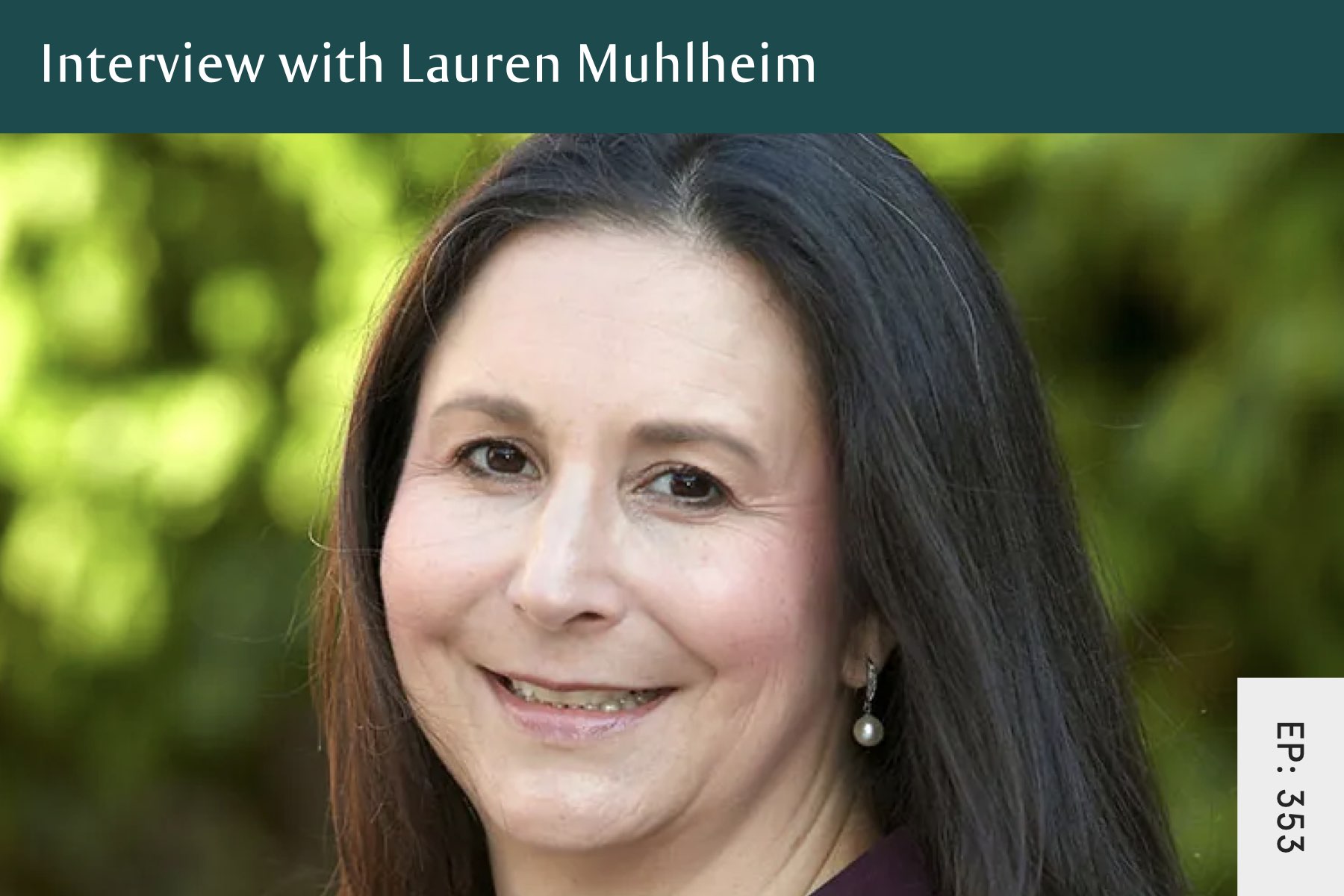
Episode 353: In this episode, I’m joined by psychologist Dr Lauren Muhlheim to discuss her new Weight-Inclusive CBT Workbook for Eating Disorders. We explore what CBT actually is (and isn’t), how weight stigma became embedded in traditional CBT-E, and what needed to change to make CBT genuinely supportive of recovery at any body size. We also unpack core recovery foundations including regular eating, restriction, weight suppression, and building a life that’s bigger than the eating disorder.
Dr Lauren Muhlheim (she/her) is a psychologist, certified eating disorder specialist, “diet culture deprogrammer,” and the founder of Eating Disorder Therapy LA. She has worked in eating disorder treatment since the 1990s and supports people with eating disorders, body image concerns, anxiety, and depression.
Lauren primarily works with adults stuck in cycles of dieting, bingeing, purging, or over-exercising, helping them build peace with food and their bodies and reclaim their lives. She treats all eating disorders across the size spectrum, including anorexia nervosa, bulimia nervosa, binge eating disorder, OSFED, and ARFID, and has experience with conditions such as orthorexia, muscle dysmorphia, purging disorder, and night eating syndrome.
She also works extensively with families of teens who are not eating enough or have lost weight, empowering parents to play an active role in recovery at home. Lauren is one of the few therapists in Los Angeles certified in Family-Based Treatment (FBT) and is the author of When Your Teen Has an Eating Disorder and co-author of the Weight-Inclusive CBT Workbook for Eating Disorders, both published by New Harbinger.
Lauren is passionate about making evidence-based, weight-inclusive treatment more accessible. She is a Certified Body Trust® Specialist, an advocate for body diversity, and has a special interest in supporting trans and gender-diverse teens and their families.
00:00:00
00:06:03
00:08:30
00:14:39
00:18:19
00:25:36
00:32:33
00:36:18
00:42:45
00:49:41
00:55:38
01:00:44
01:05:34
01:10:17
01:13:53
01:21:44
01:26:01
01:35:12
01:45:49
01:48:00
00:00:00
Chris Sandel: Hey, everyone. Welcome to Episode 353 of Real Health Radio. I’m your host, Chris Sandel. I’m a nutritionist and a coach and an eating disorder expert, and I help people to fully recover.
On today’s show, we are looking at CBT, cognitive behavioural therapy, and eating disorder recovery. I don’t often think of this label when I think about the way that I practise. I talk about I use ACT or I talk about I use polyvagal theory or I talk about self-compassion, but I don’t usually speak about what I do as being CBT.
Partially – and I go through this in the episode – it’s because I’ve been put off by this title, especially some of the books written about it connected to eating disorder recovery. But because of the conversation today, my guest today, the book that my guest today has written, I can now fairly confidently say that I do use CBT in practice, and I have been doing that for a very long time; it’s just I don’t use that label.
Before I introduce my guest, I just want to mention that I’m currently taking on new clients. If you are living with an eating disorder and you would like to reach a place of full recovery, irrespective of whether full recovery feels like this distant thing or this thing for other people, if you would like to get to that place, I truly believe that everyone can get there. This is what I work on with people, and I’ve been seeing clients for the past 15+ years and I’m good at what I do, getting people to that place of full recovery.
So if that is something that you’re interested in, you can send me an email at info@seven-health.com and put ‘coaching’ in the subject line, or you can go to my Instagram. It’s @sevenhealthcompany, and you can send me a DM just saying that you want to look at coaching, and I can send over the details.
So, on with today’s episode. My interview today is with Dr Lauren Muhlheim. Lauren is a psychologist, a certified eating disorder specialist, a diet culture deprogrammer, which I really love, and the owner of Eating Disorder Therapy LA. She helps people with food and body issues, anxiety and depression, and her primary work is with people who are stuck in the cycle of dieting, binging, purging, and overexercising and can’t figure out how to stop. She helps people of all ages and with all eating disorders.
Lauren has been on the podcast before. It’s Episode 232. I’ll put that in the show notes. I make reference to it at the beginning and what we covered in that one. It’s a great episode, so I highly recommend that you check it out.
But for this episode, what we’re focusing on is her new book, and the book is called Weight-Inclusive CBT Workbook for Eating Disorders. What we cover as part of this is why there was this need for this book to exist and the gaps in the market that Lauren saw, but also how traditional CBT was actually harming people in larger bodies and why there needed to be a different way connected to this.
We also talk about what CBT is and what it isn’t, and how Lauren uses this in practice and how this is covered as part of the book. We look at the commonalities with all eating disorders and why CBT can be used across all eating disorders; it isn’t only for this one or that one. We look at weight suppression. This is such a missing clinical lens that most people just don’t recognise. We can notice someone’s weight suppressed if they’re matching up to some kind of stereotype, but actually, this is something that happens all across the weight spectrum, and it can really get in the way of someone’s recovery, especially if they’re being given advice that really goes in opposition to this.
We talk about where to start in recovery. While it can feel like there are many different places to start, there’s one area that really is going to make the most difference and is critical and crucial for everyone. We talk about fear and ambivalence, which are very normal and I would even say necessary parts of recovery because of what they are doing. They’re like a protective mechanism. So we talk about this and talk about how to overcome this or how to deal with this or how to make changes even though these things are there. We talk about self-worth and moving beyond self-worth just being dictated by the size of one’s body or the shape of one’s body. And then we also look at relapse prevention and what this can look like in real terms.
I really loved this conversation. I really love this book. It’s one that I’m going to start using and recommending more. So if you do like this conversation, I do highly recommend getting the book and checking it out. You won’t be disappointed.
So without further ado, here is my conversation with Dr Lauren Muhlheim.
Hey, Lauren! Welcome back to the show. It’s lovely to have you here today.
Dr Lauren Muhlheim: Thanks so much.
Chris Sandel: I was looking – you were last on four and a half years ago. It was Episode 232. So for anyone who hasn’t listened to that, I highly recommend checking it out. We talked about some of the things that we’ll cover today; we did talk about CBT. A lot of family based therapy we talked about. We went through avoidant restrictive food intake disorder, or ARFID, and the different types of ARFID, which was really helpful. So I highly recommend people check that out if you haven’t listened before.
Today what we’re going to really focus on is the new book that you have and a lot of the topics from that.
00:06:03
Before we get started, just for anyone who hasn’t listened to that previous episode, do you want to give just a very quick intro to who you are, what you do, that kind of thing?
Dr Lauren Muhlheim: Yeah, sure. I’m Lauren Muhlheim. I’m a psychologist based in Los Angeles and an eating disorder specialist, and I’ve been treating eating disorders since the ’90s. I’m particularly passionate about evidence-based treatment and adapting evidence-based treatment to be more weight-inclusive. I have a group practice where I train other therapists to become eating disorder specialists and also train graduate students.
I’m very passionate about helping other clinicians develop their skills and using the basis of the evidence-based treatments. The new book is coming out of that passion, and it’s written with two amazing colleagues, Jennifer Averyt and Shannon Patterson, who are both psychologists as well.
Chris Sandel: Nice. I just want to add that you work with people of all ages. I’m correct in saying that?
Dr Lauren Muhlheim: Correct, yes. My first book, that we plugged in the last podcast, was for parents of teens with eating disorders based on family based treatment for teen eating disorders, and the new book is for adults, and it’s a workbook. My practice encompasses all ages. I see kids with ARFID and adults up through old age.
Chris Sandel: Great. I just wanted to make that clear because obviously not everyone does, and if anyone ever reaches out who says “Hey, can you work with my son and my daughter and they’re 12 or 14” or whatever, you are the person that I always give them details of. I’m like, I don’t work with kids, but please get in contact with Lauren and her practice, because I know that they work with all age groups.
So if anyone’s listening to this and you do have someone who is younger than can work with me, please get in contact with Lauren.
Dr Lauren Muhlheim: Also US-based. California.
00:08:30
Chris Sandel: Yeah. So the new book is The Weight-Inclusive CBT Workbook for Eating Disorders. Just as a starting place, what made you feel like you wanted this book to exist and why? What gaps were you seeing that felt like they were being unaddressed or it just felt unacceptable for this book not to be out in the world?
Dr Lauren Muhlheim: This was in the making for a number of years. I was trained in the ’90s by one of the developers of CBT, Terry Wilson, who was the main collaborator with Chris Fairburn, who later went on and wrote the updated manual.
But when I trained in graduate school – I still have it, the typed manual for CBT for Eating Disorders, and it’s ingrained in me. It’s the leading evidence-based treatment. What I observed over the years is that newer generations of therapists are rejecting this model because there are elements in it that are stigmatising and definitely fatphobic, and want to just throw it out. In fact, I was doing some talks at conferences with a colleague, Rachel Millner, about eight years ago, like “Evidence-Based Treatments: Adopt, Adapt, or Abandon”, and she was really of a mind that we needed to abandon the evidence-based treatments and start all over.
There are a lot of therapists that have felt that way, and as I’ve become more engaged in weight-inclusive and HAES communities, my own use of the model that I was trained in in the ’90s had evolved quite a bit. So I really felt that the model itself could be salvaged. I was also concerned about it being in the hands of people who were not aware of weight stigma and weight suppression and that it could be harmful for clinicians who were CBT trained to be still using the old manuals, the old books, the old workbooks without this adaptation, which seemed to me obvious, because I had been doing it.
And same with my colleagues. When I met Jen and Shannon, they had worked together at the Phoenix VA, and they had both been modifying it in certain ways that were very consistent with what I was doing. So that’s how the idea for the workbook came about. We had already been doing this, so we were just crystallizing our adaptations.
Chris Sandel: Nice. I think that’s the sign of a good clinician; you can learn something and you can take what is useful and then leave everything else behind, and that works great when you have the experience to be able to do that, but I guess if you’re a complete newcomer to this and then you get exposed to that other book and that then becomes the way that you practise, you don’t know that there is another way, or you don’t know that these elements are causing harm. So I can definitely see why this was important.
I can’t remember if it happened after our last conversation or it had been beforehand, but I got the Fairburn book, and I didn’t get that far into it. I put it down. I was like, “I can’t get on board with this.” The language, the way that it spoke, it really had an impact on me where I’m like, no, this isn’t for me. I use acceptance and commitment therapy a lot more, which I know is an offshoot of CBT. But in a lot of ways it put me off getting into CBT in the way that it’s like, I already have the ways that I do things; I’ve taken what I like and I’ve left the rest. But that book did not in any way make me think “This is the thing that is going to help the clients that I work with.”
Dr Lauren Muhlheim: Yeah, I think it was helpful that I was trained in that typewritten previous manual because it was much sparser. There was a lot less – because I went back and looked at it, and there’s a lot less weight stigma. I mean, there was still the weekly weighing, but it wasn’t as apparent as in that Fairburn final manual.
And he was even fence-straddling at that time. He would talk about binge- proof dieting after recovery – like, what does that mean? But when I was first trained in the ’90s, the plan was binge eating disorder was not a diagnosis, and they were just discovering what they called ‘obese binge eaters’, OBE, which was going to be the people that they later named as having binge eating disorder.
Actually, Carolyn Becker and I – Carolyn wrote the foreword for the book; she was Terry Wilson’s PhD student and I was a PsyD student who had worked my way into his lab – we were going to run a group where we were going to first do CBT and then after a course of CBT, we were going to do Kelly Brownell’s LEARN Program for Weight Control. And it turns out we never got a big enough cohort to run the group, so thankfully I didn’t have to harm those people. [laughs] But yeah.
00:14:39
Chris Sandel: I know we did this on the last call, but again, for anyone who hasn’t listened to that or they listened to it four and a half years ago, I think it would be useful to set this conversation and define what CBT means in plain language. Because I know lots of people have ideas of this or concepts of it, but how do you define it?
Dr Lauren Muhlheim: Cognitive behavioural therapy is CBT, and it’s one of the leading psychological treatments for many disorders, including anxiety, depression, and eating disorders. It really looks at what’s maintaining symptoms in the present day and the interplay between thoughts, feelings, and behaviours. It looks to make changes in one of those realms to produce changes in the others.
I think a lot of people focus on the cognitive part of CBT and think that they’re just going to do thought challenging and convince people that it’s not bad to eat cake or something, but CBT is really a behavioural treatment and it focuses on changing behaviours first. In eating disorders, the work comes about by seeing that some of the things that you’re predicting don’t happen – or if they do, that you can tolerate them.
For example, if someone’s afraid of eating cake, you’re not just going to argue with them and restructure their thinking out of that thought. What you have to do is try to get them to eat the cake and see that they can handle it and survive and that maybe life will even be better. So that’s where it’s really a behavioural treatment and the focus is on changing behaviours around eating first.
Chris Sandel: Nice. I do remember from our previous conversation, this was the part I was able to definitely get on board with, where I’m like, okay, that makes sense the way you’re explaining it. I think too much of what I’ll often see is this very big focus on challenging thoughts and writing down your thoughts, and really the cognition piece – as you described, it’s a behavioural intervention. It’s noticing what then happens in terms of cognitions based on those behavioural interventions and making those changes.
And it’s not that there can’t be analysing thoughts or beliefs or those kind of things, but that’s not the primary modality in which this has an impact on someone.
Dr Lauren Muhlheim: Yeah, and that people’s beliefs and thoughts start to change as a result of what they notice when they change their behaviours. They see that they can tolerate doing these things that maybe they’re avoiding.
Chris Sandel: Yes, for sure. I use a lot of polyvagal theory and I’m a very big believer in ‘story follows state’. We need to change the state first, and I think most people are trying to do this the other way around.
Dr Lauren Muhlheim: Yeah, and at its heart, when I was trained in the ’90s, I always thought of cognitive behavioural therapy for eating disorders as an anti-diet treatment because the focus is really on regular eating and ‘all foods fit’. Which seemed to me very strongly anti-diet. So I do think it’s a very powerful treatment.
00:18:19
Chris Sandel: For sure. You were and are very explicit in the book, like, this isn’t a rejection of CBT; this is still CBT. So I guess for you – and maybe you’ve answered some of this, but if there’s anything extra, what did you want to preserve from the traditional CBT and what did you think like, “This is a non-negotiable; this part has to go”?
Dr Lauren Muhlheim: A couple of the things that we felt were essential to keep was, one, the focus on regular eating, because that’s really where the heart of the work takes place, and that has to be the first step for recovery from any eating disorder, as you know. And I know that one of the things I love about your account is you and I think so similarly about this. Sometimes you post on Instagram and I’m like, yes, exactly! So I know we’re totally aligned around that.
The other thing that I think is really important for CBT is the use of self-monitoring or keeping food records. As I’ve talked to colleagues about this book and our work, and as I train therapists in my own practice, I think one of the things – because a mainstay of any cognitive behavioural therapy is self-monitoring. So if someone’s depressed, we’re asking them to keep mood logs to see how their mood is fluctuating and then we try to identify what activities are mood-boosting versus mood-deflating, and build mood that way. With eating disorders, we’re asking people to keep food records, and it’s really important because if we’re meeting with people only one hour a week and we ask them to recall what they ate for the whole week, they can’t remember.
I look at food records all the time, and when I train the clinicians in my practice, what we find is that people are undereating almost 100% of the time. Like 100% of patients are reporting undereating; not that they’re 100% undereating. But there’s almost always restriction, and the client comes in and says, “I’m eating so much, I’m binge eating, I’m emotional eating” and then we ask them to do food records and you see that they’re restricting for long periods of time or they’re restricting food groups. It’s only when you see these food records come in that you can point out where the undereating is occurring.
So really that’s important, too, to build that and to help people see where they can make adjustments. We felt very strongly about keeping that.
We kept the idea of developing a formulation for what’s maintaining behaviour so people could map out what is driving what. So if there’ restriction and then a binge, helping them to see the connections.
Those were some of the main things, as well as focus on some strategies for body image and perfectionism, and a small focus later on on some cognitive strategies, because that really does come later in the treatment.
But some of the things we took out were the focus on regular weighing, knowing your weight, knowing your BMI. It’s called ‘collaborative weighing’, but I did hear one researcher at a talk say basically “if the client doesn’t agree to be weighed, you don’t treat them.” It’s like, well, then it’s not really collaborative. [laughs] And that is something that – because people in larger bodies know they’re bigger, and many of them have had trauma at medical doctors where their weight was used against them.
So is it really helpful exposure? Because the theory in traditional CBT is that regular weighing is exposure and it gets them used to being weighed so that then it’s easy for them. But if it’s traumatic, and I don’t know that it really adds anything – so that was one of the things we took out, regular weekly weighing. Knowing one’s weight, knowing one’s BMI. We don’t feel that that’s something to drive home.
Now, there are a lot of people who are weight suppressed, so we do ask about that, and anyone who’s low weight hopefully is followed by a doctor, so we’re putting that in the hands of medical people and not people’s own, like, “know your BMI and obsess about it.”
And there are other things, like in traditional CBT there’s behavioural experiments to address the broken cognition. Remember, because this treatment was developed on primarily thin white women who believe that “I can’t eat pizza because I’ll gain 5 pounds”, in traditional CBT, we’re supposed to have them weigh themselves, eat pizza, then weigh themselves the following week, and then when they don’t gain 5 pounds, then you say “Aha, see? Pizza doesn’t make you gain weight. Pizza’s safe.” But that just reinforces that gaining weight is the worst thing that can happen to a person. So we took that out.
Our suggestion is, what about running behavioural experiments that you can tolerate whatever happens? Eat pizza and maybe you do gain weight. What happens? Is life maybe a little more joyful? Did you have fun with your friends? Did it feel better to partake versus sitting there on the side and watching everyone else eat pizza? So expanding that.
And then I think we really focused on preventing undereating much more so than preventing binging. We really use delays and alternatives more to stop purging, because we see that binging is often really driven by restriction and undereating.
00:25:36
Chris Sandel: Nice. There’s a couple of things that you said that I want to address, and then we’ll get to some of the other stuff we can go through. In terms of the monitoring and keeping a food log, this is something I do very regularly with people – often more at the start, and as time goes on we’re doing a little less just because it’s feeling less important by that point.
I prefer to call it an awareness log as opposed to a food log, and as part of that we can put in what time you go to bed, what time you’re waking up, what activities you’re doing across the day, any symptoms, what’s going on with mood, all of this, so that we have something in black and white to go through. And I think that’s really helpful. I know you said when you do that, 100% of the time people are undereating. And it’s very obvious to me and probably you that that’s occurring, and it’s not necessarily obvious to the person that that’s occurring, especially because so often, it’s like, “Oh, you think this is bad? You should’ve seen it before.”
There’s this very relative thing that’s happening where I’m comparing what used to happen before when I wasn’t having breakfast or I wasn’t having that snack or I didn’t use to have carbs. So it can feel like “this is a lot” even though actually, what you really need isn’t being consumed across the day or the week. So having that in black and white and being able to point that out and being able to say, “There’s this gap from when you wake up to when you have your first meal that’s like four and a half hours” or “There’s this gap in the afternoon” – and again, someone can feel like “Oh, I was busy, I was fine.” But we’re able to point out, that’s going to be having an impact on you either in the moment, or that’s why the next day was the way the next day was.
Dr Lauren Muhlheim: Yeah. I think we have to look to the culture, and the culture is at this time normalising restriction, fasting, intermittent fasting, avoiding whole food groups, ridiculously low energy intakes for people. The influencers, “Wha I Eat in a Day.” People get so much misinformation about what normal, regular eating should be that they really are quite confused. And many of the people we see have been told by doctors to lose weight. So when they come in to us and we say, “Oh my God, you’re not eating enough”, they’re like, “What? Everyone’s telling me I should be losing weight. I thought I was doing so well!”
So yeah, it’s really hard. But it’s fun when I train graduate students because one of the things I love is how quickly they pick this up. I’ll have a conversation with one of them and I’ll say, “What do you think the diagnosis is?” for this new person they’ve seen, and they say, “I’m going to wait until I see the food records. They say that they’re binge eating or emotional eating, but I’m going to look at the food records and then I’ll know, because maybe it’s more like anorexia and they just feel like they’re eating a lot.”
Chris Sandel: For sure. A lot of the times when I look at the food logs, I’m like, if this was a magazine, this would be held up as “This is the way you should be eating.” So I get why people are confused. I think there’s also a difference between what I need in recovery versus what I need if I am someone who hasn’t been living with an eating disorder for the last 20 years.
Often what I point to as well when I have these conversations – and I see this again and again, and I’d love to get your take on this. So many of the people I see – I’m going to guess 80% and up – when I say, “What was your eating like before you had an eating disorder?”, they needed more than the average person. Like “I used to out-eat all my brothers and sisters” or “I used to out-eat the guys when they would come round” or “I used to eat a normal amount because my mum wouldn’t let me have more, but I always knew I needed more than most people.”
This can sometimes be something that someone’s had shame about from a very young age, but often it wasn’t a problem. This was something that was either laughed about in the family in a good way, or it was celebrated, or “It was just who I was” and then it became a problem only later on, once the eating disorder occurred.
I’m mentioning this just because obviously if you had higher demands than the average person before an eating disorder, that’s going to be true after having an eating disorder, and it’s also going to be very true in recovery. So if you’re trying to eat what your work colleagues are eating, that’s just not going to be anywhere near enough.
Dr Lauren Muhlheim: So true. Recovery really does require eating more and eating more regularly throughout the day, and that’s what we drive home throughout the book. We try to drive it home still, like we want to be sure you’re eating enough. I really wanted to be sure that people were eating enough before we worked on other strategies to prevent binge eating, because otherwise you’re just teaching people how to diet.
Chris Sandel: Yes.
Dr Lauren Muhlheim: Which is not sustainable anyway, but you don’t want to reinforce restriction. And that’s, again, what I drive home in my practice: when you’ve been undereating, the natural tendency, your body’s survival mechanism, is to go in search of the highest calorie, calorie-dense food because that’s what kept us alive and kept our ancestors alive, and your body doesn’t know the difference between a lull in eating and a dangerous famine. So it’s going to be shouting at you to get food until you do. There’s no hack for that. We have to feed our bodies adequately.
Chris Sandel: For sure. We’ll definitely come back to this piece in a moment because I want to go into it in a bit more detail.
00:32:33
But the other thing you said that I want to reflect on in is about the weighing piece. I talk a lot about eating disorders being disorders of avoidance and that we need to do exposure to get over our fears, and I believe that to be true in lots of different ways.
But we, for the longest part of human history, never knew what our weight was. It’s in the last 100 years, 80 years, that we’ve had a scale, less time than that where we’ve had it in every person’s home. So I’m fairly firmly of the belief that you can live a very happy, healthy existence never knowing your weight again. That for me feels less of a necessity of like “you have to overcome this thing.”
And if someone truly is like “Hey, I want to be in a place that I can stand on a scale and it does not dictate my mood”, fine. We can definitely work on that and we can have action-taking connected to that. We can do different practices because that’s an intentional goal of where you want to get to.
And I don’t believe that that’s what everyone has to do. We can be at a place where you haven’t weighed yourself for the last 12 years, and that’s actually what’s going to happen for the rest of your life because you know this doesn’t lead you to a good place; it’s not helpful for you.
The other part I would add with this is there are times where I will use weight with clients if they are on board with doing it, because it actually makes sense in their situation to be doing that, and it can be a useful tool for us to look at, it feels like you’re eating a lot of food on paper; what’s actually happening with your weight? We can look at the symptoms and that’s useful, and it’s just another bit of information that we can look at if someone’s okay with doing that.
I’m just trying to get across that there is real nuance with this. There isn’t a “you have to do it this way” or “you should never do it that way.” And I know that’s not what you’re saying, but this is one of those areas that comes up a lot for people, so I wanted to mention it.
Dr Lauren Muhlheim: Yeah, and I totally agree. What we tossed out was the mandated weekly what they call ‘collaborative weighing’ because I think it’s more nuanced than that. Like you said, there may be situations where there is some benefit to someone knowing their weight and to doing exposure, but you have to know exactly what the exposure will do. Will it help this person, and how so? You have to really understand the function of the avoidance if they’re doing that.
But it’s not like – some CBT experts will say that if the therapist is not weighing the patient, the therapist is avoiding their own anxiety. I think it’s more trauma informed to really understand, if you’re weighing a patient, why you’re doing so, and what you’re doing with the information.
Chris Sandel: For sure. If I’m thinking from that more exposure, “I want to be comfortable being able to see the number”, when I think about when is the right time to be doing that, it’s typically further on down the line. We need to get more nutrition coming in, we need to have more stability with that. There’s other tools that we can learn to be dealing with emotions and thoughts, etc., and then we can come to that place later on. So even if it is useful, it’s not the first intervention we need to be using with someone.
Dr Lauren Muhlheim: Right.
00:36:18
Chris Sandel: Let’s talk a little about – and you’ve touched on this already, but just go into a little more detail – the way that traditional CBT has harmed people in larger bodies. I know this book that you’ve written is specifically about this very weight-neutral approach and weight-inclusive approach. Are there any other ways that you think that the traditional way has been harming people that you haven’t mentioned already, or where clinicians who’ve been trained in that by-the-book way, this is impacting what they’re doing and it’s coming across as diet culture even if they’re not intending that? Anything that you haven’t mentioned up until this point that you want to make sure you get?
Dr Lauren Muhlheim: The traditional CBT manuals do talk about having a ‘right’ weight being in the centre of the BMI, low-normal range. I think one of them has the words that if you’re above that, you need to know and you need to do something to try to get your weight down. Which is very weight stigmatising.
Some of them have language to that. The supposition is that if your weight is higher, you must be overeating. One of them actually talks about binge-proof dieting. I don’t know what that is, because I think all dieting can produce binge eating. But yeah, the idea that after you treat the eating disorder, you can go back to some kind of restricting.
There’s this messaging throughout that I think people in larger bodies will find very offensive. Fairburn wrote his manual and then he recommended that people do some reading of their own, and of course he had a self-help book, Overcoming Binge Eating, that was the required text to be doing your own psychoeducation.
I had started using the Centre for Clinical Interventions’ workbooks from Western Australia. Anthea Fursland was one of the authors. I thought they were amazing, except they were dated. They did retain some of that “know your BMI.” And I had started redacting them and trying to cross out all the BMI stuff and all the stuff about knowing your weight. But it was a lot. [laughs] Every once in a while, a client would be like, “What is this?” and I’d be like, “Oh yeah, ignore that.”
It just permeated, this focus on being a healthy weight, knowing your weight, which we know is not true because bodies are diverse and there’s always been body diversity. It’s a normal curve. Not everyone is going to be the exact same BMI. There’s always going to be outliers, and even if that outlier loses weight, there’s still going to be someone else there. So we have to accept that that’s normal and let people’s bodies alone.
Chris Sandel: I totally agree with that. I think the difficulty as well is if you’re recommending this thing to a client and then they start reading more about it and then there’s all of these other things – you’re like, “Oh, but don’t read that part of it” – it becomes more difficult to be like, “Why should I trust the other bits? If there’s all of this in here that you’re saying I shouldn’t trust, what makes you say that this part’s good?”
So the fact that you’re now able to have a book to be like, “You can read the entirety of this thing”, there’s no bits you’re having to skip over – I think that’s a lot more powerful.
Dr Lauren Muhlheim: Yeah, it’s really exciting. And that was one of the things, because after redacting it – and my co-authors and I were trying to decide, should we try to do a manual? And then all of a sudden it hit me. I’m literally chopping out parts of this workbook that’s online and free, so why don’t we just write one that’s going to be safe?
Chris Sandel: Nice. When you initially had the idea, was it going to be for clinicians? Was it more going to be for clients? When I read through it, obviously anyone can use it, but it’s very much aimed at the client or the patient so that they’re going through it, they’re reflecting on their journey with all of these things. But when you’re talking about a manual, that makes me think more this is aimed at the clinician and how they’re going to be using this when they’re working with clients or patients.
Dr Lauren Muhlheim: No, you’re right, this is a workbook for clients to use themselves. We hope that clinicians will use it. Guided self-help is a very validated treatment for eating disorders, so whether it’s an expert in eating disorders and the client’s doing their own psychoeducation in a workbook like this, or maybe a therapist is not an eating disorder expert but they can use this workbook with their clients – the research shows that that can be very effective. And then also, self-help alone, where the client can use the workbook just on their own.
We had toyed with rewriting the manual, but my relationship is with New Harbinger, and they are really not writing books for professionals anymore. So that tipped the scale into “let’s start with the workbook and see where that goes.”
Chris Sandel: Perfect. That makes sense.
00:42:45
One of the things that you open the book with saying is that eating disorders have more in common than differences, and that one of the commonalities that joins them all is restriction or failure to eat adequately, and that this is at the centre of all of them. I’m 100% on the same page with you on this, and I know you’ve mentioned this already a little bit, but why did it feel like this is a really important place to lead with for this book?
Dr Lauren Muhlheim: Yeah, and I know we are so aligned in our thinking about this. Because, like I said, a lot of the clients who come to us are in bigger bodies. They’ve been told that they need to lose weight. They are puzzled by where the binge eating and what they call ‘emotional eating’ is coming from, because they just assume that they’re eating too much. But like I said before, when you look at the food records, you can really see how the dieting and the restricting is driving those other behaviours.
I can’t think of any time that I’ve seen someone who was binge eating who wasn’t either actively restricting or had a very significant period of restriction that then drove binge eating.
Cycles of restriction and binge eating can be within the day or they can be much more extended. Someone who’s been restricting significantly for months may be eating off the rails for a couple months until their body realises that food is abundant again and that the body’s not about to starve to death. So it’s really helping people see the connections and understanding how important it is to eat regularly.
And that really is Step 1, has always been Step 1, of CBT, and for all eating disorders and for all body sizes.
Chris Sandel: Coming back to something we said earlier on in terms of, it can be very hard to spot that I’m doing restriction here because of how much we’re skewed in terms of what we’re seeing online and “What I Eat in a Day” and all of that, where someone can feel like “Oh, I thought I had it so together over this last year and I’ve been so healthy and I got back into exercise and I’ve been doing that really consistently.” In their mind it’s like, “For the first time in a really long time, I’ve been ‘taking care of myself’, so it feels like these binges or what’s happening with food now has blindsided me. None of this makes sense to me.”
I’m just mentioning that because I think that’s something I see a lot of. Less of now, just because of what I write about, and most people are self-selecting and are like, “Okay, I’ve got an eating disorder. That’s why I’m coming to you.” But definitely when I was working more in the “I want to stop dieting”, more of the disordered eating place, there was so much of that confusion going on, like “This doesn’t make sense to me.”
Dr Lauren Muhlheim: Yeah, and another variation of that is people eating large amounts of primarily fruits and vegetables and very low fat and they’re like, “Look how much I’m eating!” It’s like, okay, but there’s no density there so you’re literally starving.
Another version is now people on GLP-1s who have no appetite and they’re not eating throughout the day and then maybe they’re binging at night.
Chris Sandel: Yes. I don’t know if we’re going to get into GLP-1s today, but yeah –
Dr Lauren Muhlheim: No, that’s a whole other topic.
Chris Sandel: There’s a big impact on it as well. Something else – I’ve said this at numerous different points on the podcast, but I want to say it again: so much of our defining of eating disorders and which category someone falls into is just about what size body someone is living in. Because the behaviours someone can keep up with anorexia or with bulimia or with binge eating disorder are the exact same; we just frame it in a different way and we explain it in a different way because of someone’s body shape and size.
That’s another reason why all of these things are the same. We’re getting to the same outcome, we’ve got the same driver; it just presents a little differently depending on some of the behaviours and it presents a little differently depending on someone’s body. But we shouldn’t get so bogged down in “Oh, they’re in a ‘low’ weight so this must be happening” or “They’re in a ‘larger’ body so this must be happening.”
It’s like, no, I’ve had people that I look at what they’re doing, I look at all their symptoms, and I wouldn’t know before meeting them what they’re going to look like or the size of their body. Because I’ve had people who are in very large bodies who are in a lot worse metabolic state, are having all these symptoms, all these things going on that you would associate with someone who’s in the stereotypical emaciated body. It’s just their body is presenting differently.
Dr Lauren Muhlheim: Yeah, we see those people. One of my newer therapists who came from higher levels of care said to me, so alarmed, “I’ve not had anyone eating this little. This is alarming.” But the client’s in a bigger body, so we can’t even help them get higher level of care easily because their doctor doesn’t think it’s a problem.
Chris Sandel: Yeah, or they think it’s a problem that they’re in the larger body and say, “This is the perfect candidate for GLP-1s” or that kind of thing. So yes, I really feel for those people. I know this is a big reason why you’ve written this book because you can see how helpful CBT is for everyone living with an eating disorder. It’s not only relevant if your BMI is below this amount.
Dr Lauren Muhlheim: Nicely said. Thank you.
00:49:41
Chris Sandel: You’re welcome. Then connected to this is the idea of weight suppression. Again, you’ve mentioned it in passing, but why do you think this is still so misunderstood, even among clinicians, this idea of weight suppression? And maybe explain exactly what you mean by weight suppression.
Dr Lauren Muhlheim: This is one of my favourite topics. Weight suppression is defined as being below a previously attained higher weight if you’re an adult. But think of it as meaning you’re below your body’s set point. There’s a lot of research on weight suppression, a lot of it by researcher Michael Lowe. I’m surprised by how little it’s talked about. And back in the ’90s when I trained, I was actually taught that if someone had bulimia and they were binging and purging, we should tell them that once they stopped, their weight would stay the same, and reassure them that they wouldn’t gain weight – again, which was a horribly fatphobic intervention. But the belief was that it would even out.
But my reading of the literature now is that weight suppression, other than restriction, is the biggest driver of binging, and that it’s the body’s attempt to get the body back to that higher weight. And when you look at the research, there’s appetite increases, there’s more leptin, metabolism slows down to help the body get back to this higher weight.
I think rather than doing what I did in the old days, reassuring people that they won’t gain weight, I’m actually predicting that people may gain weight and may need to gain weight to really stop their binge eating. Because that’s what the research shows. And again, if you understand that people naturally come in a variety of bodies, that makes sense.
Chris Sandel: For sure. This is where I’ve seen so many clients who’ve gone to inpatient – and it’s not that this is only happening in inpatient, but they’ve been told “We just need to get you to this place and then you’re going to be weight restored.” And that number that they’re told in a lot of ways has just been plucked out of thin air. It’s not that we’ve done a real deep dive into what your history’s been, all of these things; it’s just “That sounds like a sensible BMI, so that’s what we’re going to get you to.”
I’m very explicit when I have conversations with people of like, I don’t know what is exactly going to happen with your weight. It would be very arrogant of me to think that I’m going to know exactly what your body is going to do and where it’s going to feel that this is the right place to be. I don’t know that information. We can take a bit of a guess based on some of your history, but the reality is, as part of going through recovery, especially if you’ve had an eating disorder for a long time, your body may prioritize putting on more weight than you did have before because, hey, you just had a 20-year famine and it doesn’t feel safe to just get back to what you were eat before, and actually it’s really important as part of the healing process to be going above that.
So there’s a load of different reasons with this, but I think the thing that I want people to get across and that you were talking about here and in the book is, you can be weight suppressed at all states or all weights across the spectrum. Because I think that’s the misunderstanding that too many people arrive at, like “Of course I can’t be weight suppressed. Look at me, or look at my BMI.” That’s not what happens.
Dr Lauren Muhlheim: Yeah, and you look at the people who’ve been on The Biggest Loser, and the research has shown they either pretty much gain the weight back or remain stuck in an eating disorder that was induced by the show, because that’s what our bodies are meant to do, to go back to that higher weight. That’s the critical point, really understanding that even if you’re in a bigger body, you may still be weight suppressed. So if you’re struggling with binge eating, gaining weight and eating more might be necessary to really stop the behaviours.
Chris Sandel: I just put out a podcast on constrained energy theory and just looking at the fact that the body is not endlessly additive. If you add in more exercise, it doesn’t just add that energy output on top of what is there as a baseline and is constantly adding in more and more and more. That actually, your body has to constrain things. And it makes sense evolutionarily to constrain things, because if you’re now wandering around more and more and you’re not finding food, it does not make sense for your body to keep burning things at that same rate.
So it has to turn things down and turn things off, and that is a very sensible thing for the body to do. At the same time, it’s now going to still be pushing you towards food, and when food then is there, your body is going to make good while it is available and it’s going to push you towards these things. It’s not some moral failing; it’s not someone being weak-willed. This makes sense.
Dr Lauren Muhlheim: Yeah, for sure.
00:55:38
Chris Sandel: For you, what questions or what reflections do you think tend to unlock this insight around the weight suppression piece? If you’re trying to help a client come to that realisation, what are some of the things you’ll look at?
Dr Lauren Muhlheim: We actually have a quiz, “Are you weight suppressed?”, in there. Some of the things – I hear people go on vacation and they gain 10 pounds. That’s a sign. If you gain weight easily, it’s a sign that maybe you’re weight suppressed. If you’ve been at a higher weight. If you’re binge eating. If you’re thinking about food a lot of the time. If you’re not sleeping well – and you’ve probably seen this; I see a lot of teens with anorexia who are starving. When you talk about the basic needs, sleep and food compete, and if someone’s not eating enough, their brain’s going to wake them up to search for food.
There’s lots of signs like that. Someone’s history, and also maybe looking at maybe someone’s been weight suppressed their whole life. Like, have you been dieting for so many years that you’ve never really eaten enough?
Chris Sandel: The thing I was just going to add is I know the way that eating disorder brains work, and there’s always this “Oh, if I didn’t hear every one of those symptoms that I have, of course I can’t be weight suppressed.” So I’ll just say I’ve seen people who are starving who are not sleeping very well, and I’ve seen people who are sleeping 9 hours a night and for whatever reason, it’s just not affecting that symptom, or it’s not affecting that system in an obvious way. Of course the repair is not going to be going on in the way that it should with sleep, but it’s just not so obvious to someone.
I’m mentioning this because I know that people will hear that and think “Oh, those ones aren’t happening for me, so it’s not suppressed.”
Dr Lauren Muhlheim: Yeah. And there is a quiz, and we felt this was a unique addition to our version of CBT – asking people to think about that question, like is it possible that your weight is too low? And what would that mean?
Chris Sandel: What are people’s reactions when you go through that? I know you’re going to see a wide range of things, but is there some “Okay, now it makes sense” piece with this? Or it takes a little longer to get to that place?
Dr Lauren Muhlheim: I think as with everything, people are in different stages of readiness to hear that message. Some people just are not ready to hear it, and others, maybe after a lifetime of fighting where their body wants to be, are in a better place to accept it. We just hope people will start to consider it. It may be the first time that they’re hearing it, because if your doctor’s been telling you to lose weight and we’re saying, “Hang on, the reason you have an eating disorder is because your weight’s too low”, that’s mind-blowing. It’s going to take time for people to really absorb that information.
Chris Sandel: Yeah, and there can be so many mixed feelings about that. There can be relief to hearing that, there can be terror to hearing that. You can have a lot of things all co-occurring at the same time when hearing that message.
Dr Lauren Muhlheim: Yeah, and grief I think is a big thing because if everyone believes what Oprah has been spinning for years, that everyone bigger has this inside thinner person ready to come out or whatever, people hold on to that. So to let go of that and accept that your body’s not going to be smaller I think can be very hard for people.
Chris Sandel: Yeah. Understandably, people are pissed. “Why have I been told this? Why have I been treated in this way?” Especially if someone’s dealt with this for the last couple of decades, like “Why am I only hearing this now for the first time? Why wasn’t this told to me back then? Even if I have this fear of gaining weight or my body changing, I also recognise I didn’t want to spend the last 20 years being like this. It would’ve been nice to have heard this a long time ago.”
Dr Lauren Muhlheim: Yeah.
01:00:44
Chris Sandel: In terms of the getting started piece – and I know you’ve said this already, this starts with the food piece. But if someone’s feeling overwhelmed or not sure where to start, what would you be suggesting for them?
Dr Lauren Muhlheim: As I said, we start everyone with – Step 1 is what we call regular eating. What that means is trying to eat regularly throughout the day, approximately every 3 to 4 hours, with no major gaps. Typically we want to see three meals and two to three snacks depending on the structure of one’s day. Usually breakfast within an hour of waking, and then a lunch and a dinner, and snacks when meals are more than 3 hours apart.
It’s getting that structure in first. Even if people are undereating, we try to get the regularity first. It’s sometimes also called mechanical eating, which means eating by the clock, by a schedule, because early on we don’t want to rely on hunger cues, which are often hard to discern. We can gradually build out those eating episodes to be more complete snacks and meals, but we always start with putting them in place with whatever. We do successive approximations toward the goal, so if someone just wants to start by adding a breakfast or adding a piece of fruit to their coffee, that can be a very basic first step, and then we try to go gradually and fine-tune to be more complete and regular meals and snacks.
The idea that people have a plan – Fairburn, in his manual, said, “If I or a member of my staff call you at any point during the day, you should always be able to tell me what and when the next meal is.” And it doesn’t have to be rigid like you’ve written out your meals for the week and it’s set in stone. I always tell people what that means is that you don’t come home from work at like 6:00 and have nothing prepared for dinner or no ingredients so that then you’re raiding the cupboard because you’re starving and it’s going to take too long to make anything.
So you want to have a general plan, knowing that you have food or where you’re going to be that you can put something together. It doesn’t mean you have to prep and carefully plan every meal. So that’s how people should get started.
Chris Sandel: Nice. I think of – I’ve talked about this before on the podcast, but the RAVES model. Have you come across this before?
Dr Lauren Muhlheim: No.
Chris Sandel: Someone from Australia – I can’t remember where in Australia it is, but it stands for Regularity, Adequacy, Variety, Eating with others, and Spontaneity. The idea being that these are all the things that we’re going to work on as part of recovery, but we don’t do all of these to start with. There is a succession with them and there is an order. We start with regularity and adequacy, and then later on we move to the other pieces.
And it’s not that you can’t do those other things; it’s just sometimes if I try and focus on variety, that is so scary that actually my eating doesn’t increase. If that’s the case, we want to focus on you having the same thing, but your energy going up because that’s the most important thing at this point. If variety helps you to have more come in or eat more regularly, cool; we can use that to start with. Same with eating with other people. For some people, that’s really terrifying; for other people, with the right people, that accountability is actually really helpful and “That helps me to be more regular or to get more food in.”
It’s just I think a simple model for people to understand that certain things are more important at certain points, and obviously you were talking about the regularity piece.
Dr Lauren Muhlheim: That sounds exactly similar. But I like that acronym. I may start to use it.
Chris Sandel: Yes. I’m blanking on the person’s name. It was not me that has come up with it. But yeah, I think it’s a really useful thing to remember with it.
01:05:34
In terms of for your practice, are you giving people explicit meal plans? Do you have strong feelings on that? “I’m very pro it”, “I’m very against it”, “I think it doesn’t matter”?
Dr Lauren Muhlheim: Well, first of all, we’re not dietitians, we’re therapists, so we don’t give meal plans. But even if we were, we wouldn’t give meal plans. [laughs] Because the goal is really to start where the person’s at and build from there.
We talk about just starting where they’re at and then building out to include different food groups, and that’s where we might bring in a dietitian to give more specific guidance.
Otherwise, we’re referring to the Plate-by-Plate method; they have a great Instagram account where they have images of what different plates look like. We use that to sometimes challenge clients who think they’re eating a lot, and we show them what some of those more full, adequate plates look like, just to give people a little bit of a nudge.
Chris Sandel: I’ve got their book holding up my microphone, otherwise I would lift it up. [laughs] So yes, I’ve got that one.
Dr Lauren Muhlheim: Their Instagram is nice because of the photos. Highly recommend that Plate-by-Plate approach.
Chris Sandel: For sure. As a nutritionist, I do do exactly what you’re talking about there. I will do meal plans for people, but I very much want to take a collaborative approach, and sometimes people are like “Hey, just tell me what I need to do and I’ll do it” and that’s fine. But a lot of the time it’s like, do you want to look at what you’re already doing and we then build on top of that? Does it feel like “Actually, what I’m already doing is getting in the way of me having the kinds of meals that I need to have, so let’s scratch that and we’ll start from the bottom up”?
But I do agree with you in that especially in the beginning, the idea of “I’m just going to wing it, we’ll just see when we get to 11 a.m. what I feel like”, that very rarely works for people in the beginning stages. Maybe we can explore that later on as things get to a better place, but having some idea of “This is what I’m doing across the day, I’ve actually gone to the shops, I’ve brought that stuff, I’ve got it, I’ve taken it with me to work”, all of those things are really necessary.
Because there can often be this feeling of “I just want to be a ‘normal’ eater. I just want to be able to have freedom and listen to my hunger. That’s what I’m working towards.” So there’s resistance to even following a plan, just being rigid like the eating disorder, and there’s this misunderstanding of we need to take steps to get there.
Dr Lauren Muhlheim: Yeah, there’s a misunderstanding and almost an idealizing of intuitive eating and what that means, and that you should wait until you’re hungry, and then at that moment have exactly what you want at that moment. Unless you have access to a personal private chef, you can’t. That’s just not realistic.
For most people, having a general plan – and it’s hard. We talk in the book also about this is harder for people with neurodivergence. Planning may be harder for them, and preferences may also come in and out. So being mindful that there are different ways of doing this. It doesn’t have to be so rigid. But yeah, being 100% spontaneous is really not great for early recovery.
Chris Sandel: I know for myself, if I leave the preparing of food too late, it’s an unenjoyable experience. It has a real impact on my state, on my mood, and this is someone – I’m not in recovery from an eating disorder. I have a very healthy relationship with food. So if you’re struggling with this and then you’re trying to prepare things well past the point of which you should’ve eaten, it makes it way more difficult than it needs to be.
Dr Lauren Muhlheim: Yeah.
01:10:17
Chris Sandel: If someone’s unsure about this, like “I just don’t understand why we need to start with food or with regular eating – so much of my struggle is about my weight, or so much of my struggle is about these other aspects of this” – maybe there’s some OCD, maybe there’s some other things going on – “it just doesn’t make sense why we’re not focusing on those other things”, what would you say to that person?
Dr Lauren Muhlheim: The baseline should still be regular eating because when someone’s not eating regularly, it’s harder to think clearly. Emotionality is more extreme in someone who’s not eating enough, so we see a lot more emotional dysregulation. It’s just going to be harder to do these other things if you don’t have this baseline of regular eating.
And some of those symptoms can get better just with regular eating. If you look at the Minnesota Starvation Study, they put perfectly healthy men, as measured by medical and psychological measures, on a diet where they reduced their intake in half, and over the course of like three months, the men exhibited symptoms that looked like a gazillion mental issues. They looked like they had bipolar, they had anxiety, they had depression. So I think it’s well documented that undereating can cause all kinds of other symptoms. That’s another reason why it’s important to make sure that the body’s getting enough nutrition and then you see what’s left.
This comes up a lot in my treatment of teens with eating disorders. Some of them look really sick; they look like they have OCD. There’s this one mom who is active in the parent community whose daughter was hearing voices and they told her she had schizophrenia and she looked like she had OCD. And it was all just malnutrition. So if you can get the nutrition piece and the malnutrition solved, then you have a better view of what’s really left.
Chris Sandel: 100% in agreement with you on this. It’s not that I think that if you do the eating piece, then everything goes away, that you won’t have anxiety after this or there will never be OCD or there can’t be other things going on afterwards. There can be. And one, we can deal with a lot of these things just in terms of restoring the nutrition, but two, we then have a better capacity to deal with those other pieces that are still remaining, so that you have a better way of “Oh, I’m dealing with this anxiety and now I’m able to use this more constructive way of being able to deal with this, whereas before I couldn’t even latch onto that. It would be so automatic that I was doing this other thing.” So yeah, I totally agree with you.
01:13:53
One of the things we mentioned before was around the awareness log or this monitoring piece, and I wonder, for you, with clients, how you’re able to do this or some of the suggestions you may have where this is actually helpful versus this then just becomes this other tool of suppression or beating oneself up or it’s actually not being used in the most effective way.
Dr Lauren Muhlheim: I think the first thing is framing it that this is not a tool for dieting. We’re not doing it in the ways that people may have used it in the past. A lot of people have had bad experiences, whether it was Weightwatchers or My Fitness Pal, where they’re obsessed about it and trying to get lower intakes.
I think one thing that we try to do is make it clear that we’re not judging. We’ve seen everything, and we are going to be looking for important information, especially where eating may be inadequate. We try to take a non-shaming approach and to have people understand that if there are episodes of overeating, to really approach that with a lot of compassion and acceptance versus trying to beat themselves up.
So we really try to emphasize that, that we’re looking for understanding and that the goal is to use the information to move forward with a ton of self-compassion. Hopefully that’s an aside.
And also, we try to give people options. It doesn’t have to be handwritten sheets; people can use an app, people can do a Google Doc, people can take photos on their phone. But we just encourage flexibility with doing this.
One of the things we also look at is if people don’t want to write it down, they could just keep hunger and fullness ratings, and that really comes out of Appetite Awareness Training by Craighead, where they have people keep hunger and fullness ratings before and after eating to try to build that awareness. I find that really helpful to see if people are eating enough, because if someone’s not eating breakfast and then eating a lot at lunch, then we can understand that they’re eating a lot at lunch because they were starving when they got to lunch. They can then start to see, “Okay, maybe I should have breakfast.”
Chris Sandel: Yeah. I had a client recently and there was this fear of moving all the meals up because there was the worry that “I’m already so hungry; if I start eating earlier, I’m going to end up eating more”, which I know is a big fear and why so many people delay. But she then did it and she was like, “Oh, now when I get to my lunch, I’m not as hungry as I was before because I didn’t wait so long to have my breakfast.”
There can be this mismatch between what we predict is going to happen and then what actually happens, and this is why the ‘B’ in the CBT is so important, like hey, let’s do the behaviour, let’s run that experiment, and then we can talk about what the actual outcome is as opposed to what the eating disorder predicted was going to happen.
Dr Lauren Muhlheim: Yeah, I love that. That’s a great behavioural experiment. When people are reluctant to try something, that’s one of my favourite things to do: How about if you tried it for one day and ran the experiment to see what happened and how that felt compared to the days when you don’t eat breakfast? And the food records really give them a chance to put the information in there and report back.
Chris Sandel: Yeah. I was just going to say, otherwise it’s like, I have my theories on what’s going to happen; you’re going to have your theories on what’s going to happen. At this point we’re just talking about theories. Let’s look at what actually happened and then we can have a discussion about that actual piece.
With the awareness logs, I’m the same as you; there’s real flexibility around this, with the idea of, hey, we’re just trying to gather more information about this. I know for some clients, there can be this real fear that “If I share this, I’m going to be told off and you’re going to see how little I’m eating and you’re going to make me have to eat more even though I don’t really want to admit that.” And I also have the experience of someone saying, “I’m so scared you’re going to look at what I’m doing and you’re going to tell me I’m fine and that I don’t need to change anything, and that’s my worst nightmare because I’m constantly, in my mind, being told I’m not sick enough. So if you look at what I’m doing and you’re telling me it’s all okay, where do I go from here?”
I’m mentioning this because I think people can have a whole range of experiences and a whole range of fears when doing this.
Dr Lauren Muhlheim: Yeah, and those are really good points to bring up. I think there is vulnerability in doing food records, and especially showing them to a provider. But we usually get such valuable information, because it’s really hard to know if you’re not doing this kind of tracking. You don’t have the awareness. So this is really such an important tool to understand what’s going on and start to build the awareness so that you can start to make some changes.
And I want to say, to the person who says “You’re not going to find anything to help them”, I think we’ll always find a way to help if someone’s having distress over this.
Chris Sandel: For sure. And I know you said earlier that this book and a lot of the CBT stuff, people can do on their own and just using this book as a guide. I do find that the awareness log piece can be more challenging for most people to do on their own because they just don’t know what they don’t know. And as we talked earlier, if you’re undereating, you can then look at this and be like, “Oh my gosh, I’m eating so much food”, and for someone who does understand this, they see a very different thing.
So it’s not that I’m against someone doing this on their own; it’s just having the understanding that “Maybe I’m not going to actually be able to pick up everything out of this thing. I’m not going to have an accurate representation of what this is really showing.”
Dr Lauren Muhlheim: Yeah, they may struggle a little more without a provider.
01:21:44
Chris Sandel: Yes. What about in terms of ambivalence or fear? This is a very normal, expected part of recovery, so how do you deal with this? I imagine this isn’t just coming up in the very early stages. It happens at all points around recovery. But just talk about how you deal with this in your practice and how this connects in terms of the CBT piece.
Dr Lauren Muhlheim: I think just naming ambivalence is really important. One of the things that we did retain was an exercise of decisional analysis, where people look at the pros and cons of doing this work versus staying stuck in their eating disorder, and what are the risks and what are the potential benefits. And hopefully seeing in your own mind what the motivation is, hopefully that keeps driving to make small changes.
At the same time, I think we allow people space to sit in the discomfort of “This is really hard”, especially in our culture. There is so much toxic messaging, and there are places that are not welcoming to people in bigger bodies. So we just find it important to call that out and name it and work on both accepting one’s body and getting angry at society, versus taking it out on yourself.
Chris Sandel: For sure. I think more generally around the ambivalence piece, I know for me as a practitioner, I think I’ve got better with this over the years. Because it is that – you’re treading this line between “I don’t want to collude with the eating disorder” and “I’m going to have to ask people to do things that are deeply uncomfortable to recover.” I’m always very upfront about this, and it’s then figuring out, how do we navigate this?
I don’t want to then be agreeing or having someone agree to something that I don’t actually think is going to be helpful for them. They can go ahead and do it – and this is the thing I always say. Hey, if you want to run that as an experiment or do that goal, you’re able to. I also want to acknowledge from my perspective what I think is going to happen, even if you actually follow through on this. I want to manage those expectations that if you make that change, I don’t actually think you’re going to notice a huge upside, and these are the reasons. And if you want to do it, you can, but I want to say this so that you’re not disappointed when that outcome occurs because you imagined there was going to be this really big change with it.
It is finding that balance between, as I said, not colluding with the eating disorder and not having someone be completely overwhelmed by what is being asked of them.
Dr Lauren Muhlheim: Yeah. There’s a lot of balancing to do. We can’t tell our clients what to do. We can give them information and encourage them to try things.
Chris Sandel: Yes. And coming back to something we’ve already talked about, I will regularly say to people, I can’t convince you of anything. Often, the state that you’re in, you can’t convince yourself of anything. The only way that anything is actually going to shift here is – this is why we need to do the regular eating, this is why more food needs to come in, because story follows state, and in the state that you’re in, it makes complete sense that you’re having these thoughts, these feelings, these beliefs, these fears. So coming back to why that action-taking piece is just so important.
01:26:01
In terms of one of the things that you talked about in the book, it was around self-worth, and I really liked this section. When you think about self-worth, and especially connected to this work, what comes up for you?
Dr Lauren Muhlheim: One of the things is the original CBT posits that low self-worth is driving the eating disorder. One of the things that we did in our cognitive model was posit that it was actually not internal to a person, but that it was external, that diet culture is what drives the feeling that one is not adequate as-is and needs to change their body to fit these cultural norms. Which I think is a much more empowering place to start, that it’s not that the person has low self-worth and therefore is trying to diet, but that it’s the culture sending these messages. Normalising that is one of the things we did.
And then we did retain this idea of the pie chart, that one derives one’s self-worth from different domains, that when one is caught in an eating disorder, maybe self-worth is largely related to shape and weight and the ability to control it, and that part of the way out of that is to build these other domains, whether it’s activities or values. So your self-worth gets tied to your relationships, your volunteer work, and that helps shrink the amount of self-worth that is tied to shape and weight.
Chris Sandel: I’ve heard Tim Ferriss talk about this. I have very mixed feelings about Tim Ferriss in terms of some of what he talks about I’m onboard with, some of it I am deeply against. But he talks a lot about identity diversification, and I think this is the same thing, self-worth diversification. If the whole way that your self-worth is dictated or felt is based on external validation or the size of my body or this one domain, even if that one domain feels like it’s healthy, even if it’s as a great musician or as an artist or whatever, if it’s only on this one thing, that’s some pretty shaky ground.
Dr Lauren Muhlheim: It’s risky.
Chris Sandel: It’s very risky, versus if there is this “Hey, I get this from being a parent and I also get it from doing the work in the community and I get some from my job.” It means if one of those things wrecks, in the way that it does in certain times – people go through divorce or things happen – “I haven’t had my legs completely taken from under me because I’ve got these other areas.”
Dr Lauren Muhlheim: Yeah, it’s the total eggs in a basket thing, and diversification of sources of self-esteem is so important. I saw that in 2008 to 2010. I was practising in Shanghai and I would see these career executives, expats, where literally the entire self-esteem was around career, and then something happens and wow, the deflation of self and the depression that emerges when there’s no other domains to balance the loss of that one domain is really hard.
Conversely, I’ve seen people come out of that by quickly building other domains and getting themselves out pretty quickly.
Chris Sandel: Do you want to describe the circle exercise as part of this? What does that look like?
Dr Lauren Muhlheim: You basically make a pie chart and you think about what are the ways that you base your self-esteem, and you make a pizza pie and the slices represent how much you think your self-worth is coming from different areas, whether it be career, relationships, certain volunteer things. It could be humour, like a value; it could be hobbies, different interests. Things where you feel like you have an impact, where you get a sense of self.
And then the goal, of course, is to look at that and see how it may be out of balance. It’s always easier to find domains to build, and that usually allows the shrinking of the eating disorder.
This is what people in recovery have described. I’ve heard people say, “What helped me in recovery was I built this life that was so much more interesting than the eating disorder. I became really engaged in my career and my relationships, and I could do these things”, so the eating disorder shrinks by comparison. So this exercise is trying to get people headed there.
Chris Sandel: Yeah, because I think the eating disorder in a lot of ways is somewhat counterintuitive to how someone would imagine. For example, “As more and more of my life falls by the wayside, it should be blindingly obvious just how much this is having an impact on me. I used to be able to do that thing and now I can’t do that thing. I used to hang out with these friends and now I don’t see them anymore. More and more of my life has fallen by the wayside; it should, in theory, make sense that then I’m able to see that the eating disorder is causing all of this, and therefore this is the thing that I need to get rid of.”
And what actually happens is the opposite. The more that life falls by the wayside, the more this thing becomes “Now this is really important to me because everything else is gone. If I don’t have my exercise or if I don’t have my food routines, if I don’t have this, then what else have I got?”
So much of when I’m working with people – because I think there can be a lot of rhetoric around recovery of “You need to put all your life on hold and focus on recovery.” And while I agree with that for certain things we need to put on hold, actually, what recovery is about is, how do we bring more life into your life? How can we remind you of these other things that are actually important for you?
The identity piece comes up so often, like “I’ve been losing my identity as this person”, whether it’s the fit one or the healthy one or the eating disorder one or whatever it is. The reason that that has become your identity is because so much of everything else has fallen away. So your identity becomes “What do I spend my time on for the vast majority of my days or my weeks?” So if we can bring in, “I’m now working at that dog shelter and I’m hanging out with this person and I joined this book club”, now there’s some other things for me to start to hang my self-esteem on.
But not even just hang my self-esteem on – I’m doing things that I actually enjoy outside of this, so I get to see that there’s this point of contrast between when I just do the eating disorder and when I have some of the eating disorder going on but I’ve got all these other things coming back in, and it’s at that point that you can start to recognise, “Oh, I’m starting to enjoy life more now that I’m getting more of these other things coming back in.” It’s then less about convincing someone and more about someone noticing, “Oh, there has been this shift.”
Dr Lauren Muhlheim: Yeah. I like the way they say it in DBT, which is building a life worth living.
Chris Sandel: Yes, totally. Because it becomes very apparent that that’s not what someone’s doing, and as an outsider, it’s like, well, there’s a very easy thing to change, but it doesn’t necessarily feel that way when you’re in the midst of it.
Dr Lauren Muhlheim: Right.
01:35:12
Chris Sandel: The last thing I want to talk about – this is another section from the book – is just looking at relapse prevention. The way that you talked about this in the book, it felt very realistic rather than alarmist. So tell me, what do you think people misunderstand about relapse?
Dr Lauren Muhlheim: I think all of CBT does a good job of emphasizing relapse prevention. The goal is for people to become their own therapist so that they’re not dependent upon therapy forever, and I think CBT is pretty proactive about helping people have a maintenance plan and also to learn to spot early trouble. I liken it to becoming a defensive driver. Initially you’re hitting every pothole, but with practice you learn to go around them.
We encourage people to identify, what would be some of the things in your life that could be triggering? How can you use the skills that you’ve developed to navigate those? Especially when you can anticipate that something’s going to be hard. Like let’s say you’re moving across the country; that’s going to be stressful. So maybe at that time you need to go back to more careful planning of meals to make sure that you don’t miss meals. Or it’s going to be prom season and everyone around you is going to be dieting. How are you going to navigate that?
And not everything is predictable, but we try to help people identify what some of those common or expected triggering situations might be and plan for them.
Then we also identify that there could be some early signs of lapses and that we believe that clients, by the time they’ve gone through a course of treatment, have the skills to navigate those. So we encourage them to go back and use some of the strategies that they’ve used, whether it’s you need to start keeping food records for a time again – I find that really helpful. Sometimes I get clients that come back to me years later and we look at what happened, and often it’s something like they’re in a job where they haven’t been able to have lunch, so they’ve started to binge eat in the evening again. Or they went down a rabbit hole with something that they thought was curing a medical situation that led them to start restricting again.
So sometimes these things are subtle, and I just encourage people – as we’ve said, we’re in a difficult time in society. There’s so much focus, and it’s easy to fall back on dieting and restricting. So the idea that you might need to look at it again, pull yourself back out, shouldn’t be surprising.
Chris Sandel: For sure. As we’re talking about this, I’m thinking about a particular client that I’ve been working with for the last couple of years, and it’s interesting, the difference in her response when things start to go in a not-so-good direction now compared to before.
In the beginning, when this would happen, there wouldn’t be the awareness around that this was the eating disorder again or that “It could be connected to the fact that I’ve been undereating or that I haven’t been doing the things that help me to stay more grounded.” It would just instantly be back into the eating disorder rhetoric of “But I’m so scared about the weight gain” and all of those fears that had started to lessen, when they came back, it was like they were always there, they were so permanently there. That awareness they had had really disappeared, and it disappeared very quickly.
And part of the reason it disappeared very quickly was they were still within the same kind of band. We’d made a little progress, but it was still, most days, not where they wanted it to be. And what’s changed is that they’ve now got to a much better place, so there is this real obvious difference in contrast between when they’re in their eating disorder and when they’re in a much better place.
What’s that meant is when there have been more blips because they’re studying and it was exam season and they didn’t spend as much time doing the journalling or the things that were helping them, and then food dropped down a little bit, they’re actually able to notice that, and they’re able to recognise, “Oh, just because this is going on, doesn’t mean I’m now in a full-blown relapse.” It’s more like, “Okay, I’m noticing I don’t feel as good as I was before. I’m noticing there’s extra anxiety. I’m noticing there are these thoughts that weren’t there before, and I also know what I need to do about it. I know that once I start doing more of the eating, I get back to doing more of my journalling and doing more of my art and those kinds of things, it starts to improve.”
So I think what happens is, you get to a place where you’re putting the blame in the correct place. Where before, it’s all the blame that the eating disorder is talking about, the fear of weight again, “these foods are so unhealthy”, all of that, and then with time, “I realise what’s truly driving this thing.”
Dr Lauren Muhlheim: Yeah, and as a behaviourist, I like to say that recovery is practising certain skills, and the more you practise the skills, the easier it gets. It’s hard to do a skill early on when anxiety is really high. We learn new skills in low stress, moderate stress situations first before we get strong enough to practise them in the highest stress situations. But with practice, it gets easier and easier, so over time, people can call upon those skills and manage on their own.
Chris Sandel: For sure. I think also, it’s often during the ‘relapses’ that people learn the most, because once things have been going well, you can take for granted that that thing’s actually doing anything. And it’s only when that disappears or something changes that you have the insight of like “Oh, that was doing more than I was recognising it was doing for me, and that thing is actually important.” For a lot of clients, they realise, “Hey, there’s these handful of things that if I keep these things in mind, things go quite well.”
I often think of Pareto’s principle, the 80/20 principle – the idea that within any given situation, you could have 20 different options; those aren’t all going to be equal in terms of their outcome. There’s going to be a few of those things that account for the majority of the outcome that you see. So for most people, find your 3 to 5 things that make all the difference for you and then focus on those. When you have more time, you can focus on more things, and when time is stretched, just focus on those and they will see you through.
If I’m, again, thinking of this client, that’s what she is now very good at doing, like “These are the things I just need to prioritise, and when I do that, we can mostly keep it on the rails very well.”
Dr Lauren Muhlheim: Absolutely. I agree with you. When I work with someone and maybe regular eating breaks the cycle and they never binge again, that’s always great. But then I worry – if someone has one more binge that we can analyse and look at, there’s almost relief in that because then you’ve had the chance to explore and manage how they’ve handled that, and that then becomes a great opportunity for learning, as you said.
Lapses and reemergence of behaviours I think can really be explored in a helpful way so that people can understand and not just have to white-knuckle it. We really want people to understand and see what they’re doing that’s helping their recovery.
Chris Sandel: Yeah, and to pressure test this when conditions do get tougher. Often when clients are like, “I think I’m fully recovered”, I’m like, cool. Let’s wait another couple years and then we’ll see. I don’t want bad things to happen, but I want you to go through redundancy or break up with this partner or have this thing happen with the family and you’re still able to either completely hold steady in terms of your recovery, or there was a little bit of backpedalling and then we were able to sort it out. You’ve been able to prove that this thing can weather the hard times, not just when everything felt like it was really easy.
Dr Lauren Muhlheim: Right, and then that really strengthens the recovery.
01:45:49
Chris Sandel: Definitely. Lauren, what haven’t we gone through that you want to mention, if there is anything that we didn’t get to hit yet?
Dr Lauren Muhlheim: One thing is I wanted to give a shout-out to you, Chris, because you allowed us permission to reprint your ‘Signs of Hunger’ in our workbook, which I loved so much. When we did the podcast four and a half years ago, you mentioned that to me and then sent it to me, and graciously have allowed me to use it with clients and to reprint it in the book. It’s so helpful.
What you did is you have a list of the more subtle signs of hunger that people may not realise – things like headaches and being thirsty. I don’t know if you want to share some more of them.
Chris Sandel: Acid reflux, cold nose / fingers / toes, irritability, anger. There’s quite a list, whether this be physical type stuff or more mental / emotional type stuff.
Dr Lauren Muhlheim: Yeah, and that’s been so helpful to share with clients because so many people think hunger only means growling in the stomach. I’ve found that so helpful to help clients build awareness of “What are the other signs that I may really be hungry?”, and that really fits in so nicely with what we were trying to do in this workbook. So I wanted to give you that shoutout and a huge thank you for sharing that with us, and hopefully with many more people through the workbook.
Chris Sandel: You’re very welcome. I was glad when you said you’d been using it, when you asked about including it in the book, so I’m glad that that information is in there.
Dr Lauren Muhlheim: Yeah, I think it’ll be super helpful to people.
Chris Sandel: Is there anything else from the book that we didn’t hit that you want to mention before we wrap this up?
Dr Lauren Muhlheim: No, I think we covered a lot today. Thank you so much.
01:48:00
Chris Sandel: You’re welcome. The final thing then is just, where can people be finding you? I’ll put everything in the show notes, but if people want to find out more about you or more about the book, where do you want to point them?
Dr Lauren Muhlheim: The book is The Weight-Inclusive CBT Workbook for Eating Disorders, and it’s hopefully available wherever you get books. The publisher is New Harbinger, so they will sell it directly from their website. It’s of course on Amazon and Goodreads. And my own website is www.eatingdisordertherapyla.com. I have a page there for my book and I also have a blog and lots of other resources. So yeah, that’s where you can find me. I have also Instagram @eatingdisordertherapyla or something like that, I think. [laughs]
Chris Sandel: I’ll fact check that, and if it’s wrong, I’ll add it.
Dr Lauren Muhlheim: And I have a Facebook page. So that’s where people can find me.
Chris Sandel: Cool. I will add all those to the show notes, and thank you so much for coming on the show. Thank you for creating this great workbook that people can be using. As I said, the contrast between reading this versus the Fairburn book, it couldn’t be bigger. This is a really great addition in terms of creating – you’re so passionate about CBT, and to then be able to have people who really do need it be able to have access to it and not be put off by not-great language and biases, I think it’s a really important thing.
Dr Lauren Muhlheim: Well, thank you so much for your support and for having me.
Chris Sandel: You’re welcome.
So that was my conversation with Dr Lauren Muhlheim. I really loved what we got to cover as part of this one. We barely scratched the surface of this stuff in terms of what is included in this book, so don’t feel like “Oh, I’ve listened to that conversation, I don’t need that.” If you found this helpful, then I highly recommend getting the book, because it is a really great resource.
And as we talked about in this episode, CBT, often how it’s been written, especially over the last couple of decades, there are some real glaring errors for how it should be written in terms of language, in terms of how things are focused on. So if you’ve been put off by this in the past, then this is the book for you to be able to get the benefits of what CBT can offer, but without all of the incorrect language and the biases and the shame that is then added on top with so much of the other writing.
I really loved doing this episode with Lauren. The final thing I’ll just say before I wrap this up – as I mentioned at the top, I’m currently taking on new clients. If you want to reach a place of full recovery and you would like to have some help to get to that place, then I would love to be that support for you. You can send an email to info@seven-health.com or you can go to Instagram @sevenhealthcompany and send me a DM, and we can then send over how to get started with this or what that can look like.
Alright, I will be back with another episode next week. Until then, take care, and I will see you soon!
Thanks so much for joining this week. Have some feedback you’d like to share? Leave a note in the comment section below!
If you enjoyed this episode, please share it using the social media buttons you see on this page.
Also, please leave an honest review for The Real Health Radio Podcast on Apple Podcasts! Ratings and reviews are extremely helpful and greatly appreciated! They do matter in the rankings of the show, and we read each and every one of them.



Policies
Social
Copyright © 2009 – 2025
seven-health.com · All Rights Reserved.
Share
Facebook
Twitter