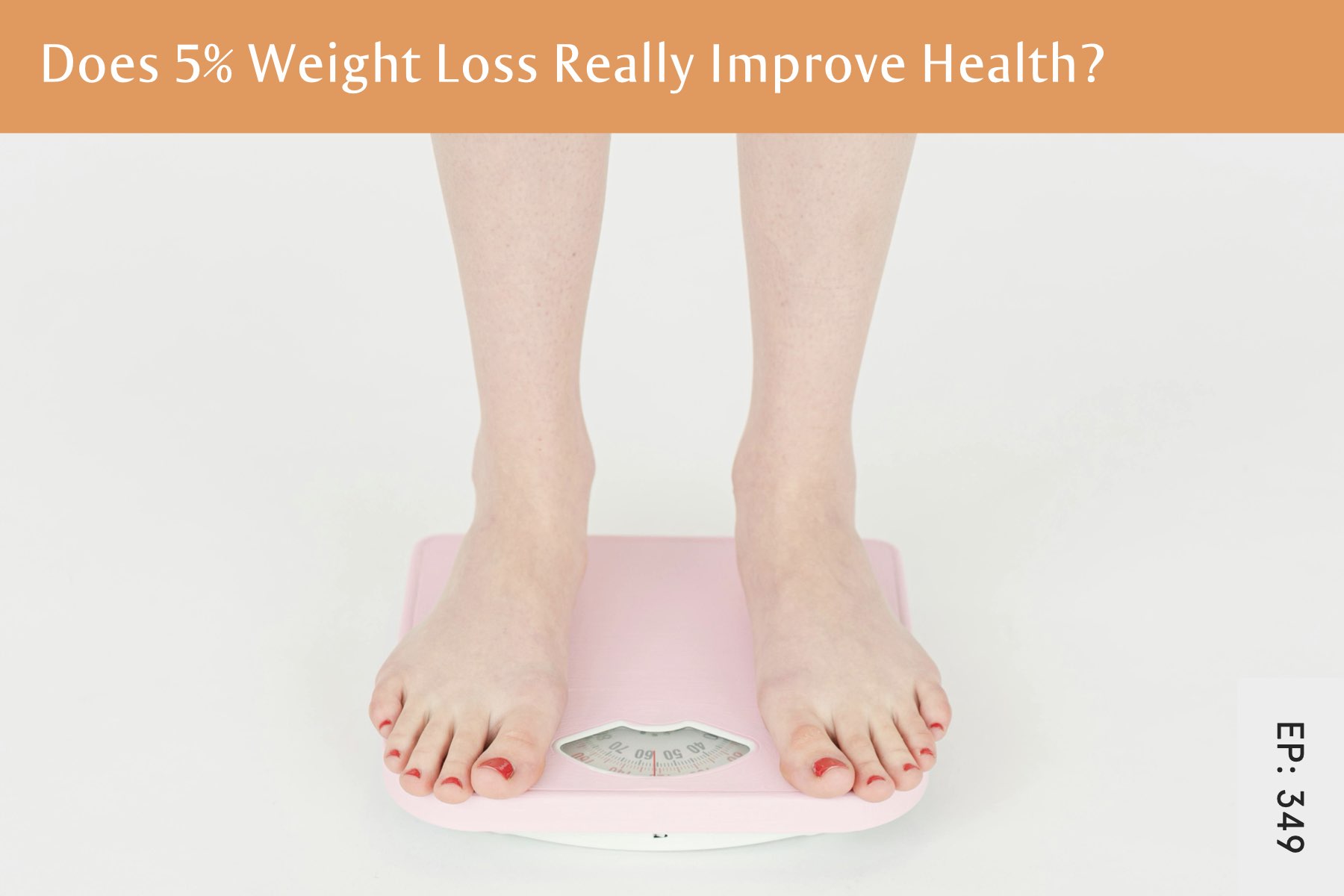
Episode 349: There's this claim that is made that "just a 5% loss in weight leads to improvements in health." But is it true? In this episode, I look at where this claim comes from and why there are other factors outside of weight loss that are actually driving the improvements.
00:00:00
00:01:22
00:03:37
00:07:08
00:09:17
00:12:00
00:16:09
00:18:06
00:23:20
00:00:00
Chris Sandel: Hey! If you want access to the transcript and the show notes and the links talked about as part of this episode, you can head to www.seven-health.com/349.
Hey, everyone. Welcome back to another episode of Real Health Radio. I’m your host, Chris Sandel. I’m a nutritionist and a coach and an eating disorder expert, and I help people to fully recover.
Before we get on with today’s show, I just want to say that I am currently taking on new clients. If you are living with an eating disorder and you want to reach a place of full recovery, then I would love to help. And it doesn’t matter how long this has been going on; it could be something that developed in the last year or it could be multiple decades into your eating disorder. I still believe that you can fully recover. I know for some people, that just feels like a pipe dream, it feels too far out in the future, “I’m never going to get there”, but I still believe that you can reach that place.
So if you do want to recover and you do want to explore about reaching that place of full recovery, I would love to help. You can send an email to info@seven-health.com and just put ‘coaching’ in the subject line, and I can get the details over to you.
00:01:22
So, on with today’s episode. For this one, I want to cover the idea – and this came up in a recent episode with someone where we were talking about – it was on the GLP-1 episode. If you haven’t listened to that one, I highly recommend doing so. But we were talking about the 5% rule, or the 5% that people talk about, “If you just lose 5% of weight, you can see so much improvement just from that tiny weight loss.”
I kind of pushed back in that episode and said I don’t actually believe this to be true and I want to do a little bit of digging into it, and that’s what I want to do today. I think we’re at a point where so many people are taking these weight loss drugs. We’re seeing so many celebrities who are very, very thin and we’re having this whole new conversation around weight loss. We’re also seeing it in a very different way.
I think this idea, this if you can just lose 5% and that will improve your health – I think this could be one of the most insidious things connected to weight loss, because what it can do is it means that when people are failing to keep off the weight long term, where they’ve had this large amount of weight that comes off and then understandably, it all goes back on because that’s just what happens as part of this – and this is true whether you’re taking a weight loss drug or whether you’re doing it the old-fashioned way – you have the weight come back on.
What is often then sold is, “If you could just make this 5% change, then you’re getting so many of the benefits. You don’t need to make this really big change in terms of your weight. It just needs to be a small amount.” And again, that sounds so palatable. It sounds like, “Oh, that makes sense.” It sounds more doable, more attainable.
But the problem is, you’re still focusing on weight loss, and I think that’s a really big trap. And I don’t believe that the science actually supports this idea that it’s just about losing 5% of weight. So that’s what I want to go through today.
00:03:37
If we look at this idea, where this came from, there were weight loss trials that were happening in the 1980s, and they started to make this report that people who lost roughly 5% of their body weight could start to see these changes and these improvements in certain metabolic markers. And these findings then got incorporated into obesity treatment guidelines, into GP trainings, into public health messaging, and this has now been here for the last 30 or 40 years, and it’s what everyone knows. It’s like this is common knowledge, and this is how to improve things.
What these studies did was get people to lose weight as part of them, but people changed their behaviours while doing this. They changed their eating patterns, they changed their movement, they changed their sleep, they changed their stress levels. There was support, there was accountability, there was medical monitoring. The thing with this is, how do we know which of these things was the thing that made a difference for people’s health?
The thing with these studies is we don’t and we can’t separate the effects of weight loss from the effects of all of these different behavioural changes, from the different eating, from the reduced shame, from the better support. So how are we able to say that it is the weight?
We are able to look at why we think it’s not the weight by looking at what actually happens with these kinds of studies. When we look at these studies, there are improvements that happen before the weight changes. There are improvements in terms of glucose and blood pressure and triglycerides and liver fat and inflammation, and these can actually start to happen within days or within weeks, long before weight changes start to occur.
Again, this would strongly suggest that it’s behavioural changes or the support or a lot of other things that I’ll go through in a moment that are being the driver here. It’s not the weight loss. It’s these other things.
We then have weight-neutral studies that also show similar improvements without the weight loss. In Health at Every Size, these weight-neutral interventions are done where we do work on people’s relationship with food, we do work on their eating, on their stress levels, all of these different things, but where the goal isn’t that we need to have weight come off. That is not the focus of these trials.
What happens when people do this is there’s improved blood pressure and liver, there’s better mood, there’s better self-esteem, there’s better body image, there’s less disordered eating, there’s better physical activity levels – and none of these things required weight loss. These improvements happened directly because of changes people have made, the support people are getting, and this would again go to show that weight is not the agent that is driving this. It’s not a causal factor. It can be correlated with it, but it’s not causing it.
So we can start to look at, maybe this isn’t the thing that’s making all the difference.
00:07:08
The question then may be, from some people, “What’s the harm, then? If I can get all of these things and I can also get weight loss, I’m getting the best of both worlds, so why wouldn’t I pursue weight loss?”
The reason for this is that we aren’t very good at getting weight to permanently stay off of people. And this is still going to be true with the weight loss drugs, because with the weight loss drugs, you’re on them for a particular amount of time and then you come off of them, and you then come off of them and there is the regain that happens as part of this.
You don’t want to be on those drugs permanently because there are things that can go wrong when you’re on them. And again, we did a whole podcast episode on this, so I will put links to that in the show notes. But what happens – and this is true with the old-fashioned dieting as well – is people lose weight, then they regain the weight, and people lose weight, then they regain the weight. This is known as weight cycling.
Weight cycling isn’t benign. It actually causes lots of problems for the body. There’s increased inflammation, there’s higher cardiovascular risk, there’s greater long-term mortality connected to it. So it’s not something where it doesn’t really matter so much. It really does matter, and it can have an impact.
And again, we don’t necessarily know exactly what is driving this. Is it because people have stopped doing certain behaviours? Is it because of the actual weight? Is it because of the shame that’s now building up in that person, because “Hey, I’d lost this weight and now I’ve regained this weight” and there’s the social stigma that is connected to it? So we don’t know exactly what the mechanism is within this, but what we do know is that weight cycling, and all the things that go along with weight cycling, do have a detrimental impact on someone’s health, and that this is very harmful.
00:09:17
I want to talk about why there can be these improvements in health when someone goes into a weight loss programme. I think this is a really important piece because I think this gets forgotten about. Again, the focus is on, “Oh, they lost the weight and this is what’s helping”, and it’s really not.
When you are in a structured weight loss programme, you’re getting increased support. You’re getting someone who is genuinely caring about you. And yes, maybe the goal is that you’re losing weight, but they’re taking the time. You’re not getting six minutes in a doctor’s office where you get ambushed with, “Hey, do you want to lose some weight? I know you’ve come in for a rash or a migraine, but let’s talk about weight.” You’re getting genuine care and support, where someone’s listening to you.
In that environment, someone is reducing that shame. They’re like, “We’re here. We’re going to help you.” It can be “Hey, I’m able to actually talk about this honestly and openly with someone in a way that I haven’t been able to do before.” It can feel like someone’s finally taking you seriously and listening to all of the things that you’re going through.
There can be more consistency, whether that is consistency in terms of having this kind of support and sessions; there can be consistency in terms of the habits that you’re keeping up because you’re following this plan or this structure.
There can be this genuine feeling of “I’m doing something really good for myself. I’m taking care of myself.” And the chronic stress that someone is under when it feels like they’re failing, they’re doing everything wrong, they’re not looking after themselves, they’re not looking after their health – that is a huge impact on the body. That in and of itself causes metabolic dysfunction.
So reducing that stress just by the kindness and the compassion has a really big impact.
And we know from research, if you treat someone with dignity, it improves their health. It improves their cortisol. It improves their inflammation. It improves their metabolic markers. So in these trials, are we seeing the improvements because someone has lost weight, or is it this is what happens when someone’s treated with respect, this is what happens when someone is given consistent care?
My belief is that that is the thing that is doing this. And this is why we’re seeing these changes occur and these improvements occur before the weight loss actually comes off.
00:12:00
I’ve done podcasts before on weight stigma. It’s been a while, but I will put it in the show notes, where I’ve looked at this topic. But there are decades of research looking at weight stigma, and weight stigma in health care, in media, in family, in relationships, in our society, and the damage that this causes. The psychological damage that it causes, but also the physical damage that it causes.
So when someone is experiencing weight stigma, there’s higher cortisol, there’s chronic inflammation, there’s increased blood pressure, there’s dysregulated appetite and hunger hormones, metabolic dysfunction, worsening mental health. There can be reduced physical activity due to shame and exclusion.
It’s really interesting when I look at this list – these are all the things that get blamed on someone being in a larger body. Like “This is what happens when you ‘don’t take care of yourself’ and you’re living in this larger body.”
These are the things that happen when someone is experiencing stigma. So once again, how do we know that all of these things that we keep getting blamed on for someone’s weight isn’t just created by this stigma alone?
This is the thing that I come back to again and again when talking about this stuff: we don’t have a good control to be able to look at this. There isn’t a place where someone can go or somewhere in this world that we can compare where people are in larger bodies and that’s not a public health concern. They’re not being told, “You need to change this, you need to be doing things differently. This is not how you should be healthy.”
So we don’t have a way of being able to control for that variable, which means that any time anyone goes in for some kind of weight loss research, we don’t know how much of this is happening because of the body changing physically because of the weight dropping or because of the psychological impacts and the physical impacts of “I’m now taking care of my health, and I’m experiencing less stigma because of this.”
I think this is a really important thing to remember and understand because I think this gets lost in conversations. When I’m seeing things online of “Well, this one raises your risk of cancer by three times, and being in a larger body raises your chance of this thing”, I’m like, how do we actually know? Genuinely, how do we know that it is about the weight?
And it’s not that I don’t think someone’s weight could have an impact on their body. We don’t know, and it’s likely that there could be some impact, that this does have an impact on certain things. But when we talk about ‘we know that it does, everyone knows that it does’, that’s just not correct. There’s a million and one variables that can be having an impact on someone’s health, and yet we’re choosing to focus solely on weight and helping people lose weight or telling people that they need to lose weight. I just don’t think that that is very helpful at all.
What, again, we’re seeing in these trials is that these trials unintentionally reduce stigma, and because of that, they’re receiving compassionate, regular care; they’re spoken to with respect; they are experiencing less shaming from clinicians because of the environment that they’re in; they’re having someone listen to them closely; they’re feeling part of a supported group, etc., etc. So again, just remembering what we’re seeing that is supposedly about weight loss is very much about other things that are going on.
00:16:09
The reason that I’m wanting to do this – and as I said, there was the GLP-1 conversation that I had recently on the podcast that sparked this, but understanding the landscape that we’re living in right now. These medications are everywhere. They’re in the media, they’re in clinics, they’re on social media platforms, there’s celebrities endorsing them. I had a client reach out and tell me she took her son to the doctor because of strep and he had a rash and he was dealing with that, and GLP-1s were brought up in that conversation, despite the fact that it was completely irrelevant to what was going on. It felt like, “Here’s an opportunity to just mention this.”
I know from so many people that they’re seeing friends, family, co-workers who are losing weight, and especially if you’re in recovery from an eating disorder – but I think this can be hard for people irrespective of that – that can be really hard, and it can stir up a lot of shame and fear and feeling like “I’m being left behind and maybe I should be doing this.”
But I want to also remember that when people come off these medications, the weight is going to go back up. That’s just what happens when we’re not taking something that is then suppressing someone’s appetite. And this artificial suppression of appetite means that people aren’t taking in the food that they need during the time that they’re on these drugs, and that has impacts on their health.
I know all of that is hard to see because we don’t know what’s going on in someone’s body. We don’t know what’s going on in someone’s life. We don’t know what’s going on in someone’s mind. And when we’ve been led to believe for so long that thinner = healthier, we make a whole host of assumptions when someone is in a smaller body and when someone’s lost weight, but those assumptions aren’t necessarily correct.
00:18:06
The thing that also comes up when we talk about this is that often, when the health argument falls away, someone can hear “Okay, the 5% thing is not true, or losing weight doesn’t actually make me healthier” and the response is “But I don’t care. I still want to lose weight.”
I think this is important to acknowledge if this is your reaction. If you sit with the idea that “Hey, I truly believe that health is not going to improve by losing weight, and do I still want to lose weight?”, for the majority of people, the answer to that question is still yes. And this is because of the society we live in, not because of health.
Often when people are talking about health, it’s just a way of doing it in a way that makes them feel better about themselves, or it feels more socially acceptable to be able to say “I’m doing this for my health” as opposed to “I really value fitness. I really value the beauty standards. I really value the hierarchy that we have in society and I want to be part of that. I do have internalised fatphobia. I do fear stigma. I do fear that judgment from my doctor or judgment around my body or fear of rejection”, so it’s a lot easier to just say “Hey, I want to take care of my health and this is why I want to lose weight.”
I think it’s important to be a little bit to acknowledge this, because so much of what we talk about as a society around weight and thinness and the importance of it is just rooted in culture. It’s not rooted in biology. It’s not truly rooted in health. It’s rooted in what we think of as a culture as being ‘right’ or ‘moral’ or all of those different things.
It can be hard to then be with. It’s hard to do recovery in a society where you can see that they have this value, and we can see that certain things are put up on a pedestal.
And again, this can then become the reason that the eating disorder uses for why we shouldn’t do recovery. Because what happens if there is this rejection? What if someone says this thing? What if my parents do this? There are all of these ‘what ifs’ that can come up, and this becomes the reason why I shouldn’t do recovery.
While I know that that is a reality in terms of the things that come up, I also know the people I’ve worked with who’ve gone through recovery, and the meaningful difference that that has made in their life, and how much better their life is because of this. And that doesn’t mean that everything is amazing all of the time and that everything is easy. There is the grief connected to this. There is the working through all that. There is the body acceptance and being able to accept that “Hey, my body doesn’t look like it used to or it doesn’t look like the way I imagined it, or this thing that I’ve been working towards for so long about having this body and what it would mean, I’m now having to give that up.”
So yeah, there can be a lot of grief with that, and there can be a lot of learning how to tolerate that and to tolerate these different emotions that come up because of that – and that is what recovery is about, because there’s then the recognition by going through this of, “Yes, even with all these difficulties and challenges, this is a better life. I don’t want to go back to the eating disorder.”
And it can take time to get to that place, and there can be days where it doesn’t feel so true and it does feel more challenging. But the further along someone gets, the more they’re able to recognise, “This is actually the right path. Even with all the challenges, this is the thing that I want to be doing and this is where I want to be getting to, and I can notice that these are better experiences that I’m having.”
So that is kind of what I wanted to cover as part of this episode. When I did the previous one on GLP-1s and this was brought up, it was something that I’ve been thinking about and wanting to cover because, as I said at the top, I think it is this very insidious thing that is said, and it makes it look like this is much easier, “you don’t have to make a huge reduction in your weight, just 5% is fine and we can do that by just restricting a little here”, and actually, we can get the benefits to someone’s health while not focusing on weight loss.
And if weight loss happens, fine. It’s not that I’m against that. But we’re not pursuing that intentionally, and we’re doing the things that do actually make a difference to one’s health.
00:23:20
If I’m thinking about what are the things that make someone healthier, it’s being able to have nervous system safety and being able to do the things that can help with that, to have practices that can then support that, to be able to consistently eat and to be eating enough, to be getting in adequate amounts of food and doing that on a regular basis to be able to support the body.
To be able to do gentle movement if it’s appropriate at the point that you’re at. And for some people, that’s just not appropriate because of where they’re at in recovery, but to be able to have movement or have time outside or time in nature, fresh air – these are all things that are important.
To be doing things that can reduce stress. I know that some people have more capacity of being able to do this than others, but “Where can I be reducing stress within my life? How do I be able to reduce shame in my life, and a lot of that self-shame that I’m then putting on myself? How do I work on identity-level healing around body image so that I’m not shaming myself for the body that I’m living in, and I can be able to treat it with respect and look after it and care for it?”
And having supportive health care that doesn’t hinge on weight. Again, I know that that might not necessarily be within everyone’s control, and they do have to do some mantras before going to the doctor’s office and have to remind themselves that “Okay, I’m doing things a different way than may be prescribed to me.”
But if I’m thinking about what would be good at a society level for health care, it would be removing this focus on weight in the way that it is right now.
The thing I want to also just mention at the end here is that we really need to think about health in context. What is healthy for one person is not necessarily healthy for another person, and what is healthy as part of recovery can look very different to what is being promoted to the masses or what lots of other people are doing, and recognising that even though it can look different, doesn’t mean that that’s not healthy.
The healthiest thing that someone can do is not have an eating disorder, so if that means doing things that fly in the face of a lot of recommendations, then so be it. But that truly is the thing that is going to lead to the biggest improvements in one’s health: not having an eating disorder.
Okay, so that is it for this episode. Maybe a little more rambly than my usual ones, but I felt like I wanted to get this off my chest. As I mentioned at the top, I’m currently taking on new clients. If you are living with an eating disorder and you want to reach a place of full recovery, I would love to help you get there. You can send an email to info@seven-health.com, put ‘coaching’ in the subject line, and I can send over the details.
All right, that is it for this week. I will catch you all again next week. Until then, take care of yourself.
Thanks so much for joining this week. Have some feedback you’d like to share? Leave a note in the comment section below!
If you enjoyed this episode, please share it using the social media buttons you see on this page.
Also, please leave an honest review for The Real Health Radio Podcast on Apple Podcasts! Ratings and reviews are extremely helpful and greatly appreciated! They do matter in the rankings of the show, and we read each and every one of them.

Policies
Social
Copyright © 2009 – 2025
seven-health.com · All Rights Reserved.



Share
Facebook
Twitter