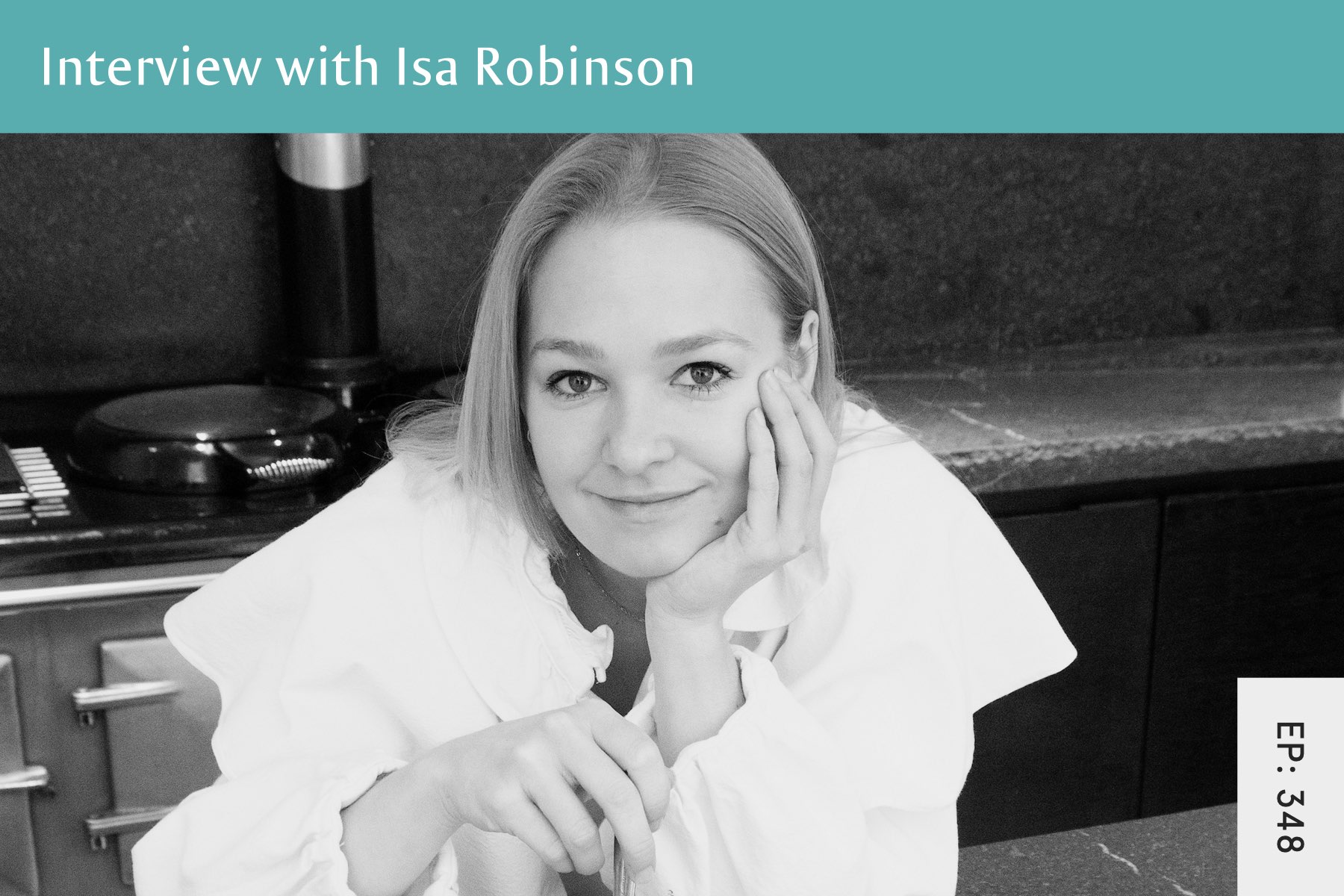
Episode 348: This week on the podcast I chat with registered nutritionist, Nutritional Therapist and certified Intuitive Eating counsellor Isa Robinson. We chat about her eating disorder history, clean eating, redefining healthy eating, body image, rebuilding body trust and the talks she's doing in schools.
Isa Robinson is registered nutritionist (RNutr), Nutritional Therapist (mBANT) and certified Intuitive Eating counsellor with a special interest in eating disorders, disordered eating and nutrition for mental health. Isa firmly believes that the way we think and feel about food is just as important as what’s on our plates and that all foods can fit in a varied and balanced diet.
Isa completed her undergraduate degree at The University of Edinburgh where she based her thesis on the rise of clean eating and how it may be used as a mask for restrictive eating. Following this, she completed her masters in Eating Disorders and Clinical Nutrition at University College London, obtaining a distinction. Isa has gone on to undertake reputable training in body image, intuitive eating and nutritional psychiatry.
Isa is an ambassador for UK’s leading Eating Disorder charity BEAT and also partners with schools. She is passionate about raising awareness amongst young people about nutrition misinformation, especially that spread on social media. Isa has undertaken placements within the NHS and private settings, and across a range of ages. Her approach fuses evidence-based nutrition science with psychological modalities to help individuals feel empowered around food.
00:00:00
00:05:41
00:07:30
00:18:25
00:26:46
00:34:32
00:43:20
00:48:43
00:57:24
01:02:58
01:11:45
01:23:55
01:32:38
01:38:10
01:48:59
00:00:00
Chris Sandel: Hey! If you want access to the transcript, the show notes, and the links talked about as part of this episode, you can head to www.seven-health.com/348.
Hey, everyone. Welcome back to another episode of Real Health Radio. I’m your host, Chris Sandel. I’m a nutritionist and a coach and an eating disorder expert, and I help people to fully recover.
Before we get on with today’s show, I just have an announcement that I’m currently taking on new clients. If you are living with an eating disorder – and it doesn’t matter how long this has been going on, whether it’s been something that’s been something that’s been the last year or it’s been going on for multiple decades – and you’d like to reach a place of full recovery, then I would love to help. I know the idea of full recovery can feel like this pipe dream or can feel like it’s for someone else, but I truly believe that everyone can fully recover from an eating disorder. It’s about doing the things that get you there, and if you do those things, then you will reach that place of full recovery.
So if this is something that you would like to work on and would like help with, I would love to support that. You can send an email to info@seven-health.com and just put ‘coaching’ in the subject line, and then I can get over the details to you.
Alright, so on with today’s episode. Today it is a guest episode, and my guest today is Isa Robinson. Isa is a registered nutritionist and nutritional therapist and certified intuitive eating counsellor with a special interest in eating disorders, disordered eating, and nutrition for mental health. Isa completed her undergraduate degree at the University of Edenborough, where she based her thesis on the rise of clean eating and how it may be used as a mask for restrictive eating. Following this, she completed her master’s in eating disorders and clinical nutrition at the University College London, obtaining a distinction.
Isa has gone on to undertake reputable training in body image, intuitive eating, and nutritional psychiatry. She is also an ambassador of UK’s leading eating disorder charity, BEAT, and also partners with schools. She is passionate about raising awareness amongst young people about nutrition and nutrition misinformation, especially that spread on social media. Isa firmly believes that the way we think and feel about food is just as important as what’s on our plates and that all food can fit in a varied and balanced diet. Her approach fuses evidence-based nutrition science with psychological modalities to help individuals feel empowered around food.
This conversation, to start off with, we cover Isa’s background, both academically and training-wise, but also her history with an eating disorder and what her recovery looked like and the different phases with that recovery. She has quite an interesting story about this and what she realised a number of years after she thought she was recovered.
We then spend the rest of our time talking about a handful of topics. One, we talk about clean eating. As I mentioned in her bio, her thesis was on this, so we talk about this and what she discovered. We talk about how this has morphed over the last 10-15 years since the initial rise of the idea around clean eating. And we talk about other ways of thinking about food and health if we’re putting clean eating to the side. We then look at body image and rebuilding body trust. A lot of this is looking at different tools and ideas about what this process can look like in recovery.
And then finally, we talk about the talks that Isa is doing in schools and how she got into this, the different ages that she’s talking to, what she covers as part of these, and also some of the biggest fears and concerns that people who are at school – and we’re talking about kids who are in high school but also who are in the younger years now – what are their fears and concerns connected to food and health and body image.
This is a varied conversation. I loved what we got to cover as part of this one. So without further ado, here is my conversation with Isa Robinson.
Hey, Isa. Welcome to Real Health Radio. I’m excited to chat with you today.
Isa Robinson: Chris, I am so excited to be here. As I was just mentioning, I’ve been a keen listener of your podcast since probably about 2017. So yeah, just stoked to be here and excited for what this conversation may bring.
Chris Sandel: Thank you for saying that. I’m glad that you’ve persevered through all of these years. I think there’s a number of topics I want to talk to you about today. I want to talk about clean eating, because I know this is something you have a lot of experience around and have done research in. I want to talk about building trust and body image, because I think that’s a really big part of the work that we do together. And I also know you’re doing talks in schools, which I’m really fascinated about, and how you’re approaching this and what you’ve learned and what you’re sharing. Those are the main areas we’re going to hit today and then we’ll see where else the conversation goes.
00:05:41
But for listeners who don’t know who you are, do you want to just give a bit of background on yourself? Who you are, what training you’ve done, that kind of thing?
Isa Robinson: Yeah, absolutely. My name is Isa. I’m a registered nutritionist and nutritional therapist, and I run the private practice Isa Robinson Nutrition as well as working for a private clinic.
Really, I specialise in eating disorders and disordered eating, but what I really like to say there is what I feel I love about this work – I was going to use the word ‘passionate about’ but I thought I’d try something different – is really supporting individuals to foster a healthy relationship with food. What I think about there is not just the what we eat that’s often tied up with ‘healthy eating’, but how we’re thinking and feeling about food. I believe how we’re thinking and feeling about food is just as important as what’s on our plate.
As well as that, I have had a stab at doing my own podcast, the 50 Shades of Food & Nutrition podcast, but we just did one season. So Chris, maybe you’ll inspire me to start another one.
And I love, absolutely, working alongside schools. I go into schools and talk. Initially that was with students, but it’s expanded to parents and sometimes teachers, on creating what I like to call this whole school culture in terms of eating disorder prevention but also fostering that healthy relationship with food. I think it needs to come from all those angles so the messages are consistent and clear, particularly for young people, when diet culture around the sides is shouting loudly.
So that’s a little bit about me.
00:07:30
Chris Sandel: Awesome. Tell the audience, or I would like to know, more about you in terms of what drew you into this work. Especially with working with eating disorders and intuitive eating and all of this, did you know that was what you wanted to do when you first said “I want to study this”?
Isa Robinson: Long story short, I studied geography for my first degree at Edenborough, and I studied that because I was good at that at school, good at my colouring-in, and I went to Edenborough. Before going to university I had struggled with my relationship with food. I had been diagnosed with an eating disorder when I was around 15-16. I was pretty lucky, I suppose; I had early intervention – didn’t know what that was at the time. I probably had FBT. Didn’t know what that was at the time. I didn’t have much formal treatment, but I did have my family and some medical professionals on board and was able to make a pretty good recovery from that, certainly in terms of my physical health.
But I think some of the mental chatter carried on a little bit, and it was really when I got to Edenborough that I was motivated to really enjoy my social life. University can be amazing for that in so many ways. But it was also the time, 2012-2013, when wellness was really landing in the UK. I’m thinking the time of like peak juice bars in London, even though the temperatures there are usually pretty cold, wellness cafes popping up, the beginning of some of these things.
I found that, and I appreciate how detrimental this can be to so many people and their relationship with food. For me, it was, I suppose, a curiosity. It became a bit of a hobby. I set up a wellness account called Goodness Guru, and really I was just cooking and experimenting, but I was also actually living this quite ‘normal’ English uni life – drinking, partying, out late. And then I was having fun making these porridge bowls or whatever it was. Honestly, I felt like a real fake, Chris. I was like, “Oh my God, I’m going out and staying out till 4 in the morning and then I’m decorating an acai bowl and posting it on Instagram the next day.” It felt a bit weird. It felt full of contradiction.
As my wellness blog took off, I started being invited to some events in London. Quite weird stuff, I have to say, retrospectively – like events where we would spend like two hours decorating an acai bowl. That is quite strange. Or exercise classes or whatever it was. And I was meeting up with other people who had also done similar blogging experiences, and I found that they would maybe tell me all the things they didn’t eat, rules they were following, lifestyles, and I thought, “Hang on a sec, this doesn’t seem that healthy to me. It seems like it’s got a sinister edge.” In truth, it really reminded me of what I’d been through in my earlier teens. It seemed restrictive, it seemed rigid, it seemed extreme.
That basically spurred me to (a) want to study nutrition. Do all of these claims by wellness hold up? Is kale the holy grail? But also to base my dissertation on clean eating and what that means. I interviewed lots of these bloggers, who were amazing and really brave and forthcoming, sometimes sharing their own experiences of eating disorders and their take on the space as well.
So really, I guess that’s how I got into studying nutrition. That’s how I became interested in clean eating. Starting to, I suppose, just be a little bit critical about what I was seeing and think, “Hang on a sec, is this about wellbeing?”
I guess the end of the story is no, I don’t think wellness, wellness culture, clean eating truly hold wellbeing at their core. I think they’re often a mask for a lot of other stuff. But I think they also create a lot more anxiety, fear, rigidity, restriction, and mental chatter than wellbeing could entail if we were thinking about that in a holistic, 360-degree sense.
Chris Sandel: I love that – I know clean eating is not a great thing en masse, but for you, it was this gateway into something that became so much better. It allowed you to create this following, but to then meet other people and then start to think very critically about this and think, “Hang on a second, let me go and see if I can study this stuff and learn what is actually true” and to notice the patterns of “This does feel a lot like my eating disorder before.” So there was something good that came out of that.
Isa Robinson: Yeah. Honestly, it was such a wake-up call where I was like, “Oh my God, this feels familiar.” And I guess always feeling like I didn’t quite fit in that space. I think sometimes – I’m making myself out to be an alcoholic; I wasn’t. I was just a student. But I remember even once turning up to some breakfast and I’d been out with friends to the pub the night before and thinking, “Hang on a sec, I don’t fit in here”, but it felt perhaps not right to not also be having those social experiences. I just felt freed in so many ways, and then it was almost like this thing that was supposed to be wellbeing was sucking me back down into a trench. And that was when I was like, “Oh my God.” It was such a wake-up call, actually.
Chris Sandel: I remember a similar thing when I was first studying. Similar to you, I was out drinking, out partying, and I held up a lot of the lecturers on this real pedestal of like “Oh my God, I wonder what they must do when they’re at home and what they must cook.” And then I became friends with them and we would go out, and it’s like, “Oh, they’re drinking too and they’re eating all the foods.” It was actually really refreshing to notice, “These people are regular people.”
Isa Robinson: They’re human.
Chris Sandel: They weren’t sucked into the whole clean eating thing. They were people who were living their very good lives. There was ups and downs, there were all of these things, but if you came round and sat at our table in that restaurant, no-one’s going to be going, “Oh look, it’s a group of nutritionists.” It would’ve just been like, “Oh, they’re just regular patrons.”
Isa Robinson: Chris, you know what’s interesting? I studied nutritional therapy first, and I did that first because I did basically no science at any level. Also, I regret that because I thought I hated science but turns out I love science. So I studied nutritional therapy first because it gave me a year of biomedicine, and that allowed me to apply to do my master’s at UCL, which I did in eating disorders and clinical nutrition.
But it’s so interesting. In my nutritional therapy – and massive trigger warning to those that may want to study nutritional therapy – that was a hotbed. The difference, I guess, is that nutritional therapy is a bit more holistic, I would say. Generalising, it’s a little bit anti-medicine. “We can all do natural healing” and a lot of Hippocrates, we love ‘food as medicine’.
I felt, again, that was a real hotbed for disordered eating and everyone engaging in very – I suppose, again, rigid eating patterns. Again, no judgment. Often because they’d had difficult personal experiences with health in various ways. But very different to those perhaps coming from a much more hardcore science, research, evidence-based side that were more ‘regular’ humans enjoying all that food and drink have to offer outside of its functionality. And again, that is really important in healthy eating.
Chris Sandel: For sure. My training was at the more nutritional therapy level, and it’s amazing then over the next 5 years, 10 years, how much I then disavowed so much of that and I went on to learn more and more and to understand this in a different way. And I would agree with what you said there in terms of there was a lot of disordered eating going on, there was a lot of fears – but interestingly enough, a lot of the lecturers who I’m referencing, that wasn’t necessarily their take on things. There could be this difference between them and a lot of the students who were there.
It is really interesting – obviously, at the time that I was studying, I didn’t have this knowledge around disordered eating or eating disorders, but now when I look back, it is so obvious how rife that was.
Isa Robinson: Yeah, and week new that. Also, it’s such a contradiction. It’s like, “Eat all this natural stuff and unprocessed, but by the way, take a billion supplements!” And take a billion unregulated supplements. And I’m not saying there’s not a space for whole food and there’s not a space for a supplement. It’s November here in the UK. Vitamin D, yes, good idea. And at the same time, it does seem – and again, I often like to point out how diet culture and wellness culture are just full of contradiction and they seem to want to sell us a billion supplements whilst also making us terrified or guilty or bad for eating some processed food like cereal. I mean, how on earth does that make sense?
Chris Sandel: Yeah, I agree with you on that disconnect there.
00:18:25
In terms of your personal story, going back to you developing that eating disorder, I know eating disorders are biopsychosocial and there can be many different components, but when you reflect on it, what was going on for you? How did you end up in that spot?
Isa Robinson: Chris, I’m actually really glad that you asked me that question, because it’s funny how I came to this. I actually, until 2020 – and this is awful – well, it’s not awful. I’ll admit my ignorance. I purely thought that my eating disorder had always been a desire to be smaller. A desire to be smaller because that was the trend, because I would look better in clothes, whatever that might be. I’ve actually spoken publicly about how I then came to learn more.’
At the time I’d done most of my master’s and I still couldn’t get underneath the iceberg, I call it. If we see the symptoms or the labels or whatever, food restriction, overevaluation of weight and shape, what goes underneath there, I just couldn’t.
I started seeing clients in 2018-19, and I basically burn out really quickly. This work is psychologically demanding. I love it, and also I think it takes time, as with any job, to adjust to the ways in which you’re navigating your everyday with doing this work and being with incredibly brave individuals in hard stuff.
It was when Covid happened, I was feeling really burnt out, and I guess the way that I was feeling that is I was permanently exhausted. I just felt so fatigued all of the time, and it really scared me, actually. I’ve never felt like that before. I felt like I couldn’t get out of the fatigue. It wasn’t that I was sad or anything like that; I just basically was struggling to stay awake.
I decided that this would be a really good time in my life to get some therapy. I’d actually never had therapy before. I worked with an amazing therapist. It was never about my eating disorder. It was about my burnout or whatever and stuff that was manifesting in my life as a – however old I was, 26-year-old – which actually helped me to get under what it had been about. And truly I think it was about not feeling good enough.
I’m sure there were many other – I have definite psychological traits. I like to be organised, I’m efficient, I like structure, routine. There were definitely other things. I was in quite a high-pressure school, I put a lot of pressure on myself. Obviously we live in diet culture, so that’s there. But I think really the main catalyst was I didn’t feel good enough in myself. I didn’t feel enough as a person. I think that’s what led me to think, “If I’m smaller I’ll be better.”
So I think that was such a key part. Doing that therapy as a 26-year-old helped me to make sense of an experience that happened to me 10 years prior and has made me such an advocate for therapy. I mean, I’ve always been an advocate for therapy, but I feel like often therapy is good before we think we need therapy, if that makes sense.
Chris Sandel: For sure. Let’s not wait until the house is burning down before we try and do something here.
With that piece of information that you discovered it was about not feeling enough, good enough, whatever it may be, had you then worked through that in those intervening years? Or it was more, “That was still there; I just wasn’t medicating it through the eating disorder, but this is what I worked on from 2020 onwards”?
Isa Robinson: Totally. And I think that feeling had manifested and come up in other areas of my life. Perhaps in some social situations or scenarios and perhaps in ways that I might still be people-pleasing, not feeling enough. It was coming up, perhaps not in problematic ways beyond just the way that I was feeling; perhaps related to my work.
So I think it did, and I think actually being able to make sense of that and then being able to use affirmations and some mind-body practices and just to hold that nugget – I knew that perhaps in certain situations when I started to feel a bit awkward or I had awareness of where my hands were, I’d just remind, “I am enough. It’s okay”, find my breath. I think it really did – again, it was like another light bulb moment where everything fell into place.
Eating disorders are very complex. I’m not saying that was the sole reason. But I think that was one that I perhaps hadn’t been able to label, put my finger on, understand. And it helped me make sense of so much else that came after that.
Chris Sandel: Nice. I’m glad you were able to have that insight with the therapist. When I think about eating disorder recovery, there is the initial phase where it is a lot more of “Let’s look at the food piece and the exercise piece and the body image piece” and that type of stuff, but then it does go off into all these other areas of life. And we can start on that stuff earlier, but I think that’s what then becomes the things that really cement the full recovery piece, because you start to understand, “Oh, this is how I tend to be in relationships” or “This is what I tend to do around anxiety” or “This is my stuff around money” or “This is my stuff around” whatever it may be.
For you, there was this feeling of not enough, and maybe I’m not doing that by trying to be thin anymore, but that’s where my workaholism then comes in, or that’s where I feel so overwhelmed by the clients because this is about my self-worth, whether they get better or they don’t. I’ve seen this with lots of clients, where they recovered from their eating disorder, and then 20 years later, something happens and it’s all back. And it’s because there’s been this thing that’s gone on in the background that we haven’t really dealt with.
Isa Robinson: Yeah. It’s so interesting. I think certainly for adolescents going through an NHS treatment, the focus is nutritional rehabilitation, it’s weight restoration. It has to be. It absolutely has to be. And at the same time, I think because resources are scarce and this work is kind of deep and it requires a certain level of being able to be insightful about one’s thoughts, feelings, and emotions – and I’m not sure at 15 I would’ve been. I’m not speaking for everybody that age because that wouldn’t be fair, but I think that piece can get left out.
So yeah, I didn’t realise when I sought out therapy that I would be going back over. I was like, “I’m cured for that.” My relationship with food was hunky-dory. But it was amazing to be able to make sense of why I had, I suppose, fallen off a straight and narrow path. And not just that, but it did help me to make sense of it more.
00:26:46
Chris Sandel: Nice. I know you mentioned a few things in terms of mantras or doing some breathing. Are there other specific ideas that you can say “Actually, this really helped in terms of that ‘not enoughness’ feeling”? Because I know this is so common, and look, different things work for different people, but if there’s anything that stands out as practices, please share.
Isa Robinson: There’s lots that I have subsequently found on my own, but there was one thing that my therapist did with me. She basically did a guided body scan that she tailored specifically to me. Like many of our clients, I’m sure, when somebody says “Have you tried meditation?” or “Just take a few deep breaths” or “Ground your feet on the ground”, I am the person that wants to roll my eyes and be like, “Oh my God, if somebody else tells me to take a deep breath when I’m having a meltdown, I will…” I don’t know, get so angry.
So I was a bit like – anyway, we did this, and she wrote it and she built up my acceptance or willingness to do it, and it was so amazing. She did this guided meditation, and I can’t remember all of it, but there was this one bit where she said, “I am enough, and I don’t need to let X, Y and Z impact me.” And it really came back to that, and I held her voice, I trusted her, I liked and respected her, and I just held that.
She sent me the recording and I had that to listen back to – and truthfully, I don’t think I ever did; I just held some of those soundbites in her voice, so when I was in certain situations or perhaps my thoughts were overflowing or going through one of those moments, I put my feet on the ground – there was a bit of that at the beginning – feel the weight of the chair underneath me, the back of the chair, and just remind myself, “I am enough.” I found that to be really, really powerful in terms of that.
In terms of other things we did, I think it was mainly just talking through it. I can be really honest that I like a lot of theories and being in that perhaps more than the practices. For example, having a solid understanding of something like the nervous system, polyvagal theory, is really useful for me. For listeners, shall I briefly –
Chris Sandel: Sure. I’ve covered polyvagal theory at various points, but for anyone who hasn’t listened to it, you can give a quick little bit.
Isa Robinson: It’s knowing that our nervous system cycles through different phases, and effectively, when our nervous system perceives a threat – that can be anything; it could be like, oh my gosh, there’s a really loud noise in the street and you hear a scream – “Oh my God, threat” – but it could be an email popping into your inbox. It could be anything. And when that happens, our nervous system can go into that fight or flight, so we feel panicky, we feel our heart beat in our chest, all that kind of thing.
For me, just understanding that – and then the freeze. When we think that we can’t fight or flight, run or fight our way out of that threat, we just freeze and shut down. So I think when I say I was really fatigued, I was in freeze or shutdown. I just couldn’t keep going. I was so exhausted. Or we might go into people-please, just saying “Yes, yes, yes” because we’re panicking in the moment.
Just having an understanding of that and how that could be applied to my everyday, how I was cycling through these states – obviously there’s also a safety space where we feel grounded and connected – that again really helped me, just to be like, “Oh, I’m just really activated right now” or “I’m in freeze, that’s why I’m really exhausted. Let’s just have some acceptance of that. I’m going to be here for a little while. What can I do to maybe help myself out? I’m not broken. Nothing really, really terrible is going to happen. This is just where I am right now.”
Again, that awareness helped me to have some solace from different things. Again, I’ve really loved having the opportunity to go deeper into things like polyvagal theory or body scans or other different practices, get further training on those to be able to use them with the amazing individuals I have the joy of working alongside, more specific to food and body image in the work that we do.
Chris Sandel: Nice. I use polyvagal theory a lot with clients because I think it is so useful to be able to notice the state that one’s in and to recognise that, depending on the state that I’m in, certain thoughts, feelings, beliefs, memories, all of this stuff will naturally arise within you. So to be able to start to notice, “Oh, these things are going on and it tells me that I’m in this state. This isn’t permanent, this is transitory; what could help me now in this moment to either be with this or to move through this?” So yeah, that’s definitely a lot of the stuff that I focus on.
Also, the part about you mentioning there was this guided meditation that you received – I’ve got, as part of when I work with clients, there’s one-on-one stuff, there’s group stuff, there’s a programme that I’ve created, and as part of the programme I’ve got some different meditations in there that I suggest that people use regularly. And it’s really interesting that if I don’t do them in session with people, they don’t often use it very much.
But if I say, “Look, I know this is in the programme, but we’re going to just spend this next 10-15 minutes going through expansion or dropping anchor” or whatever it is, they then tend to relate to it a lot more and it means that they then do listen to the recording. But they hear it with different ears because they’ve had that one-on-one experience and we’ve been able to have a conversation about what they noticed. So it brought a smile to my face when you were talking about that because I’ve seen the same.
Isa Robinson: Chris, I do the same now. If we’re ever thinking about any distress tolerance skills, body scans, we’ll always do them in session. Even something like just taking a breath, practising it in session I think definitely allows someone to have the lived experience of it being useful rather than just like another list of tools. I think that lived experience of trying something out then changes our relationship with it and helps it to seem more worthwhile to us.
Chris Sandel: Yes, for sure. And for anyone listening, I mentioned about polyvagal theory; I’ve done a long podcast with Deb Dana and also Justin Sunseri on this topic. I will put the links to both of those in the show notes. They’re both really good episodes. Very much diving into this in more detail.
Isa Robinson: I think I’ve listened to your one with Deb Dana, actually. Love her work.
Chris Sandel: Yeah, she’s fantastic.
00:34:32
So let’s come back to the clean eating piece, because I think this would be great to explore in a bit more detail. I know you did your master’s research on this, so tell me more about – and maybe I’m asking you to really dredge up the memory because it’s going back a while, but what did you focus on as part of that? What did you discover as part of that?
Isa Robinson: It was actually my undergrad dissertation. Somehow, I connected it to geography. When we think of geography, it’s space / place, and we’re thinking the space / place of the body but also the space / place of social media.
What I concluded was that clean eating was a mask for disordered eating and restrictive eating practices. I think probably what we can add to that is how maybe clean eating / wellness culture was the next wave of diet culture, and how diet culture has changed and clean eating has been a form of that, but I suppose in a more legitimised form.
But also, I looked a lot at the objectification of the female body as part of clean eating. I called it the clean eating movement, but I’m using ‘clean eating movement’ and ‘wellness culture’ synonymously there. This was 2015-16 I was doing this, so I’m talking about a decade ago. So things have changed.
But yeah, looking at how health wasn’t about this lived experience of health and authentic wellbeing in terms of our physical health, but also mind, body, soul. It was really being equated to female beauty standards and wellness being a look, it being a trend, it being an extension of capitalism, trying to sell us something that we want a piece of.
Those were my main arguments there, and it was really fun in that research using Instagram. I remember sitting in the library and I’d be scrolling through Instagram, screenshotting things. It was lots of conventionally attractive women who were the face of wellness. And it was predominantly, at that time, a female-orientated space as well.
Chris Sandel: Touching on what you just said there, it felt very – and it still does – it was putting on a performance. It was very much this Instagrammable life, and “This is what my lunch looks like and this is us on holiday on our yacht.” It was all of that and ticking the boxes of certain foods and certain things that I’m doing, but I would always look at it and be like, I wonder how they’re really doing. I wonder, behind closed doors, what’s really going on? How do they actually feel physically? How do they feel mentally, emotionally? What’s really going on?
There was this hollowness to it. It was like 2D. You could push it over. There wasn’t any real substance to it.
Isa Robinson: Totally. Also, there’s this sense of it being not just a performance in terms of body, weight, shape, looks, but also a social currency. Like there’s this kind of virtuous element to something, “I am a good, virtuous person.” I think also back in – I was doing this 2015-16, but looking from how the movement was 2010 to that time, I think it was a lot more inaccessible then. It was very elitist at that time. It was very expensive spaces and juice bars.
I think there has been a little bit of a trickle down where you can now buy lots of these things in the supermarkets. If you want chia seeds, you can get it in the supermarket. I’m picking random foods, and there’s no such thing as good and bad foods. That is not a bad food. But that was something that pre-2012 was very much isolated to health food shops and wasn’t necessarily that popular. Nut milks, all these kinds of things. And now you can buy chia seeds in Tesco’s. But before then, it was also very much part of exhibiting social currency, social status in many ways. I think that’s also quite important in the general argument.
And again, when we think about health in this 360-degree sense, we’re promoting a beauty standard that’s inaccessible; we’re also promoting a way of life that is often completely unattainable to the large majority of people because, frankly, they don’t have the time to be in Pilates in the morning and then do a 10-hour walk and then sit in the sauna and la, la, la, nor do they have the financial resources to have this supplement and this sachet and this lunch, yada yada yada.
And then just also, from just an actualist argument or counter catalyst argument, we’re being influenced to diet culture, we’re being influenced to spend our time, our money, our resources, and our headspace on living this life, buying these products – and for what? Is it because it’s to look a certain way? Is it because we want to feel enough? It comes back to my enoughness. We want to feel that we’re enough, we want to feel like we’re worthy, that we’re this successful person.
Really interestingly, having worked with clients who’ve been in their teens more recently, other trends that I don’t have my finger on the pulse of so much – things like the ‘that girl’ trend. Do you know about the ‘that girl’ trend?
Chris Sandel: I do not know about ‘that girl’ trend. Maybe I’m outing myself for not being up-to-date with stuff.
Isa Robinson: I have to give my clients credit for educating me on some of this stuff. The ‘that girl’ trend is kind of “She’s that girl. That girl wakes up at 5 a.m. She drinks her matcha with all her supplements in, then she heads to the gym, then she has her very healthy breakfast and her smoothie, and then she…” la, la, la. Then there’s also ‘that healthy girl’. “That healthy girl is the girl that lives in her ALO activewear.”
It’s so interesting how, yes, it is about these particular behaviours or habits, but underneath, I really think what we all want a piece of and why diet culture and wellness culture can shout so loudly is because that lifestyle, those habits and behaviours plus the body that is often tied up with them – even though it’s a stereotype – are the epitome of somebody who’s respected, valued, attractive, successful, has her or his shit together. It’s those kind of traits. As human beings, I think we are hard-wired to want to feel seen, heard, believed, accepted, respected. And that’s why I think they pull so much on the heartstrings.
Then when we go back to eating disorders, what makes recovering from an eating disorder so hard in this landscape and narrative is this going against those behaviours might make us feel like we could jeopardize or risk being those things. Being seen, heard, believed, respected, okay enough. And that’s really hard when we get underneath it.
00:43:20
Chris Sandel: Yeah. I think this is the seductive part of all this, because underneath, what someone wants, there’s a lot of, yeah, this is what we all want. We all want to be accepted. We all want to have good health. We want to have energy. We want to be able to meet a partner or have good relationships or friends or have a good job. These are the things that we all want.
It’s the belief that “If I do this, then that’s going to come true” or “If I do this, I’m going to feel very differently about myself” and it’s this illusion. It feels like this thing should deliver, but then it doesn’t. But the vast majority of people never get to make that realisation. It’s always just out of reach, so it doesn’t feel like I’ve been able to have that experience of like “Oh, this is just a mirage.” It always feels like it’s the thing; I just can’t quite manage to get there.
Isa Robinson: Yeah, and maybe just to add to that – and I don’t know what you think about this – I think sometimes initially, there is a positive reinforcement because we’re so hard-wired into “This is the right thing”, so we start making some changes. I think it can be really confusing between “Oh, that felt really physically good in an embodied sense.”
Maybe an example might be someone takes up Pilates, because that’s a thing – again, Pilates is not good or bad, but just using it as an example. It’s like, wait, do you feel really good after Pilates because in your body, mind, and soul that felt good? That’s really hard to be objective about. Or it felt good because you’ve been so hard-wired that this is a good thing, there’s just that immediate like “Tick, I did something good, I am therefore good because that’s what society has told me.” And how do we untangle that? All of these different things, like “I feel good because my vitamin D really makes me feel good or I feel good because I’ve done something right, that I should do, that makes me a good person?” That is so sticky to untangle.
Chris Sandel: Yeah. And the thing is, it’s not either/or. It’s most likely both. I talk about this with eating disorders. People have a honeymoon phase with the eating disorder, and that honeymoon phase could go on for a matter of months; it could go on for a couple of years, where it feels like, “Man, I’ve cracked the code. This just works so well. I’m able to hit PBs in the gym or I’m able to feel so good eating this kind of food”, and it works until it doesn’t and then you start getting the symptoms and then these things start to pile on and it doesn’t work so well.
But there’s then this disconnect of like “Hang on, it can’t possibly be this thing, because I had such a good run of it. Explain to me the last six months or the last two years. How could it possibly be that? Because I felt so good.”
Often, for a lot of people, unfortunately, there’s a time – and that time could be six months, that time could be a couple of decades – of trying to then chase that. Like, “How do I get back to that place?” before there’s the realisation of “That was temporary. Whatever good it was doing for me or appeared to be doing for me, that’s not coming back, and actually I’m just digging myself into a bigger hole when doing this and I’m now missing out on opportunities to learn how to cope with difficult life experiences without the eating disorder, or how to actually make the quality of my life bigger and better than it is now as opposed to just more and more reduced, like the eating disorder.” It often takes people a while before there is that realisation.
Isa Robinson: Yeah, it’s so true. The two things that were coming up for me there so much was just how in that honeymoon period, so often our culture may reinforce that by praise on body changes, by praise on “Oh, it’s amazing that you’re now exercising or eating this way.”
Chris Sandel: “I wish I had your willpower.”
Isa Robinson: Yeah, and “I don’t know how you do it.” But also, you touched on how eating disorders are coping strategies. I always think it’s so important to meet the illness with so much compassion of often a younger version of ourselves or a former version of ourselves who maybe didn’t even realise what was happening, case in point myself, that just needed a life raft in a moment. And they work in a moment, but then the coping strategy is no longer useful and no longer serves us. Making sense of that bit when we need to or want to remove it from our life.
00:48:43
Chris Sandel: Yeah. If we were thinking about, going back to the clean eating piece, I know people talk about clean eating or healthy eating or whatever, and underneath that there are good intentions around it. So I wonder, putting your nutritionist hat on, if you were building this from the ground up, what would it actually include? What would you want people to know about this stuff?
Isa Robinson: About clean eating or about what might healthy eating look like if it wasn’t that?
Chris Sandel: Yeah, what would healthy eating look like? If it’s truly about healthy eating.
Isa Robinson: Right, if it’s truly about healthy eating. I love that, because as you said, I think clean eating has some good intentions there in terms of some principles of what I would call – or what I have borrowed from the intuitive eating literature – ‘gentle nutrition’. There is some good stuff in there. But actually then it becomes reductionist when we just focus on the ‘what’ of the food without considering the other aspects of how we think and feel about food.
I guess if I was thinking, if not clean eating, what would I want people to equate with ‘healthy’ eating – I guess two things. First of all, the first part is I really like to think about health using the World Health Organisation’s definition of health, so health not just being our physical health but our physical, mental, emotional, social, psychological, financial, environmental wellbeing. If we think about all of those different facets of health, I like to think about how different foods, lifestyle experiences, meet different aspects of our health.
So when we think about our physical health, I am thinking of what we might typically think in terms of nutritional guidelines or gentle nutrition, having a balance of say those carbohydrates, proteins, and fats, making sure we’ve got our foods that have our vitamins and minerals and getting our five-a-day fruits and vegetables. I’m speaking obviously so boringly there, because I know that those are things most people know. The secret, I think, when it comes to healthy eating is probably the basic and boring, unsexy stuff that diet culture can’t package up and sell to us at a premium, but there we go.
Also in there, I’d be really thinking about eating regularly. So many people talk about protein to balance your blood sugars. What about just eating every two to four hours to balance your blood sugars? Eating enough. Adequacy is so left out of the picture. If we do not eat adequate amounts of food, we’re going to feel hangry. We’re going to dip into low energy availability. We’re going to feel cranky. We’re going to feel low. We’re going to feel frenetic. So that for our physical health. Staying hydrated, all that kind of stuff.
But then what about the other aspects? I think here is where we can have so much fun. Chris, at the beginning of this we were talking about going to the pub. What foods feed our social health? To me, foods that feed my social health are – you know when you go out and you have big sharing platters of things and you’re sharing drinks or you’re doing a supper where everyone’s bringing something, or it’s afternoon tea and everyone’s baked a cake or a coffee morning – those foods feed my social health. No, they are not going to be as nutritionally dense, necessarily, as the salmon that I ate, but they feed an important part of my health.
When we think about mental health, again, there might be foods that we think of, the ones that we think about like brain foods, like omega-3-rich fish or dark leafy greens or whole grains, but then also, again, eating regularly, because if we’re not eating regularly then we start to feel moody, we start to feel low, we start to feel irritable.
But also, mental health, I don’t think it is healthy, supportive for our wellbeing, to be overthinking every mouthful of food we ate, to be feeling anxious, to be feeling stressed, to be feeling guilty, to be ruminating over our food. So also as part of that mental health it’s going to be, all foods fit. We can have a bit of everything and that’s going to be okay. We can then move on for the situation.
So that’s one of the ways that I like to really zoom out from this and think about and conceptualise healthy eating and a healthier approach to food.
And then I guess the other framework that I would always advocate for if we were going to reinvent the wheel on healthy eating is intuitive eating as we understand it in the literature. Intuitive eating, coined by Evelyn Tribole and Elyse Resch dates right back to 1994, ’95, ’96, when I was born, and as part of that there is gentle nutrition. There is supporting our blood sugars by, again, eating regularly, eating adequately. Having a balance of the macronutrients. No, it doesn’t say we must have ridiculously high protein and no carbs. It says everything. It doesn’t say every meal has to be perfect, but for the most part.
But that comes towards the end, and I think the reason that the basic, boring nutrition gets confusing is because of diet culture, which keeps us really confused on what, how much, trends. Because diet culture then subsequently disconnects us from our body. We are making food decisions purely driven from our minds rather than our minds and our bodies for the purpose of self-care.
We want to look at how we eat, so perhaps taking that time to eat, what kind of state we’re going to come to for our food. If we’re coming at it from that place of threat, then we’re probably not going to have such a good experience with that meal in terms of how it tastes or how it feels in the body because we’re just not grounded enough to take in food.
So I think that framework – pleasure. Oh my God, my favourite principle of intuitive eating is thinking about vitamin ‘P’ for pleasure, enjoying our food, that being a positive experience. And not just in the moment because of the taste, but also the enjoyment in not having to overthink it afterwards and create this plan of how we’re going to put it ‘right’.
I think that’s how I would want to think about healthy eating. Yeah, gentle nutrition is important, and truthfully, I imagine every single one of your listeners knows. They know. They know the basic boring. And actually, that’s a really good base. I’d personally get rid of ‘don’t have too much of this’. I just don’t think we need that kind of negative language, so it would just be everything framed positively, because again, those foods feed our social health, our mental health, our psychological health. They feed the soul.
But I would be wanting to blend those two things, and just to think about food really positively. Food, to have access to food, to have the experience to taste, to have the experience to take in food, to have the experience of a full belly is a positive experience. And maybe I’m being toxically positive, but I would like it in those terms.
Chris Sandel: Yeah. I’m on board with everything you said there. I love how detailed you were there and how you were able to touch on so many different aspects. I think that is what this is about. It’s not just there’s this one thing; it is that there are so many different component parts with it.
00:57:24
The things I would add based on what you said – one is that context matters. What is healthy will depend on the context that someone is living in, and even the things that you’re like, “Oh, these are this standard bits of advice” – hey, they might actually not be the standard bits of advice depending on that situation. If you’re in eating disorder recovery, hey, the five-a-day fruits and vegetables might not be great for you. The leafy greens might not be great for you from a digestive standpoint.
We need to think about the context that someone is doing that. And also, your love letter to food also might not be someone’s experience in that moment because “I’m now having to eat something that does set off this threat response, and I actually still need to go through with this. I need to have the experience of that threat is there and I’m still going to eat anyway.” So in this moment, my experience doesn’t match up with what you describe, but we’re working our way to get to that place.
I just want to highlight that for anyone who’s in recovery who’s listening and who’s like, “That sounds lovely, but that doesn’t match up in any way with my experience.”
Also, as you were talking about the foods for the soul or going out and eating – I was in Lisbon, Portugal a couple weeks ago. I was out there with some friends and we went to a restaurant. We’ve been out there before, so we have this place – we have a few places we like going, but there’s one that we’ve colloquially called ‘the meat palace’ because you get these huge trays of meat that we all got to eat together. We had nice wine with it. You finish up and they bring out a tray of desserts. There’s like 20 desserts on the tray and you just say, “We’ll have that one, we’ll have that one, we’ll have that one.”
It was such a nice experience. We went there, we sat there for a couple of hours, just eating and chatting and laughing and having deep conversations, and whatever the nutritional content of those foods, there was so much more to that meal than just this.
Isa Robinson: Oh, Chris, I’m so glad that you added all those points. I love how you touched on that context matters. Maybe if this was like the utopian version of healthy eating, just all the steps that we might move through to get there, and just acknowledging everyone’s individual experience is so important. And then yeah, I’d like to get on a flight to Lisbon, please. [laughs]
Chris Sandel: Yes, I highly recommend it. For anyone who likes food, it is a very good place to go. Of the places in Europe, it’s still relatively cheap, all things considered. Yeah, it’s got some very good eats.
Isa Robinson: I love just thinking about food as adventure, as travel, as culture, as social, as pleasure, and just getting out of that food as purely functional. It’s inherently social and emotional, and I think it’s great to embrace that, wherever we are in our social or emotional or psychological journey with it – as you touched on, it can be fraught, but again just acknowledging that’s okay, because food is part of that. And obviously there’s a journey to get that back to where we might want it to be, but if we purely are putting food in this functional box, we’re just missing out on so much.
Chris Sandel: Yeah. And it’s interesting; when I think of the clients I work with or the people who are applying to work and the kinds of things they’re saying, they recognise that. There’s a recognition of “Hey, I’m not able to eat out with my friends the way that I would like to, or with my partner the way I would like to, or there’s a work conference and being able to have the lunches with everyone is a real challenge.” So there’s this recognition that it is more than just the sum of the parts. It is not just about this.
I had a call with a client today and she was talking about the fact that she went away with her husband and it was the first time that they were able to go out and have lunch together. When she thinks about previous trips, that wasn’t doable. It was like, “We had to go round to multiple supermarkets to try and find the thing that I’m able to eat, versus we were able to go to this café. And yeah, there was some food noise, there was a little bit of anticipation anxiety about it, but we were actually able to do that, and I enjoyed it. I could notice a difference, he could notice a difference.” This is the quality of life stuff that you get back as you’re doing recovery.
Isa Robinson: 100%. And quality of life can only be beneficial for our health. I often like to use ‘wellbeing’ instead of health because ‘health’ is loaded. But again, enjoying that experience, or even though there’s some anticipation, working towards embracing that experience and that freedom can only be enhancing for our wellbeing vis a vis spending precious time away from loved ones, trekking around trying to find the most ‘nutrient dense’ safe food.
01:02:58
Chris Sandel: Yeah. I want to shift to talking about body image and building trust within one’s body. Let’s start with the building trust piece. If you were to talk about this and helping people build trust, what does that actually mean to you?
Isa Robinson: I really like this sense of body trust, and I guess the way that I conceptualise it is through the embodiment work and theory. I love Catherine Cook-Cottone’s work on this. I think she is just amazing.
Chris Sandel: She’s a name that I’m not familiar with, that I haven’t talked about on this podcast. Could you give a brief synopsis on her take or framework or way of thinking?
Isa Robinson: Catherine Cook-Cottone is an academic scholar, but she’s done a lot of trauma work and eating disorder recovery work from a somatic embodiment lens. She uses the embodiment model, which she created, and it looks like an infinity. It’s really about how we can blend the internal with the external. What we mean by that is internal being thoughts, feelings, sensations that come from and within the body, with the external, so the sociocultural factors, messages we get from family and friends. And when they align so we can hold the internal and external but live truly and authentically to ourselves, then we are living in an embodied sense.
I really like also to make that a bit more understandable or relatable, just thinking about embodiment as being living from and within the body, how we can use the space of the body. Often we objectify the body, so we see the body from the outside in, we think about perhaps looking at a photograph of others, of ourselves. We look at the body. We look at the edges, what makes up the edges, what makes up the face. The opposite of that is living from and within the body.
I often think about, if I was going to get in my body, what would it feel like to put it on? Like reach into my arms and stretch my legs in. What’s it like living in?
Another thing I like to think about is I use the car metaphor. It’s not mine; I think it’s from the intuitive eating literature. But if we look at a car 10 metres away, what do we see? The outside of the car, the colour, has it been cleaned that day, has it not, has it got bird poo on it, whatever it is. But actually, what’s it like to walk up to that car and get in it and shut the door? Then what do you see? Where do you want to drive that car? Where do you want to go? Often people say the beach. Who do you want in that car with you?
So it’s about seeing our body as this vehicle and this vessel to do great things in and to appreciate, but to have trust in. Trust, to listen to the body’s wisdom and to trust it rather than basically seeing static ornaments as outer shells.
I suppose the real trust bit comes in there when we think about how we can bring together these thoughts, feelings, sensations, how we can keep an ear out for those and tap into those. It might be what we might think about at face value – things like, what does tiredness feel like in the body? What does thirst feel like in the body? What might emotions feel like in the body? What might things like anger or sadness or panic feel like in the body as a sensation? And being able to build trust in those, being able to listen out for those, build that interoceptive awareness, that awareness of what comes from within the body.
I think about how that can really be important in our relationship with food, in our wellbeing, to be able to build that kind of connection between mind and body and that trust between mind and body. I like to think about mind and matter as being important in decision-making processes around food, not just mind over matter.
But then also how this goes way beyond food in terms of being able to trust or listen out for instincts around maybe where we are in our job, where we are in relationships, where we are in so many other spaces we might find ourselves. Being able to trust what rises from within the body, at least have an awareness, and to listen to it first and then build that trust.
The last thing I’ll add, and then I promise I’ll be quiet for a second, is I really like to think about body trust through the lens of how we might trust another individual. Like, what makes us trust somebody? Do we just wake up one day and we just trust them? In terms of building a trusting relationship, that takes things like ongoing communication. It takes kindness. It takes conflict resolution. It takes getting something wrong and then apologising and course-correcting.
I think we can be in this – it’s like an ongoing practice. It’s not like we arrive at body trust and that’s tipped. Same as a relationship. We don’t just arrive in terms of a friendship and then it’s done, we’re friends forever. It takes checking in, “How are you?” “Oh, actually that thing you said really upset me” or “Can we make the effort to do this?” or “I’m going to be really kind and there for you at a time you need me.” I think all of those normal practices that we put into relationship, we can be in an ongoing relationship with our body in terms of building that trust.
Chris Sandel: Yeah. I totally agree with what you said there, and especially that last piece, because I think often it can feel like “Oh, trust has to be demonstrated to me” versus, as you say, it’s like a relationship.
Like, what am I doing to help this relationship to be trusting? If I want to be able to notice – just to use something a little bit more banal – tiredness, what’s my role in being able to do this? Because it’s one thing to say “I want my body to be able to tell me these things so I can trust my body”, but if every time it tells me these things, I ignore it and I push past it and I tell myself I’m just being lazy, then it’s not going to work because we then disconnect those symptoms from “this is how my body communicates that it is tired.”
So really understanding, actually, this is a two-way thing. I’ve got to do the work here to facilitate trust to be able to work here.
Isa Robinson: 100%. All relationships depend on at least two people. And the relationship that we have with the body is no different. I really like this, the mind and matter.
It’s funny; before this, I was like, where did this mind over matter come from? It’s the 19th century. Somebody called Charles Lyell said ‘mind over matter’, and that’s so ingrained in so many spaces, in the sports world. Actually, I really think we need mind and matter. We need both of those parts to have equal weight in decision-making, but both show up int terms of building a trusting relationship.
01:11:45
Chris Sandel: For sure. Let’s imagine you have a client and they are feeling in this space of like “there’s not a lot of body trust, I don’t feel like I’m able to understand the cues that I’m getting from my body” – how do you start with this? What are some of the things that you may start to either work on from practices or work on from a “let’s have a conversation about this”? How do you approach it?
Isa Robinson: I think it would be totally unique to the individual where we start. It may look very much specific to food. For example, something that may come up quite commonly is “I don’t trust myself around that food. If I have that food in the house, I will finish it and feel really out of control.”
So that might be something, as we were talking about with your tiredness example – if your body doesn’t trust that that food is going to be available all the time, if you only get it at certain times, then it’s a bad food and it’s a wrong food, then of course your body doesn’t trust it. How can we help your body to know that that food is going to be there? So that might be a more food-specific piece of work there with thinking about exposure. Obviously that’s going to be completely unique case by case, person by person, in terms of how we might go into that.
Then there’s loads of others, coming outside of food, although it might come back to that, and then also body image, of just like having moments in your day where you just check in with your body and you think, “What is coming from the body right now?” That might be quite a cognitive process. “What is my body maybe trying to tell me?” Or indeed, thinking about what sensations are coming from the body.
I really like thinking about sensations sometimes as opposed to thoughts and feelings because sensations can be a lot more neutral. There’s often less narrative tied to a sensation. For example, if a thought is like “I’m really bad”, there’s often a whole story that’s snowballing from that, whereas if we get under that “I’m really bad”, like, “Where is that inside of the body?” – we might use something like body maps of emotions.
There is actually a standardized Body Map of Emotion, and what they did was they got loads of participants, they played them different stimulus, and they got them to shade in where they felt that in the body. And then they were able to standardize that. Do you know the kind of map I mean? I absolutely love it.
Chris Sandel: I don’t, but it’s really interesting. I’m halfway through a book called How Emotions Are Made. I don’t know if you’ve come across this or not.
Isa Robinson: Not yet, but I’m going to put it down on my list.
Chris Sandel: I’m saying this just because the first fair chunk of the book, she debunks a lot of the stuff that we talk about connected to emotions and how there is this universality connected to emotions, and explains how we arrived at this place and where all the errors are connected to it. It’s an absolutely fascinating book. And it maps on a lot with polyvagal theory. I’m not all the way through, so I don’t know if she talks about the bit that you’re talking about and if she’s like “No, that’s not true”, but yeah, explain how you use it with your clients and how it’s relevant.
Isa Robinson: Again, it’s totally unique on the client. We might ground some of this in some psychoeducation. emotions live in the body. They can manifest as thoughts and feelings cognitively, but they also manifest in terms of felt sense. Again, what I love about getting to that is the being able to be with an emotion, stay with it, ride it out, tolerate it, make space for it as a sensation. It’s very somatic. It’s from the body rather than rationalise it or think our way out of it.
When we can make space for it and be with it, we can build that trust that we can contain it. That is also a form of body trust and not being so reactive to that sensation, whether it’s a buzzing or a beating or a pulsing or it’s a block, and where in the body that might be. I often will show my clients perhaps that those universal maps, just because they are standardized, doesn’t mean – they’re unique to somebody else. Just because many people feel panic there, doesn’t mean that that’s where you might feel panic.
But it does help to conceptualise it, and then sometimes I will give them a little drawing of a person, a very standardized picture, and part of a practice they may want to experiment with in the week might be, as they feel certain charges, as they feel something come up, whether that’s related to an exposure or it’s just as they are going through their day-to-day, I might say just take a pen or take some colours and scribble on where you feel that.
We’re just trying to build trust with the body, and then once we can conceptualise it like that, it’s there, “it’s this block in my lower abdominal region and it’s mostly fixed” – that is a lot easier to be with and think, “What does that need right now? How do we make space for it?” than say this narrative that’s just going on and on and on and on and on and on and on that I guess we’re trying to rationalise, but there is no rational rhyme or reason.
And maybe this sounds completely woo-woo, like, “Oh my God, what is this nutritionist on about?”, but it is just increasingly being able to create spaces for deeper understanding and to be alongside our body, thus building trust with it.
I think it does open so many avenues for healing, and I think one of the big ones for me – and this comes from Catherine Cook-Cottone; I can’t take credit for it – is really the sense of the space of the body being a resource for our healing. I think that many people that have experienced an eating disorder or people that think about eating disorders may think the body is the problem. The body becomes the problem, whether the body was the problem to begin with and the eating disorder fixed it or now the body is the problem because it can’t keep up with the undernutrition or whatever that is, it’s now so compromised it’s giving up on us.
So the body is this pain, struggle, and when we think about this embodiment piece, being in the body, being alongside what’s coming up in the body, having an awareness for it, creating space for it, using somatic practices like breath or awareness or heartbeat or just giving ourselves a hug, which is intensely grounding, or using the senses – using smells or using touch, squeezing ice when we’re feeling certain things – suddenly the space of the body is a resource for healing. It’s a tool that we have to manage and cope and be in the world. As we move back to things, maybe it’s a yoga practice or it’s a meditation practice or it’s horse riding or it’s nature.
Our body allows us to be in the world, but then we have the space of the body to self-regulate. And I just think that is such a cool way to think about it.
Chris Sandel: Yeah. I agree with everything you said there. I do a lot of that type of work with clients, where “let’s move away from the story part connected to this.” We can explore the story part, but there’s also some real benefit in “let’s look at this from a feelings / somatic point of view.”
Because often, if I use something like bloating, when people complain how uncomfortable bloating is and how distressing bloating is, if we talk about the physical part of that, for most people there is the physical uncomfortableness, but actually what is most uncomfortable and most distressing is all of the stuff that gets layered on top of that in terms of “Why is this still happening? How long is this going to go on? What did I eat wrong?” All of this kind of stuff.
And I would say this even for people who are neurodivergent, highly sensitive, where there is much more of a physical component that is connected to it. So much of the distress isn’t the physical sensation per se; it’s the resistance to that physical sensation. It’s the “I’ve got to get rid of this. This has got to stop now. I can’t possibly handle this” as opposed to “Let me just notice this. Let me be a scientist and notice what are all the different characteristics that are here.”
I remember hearing a podcast where someone was talking about their gateway into this was they got really debilitating migraines, and actually, at some point they decided “Let me start to pay attention to the quality of these things. Where is it in my brain or behind my eyes? Where does it start and stop?” And that shift from sheer panic and “make it stop” to curiosity made a massive difference.
And look, I know what I’m saying sounds a lot easier, me saying this on a podcast, than it does in the moment. And being able to start to bring some of those things – and do bring that in for some of the milder discomforts or the milder thing that’s a challenge. “Can I start to bring that way of thinking in, but also that way of experiencing?”
Isa Robinson: Yeah. I think it’s just so powerful. And the stories and the narratives around different sensations, like bloating, vis a vis what it feels like in the physical body – it’s funny that you mention the migraines, because when we’ve done a big deep dive into bloating and ruled out all the potential medical stuff and we’re thinking about it from a gut-brain axis point of view, I’ll often say, “When you get a headache, how do you feel about that headache?” Pel are like, “I have headaches, they’re annoying, but maybe I’ll take a Nurofen, maybe I’ll drink some water. It’s a headache. I can move on with my day.”
But the bloating is like, “I’m a good person / I’m a bad person. I did a good thing / I did a bad thing. I need to control this.” Such a different response to a physical sensation than a headache, when often a headache is actually more painful than the experience of bloating, which is uncomfortable physically, very much psychologically, but just elicits this huge response.
Chris Sandel: Yeah. We’re on the same page with this piece.
01:23:55
And then what about in terms of the body image piece? We’ve talked a lot about the body trust, we’ve talked about different sensations. How does that then come into the body image part? And I guess when you’re thinking about body image, how much of this is the aesthetics versus the aesthetics are just a small part of it and we actually need to be exploring a lot broader things than just this?
Isa Robinson: When I am starting body image work with a client – and I think, again, it’s important here to acknowledge that I’m coming at this – again, my perspective, how I show up in the world is in a straight size body, and I just want to acknowledge that I know that that means I don’t have experiences that others might as I show up to this work.
But when I’m starting this with someone, I will often ask them, “What does having a positive body image mean to you?” And it’s really interesting what comes out of that initial discussion, because what I tend to find is that having a positive body image is not about having a thigh gap or a six-pack or brown hair or blue eyes or whatever it might be.
It’s actually not necessarily thinking about my body so much. It’s feeling more confident in who I am. It’s being able to do the things that I want to do. It’s much more around internal stuff than it is about what the body looks like and how much it weighs, and I really like to be able to get at that from the beginning.
And then the other kinds of questions I might ask are, how would you know if you achieved positive body image? And again, it’s not “I would look down at a scale and it would say…” or “I would fit into X size clothing.” It’s around “I would probably be able to move through my day-to-day and I wouldn’t think about it that much.” So again, coming back to some of those things.
I really like to start with some of those initial discussions, and again, the thing that probably comes out of that often is around more positive body image being able to be in a relationship with our body and to be able to live from and within the body. So thinking about how that doesn’t mean we’re never going to have a bad body image day; it doesn’t mean we’re going to magically be able to eradicate diet culture – although I do think we should keep trying. It’s around effectively being able to acknowledge or have some radical acceptance for the culture that we live in and for those toxic beauty standards and diet culture.
That doesn’t mean we agree with it and we aren’t going to fight to change it; it just means we’re acknowledging what is. And to be able to know that that is going to be really difficult sometimes, or we are going to have difficult days, but how can we stay in relationship with our body? So on those days, how can we look after ourselves? How can we respect the body? That might be just basic, boring respect.
I often say we might hate a teacher at school, we might just really not like them, but we’re still going to go in and respect them. So that might mean just getting our basic needs for food met, ensuring we’re hydrated, we’ve had enough sleep, we’ve got a good work-life balance, we’re going to respect those needs for rest. It might be things like appreciating body functionality, what our bodies can do. It might be things like self-compassion. It might be engaging in some of those mind-body practices.
So really being able to be in that relationship with the body. Open communication, kindness, knowing that in a relationship, even the person that we love the most in the world – I adore my husband, I think he’s a 10 out of 10, but there are days where he really annoys me. There are going to be those days, and I really annoy him, we get on each other’s nerves, but how do we come back from that without suddenly having to starve or suppress my husband or whatever that might look like?
So yeah, just thinking about being in that ongoing relationship with the body, and I think so much of that embodiment piece comes into that. How can I live from and within? So not just my worth being defined by what my body looks like, but what do I want to do with this body? This is this awesome – I love that quote that says, “Your body is not your masterpiece; it’s the paintbrush that you use to create your masterpiece.”
Thinking about mission and purpose and values-driven living, what do I want to do with this body of mine? How do I want to leave my stamp on the world? Or just how do I want to experience it? What do I want to leave this world having done? Because without our bodies, we truly can’t get very far.
Chris Sandel: Yeah. I’m glad that you said all that. Also, it’s great to hear that when you start to do this exploring work with your clients, they’re able to recognise that it’s not about the aesthetics per se. It’s about these different experiences I want to have or how I want to feel in that moment or those kinds of things.
And look, even when someone is saying something aesthetic-related, we can then dig into that, like “What do you think that’s going to lead to? Okay, you’re going to feel more confident, so what you’re actually wanting is confidence. Or you’re going to have a relationship, so what you’re actually wanting is a relationship.” You can make the distinction of, it feels like that’s what’s going to lead you to that place, but there can be lots of different ways to actually feel that emotion or to have that experience.
Because yeah, I think while body image work can be taking photos or doing mirror work, often it’s a lot bigger than just that. It is then looking at relationships and social life or the kind of job one’s doing or, as you said, meaning, and all of these different aspects. What I’ve seen through this work is that when we then do all of that stuff, people tend to think better about themselves aesthetically, just simply from changing those other areas.
But even if that doesn’t happen, there’s just more body respect. There’s more “Hey, this is just a smaller part of what I think life is really about, and actually I want to focus on these other things that are much more important and meaningful to me.” Especially as someone starts to then do recovery and they’re not restricting and they’re not doing this and that, and you start to see that the quality of life is coming back – it starts to make that belief around “I have to look this way or be at this size to have a better quality of life”, it starts to change that.
And we live in a world that there is beauty standards, there is thin privilege. It’s not that it’s not easier to move in this world in that kind of a body. I was having this conversation with a client recently. It’s like, yeah, life is unfair. I totally agree that that is the way that it is in this world. And those things become a lot more salient to you when you start to prioritise those things to make it so, versus “Okay, there is some of that going on; how can I transcend that in some sense? Given that that’s the case, what are the things I can do that still lead me to have a good quality of life and still lead me to have meaningful relationships and all of these other things, even if I can’t change that thing?”
Isa Robinson: I love that theme of transcendence. Love that, love that.
01:32:38
I think the other bit there that you touched on that I think is so powerful, just thinking about the aesthetic piece as well, is how body image registers in like nine areas of the brain, and how there’s so much subjective stuff in terms of our thoughts, feelings, emotions in our brain and then there’s the light on our eyes and in the mirror and what we see back.
Thinking about body perception, there’s that thing where if you got in the tube and you were standing next to somebody who was in objectively a much, much, much smaller body than you, how are you going to feel? And then you get to the next stop and they get off and somebody gets on in a much, much larger body. How are you going to feel? Or the difference between you put your tightest pair of jeans on, how do you feel in your body, then you take them off immediately and you put your largest pair on.
How we’re feeling in our body is shifting and changing all of the time. It’s never really quite objective. I always say every perception has an element of one of those funny fun fair mirrors. You’re never going to get that full piece of reality because what we are perceiving is so tied up with the thoughts, feelings, cultural stuff that’s happening in the brain.
But also, Chris, what you said I think, it’s so interesting to me – and this might be helpful, I hope it is, for anyone in eating disorder recovery – is how the more undernourished and starved our brain is, the worse our body image is. And actually, I could put a penny in a jar that actually, as we start doing some of the renourishment, as the nutrients, nutrition, hits the brain, how much better our body image can become even if that means gaining weight.
And I think often people are really surprised when they have a lived experience of that. But it is so true, and I think the more we’re engaging in restrictive behaviours and in diet culture and our focus is weight loss or maintaining low weight or whatever that is, the worse our body image is. I just think it’s really interesting, and I don’t think it’s something lots of people can necessarily believe or know about until they have the experience of going through it.
Chris Sandel: For sure. I agree with you on that. And I will just add that that isn’t always people’s experiences. I do think that sometimes recovery can get talked up as being this amazing experience, and once you start doing this you won’t believe how much better you feel – and that’s just not the case for some people. There is this feeling, there’s moments of like, “I wish I didn’t do this. What have I done?”
And that’s not because I think they should go back; it’s more that layered onto all of this is that recovery, especially around the body image piece, there’s a huge amount of grief connected to that, and there’s a huge amount of transition period to get used to this. And sometimes different isn’t bad, but it feels bad to start with, and I need to be able to get adjusted to that. There are times where people are now in bodies where they didn’t expect to be in, and we work through that and come back to all the things that I mentioned before, that you’ve mentioned, of like, how do we have this better quality of life and experiences?
But that can take time to work through all those, and to in essence be proven that this can be true. Because there then becomes this narrative like I could never be in a relationship in this body, and now I’ve had the experience that it actually isn’t true. Or I could never have this happen, and then it happens.
I would love if it could just be this intellectual thing and someone just shifts their belief, and in some instances that can happen, and other times you actually have to have that experience. There’s no amount of me telling you this that you’ll believe until you actually experience the thing to be true.
Isa Robinson: Totally. Chris, I’m so grateful in this interview recording just to have my feet pulled down to the ground a little bit by you and just remembering the diversity of experiences and the richness and the different experiences as we might move through food and body healing. It isn’t always that toxic positivity space, and I do know that, and sometimes I feel like you get really excited by that. But yeah, just to come back to that that isn’t always the case, and it’s very normal if somebody is in that, and that’s okay to be in that space if that’s where somebody is right now.
01:38:10
Chris Sandel: Yeah, for sure. The last thing that I want to spend our time on is something you talked about at the beginning, which is the talks in schools. So how did you get into doing this?
Isa Robinson: This is something that I always really, really wanted to do, and the reason I wanted to do it is because I felt at school there was nothing that spoke to – I mean, there’s the PSHE programme, don’t get me wrong, but nothing that really spoke to what we might actually have been experiencing in terms of our relationships with food and media that met us where we were and was also maybe delivered by somebody that we felt got us.
There were plentiful talks on healthy eating. I think they were really unhelpful. I think the black-and-white ‘food is good, food is bad’, ‘this is a fact’ rather than ‘everything’s a bit of everything’ is really unhelpful. A story for another day. And then there were these talks on eating disorders. And now, I do not think they would be allowed. They were so problematic in so many ways.
I remember we had one in Year 8 and we literally watched a video on an inpatient unit, and it was filmed in the ’90s and it was all extremely emaciated young women, only women, didn’t really account for men or diversity, and everyone just seized up. It was really uncomfortable, but also it felt really unrelatable. Just the fact that I, as an 11-year-old, was worried that others might perceive me as being greedy because I had been told greedy was bad – nothing that spoke to where does that come from and what does that mean and all this kind of stuff. Having a bigger appetite was bad or wrong.
So what I really wanted to do was to create something that touched on all of those nuanced areas. It didn’t talk about what we should and shouldn’t eat necessarily, and it didn’t just go ‘eating disorders, blagh!’
I started these in September 2019, and I was really lucky that my school – I reached out to a bunch of schools and this is what I was doing, and rightly, lots of them were really concerned, like “What are you going to say? We’ve had things on eating disorders; they’ve been badly received and we’ve had parents call in and they’ve been upsetting and some can even be triggering.”
They took a real punt. I collabed a little bit with the Pastoral team. They took a punt and I delivered my talk to Year 11 up. That went really well and they invited me back, and then I reached out to more schools. It’s really snowballed from there, and I now have the amazing Matt, who’s a flourishing athlete. If we go into a co-ed school, he will speak with the boys and I will speak with the girls.
It’s very similar types of things; there’s a section on – I do a true or false at the beginning, and it’s really funny how much they get it wrong. One of them is like “Sugar is not an addictive substance.” They all think sugar is addictive. So we debunk some of that. There’s a little bit of that, how we can think critically about what we consume on social media, what food is – again, those many roles food plays. It of course keeps us alive, it’s fuel, but it’s also adventure and culture and tradition and it’s religious and it connects us with nature. We do a bit of food love stories.
And then we look at what diet culture is, how diet culture’s shifted and changed from the 1800s into the ’90s into wellness culture. I play a clip where I say, “What’s the sneaky subtle message behind this?” It’s an influencer and her abs are on full show and she’s making a pizza but it’s made of watermelon, and we look at what it’s trying to say even though it doesn’t have any words.
And then I debunk a couple of myths. I do sugar, I do bloating. Distension across the day is completely normal. Diet culture pathologizes what is just a normal part of having a physical body. Ultra-processed foods I do as well. And then actually what we can take away. Again, I look at broadening out that health. We can’t detox ourselves of any foods, but we can detox our social media feeds.
I realise I probably shouldn’t be giving away my entire talk on the podcast. But those are some of the themes, and Matt does the boys, so it can be from his perspective as a male with the different pressures in terms of appearance ideals that hit boys differently, in terms of different trends that hit boys differently. Like cutting and bulking and maybe things like creatine might be much more relevant to teen boys, and things like bloating and, I don’t know, intermittent fasting might be much more relevant to teen girls.
But also, I think being able to feel – and obviously I know not everyone wants to identify in such a binary way and that’s also important for me to acknowledge – but I think just being able to – we don’t necessarily speak about our experiences in those talks, but I feel to be able to identify with the person that’s delivering the talk is important. And obviously that’s not perfect by any stretch of the imagination, but I don’t feel like I could stand up in front of a group of boys and be able to deliver something as authentic and relevant and useful as Matt can, because he has that experience.
So yeah, that’s where it’s gone. After I’ve been speaking to – I usually do Year 9 upwards, but I think it’s kind of perfect for Year 9.
Chris Sandel: What ages is that, for people in different parts of the world that don’t know?
Isa Robinson: 13-14. Usually the first year of secondary school, from that 13 for boys. That is Year 9. I feel like that’s quite a good pitch. But sometimes it’s sixth form, and increasingly I’ve had younger and younger schools reach out, so prep schools saying, “Our 7-year-olds, our 8-year-olds, are really concerned about sugar and say they can’t have desserts.” Oh my God, that’s so concerning to me. Or “We’re worried because we have some parents that restrict sugar so much at home that when this young person comes into school, they are going absolutely crazy on the sponge and custard.”
So it’s really interesting, and I’ve really noticed in the last two years how many more prep schools, so 4 till 11, are reaching out saying that they’re really concerned about body image and food in those spaces.
And then also I’ve had more requests to speak with the parents. I think we forget that adults live in diet culture, too. I never blame, criticise, judge parents. We’re all only ever trying to do our best. We want our families to be healthy. We want our families to be happy. That’s our intention. But that’s just how it gets so overly complicated, so often speaking with the parents on some of this stuff as well in terms of thinking about prevention and day-to-day things that they can try on and off if that makes sense in the context of their family with their kids that they can experiment with.
I always pitch it like that. I say at the end, actually, ‘You can do all these things and your child might still go on to develop an eating disorder”, because unfortunately, as you said, it’s biopsychosocial, situational. Not just parents, or not parents at all. So I say that. You might do all the things that I maybe cautioned against and your child might be completely fine. But they can take what they like and leave what they don’t.
So yeah, it’s been a really amazing side project for myself. I’m always really inspired by the questions that I get asked. Sometimes it saddens me at the end of a talk how many teens line up to say, “Okay, but actually how do I lose weight?” We’ve gone through the talk.
And then also sometimes I’ll give a talk and then at the end, a number of staff might say something where I think, “Oh my goodness, did you listen to anything I just said? Because that was so unhelpful. You don’t need to share that with a group of 14-year-olds.”
But my hope, my hope, my hope is that if it can have prevented an eating disorder taking place by either just preventing or course-correcting some negative eating behaviours or alleviating maybe a trend – because obviously teenagers all copy each other – or indeed, just prompting somebody to seek support, then hopefully I will have done my job well.
Chris Sandel: Yeah. I’m so glad that you’re getting to do this and you’re getting into schools. It’s wonderful / sad that you’re then getting requests from prep schools and what you talked about there with all these fears and worries and that going on for someone who’s a 7-year-old or a 9-year-old. I’m so privileged in that I had none of that growing up, and I didn’t have any of those thoughts that were going on. So to think that that’s in the daily life of someone who is an 8-year-old or a 10-year-old, that sucks that that’s the case and it’s at such a level that people are actively seeking you out for this.
01:48:59
I wonder, what have you learnt from speaking directly to students? My assumption is you’re probably seeing people who are younger than a lot of the clients that you work with, or it’s in a different setting. So what have you learnt from this?
Isa Robinson: I suppose on a surface level – it’s not particularly deep or philosophical – I feel as though the young of today are more savvy in terms of being able to think critically on social media, and they will also say, “Stop telling me social media is so bad. I know that, and actually I’m using it for this creative outlet. I find following this person’s recipe videos quite enjoyable.” Sometimes I question mark that, and other times they are just following a nice chef or they’re following puppies or they’re following travel or whatever it is. I think it would be unfair and dismissive for me, just because I’m older, to say, “You’re wrong.” So I’m increasingly taking that on board.
I do think they get a lot of their health information still from social media. I don’t think that’s because they’re silly and they think social media is better than a doctor. I think increasingly, seeing a GP or accessing a health care professional, not everybody can do that. Not all that accessible to just have a symptom and then be able to get an appointment with your doctor that week. Social media is always in your pocket, and if we don’t have another voice of reason or another professional to tell us something different or to tell us not to worry about that or that’s fake, what are we supposed to do? So I think that’s also something that I’m intrigued about.
And I guess from a more philosophical space, I just like how I am also challenged sometimes by some of what they’re able to bring in terms of how, again, it’s easy to talk about some of this stuff in a – like we’ve spoken about body trust. Sounds easy, right? Just listen up and connect. But actually, when you’re in the moment of that, how much harder it is.
I gave a talk recently and a young girl hung back afterwards and she said that she really liked what I said, but something that’s really difficult for her is if after school she goes and picks a bag of chocolate up, she does feel really judged by her dad and that’s really, really hard for her, what should she do?
We picked that and think, let’s validate that. That is really hard, that is really frustrating. We can either let that go and transcend that or whatever it is, or can we set boundaries with our dad? She looks at me and she’s like, “How am I going to sit down with my dad and say ‘You know, Dad, I really appreciate it and I know this comes from a loving place, but when you talk down to me like that or you make that nonverbal judgment through your eyes and your facial expressions, that really hurts me’? My dad is literally going to be like, ‘Well, this is the right thing for you’.”
So again, it’s always humbling for me to be reminded of how challenging this can sometimes be to enact in a real-life context, particularly when you’re a teenager as well. I do find that.
But yeah, it’s great having this window in. I always also see the teens as my toughest critics, because they can often be too cool for school. Truthfully, I get so nervous still – and I’ve done hundreds and hundreds of these. It’s not that I’m nervous in the delivery or the content, and I change the content pretty much versus every school. I always try and speak to Pastoral or I’ll always do a form in advance, make sure it’s really bespoke.
But I’m always so nervous because teens are teens, and sometimes they are just too cool for school. It’s pretty scary. In that sense, I like that I am doing this parallel process of being in this space of discomfort and trying to ride that out and being with what is coming up in my body as I’m having a minor panic attack that they’re finding it really boring. But no, it’s a real great privilege.
Chris Sandel: Nice. I don’t think I’ve done any talks to teens, but I understand. Even just on a one-on-one basis, sometimes that’s not the easiest process. So yes, I can understand that a roomful of them can sometimes be a challenge.
Isa Robinson: Yeah.
Chris Sandel: This has been such a lovely conversation. I feel like I could chat with you for many, many more hours.
Isa Robinson: I know.
Chris Sandel: Where can people be going if they want to find out more about you?
Isa Robinson: Chris, honestly, I’ve loved this chat so much. It’s felt so wonderful and indulgent and a little break from motherhood. Also, I agree, I could chat ages. At some point – because you said it wasn’t your experience brushing up against diet culture so much as a child, so I’m curious to know how you got into this work. We can save that for another time.
If people want to find me, you can find me on my website. That’s www.isarobinsonnutrition.co.uk, and that’s a lovely space. I do have an Instagram account; that is it @isarobinson_nutrition. I also have a TikTok, but I don’t use it, so you can’t find me there. If this conversation has made you want to reach out in any way, my email address is also a good space: isa@isarobinsonnutrition.co.uk.
Chris Sandel: I will put all of those links in the show notes, and thank you so much for your time. This was wonderful.
Isa Robinson: Thank you. I loved it. Really, really great to talk.
Chris Sandel: So that was my conversation with Isa Robinson. I love what she shared as part of this. She’s got such a great website with loads of resources. Her Instagram has lots of resources. So if you liked what was covered as part of this, I would highly recommend checking out the links that she talked about and going to the show notes to find those as well.
As I mentioned at the top, I’m currently taking on new clients. If you are wanting to recover and you want to reach a place of full recovery, then I would love to help. You can send an email to info@seven-health.com and just put ‘coaching’ in the subject line and we can get the details over to you.
All right, that is it for this week’s episode. I’ll be back with another episode next week. Until then, take care, and I will see you soon!
Thanks so much for joining this week. Have some feedback you’d like to share? Leave a note in the comment section below!
If you enjoyed this episode, please share it using the social media buttons you see on this page.
Also, please leave an honest review for The Real Health Radio Podcast on Apple Podcasts! Ratings and reviews are extremely helpful and greatly appreciated! They do matter in the rankings of the show, and we read each and every one of them.

Policies
Social
Copyright © 2009 – 2025
seven-health.com · All Rights Reserved.


Share
Facebook
Twitter