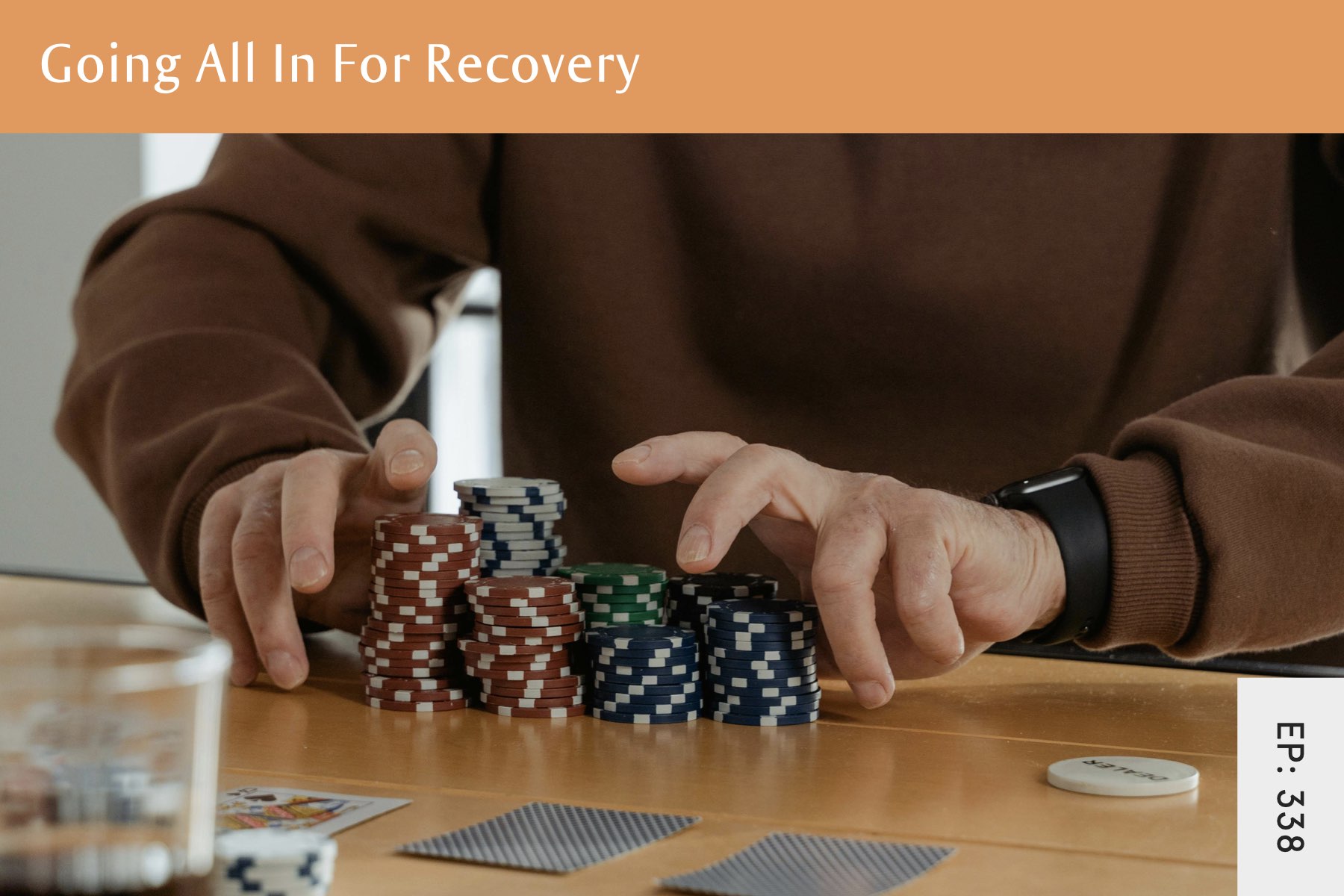
Episode 338: The concept of going "all in" for recovery has gained more mainstream popularity over the past few years. In this episode, I look at what this means, how it can be helpful in recovery, what the limitations are with this option (because I do think it, at times, it's oversold in what it can deliver), and what's most important in recovery, whether or not you're going "all in."
00:00:00
00:01:57
00:09:12
00:16:26
00:20:31
00:30:32
00:35:25
00:37:26
00:00:00
Chris Sandel: Hey! If you want access to the transcripts, the show notes, and the links talked about as part of this episode, you can head to www.seven-health.com/338.
Hey, everyone. Welcome back to another episode of Real Health Radio. I’m your host, Chris Sandel. I’m a nutritionist and a coach and an eating disorder expert, and I help people to fully recover.
Before we get on with today’s show, I just want to say that I’m currently taking on clients. If you are living with an eating disorder and you would like to fully recover, irrespective of how long this has been going on, whether it’s something that’s developed in the last year, whether it’s been going on for multiple decades, I would love to help. And I know for some people, the idea of full recovery can feel this very distant thing that feels so out of reach. Any part of you that thinks “Okay, this could be a possibility”, then please get in contact. I truly believe that everyone can fully recover; they just need to do the things to help them get there, and this is what I work on with people.
So if this is where you would like to get to, please get in contact. You can send an email to info@seven-health.com and just put ‘coaching’ in the subject line, and then I can send over the details.
So, on with today’s show. This one, we are going to be talking about going all in with recovery. This is something that has come up a lot more recently in the group that I manage and with one-on-one clients. I know it’s a topic that I’ve covered at various points with guests on the show, but I’ve never really done a solo episode on it, so I wanted to use this time to go through it and to really give an honest overview of this in terms of what is going all in, when can it be helpful, what doesn’t it help with, and sharing information connected to this.
00:01:57
When I think about this idea of ‘going all in’, it’s become very popular. I feel like maybe 10 years ago, it was this very niche idea, whereas more recently it feels like it’s hit more of the mainstream and I see more and more people talking about it. I associate it with people like Tabitha Farrar and Kayla Rose Kotecki and Becky Freestone. It’s not that they’re the only ones talking about this; they’re just people who are in my sphere and people I know of and have had on the show, so I think about them. I also think about within a lot of the HA (hypothalamic amenorrhea) recovery space, going all in is something that comes up a lot within that.
So what do we actually mean with going all in? And look, I know there can be lots of different definitions connected to this and that often, when people talk about “I’m going all in”, they have their own definition of what this looks like. So let me just give the broad idea of what this means.
Going all in means no restrictions at all connected to food. It’s not just about “I’m going toe at more”; it’s really completely removing any limitations around types of foods or timings of food or quantity of food. If you’ve eaten and you’re hungry 20 minutes later, you eat again. If you’re thinking about food, you eat again.
As part of that, it’s responding not just to physical hunger, but mental hunger. So eating even when you’re not physically hungry, but because there is a mental preoccupation with food, or you start thinking about food. Basically, any kind of food thought is an indication that “I need to go and eat something.”
There is then no compensatory movement connected to this, or no compensation at all in any other ways. Rest is very much prioritised as part of this, even completely giving up exercise, whether that is for a very short amount of time or for a longer amount of time. But we’re having a cessation in terms of exercise and movement.
I say exercise and movement because this also includes “Hey, I’m not going to just stop the running and the swimming and that kind of stuff; I’m also not going to be doing my walks. I’m also not going to be doing the cleaning around the house. I am going to do as little actual movement as humanly possible” because that’s what is required or that’s what is part of this approach.
There is an acceptance of weight gain – and not just tolerating it, but really being willing to gain as much as the body needs to as part of this, even if this is leading to a weight overshoot or even if this is leading to changes outside what is considered normal or acceptable. It’s really leaning into this. And I know that with this part, it’s not that someone feels like this all of the time. There can be ups and downs, there can be times of feeling very strong in the “I will do whatever I need to, irrespective of what happens”, and then there can be moments where there is a lot of grief connected to this. There can be a lot of uncertainty. But it’s continuing to “I’m going to keep doing this no matter what comes up.”
I just want to be careful with the word ‘acceptance’ here, because I don’t think it’s this unwavering acceptance in the way that people think about it. The acceptance piece is more about “I’m going to continue doing the things that I need to as part of this irrespective of how I’m feeling in the moment.”
There’s really a focus on recovery over control, so removing the control around how the body looks and shifting it to really just doing the things that will help it physically recover in the quickest possible time. And that’s why there’s no upper limit in terms of the eating, that’s why we’re completely resting, because we’re trying to do things that lead to the quickest physical recovery that can possibly happen.
Connected to all this is this very cold turkey mindset. For many people with going all in, it’s not “I gradually build my way up there”; it’s jumping in head-first, all at once, “On Day 1, I’m stopping my exercise, I’m eating more, I’m doing all of the things.”
I will just say in my experiences with people who’ve gone all in, yes, that can be the case, and there’s lots of times where I’m working with clients and it’s after three months or six months, or at some point of doing the more gradual approach or a more structured approach, there’s this realisation of “Hey, I’ve just realised I need to and want to rip the band-aid off of this. I just want to go head-first into it.” It’s not that they needed to do that to get into all in, and that’s not part of the all in philosophy or what you have to do, but we can say that there’s this delineation between “I was doing recovery in this other way to start with, and from this point on, now I’ve gone all in.”
The other piece I would say connected to this is that there’s a lot of people where they do the all in where they’re doing this of their own accord. They’re doing it outside of professional help. And for a lot of people, they’ve tried different approaches, they’ve done inpatient or they’ve done outpatient, and they’ve done all these different approaches and it just hasn’t really worked.
From watching videos online, from listening to podcasts, from following certain people, there’s then this decision of “Hey, all in is the one thing I haven’t tried, and I’m going to start doing this.” They realise in all of the other approaches, we were going too slowly with it, or “I wasn’t the one who was making the choices. Yes, I did eat more while I was in inpatient, but I was never the one who was preparing those meals” or “Yes, I saw that therapist for ages, but we weren’t actually doing anything connected to making changes. There was a lot of reflective work on childhood” or whatever it may be.
So just realising, “Hey, this is the thing that I haven’t actually done before, and I want to lean into this.”
I would say for many of the people that I work with, with going all in, this is what they’ve done in terms of they started going all in of their own accord. It might be I’ve been doing this for three weeks, I’ve been doing this for six weeks, I’ve been doing this for a couple of months” – it’s at that point that they then reach out.
It’s usually “I’ve been doing this for a while. I’ve noticed some changes. There’s some positives with this, there’s some challenges with this, and I recognise that I don’t want to do this just on my own. It’s too much for me to do this on my own” or “I’ve tried this approach on my own before, and I realised that I came unstuck at some point, so I want your help to continue doing this. And yes, I will keep doing the all in piece, but I want your help to help me continue to do that, but also to look at all the other components that are connected to recovery and why I developed this eating disorder in the first place.”
00:09:12
I want to just say where I think going all in can be helpful, because I do think that there are lots of benefits to this approach.
The number one reason why I think it’s so useful is it really helps to restore the physiology; it helps to deal with the energy debt that accrues as part of living with an eating disorder. Eating disorders – and I’ve said this many times before – are biopsychosocial, meaning there is a biological component, there is a psychological component, there is a socialisation component, and a lot of these things are interconnected, because if you’re in a low energy state, that has an impact on your psychology.
But so much of the symptoms that are connected with an eating disorder, whether that be physical symptoms or mental/emotional symptoms, are being driven by the state that the body’s in and the energy debt that has accrued because of the restriction that happens with all eating disorders.
So the benefit of this approach is we are starting to deal with the physical pieces of the eating disorder much more quickly. The body and brain can start to repair, and repair much more quickly than if we’re taking this very slow and steady approach. It means that there’s a repair in metabolism, in metabolic function, in hormones, in neurological damage that has occurred. It just allows the body to physically heal at a much more rapid rate.
It removes so much of the ambiguity. There’s no more of the “Am I allowed to eat this? Is this too much?” There can be this real relief because there’s this clarity. If I’ve spent so many years overthinking it, if I’ve been trying to make changes that are trying to appease the eating disorder and essentially asking, “Is this okay with you?” and the eating disorder says no, so I try and make another change that maybe the eating disorder is okay with – we’re not even going into that realm, and we’re just going head-first into these are the things that are going to be most pro-recovery.
I think that can be very helpful because it gets rid of all of the ambiguity and the unsureness around it because there is no upper limit. The goal is to be eating and resting.
By doing this, I think it starts to rebuild trust a lot quicker. There can be this feeling of “I really don’t trust my body”, and there can be lots of reasons for that, but a lot of that is, again, because of the state that the body’s in. So you’re not getting great feedback in terms of hunger and fullness and different signals. By being able to bring in all of this energy in a very short amount of time, it allows the body to upregulate and repair, so you start to be able to notice hunger and fullness signals better. You’re responding to your hunger better. You’re responding to your fatigue better by resting. You’re allowing yourself to experience pleasure again, whether that be pleasure from eating or whether that be pleasure in other ways, from seeing people or doing other things.
So it really helps someone to reconnect to a lot of those body signals, and this has such a knock-on effect by being able to do that in a very quick manner.
It also can lead to a lot of momentum, because the rapid changes – even though people think these are going to be scary, they can create this real snowball effect. “I’m eating more, so I now start to have better brain function, which means then I’m better able to emotionally regulate, which then supports me taking even more recovery-aligned actions. It then allows me to start to see friends more when previously I was isolating. I’m starting to do things that are bringing more joy and fun.”
So you can have this real cascade effect where so often, when we’re doing recovery in this very slow way, there can be this leap of faith of “I’m doing these things, everyone tells me there’s this upside from doing them; I haven’t noticed it yet, but I’m going to keep going and eventually it’s going to become apparent to me.” Whereas with this approach, even though there can be uncomfortableness, even though there can be challenges with it, you can start to very quickly see improvements. And that can be improvements in terms of the quality of your life, it can be improvements in terms of physical symptoms, mental symptoms, emotional symptoms.
As I’m talking about this, I’m thinking of a particular client at the moment who I started with maybe three months ago, and she went all in, had gone all in a handful of weeks before we started together. And in a very short amount of time, her life transformed in terms of being really isolated, not doing very much with her life, to seeing people going out, getting her old self back. And it’s not that there aren’t challenges; it’s not that we’re not still working on certain things connected to it. But it is really night and day where she is now compared to where she was a few months ago.
Again, I think that can then continue to build momentum and really allow you to see, “This is the thing that I need to do. This is the way that I support my body.”
The final piece I would say with this is it really challenges the eating disorder, and does it in a very head-on way. I think about eating disorders as being anxiety disorders and disorders of avoidance. So much of what the eating disorder is doing is allowing you to avoid – allowing you to avoid certain thoughts or feelings or sensations or events or situations. Those things will come up again and again and again, but “I get this temporary relief and a temporary way of avoiding them by doing the eating disorder behaviours.”
What recovery is about is action-taking. It’s the opposite of avoidance. It’s doing the things that are scary. And what going all in does for you is, in a very short amount of time, you are dealing with many of the things that you’ve been avoiding. Again, that can be so beneficial in terms of starting to understand, “Oh, actually, I can do that thing” or “Yeah, that was uncomfortable, and I survived it” and realising “I can tolerate a lot of the things that I didn’t think I would be able to tolerate.” And again, doing that in a very short amount of time where it might take someone a year to get to that place when they’re doing it in this slow and steady way versus “Within a matter of months, I’ve learnt so much by taking this approach.”
I think, again, just touching on what I’d said before, there can be this real relief that “I’m now not spending my whole day just negotiating with the eating disorder. I’m not bargaining with it. I’m just getting on with things, and I know the things that I need to do as part of recovery, and I’m just going forward with those.”
00:16:26
The incorrect beliefs that I see about all in, and “the reason why I shouldn’t be going all in”, is the fear around things changing too quickly or too fast. So “It’s going to be too much food” or “It’s going to be too many new foods” or “The weight gain is going to be too quickly.”
There’s this idea that “If I go slow and steady, then it will feel more manageable, and I can consistently be getting okay with things, and then I’ll gradually increase it again, and then I get okay with it and I gradually increase again.” The reality is, I just haven’t seen this to be true with people. I’ve had people who do things in a slow and steady way where it still feels too overwhelming and too much.
I think there’s this mistaken belief that “If I go slower and this thing is smaller, then in terms of how my nervous system reacts and how it feels to me, it’s going to feel easier.” And again, I don’t believe that to be true, based on the clients that I’ve worked with.
Really, one of the biggest fears with this is “I don’t know where this is going to end up.” I think people feel like the fear is that it’s going to be too quick and too soon and all of those things, but actually the fear is “I don’t know where this is going to end up.” Actually, what happens by going all in is you get to start to discover that a lot more quickly than if you’re going at it in a very slow approach.
And really, if I look at where people become stuck with recovery, yes, it is from their going too slow and not making meaningful changes, but it’s really when you start believing the eating disorder thoughts and all of the ‘what if?’ thinking and all of the fears and those types of things. And this can happen with someone going all in. At some point, there’s the worry of “But what’s going to happen with my weight after this point?” or “When is this going to end?” and you start to get hooked by those thoughts and you start to pull back, and that’s where things start to unravel.
But I equally see the same thing happening even when someone’s recovery is going in the most perfect way in terms of “I’m making this change and it’s leading to this slow increase, and I’m making this other change and it’s leading to this slow increase.” It feels like that should be the golden ticket, and it just really doesn’t.
The other piece I find that comes up a lot, especially when people are trying to do this in a very slow and steady way, is they’re wanting to really understand how this works. So “If I reduce my exercise by this amount, what’s going to happen on the scale? If I increase my eating by this amount, what’s going to happen? I’m trying to understand that X amount of calories leads to this amount of weight gain, or this amount of reduction in exercise leads to this amount of weight gain.”
The reality is, it just doesn’t work in this very linear fashion. People then get really hooked by this “Hey, it’s not making sense to me. This week I feel like I didn’t make much of a change and yet something really jumped up.”
The thing with going all in is you’re just not getting into that line of thinking. It’s, “Hey, I’m just doing everything in my power to heal as quickly as possible, and if the weight’s going on quickly, the weight’s going on quickly. If it’s going on slower than I expected, it’s going on slower than I expected. But I’m not trying to understand this somewhat impossible riddle.” It is highly illogical, and bodies change not in a consistent way, especially in the early stages of recovery.
I’m saying all this because I think there can be a lot of a block towards people going into this approach, and the block isn’t connected to reality.
I’m going to go through certain bits and reasons why I don’t think that all in helps in certain situations or it actually doesn’t repair this piece, so I want to talk about that, but I think there can be some incorrect beliefs around why this shouldn’t be the right approach.
00:20:31
Then looking at the limitations of all in. I think this is an important piece to go through because I don’t see a lot of people talking about this when they are talking about all in. I think it is either vilified as “No-one should do it, it’s too quick, it’s too overwhelming, it’s not the right approach” or “This is the most incredible thing. Everyone needs to be doing it.”
Let me just share the limitations that I see with all in – and this is based on from working with lots of clients and seeing people who have done it, people who haven’t done it, and understanding the complexity connected to eating disorders.
The first thing I will say is that I believe that all in can be oversold in what it does. Yes, it can help in terms of recovery and the physical recovery of the body, but where it doesn’t necessarily help is with things that predate the eating disorder or things that have happened outside of the eating disorder.
For many clients I work with, they had longstanding body image problems well before they developed an eating disorder. There are clients that I’ve worked with who had body dysmorphia before developing an eating disorder. There are clients who have lots of trauma that has occurred throughout their life. There are clients who are neurodivergent, whether they’re ADHD or autism spectrum disorder or high sensitivity. All of these things are separate from the eating disorder.
I think what can often happen is it’s really oversold like “If you go all in, everything will be repaired.” What I often see for the people who have really incredible turnarounds from going all in – and this isn’t always the case, but it is often the case that for that person, so much of what the eating disorder was about for them was just purely biological. For some of them it was just dumb luck that they went on a diet and then they found themselves in this position. They didn’t have body image issues before all this started, they weren’t growing up in a household where people were fatphobic and making comments about people’s bodies, there wasn’t dieting going on in their household. Before they went on their first diet, they lived very much outside of diet culture in so many ways in terms of it just wasn’t affecting them.
So for that person, when they develop an eating disorder, yes, all in really does help them because we’re then dealing with the biological component really quickly, and that was pretty much it, or a very big component of what was going on. So that is where someone can feel like “This is the be all and end all. This is the only thing that someone needs to do” because that was their experience.
I want to really highlight this. And again, this isn’t to say that all in isn’t the right approach for someone who has had trauma or has body image issues that predate the eating disorder or is neurodivergent. It can still work. It’s just we need to go in managing expectations of what this thing does and doesn’t do.
I think there can be this promise that people have – and this can be either an unspoken promise or it can be a very explicit promise of “This will bring really quick healing and really quick peace for you.” And when there are then still challenges and emotional upheaval and all of these things, people can get very disillusioned. It can feel like “I did all of this and I still feel awful. Recovery doesn’t work. I feel so angry that now I’m living in this bigger body and it hasn’t translated into me feeling the way that I’ve been sold that I’m going to feel.”
The next limitation I see with it is that we need more than just food and tsopping exercise as part of recovery. For so much of what I work on with people, yes, there is the biological or physiological component, but we need to learn other coping skills. This isn’t just all about being in energy debt. Again, I think if this approach is done just in and of itself, and “this is the only thing that you need”, or that’s what someone is told, then we’re not really looking at the other things that are really important.
And especially if you’ve lived with an eating disorder for 5 years, 10 years, multiple decades – what the eating disorder has become is a way of coping. I said earlier, eating disorders are about avoidance. It means that any time there’s been a challenge, “Hey, I just use the eating disorder.” This means that we haven’t learnt other ways of being able to cope.
There are going to be lots of things that then come up when we start to go all in. Yes, there are going to be changes from a physical standpoint, but then there’s also going to be stuff connected to life, stuff connected to kids or partner or work or all of these different things. And if the eating disorder was my only way of coping before and now I’ve removed that, I’m going to feel pretty raw and exposed and vulnerable.
So again, it’s not that all in can’t help, but it needs to be done alongside these other things that are allowing someone to have tools to deal with distress or when panic comes up or when there’s grief or there’s shame or all of these different things that are part of being a human being and are unavoidable and are going to happen in a high concentration when you’re going through recovery.
I’d also say that I don’t think that going all in is always accessible for everyone. Someone may be a caregiver, they may be working full time, they may be working with other co-occurring conditions, and if we’re looking at the way that all in is often talked about, where “If you ever think about food, you need to go and get something to eat” – I just don’t think that that is realistic for everyone from a logical, practical standpoint, but even from an emotional, feeling safe standpoint.
Again, it’s not that we can’t make big changes. We can. But it might be we need to do this in a more structured way for it to actually fit in with the life that you have and the challenges that are part and parcel of that.
I think as well, within some online spaces where all in is talked about, you can get into this very all-or-nothing thinking and it becomes very echo chamber-y, not a lot of nuance. This idea of “If you’re not eating 5,000 calories a day and never exercising, you’re not doing recovery.” I think it becomes this very black-and-white thing, and I don’t think that is helpful for anyone.
The other issue that I see with this – and this is less about a limitation with going all in and more how I see the eating disorder using this. There can be this feeling of “I just want total freedom. I really just want to be able to completely release the reins. I don’t want to have food taking up so much space in my mind and in my day, so I really want to go all in. And that’s why I’m not going to follow a meal plan, that’s why I’m not going to follow any structure. I’m just going to allow myself to eat whenever I want to eat and I’m going to go all in.”
But then, when someone gets to meal time and snack time and at various points throughout the day, they just feel overwhelmed. They’re paralysed. This indecision creeps in. It could be at meal time, it could be at snack time, it could be “I’m noticing I’m hungry, and yet I’m now panicked and I don’t know what to do.” What then happens is I have a resistance to following any kind of structure because I want to go all in, but yet I’m actually not really making any changes.
I’ve seen this happen for many people, where there’s a reluctance to create any kind of structure, there’s a reluctance to be saying “I’m going to be increasing my breakfast or my lunch by this amount because let me just get there and I’ll see what I want when I get there. Let me lean into my body and what are my cravings and all that”, and it’s just the eating disorder in disguise – the eating disorder using this against someone.
In these situations, it really is “Hey, you need to have structure first.” If someone comes to me and they’re already doing all in and they’ve really proven that they’re able to do that – great. But if I’m working with someone and they’re saying, “Hey, I want to do this”, my way of approaching it, especially in the beginning, is “I want you to prove that you can do this, so to begin with, we are going to up your baseline. We’re still going to have your structure; we’re still doing three meals, three snacks a day. We’re going to increase them so that they are at a much higher level. And if you want to eat over and above them, if you want to be adding in another snack, if you want to be having more, go for it. But this needs to be the minimum.”
I do that because that then protects someone. What I find most of the time is that people then stay with the plan. Maybe they have a moment of going a little bit higher, but they don’t typically go higher. And I don’t think that is because they are sticking to the structure. My belief – and I’ve tried this with many people – is when we remove the structure, everything falls by the wayside.
So in a sense, from my perspective, you need to prove that you can go all in first, with a structure in place as a minimum, and if you prove that you can do it, then great. But let’s not remove the structure until that is actually happening.
00:30:32
So then the question is, do I do all in with all clients? The answer is no, I don’t do all in with all clients. And if I’m thinking about what percentage it happens, I would probably say maybe 10-15%. So most of the time, I’m not doing this with people.
For the people that I do do it with, as I’ve said earlier on, most of the time they’re already doing it when they approach me. So they’ve already started doing this and then they’re wanting to have more support alongside it. Or, as I said earlier, they’re working with me, we’re doing the structured approach, and then at some point three months in, six months in, whatever it is, that’s where they realise, “Hey, I want to do this other thing.”
So for me, with recovery and when I’m working with people, typically there is more structure in place, where we do have very clear goals of “This is what you’re focusing on right now” or “This is the meal plan that you’re using right now”, with the caveat of “This is a minimum. You have my complete blessing and my encouragement to go above this, but this is your minimum.”
I want to have these very clear goals where it can then be obvious, “Am I doing this or am I not doing this?” I think, while I said in the beginning that going all in can remove a lot of the ambiguity, that can be true if someone starts to do it and they are actually doing it. Otherwise, you can get into this very gray area where “Actually, I’m not really following anything, and there’s no real structure to this at all.”
Really, for me, it’s like setting some minimums and then encouraging people to go above that. And when I say minimums, it’s not some really tiny small amount. We’re setting minimums that are going to lead to meaningful changes.
I also have a really big focus as part of the work that I do on coping strategies and helping people to understand how to regulate their nervous system, how to deal with certain thoughts and feelings as they arise, “how to be able to challenge myself so that I am starting to go out and eat with people or I’m eating earlier than I used to or I’m challenging all these rules” and being really explicit about that, and doing it in a fairly structured way. And a structured way doesn’t necessarily mean slowly; it just means, again, we’re clear about what’s actually going on.
The one area I will say that I will typically go ‘all in’ with people is connected to exercise and really encouraging a fairly cold turkey cessation of exercise. Again, this isn’t always the case, but it is a lot of the time. I’ve done a whole episode on exercise where I talk about that specifically and in more detail, so if you want to listen to that, it’s Episode 322. I will put that in the show notes.
The reason I’m going through all this as well is, yes, eating disorders clearly have a biological component, and as I’ve said, so much of it is down to being in this lower energy state – and really acknowledging that there is complexity to all this. It’s not just for that, or for the vast majority of people, it’s not just that.
I also just don’t want to be in this all-or-nothing mindset with recovery where “You’re either doing it this way or you’re not doing recovery at all” because I really don’t believe that is true. And yes, I feel that there is a tendency for people to be doing things that aren’t actually helping their recovery. They’re busy with things that, even when they do them, aren’t leading them anywhere meaningful. So yes, I want to nip that in the bud and I want to say, “Hey, let’s change that piece of this.”
But the idea that if you’re not doing all in, you’re not doing recovery, I just can’t get on board with that because I just don’t believe that to be true.
Are there times where I wouldn’t recommend going all in? I don’t necessarily think so. I was trying to think about this before I hit record; is there a time where I would want to try and talk someone out of this? I can’t think that I would. If someone wants to do it, yeah, I want them to go for it and just manage expectations connected to this. “This is what I expect you to see in terms of changes; these are the areas that I don’t expect to see changes. These are where I think you will notice some challenges. These are where I believe it makes it easier than other approaches to recovery.”
So having someone know all of the details so that, in a sense, they’re making you an informed choice. There’s informed consent because they’re going into it with eyes wide open as opposed to this sunshine and rainbows belief connected to it.
00:35:25
Really, the final takeaways for you with this would be, I think all in can be a very powerful approach in terms of how it can heal the body from a physical standpoint, and even from a mental/emotional standpoint because of how story follows state, and the state that you’re in has an impact on your thoughts and feelings and sensations. So I do think it can be very powerful, and it does cut through so much of the ambiguity and it is very direct in that way.
And I don’t think it’s the only way. I think there are many different ways of doing recovery. I would like to see more people taking this approach, if I’m being truthful, because I do see that too many people from my perspective are trying the other end of the spectrum of “How do I do this in the least quick way? How do I do this in the way that gives me the least amount of worry or anxiety?” The problem is, if you’re asking the question “What’s going to create the least amount of anxiety today?”, the eating disorder is going to raise its hand and say, “Hey, I’ve got a load of stuff that I would suggest would help with this.”
So I really want the shift to be, “What are the things that are going to make it most supportive for my recovery?” For many people, all in is the answer to that question. With the caveat that we need to be layering on these other things. We need to be layering on coping skills, we need to be looking at all of these other areas that are connected to the eating disorder, that predate the eating disorder, that are co-occurring conditions, etc., because it’s not just all biological.
So if all in works for you, amazing. Have at it. And if it doesn’t, that doesn’t mean that you can’t do recovery or you’ll never fully recover or anything along those lines. It just means you need to take a different approach.
00:37:26
Based on this, I’ve got a couple of journalling prompts that may be useful just to reflect on with your recovery and the approach that you’re taking, whether that is you’re doing this on your own, whether that’s you’re working with someone. But just starting to have a look at what you’re doing.
As I said at the beginning, we can define ‘all in’ in different ways. There is the standard way that it has been defined, as I’ve gone through in this podcast, but you could also take the approach of “All in just means me doing as much as I can possibly for my recovery.”
The journalling prompt connected to this would be: “What would going all in look like for me if I considered my needs and my capacity and the fact that I’m waiting to recover from an eating disorder and do that in the quickest possible way?”
The next one would be: “Where am I still bargaining with the eating disorder, or where am I making eating disorder appeasement choices?”
And then the next question would be: “What support do I need to move forward in a sustainable way?” I really don’t believe that people should be doing recovery on their own. And I understand that certain people find themselves in that position because there isn’t the resources that they can find or they don’t have the financial means to be able to work with someone. So I really understand that piece. Even if it means “I can’t afford to work with a coach or work with someone”, what is the support that you can be able to get access to at this point? What resources can you get access to? What friends, family, whatever it may be?
And again, I know that certain people are much more limited in this way, but we can start to redefine what we mean by support here. Again, it’s support for you. with all the constraints and limitations, what is the most amount of support you can be getting with this?
So that’s it for this week’s episode. As I said at the beginning, this idea is coming up a lot in terms of going all in. I do think it’s more hit the mainstream and more people are aware of it, more people are considering it when thinking about recovery. So I hope that this episode has given you some nuance with this and looked at it from a number of different angles.
If you do want help with your recovery, as I said at the top, I’m currently taking on new clients to work with. If you want to reach a place of full recovery, whether that is going all in or not going all in, I would love to help you with that. Send an email to info@seven-health.com and just put ‘coaching’ in the subject line, and I can send over the details.
All right, that is it for this week’s episode. I will catch you again next week. Until then, take care, and I will see you soon!
Thanks so much for joining this week. Have some feedback you’d like to share? Leave a note in the comment section below!
If you enjoyed this episode, please share it using the social media buttons you see on this page.
Also, please leave an honest review for The Real Health Radio Podcast on Apple Podcasts! Ratings and reviews are extremely helpful and greatly appreciated! They do matter in the rankings of the show, and we read each and every one of them.


Policies
Social
Copyright © 2009 – 2025
seven-health.com · All Rights Reserved.


Share
Facebook
Twitter